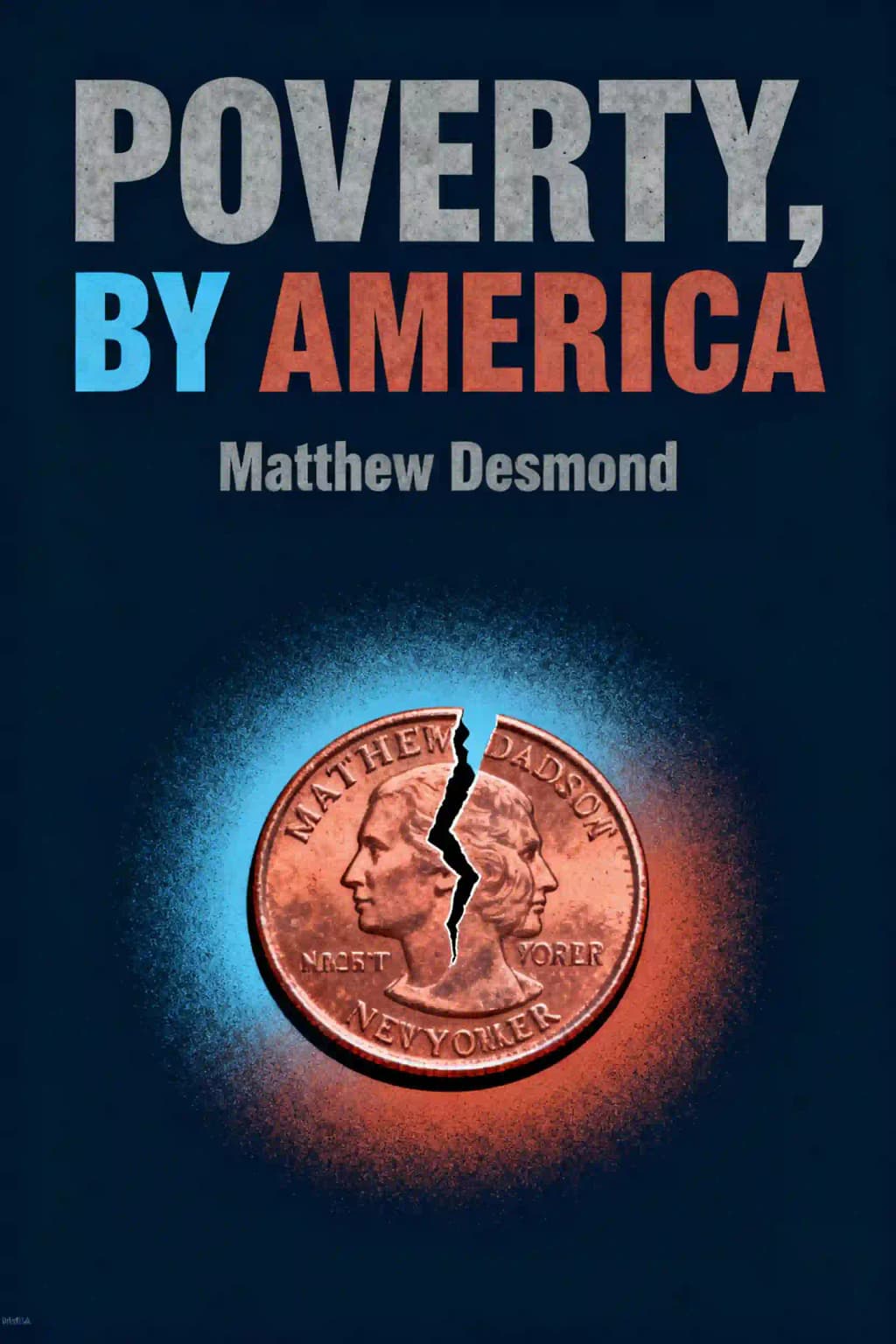
In "Poverty, by America," sociologist Matthew Desmond exposes how the wealthy perpetuate poverty through exploitation. Praised by The New Yorker as "urgent and accessible," this provocative 2023 bestseller challenges readers: Are your everyday choices unknowingly keeping millions poor? Become a "poverty abolitionist" and rewrite America's economic story.
Matthew Desmond, author of Poverty, by America, is a Pulitzer Prize-winning sociologist and leading expert on housing insecurity, urban poverty, and racial inequality.
A professor at Princeton University and founder of The Eviction Lab, Desmond’s work blends rigorous academic research with compelling narratives to expose systemic inequities. His groundbreaking book Evicted: Poverty and Profit in the American City earned the Pulitzer Prize for General Nonfiction, the National Book Critics Circle Award, and a Carnegie Medal, solidifying his reputation as a vital voice in social justice discourse.
A MacArthur “Genius” Fellow and contributor to the New York Times Magazine, Desmond’s insights on policy and poverty have shaped national debates, including features in Politico’s list of influential thinkers.
Poverty, by America builds on his decades of fieldwork and analysis, offering a searing examination of austerity and exploitation in the U.S. His research is frequently cited in policy reforms and taught in universities nationwide.
Poverty, by America by Matthew Desmond examines systemic drivers of poverty in the U.S., arguing that poverty persists due to intentional policy choices and exploitation. The book critiques how corporations, governments, and affluent Americans benefit from inequality through practices like wage suppression and discriminatory housing policies, while advocating for collective action to dismantle these structures.
This book is essential for policymakers, social justice advocates, and readers interested in socioeconomic inequality. It provides data-driven insights into systemic exploitation, making it valuable for educators, nonprofit professionals, and anyone seeking to understand poverty’s root causes in America.
Yes. Desmond’s Pulitzer Prize-winning expertise and rigorous research make this a critical read. It challenges conventional narratives about poverty, offering actionable solutions and exposing how institutions profit from inequality, earning praise for its clarity and urgency.
Desmond argues poverty is sustained by corporate exploitation (e.g., low wages), government underinvestment in social programs, and affluent Americans’ complicity in systems like exclusionary zoning. He highlights how policies favor the wealthy, perpetuating cycles of deprivation.
While Evicted focused on housing insecurity’s human impact, Poverty, by America broadens its scope to analyze systemic economic exploitation. It shifts from ethnographic storytelling to a policy-driven critique of America’s entire poverty-industrial complex.
Desmond advocates for wealth redistribution, stronger labor protections, universal healthcare, and affordable housing. He emphasizes dismantling exploitative systems and empowering marginalized communities through policy reforms and grassroots activism.
“Tens of millions of Americans do not end up poor by a mistake of history or personal conduct. Poverty persists because some wish and will it to.” This starkly captures Desmond’s thesis on intentional inequality.
He acknowledges personal agency but stresses structural barriers dominate outcomes. For example, low wages and lack of healthcare access—not poor choices—trap families in poverty, challenging “pull yourself up by bootstraps” narratives.
The book cites eviction rates, wage stagnation trends, and disparities in public resource allocation. Desmond draws on national datasets and his Eviction Lab research to highlight systemic patterns.
It critiques exclusionary zoning, predatory lending, and underfunded public housing. Desmond links these policies to racial and economic segregation, advocating for tenant protections and affordable housing investments.
Some argue Desmond oversimplifies solutions or underplays bipartisan reform efforts. Others suggest the book could explore global poverty comparisons or individual success stories more deeply.
As a Princeton sociologist and MacArthur “Genius,” Desmond combines academic rigor with activist zeal. His fieldwork in Evicted and leadership of the Eviction Lab ground his arguments in empirical data.
With housing costs soaring and wage gaps widening, Desmond’s analysis remains urgent. The book offers a framework for addressing post-pandemic inequality and corporate profiteering.
저자의 목소리로 책을 느껴보세요
지식을 흥미롭고 예시가 풍부한 인사이트로 전환
핵심 아이디어를 빠르게 캡처하여 신속하게 학습
재미있고 매력적인 방식으로 책을 즐기세요
Poverty isn't a failure of individuals - it's a deliberate economic choice.
It represents not a lack of resources but a failure of distribution.
The system has become remarkably effective at generating profits from poverty.
What looks like anti-poverty spending often functions as corporate welfare.
This isn't just another book about inequality; it's your invitation to finally solve America's most unnecessary crisis.
Poverty, by America의 핵심 아이디어를 이해하기 쉬운 포인트로 분해하여 혁신적인 팀이 어떻게 창조하고, 협력하고, 성장하는지 이해합니다.
Poverty, by America을 빠른 기억 단서로 압축하여 솔직함, 팀워크, 창의적 회복력의 핵심 원칙을 강조합니다.

생생한 스토리텔링을 통해 Poverty, by America을 경험하고, 혁신 교훈을 기억에 남고 적용할 수 있는 순간으로 바꿉니다.
무엇이든 물어보고, 목소리를 선택하고, 진정으로 공감되는 인사이트를 함께 만들어보세요.

샌프란시스코에서 컬럼비아 대학교 동문들이 만들었습니다
"Instead of endless scrolling, I just hit play on BeFreed. It saves me so much time."
"I never knew where to start with nonfiction—BeFreed’s book lists turned into podcasts gave me a clear path."
"Perfect balance between learning and entertainment. Finished ‘Thinking, Fast and Slow’ on my commute this week."
"Crazy how much I learned while walking the dog. BeFreed = small habits → big gains."
"Reading used to feel like a chore. Now it’s just part of my lifestyle."
"Feels effortless compared to reading. I’ve finished 6 books this month already."
"BeFreed turned my guilty doomscrolling into something that feels productive and inspiring."
"BeFreed turned my commute into learning time. 20-min podcasts are perfect for finishing books I never had time for."
"BeFreed replaced my podcast queue. Imagine Spotify for books — that’s it. 🙌"
"It is great for me to learn something from the book without reading it."
"The themed book list podcasts help me connect ideas across authors—like a guided audio journey."
"Makes me feel smarter every time before going to work"
샌프란시스코에서 컬럼비아 대학교 동문들이 만들었습니다

Poverty, by America 요약을 무료 PDF 또는 EPUB으로 받으세요. 인쇄하거나 오프라인에서 언제든 읽을 수 있습니다.
In the wealthiest nation on earth, 11 million children still go to bed hungry. This isn't a failure of resources-America has enough wealth to end poverty tomorrow. Rather, it's a deliberate economic design that benefits the affluent while extracting billions from the poor. Imagine walking through a grocery store where 40% of food will be thrown away, then passing a family who can't afford dinner. This jarring contradiction defines American poverty: not a lack of resources, but a failure of distribution. What makes this reality so perplexing is how poverty persists alongside such abundance. Unlike global absolute poverty, American poverty exists within arm's reach of plenty. Vacant properties often outnumber homeless individuals in major cities. The gap between our productive capacity and the lived reality of our poorest citizens highlights how poverty is maintained through policy choices, from tax structures to housing policies to wage suppression. The intergenerational transmission of disadvantage is equally striking-children born into the bottom income quintile have only a 7.5% chance of reaching the top, while those born wealthy have a 40% chance of staying there. This isn't just bad luck; it's a system working exactly as designed.