1장
When Words Become Weapons: The Battle Over Language Rules
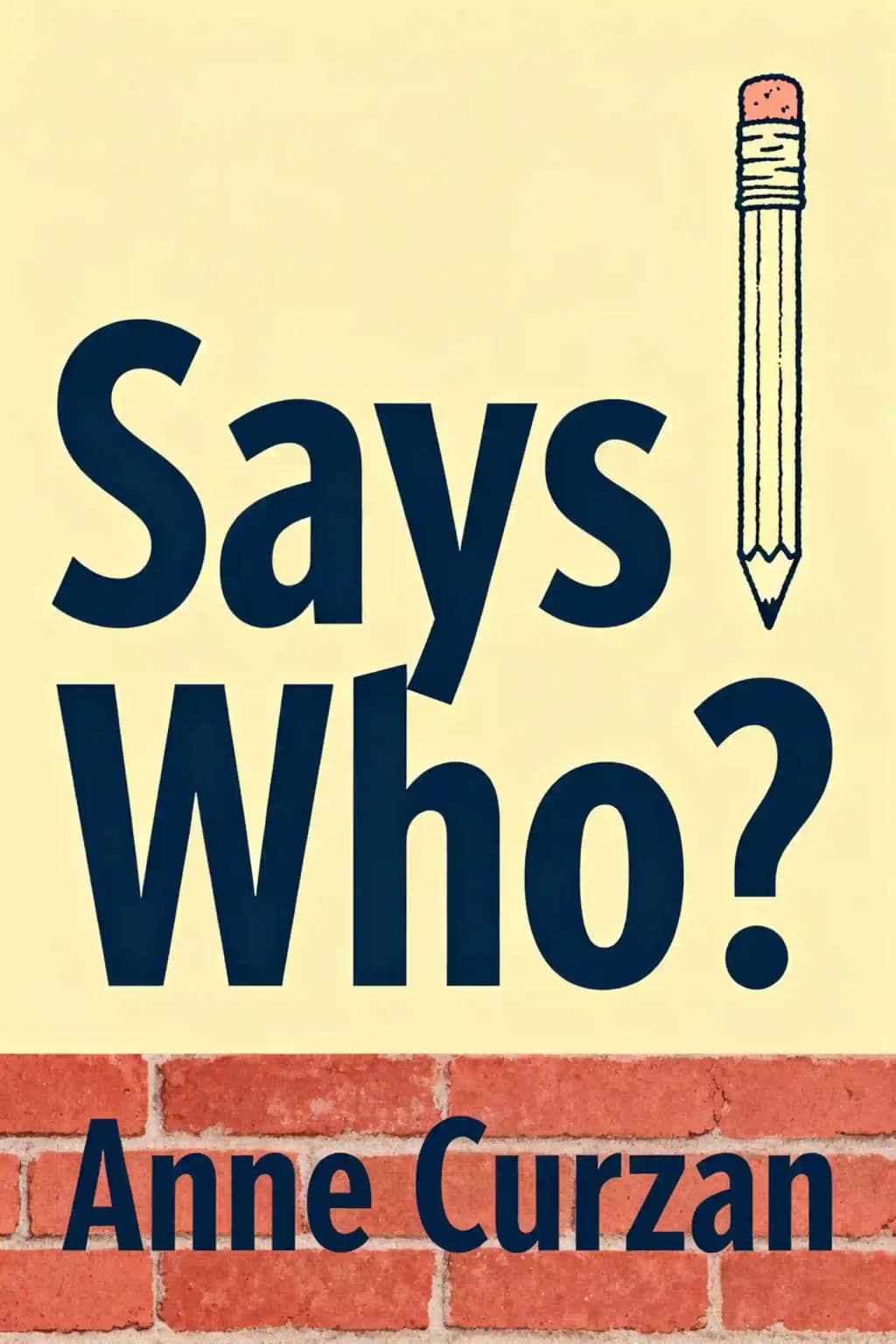
Have you ever cringed when someone says "impactful" or silently judged a colleague who wrote "between you and I" in an email? You're not alone. Language stirs deep emotions in all of us, often revealing more about social dynamics than actual communication problems. Anne Curzan's "Says Who?" explores this fascinating territory where personal preference meets linguistic prescription. The book has garnered praise from linguists and everyday language enthusiasts alike, with NPR calling it "a refreshingly balanced approach to usage debates." Even Stephen Fry, known for his love of language, recommended it as "essential reading for anyone who's ever corrected someone's grammar." At its core, this book challenges us to question who gets to decide what counts as "correct" English and why these judgments matter so deeply to us.
2장
Inner Grammando vs. Inner Wordie Showdown
Almost all of us notice things in English we wish weren't there. Some peeves are widely shared, like the use of "impact" as a verb, while others are more personal quirks. It's human nature to observe language, both consciously and unconsciously. The real question is what we do with these observations - do we judge new usages as illegitimate or admire how language evolves?
Most language lovers have both an inner "grammando" (one who constantly corrects others' linguistic mistakes) and an inner "wordie" (someone who delights in language's shifting landscape). These competing impulses create tension in how we approach language change. My own mother was a committed grammando when I was growing up, meticulously editing my papers and interrupting conversations to correct grammar. During my sister's wedding toast, she even called out "And me!" from the back of the room when my sister said "for my husband and I."
Public grammar policing, however, can be deeply uncomfortable for everyone involved. When I once enthusiastically pointed out a friend's dialectal "positive anymore" usage, the conversation ended awkwardly despite my genuine linguistic interest. This highlights something crucial: language is deeply personal and fundamentally social. When we comment on someone's language, it almost inevitably feels like a personal judgment.
The battle between "impact" as a verb and its traditional noun usage illustrates this tension perfectly. Many usage guides discourage the verb form, but their arguments aren't particularly strong. The synonym argument (that we already have "affect" and "influence") falls flat because English is celebrated precisely for its abundant synonyms that allow for nuanced expression. As for claims that it sounds "jarring," we must ask: jarring to whom? While traditionalists may find it grating, countless writers use it comfortably.
What's surprising is that "impact" has actually been a verb longer than a noun in English, appearing in the early 17th century meaning "to press closely into something" (as with impacted teeth). By the 1930s, it gained its figurative meaning about exerting force or effect. The adjective "impactful," which I personally find aesthetically unappealing, follows standard word formation patterns like "playful" and "meaningful." Linguistic data shows its usage has increased dramatically since the 1990s, appearing regularly in newspapers, academic journals, and literature.
In the eternal showdown between our inner grammando and inner wordie, time consistently favors the wordie. History teaches us that such preferences are often temporary - Benjamin Franklin once disliked "colonize," and Henry Alford despaired over "reliable." Today, these words don't raise an eyebrow. Language change is natural and inevitable, whether we like particular changes or not.
3장
Ain't: What Gets into Dictionaries, and How
"The next thing I know, you'll tell me irregardless is a real word," a dinner guest once said to me. When my expression revealed I was about to say exactly that, he immediately responded, "My respect for you just went down three notches!"
This reaction isn't uncommon. "Irregardless" taps into deep-seated feelings about what counts as a word, fueled by generations of authority figures who insisted it isn't one. Yet the word dates back to 1795, appearing in the Charleston City Gazette: "But death, irregardless of tenderest ties, Resolv'd the good Betty, at length, to bereave." Throughout the nineteenth century, it appeared in congressional documents, magazines, and law journals.
A word is simply a set of sounds (or written representations) that functions independently to communicate a meaning shared within a community. "Irregardless," like it or not, has a shared meaning-it means "regardless." It formed through the regular word formation process of blending "irrespective" and "regardless," just as "breakfast" and "lunch" make "brunch."
When people claim words like "irregardless" aren't "real," they mean these words haven't been legitimized by language authorities, particularly dictionaries. This raises important questions about dictionaries themselves: Who writes them? How do words get included? How do dictionaries differ?
We rarely question dictionaries. Even critical thinkers don't distinguish between different dictionaries or consider who edited them. We say "look it up in the dictionary" as if they were all identical. University libraries display unabridged dictionaries on pedestals, and we teach students to question every text except dictionaries-as if they were unauthored works that simply tell us what words "really mean."
Dictionary editors would say they're just trying to keep up with us as we change language. They track our speech and writing, trying to predict which new words will persist. Different dictionaries have different aims, and there's no such thing as "the dictionary." Usage labels in dictionaries are especially powerful tools, though subjective. Labels like "nonstandard" aren't inherent characteristics of words but collective decisions about appropriate contexts-decisions that can change over time.
The controversy over "ain't" peaked with Webster's Third New International Dictionary (1961), which included the word without usage labels for certain meanings. Critics condemned the dictionary as "radically permissive," revealing how language judgments are wrapped up in judgments about speakers' class, gender, race, and ethnicity. Most contractions condemned as "vulgar abbreviations" in 1781 by Reverend John Witherspoon eventually became acceptable in formal writing-except ain't, which remains stigmatized partly because of its association with historically marginalized speakers.
Dictionary editors walk a fine line between describing actual usage and providing guidance about contextual acceptability. We often mistakenly assume dictionaries prescribe correct usage when they're actually trying to describe how language is used. Usage labels are subjective human decisions that change over time, just as language itself changes.
4장
Double Negatives: How Rules Become Rules
It's 1965. Mick Jagger and the Rolling Stones release "(I Can't Get No) Satisfaction." The double negative confuses no one - Jagger clearly isn't claiming he can find satisfaction.
This counters the nonsensical notion that double negatives automatically cancel each other mathematically to create a positive statement. This myth is perpetuated everywhere, including in the popular joke about an MIT linguistics professor claiming English double negatives form a positive, while a student sarcastically responds, "Yeah, right."
Double negation - using two negative grammatical elements in one clause to convey negation - was actually standard in English for centuries. What linguists call "negative concord" occurs when multiple negative markers work together to express a single negative meaning, rather than canceling each other out. Examples include "I can't do nothing about it" or "I haven't never doubted her."
Many languages worldwide express negation through negative concord, including French ("Je ne sais pas" - I not know not). In English, multiple negation coexisted with single negation for centuries, with neither considered more standard until the Renaissance, when single negation became standardized through printing and education while many varieties of English continued using multiple negation to this day.
The idea that two negatives cancel each other out came from Bishop Robert Lowth's influential 1762 grammar book, which stated: "Two negatives in English destroy one another, or are equivalent to a positive." This rule was popularized by his student Lindley Murray's best-selling grammar that went through nearly fifty editions. Some try to justify this rule using mathematics, but language isn't math - while multiplying two negatives yields a positive, adding two negatives creates a stronger negative, which is how negative concord works linguistically.
There are instances where negatives can cancel each other out in English, but these depend on context and intonation. When I say "I don't have none of them" with emphasis on "none," it suggests I have some worries. Without this emphasis, it's simply negative concord meaning "I don't have any."
All varieties of English have systematic grammars. Multiple negation is as systematic as single negation. Standardized English isn't the parent of nonstandard varieties but rather a sibling that was elevated by those with social and economic power. Understanding this context makes us better editors, kinder teachers, and more inclusive citizens.
5장
"PC" Language: Why Emotions Run High
The term "politically correct" language often evokes extreme examples like "vertically challenged" instead of "short" or banning words like "seminal" due to masculine etymology. But focusing on such examples misses the deeper questions: What's involved in using inclusive language that isn't known to be offensive? Do efforts to promote inclusive language inappropriately restrict freedom of speech, or do they help more people feel recognized?
These questions involve prescriptive rules about usage, but are they better motivated than other prescriptions like the ban on double negatives? The expression "politically correct" has undergone semantic pejoration - its meaning has become increasingly negative. It's now so charged that reasonable conversation becomes difficult, as people don't agree on what it means.
Kareem Abdul-Jabbar defines political correctness as "a relatively benign combination of good old-fashioned manners and simple sensitivity toward others," while Ben Carson claims it makes people "sit down and shut up while they change everything." Both recognize that underlying the debate about language are more fundamental concerns about social change.
The heat in these debates comes from a profound truth: debates about language are almost always about more than language. They're about power - who gets to call the linguistic shots about what is inclusive or offensive. It's a struggle between groups that have historically held power and marginalized groups whose voices are becoming more centered in public discourse.
The claim that language was once neutral until recently "politicized" misses the point - language has never been neutral. We constantly make choices about politeness, forms of address, and other conventions that navigate power differences. Those with less social power have always had to be more careful with their language choices, as words can have serious consequences.
Common concerns about inclusive language include: constantly changing preferred terms, seemingly ridiculous new terminology, the difficulty of knowing everything potentially offensive, and fear of being "canceled." But keeping up with changing language is something we do in many areas of life. While some inclusive language efforts may "swing wide" with terms like "personhole cover," these examples shouldn't undermine the entire project of creating more inclusive language.
When it comes to intention versus reception, both matter. Even well-intentioned speakers must take responsibility for how their words are received. Being a generous listener means giving speakers space to learn and correct course, approaching potentially hurtful language with grace: "This is what I heard you say, which felt surprising and hurtful. I have a feeling you didn't mean for that to happen."
The larger project of creating kinder, more inclusive language in a diverse society is worthwhile, even if sometimes imperfect. Changing language may not always change hearts and minds, but it does change what people hear and see, making for more inclusive spaces for everyone.
6장
The Funnest Chapter: How Words Evolve New Meanings
Funner is a word that makes people cringe. Why? For the first hundred years, fun was only a noun and verb, not an adjective. The adjective use emerged mid-twentieth century, which explains why not everyone accepts it. While adjectival fun ("a fun party") is now standard, comparative forms funner and funnest still provoke strong reactions. This happens because kids naturally apply regular one-syllable adjective patterns (tall/taller/tallest) to fun, while adults correct them based on the word's nominal history (more fun/most fun).
The phrase "more unique" triggers similar grammar complaints. Theoretically, unique means "one of a kind" and shouldn't allow comparison. However, unique has been used to mean "uncommon" or "unusual" since the mid-eighteenth century. Despite prescriptivists like Fowler and Garner condemning comparative forms as "slovenly," the meaning has naturally evolved. While 66% of the American Heritage Dictionary Usage Panel rejected "quite unique" in 2004 (down from 80% in 1988), even Martin Luther King Jr. effectively used "rather unique" in describing his family lineage of preachers.
The transformation of nouns into verbs - a process Calvin from "Calvin and Hobbes" calls "verbing" - has long triggered grammar complaints. Benjamin Franklin wrote to Noah Webster in 1789 lamenting the "abominable" new verbs notice, advocate, and progress. Yet English's structure, with few inflectional endings and no grammatical gender, makes functional shift remarkably easy. Words readily jump categories, allowing nouns to become verbs (gift, impact, google) and adjectives to become verbs (clean).
Business jargon often introduces new verbs that initially face resistance - like finalize (rejected by 90% of usage experts in the 1960s but only 15% by 2014), utilize, and incentivize. These complaints typically fade as usage becomes established. English's abundance of synonyms reflects its rich history of borrowing and human creativity with language. Rather than resisting new verbs, we might appreciate them as examples of linguistic evolution and creativity.
The debate over using "hopefully" as a sentence adverb reveals how language rules evolve. While "hopefully" can modify a verb (describing someone's hopeful manner) or an entire sentence (expressing the speaker's hope about something), prescriptivists in the 1960s condemned the latter usage, causing it to be edited out of formal writing. This criticism focused on ambiguity about who is hoping, though similar sentence adverbs like "mercifully" and "thankfully" escaped such scrutiny. The prohibition against sentence adverb "hopefully" seems to be declining, though some caution may still be warranted in formal contexts.
The author explores how words can mean their own opposites, focusing on "peruse" which historically meant 'to read closely' but now commonly means 'to skim.' This semantic shift likely occurred through misinterpretation across generations. Similarly, "literally" can simultaneously mean both 'in the literal sense' and 'figuratively.' While some bristle at this contradiction, this "new" usage actually dates back to the 17th century, with examples from Mark Twain and Louisa May Alcott.
7장
Gender-Neutral Chairs: Evolving Language for Inclusion
I've become so accustomed to calling department heads "chairs" that I forget anyone might find it odd when I mention talking with a chair. This gender-neutral term is now fully integrated into my vocabulary alongside its furniture meaning, requiring no conscious effort to use or interpret.
When I was growing up, departments were run by "chairmen," even when those people were women. The push for nonsexist language in the 1980s and '90s led to various replacement options like "chairman/chairwoman" or "chairperson." Interestingly, different professions settled on different solutions, generally avoiding awkward "-person" constructions. Instead, we now have chairs running committees, firefighters fighting fires, mail carriers delivering mail, police officers maintaining order, and servers taking restaurant orders. We collectively rejected both the pairing of gendered terms and the widespread adoption of "-person" words (with exceptions like "spokesperson").
Linguists distinguish between "marked" and "unmarked" language, which reveals societal biases. Consider the riddle about a surgeon who can't operate on her son-many struggle to realize the surgeon could be the boy's mother because "surgeon" carries unmarked masculine connotations. This creates marked terms like "woman doctor" or "male nurse" that reveal our default assumptions.
Most style guides now advise avoiding these marked terms, encouraging us to question when gender identification is relevant. The same caution applies to other identity markers-we should consider whether race, ethnicity, sexuality, or religion is relevant to mention, and if so, ensure we're not marking only non-white, non-straight, or non-Christian identities while leaving the dominant group unmarked.
Thoughtfulness about inclusive language makes a real difference, even when new terms initially feel awkward. Your inner wordie should remain open to more inclusive expressions, while your inner grammando might resist abandoning familiar phrases. This ongoing conversation now includes more diverse voices, and as long as we listen respectfully to each other, our language will continue to evolve to become more inclusive and respectful for everyone.
8장
Ask, Aks, and Asterisk: The Power of Pronunciation
In linguistics, we mark hypothesized historical forms with an asterisk (*), which I consistently struggle to pronounce "correctly" as my natural inclination is to say "asteriks" rather than "asterisk"-swapping the /s/ and /k/ sounds in a process called metathesis. I'm not alone; audiences report at least four pronunciations: "asterisk," "asteriks," "asterik," and "asteris."
What's fascinating is that while this pronunciation variation rarely draws attention, the difference between "ask" and "aks" provokes strong reactions, with many considering "aks" to be "bad English." Yet both involve identical metathesis of /s/ and /k/ sounds. The stigma attached to "aks" reflects America's history of anti-Black racism, as this pronunciation is now associated with African American English.
Historically, Old English had both forms-ascian and acsian-with evidence suggesting "aks" might actually be the older pronunciation. Chaucer used both without stigma. While "ask" became standardized, "aks" persisted throughout Britain and America, eventually becoming associated with Southern speech and, through the Great Migration, with African American English.
The pronunciation "aks" isn't lazy or ignorant - it's a dialect feature important to many speakers' identities. We manage not to judge "asteriks," so we can similarly not judge "aks." Pronunciation differences often reflect natural dialect variations, from Southern "pin-pen" mergers to Western "cot-caught" mergers. These differences are fascinating aspects of our cultural diversity, not errors to be corrected.
The traditional rule distinguishing "less" from "fewer" seems straightforward: use "fewer" with countable nouns (books, items) and "less" with uncountable ones (sleep, water). But this seemingly clear-cut rule doesn't always hold in practice. While "fewer" strictly accompanies countable nouns, "less" appears with both types and has done so since Old English-over a thousand years.
The rigid distinction originated merely as a personal preference expressed by Robert Baker in 1770, who thought "fewer" sounded "more elegant" with numbers. By 1918, when Strunk published The Elements of Style, this preference had hardened into a rule condemning "misuse." Yet numerous exceptions exist: "500 words or less," "less than three weeks," "no less than 30 colleagues," and the natural-sounding "one less thing to worry about" (where "one fewer thing" would sound ridiculous).
When words enter English from Latin, their plural forms often create usage dilemmas. "Data" technically takes the plural form in Latin (singular: "datum"), but many English speakers now treat it as a singular mass noun like "information" or "research." Both singular and plural usage of "data" are common in formal writing, though academic disciplines differ in their preferences.
9장
Driving Safe or Safely: The Adverb Conundrum
Advertisements often provoke our inner grammandos with slogans like Subway's "Eat Fresh" and Apple's "Think Different." These raise questions about proper adverb usage. Is "fresh" functioning as an adverb in Subway's case? Does Apple intentionally blur the line between adjective and adverb with "different"? The ambiguity is likely deliberate-and brilliant.
Adverbs are the "trash can category" of English grammar, describing verbs, adjectives, other adverbs, or entire sentences to show time, manner, place, or degree. Unlike adjectives that modify only nouns, adverbs have remarkable flexibility in sentence placement, though this flexibility creates controversy with words like "only," which some grammarians insist must be placed precisely before what it modifies to avoid ambiguity.
Flat adverbs-adverbs with the same form as their adjective counterparts (fast, big, up, down)-create particular confusion. While many adverbs take the -ly suffix, flat adverbs historically existed without it. "Drive slow" versus "Drive safely" illustrates this tension. Historically, "slow" functioned as both adjective and adverb, though many now consider the adverbial use nonstandard.
Similarly, "Drive safe" and "Play nice" show how flat adverbs persist in everyday speech, even when dictionaries disagree about their status. Sometimes flat adverbs convey different meanings than their -ly counterparts-"working hard" differs significantly from "hardly working." Even the -ly form isn't always preferred, as shown by the historical criticism of "firstly" despite its centuries-long existence.
Intensifiers like "very," "really," "so," and "super" constantly evolve as older forms lose their impact. In speech, these adverbs perform important emotive work and can be playful and fun. However, in formal writing, removing intensifiers often strengthens the prose. "This finding is quite remarkable" becomes more powerful as simply "This finding is remarkable." While tightening prose by eliminating unnecessary intensifiers is effective, this doesn't mean all adverbs should be omitted. Some adverbs boost claims (clearly, obviously) while others hedge them (perhaps, possibly, potentially). Academic writing requires sophisticated use of both types to negotiate commitments to arguments and assessment of others' claims.
When someone asks "How are you?", responding with "I'm good" is perfectly acceptable despite what some grammandos might insist. This confusion stems from misunderstanding linking verbs. After the linking verb "to be," we use adjectives, not adverbs. Both "good" and "well" can function as adjectives. "Well" typically refers specifically to health, while "good" refers to one's general state. The misconception that "I'm good" is incorrect likely comes from confusion with adverbial uses of "good" (as in "He runs good"), which is considered nonstandard.
10장
The Singularity of They: Pronouns in Flux
The debate over singular "they" reveals a clash between traditional grammar rules and practical usage. Despite claims that English lacks a gender-neutral singular pronoun, speakers have been using "they" in this capacity for centuries. Research confirms it's the most common singular generic pronoun in spoken American and British English. Even those who claim they'd never use singular "they" often do so unconsciously in speech.
Major publications like The Washington Post have updated style guidelines to permit singular "they," acknowledging its utility and widespread use. The pronoun has over 800 years of history in English, predating the 18th-century push by grammarian Ann Fisher to establish generic "he" as the standard. While alternatives like "he or she" exist, they're often cumbersome and not fully inclusive.
Usage surveys show rapidly declining resistance to singular "they," though traditionalists in positions of power may still reject it in formal contexts. For formal writing, footnoting the first use of singular "they" with a brief explanation can help readers understand the deliberate choice. As more style guides accept singular "they," it's becoming increasingly standard, though in high-stakes formal contexts, some may still choose to reword sentences to avoid potential judgment.
The pronoun "whom" presents a peculiar conundrum in modern English: technically correct usage often sounds stuffy or wrong. While the traditional rule states that "who" is for subject position and "whom" for object position (similar to "she/her"), this distinction has been eroding for over 500 years. The confusion stems from two factors: first, English question structure places wh-words at the beginning regardless of their grammatical function, making them appear in subject position; second, English has largely abandoned the case system that once gave different forms to nouns based on their role in a sentence.
Pronouns have retained case distinctions longer than nouns, but "whom" is gradually disappearing. It survives most robustly after prepositions (as in "to whom"), though even there "who" increasingly appears. With relative clauses, the situation becomes even more complex, though speakers can often omit the relative pronoun entirely to sidestep the issue. Despite centuries of confusion documented as far back as the 1700s, "whom" has remarkably persisted through education and correction, though its eventual disappearance seems likely.
11장
To Boldly Split Infinitives: Grammar Myths Debunked
The prohibition against splitting infinitives-placing adverbs between "to" and the verb-remains one of the most widely known grammatical rules despite its questionable foundation. When asking students about grammar rules they've learned, "Don't split an infinitive" frequently appears, even when students can't define what an infinitive actually is. The rule treats the two-word English infinitive (like "to serve") as a single unit that shouldn't be separated by adverbs or adverbial phrases. This would make Star Trek's famous "to boldly go" grammatically problematic. Yet split infinitives sound natural to most English speakers.
While many assume this rule originated from imposing Latin grammar (where infinitives are single words) onto English, the history is more complex. In Old English, infinitives were single words with endings like -an (swimman, luvian), making splitting impossible. By the thirteenth century, "to" became common with infinitives, creating the possibility for splitting them-a practice documented as early as the fourteenth century in the Wycliffe Bible: "It is good to not eat flesh and to not drink wine."
When it comes to split infinitives, the advice is clear: don't be a stickler. There are rarely good grounds for criticizing others' split infinitives, and enforcing this rule often makes prose more stilted rather than more stylish. It's perfectly acceptable to split infinitives with an adverb, even in formal writing. However, for clarity's sake, avoid splitting infinitives with lengthy adverbial phrases, as separating the "to" from the main verb by more than four words can make readers wait too long to learn what the verb is.
Despite widespread belief that sentences shouldn't begin with "and" or "but," this supposed rule is more myth than reality. When polling audiences about grammar rules they learned in school, this prohibition consistently ranks near the top, yet countless published works - from academic papers to instruction manuals - regularly start sentences with these conjunctions. H.W. Fowler in the 1920s called this a "faintly lingering superstition," though it remains firmly entrenched in conventional wisdom.
The Merriam-Webster Concise Dictionary of English Usage suggests this prohibition likely originated as a teaching strategy to discourage children from writing run-on sentences with too many "ands" - a tendency that mirrors natural speech patterns. Examples from interviews with David Letterman and Edie Falco demonstrate how spoken English naturally strings thoughts together with multiple "ands." This highlights why the advice "write like you speak" isn't always appropriate for formal writing, which typically favors subordinating conjunctions (while, when, although) and sentence variety rather than coordination with "and."
Writers should embrace sentence-initial "and" and "but" as valuable tools in their writing arsenal. Contrary to what some grammandos might claim, effective writing benefits from diverse sentence structures, including varying how sentences begin and connect. Good writing balances long sentences with short ones and mixes simple, coordinated, and subordinated structures. This kind of variation engages readers and helps writers package related information together while expertly linking ideas within and across sentences.
12장
Navigating Grammandos and Good Sense
The epilogue explores how to balance deep care for language with kindness toward others. While some language enthusiasts become "grammandos" who police others' speech, the author argues for a more nuanced approach. Many supposed rules aren't well-founded and judging others' language can exclude diverse speakers. Instead, we should approach language with curiosity, asking "Says who?" when confronted with usage questions.
The author shares her own journey of overcoming strict adherence to rules like avoiding "unattended this," showing how research revealed that published writers regularly break this supposed prohibition. The key is making informed choices based on audience and context - not showing up in "verbal pajamas" to a job interview nor in a "verbal tux" at a backyard barbecue.
Ultimately, the author advocates for a joyful approach to language that appreciates linguistic diversity and creativity while remaining mindful of clarity and precision. By balancing our inner grammando's concern for structure with our inner wordie's delight in language's evolution, we can become more thoughtful communicators and more generous listeners, embracing language's rich complexity rather than policing its boundaries.