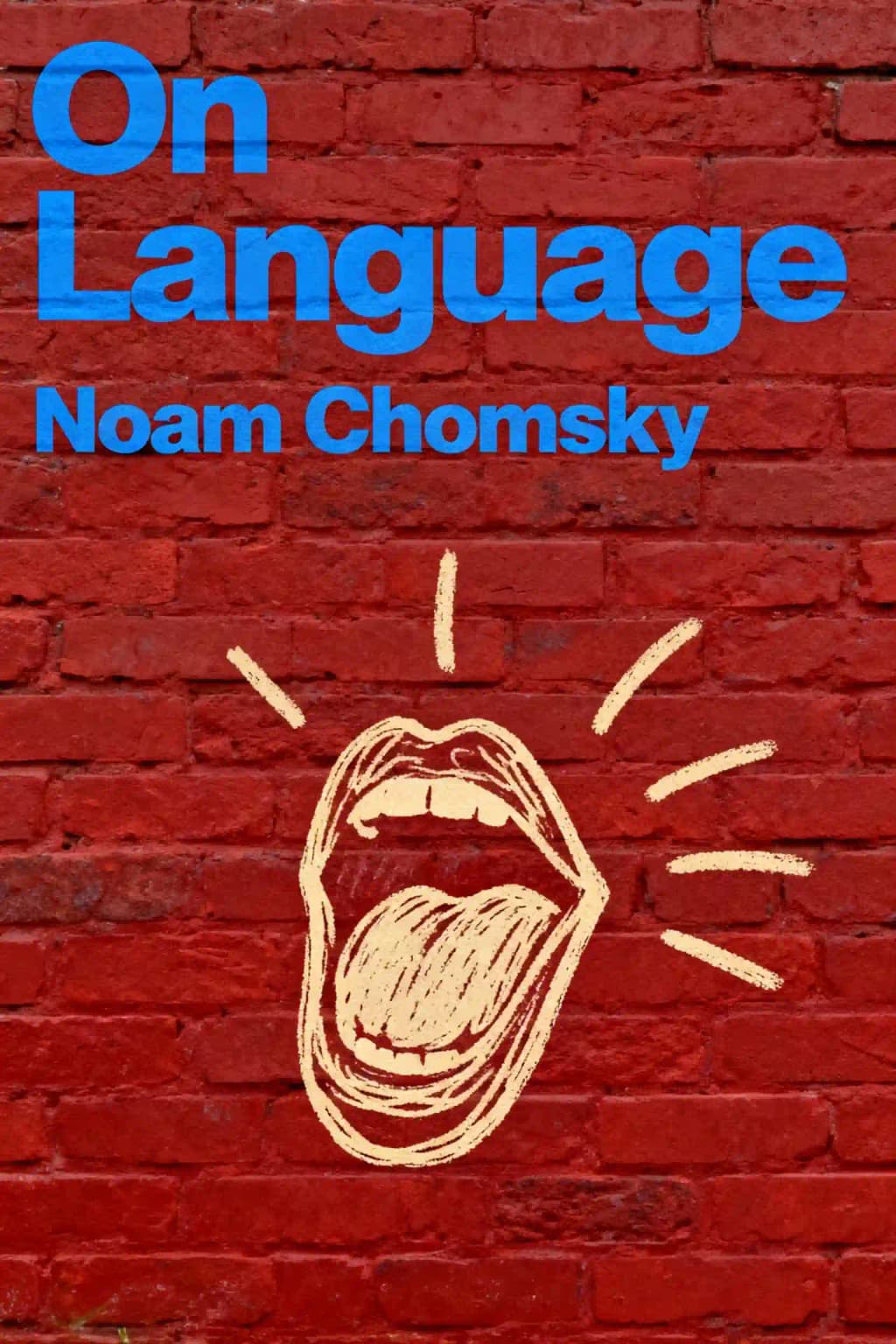
Chomsky's "Reflections on Language" revolutionized linguistics by proposing we're born with Universal Grammar - a concept that sparked fierce academic debates yet transformed cognitive science forever. What if the key to understanding human thought isn't learned, but hardwired into our minds?
Noam Chomsky, the groundbreaking linguist, cognitive scientist, and political critic, explores the architecture of human language in On Language. A laureate professor at the University of Arizona and MIT Institute Professor emeritus, Chomsky revolutionized linguistics with his theories of generative grammar and universal syntax, arguing that language stems from an innate biological capacity.
The book synthesizes his decades of research into how language structures shape thought, a theme rooted in his 1957 landmark work Syntactic Structures and his critique of B.F. Skinner’s behaviorism.
Chomsky’s interdisciplinary influence extends beyond academia—his political works like Manufacturing Consent and Understanding Power analyze media and ideology, cementing his status as a leading public intellectual. With over 100 books published and translations spanning 30+ languages, his works rank among the most cited in modern scholarship. Syntactic Structures alone reshaped 20th-century linguistics, while his 1992 Arts and Humanities Citation Index record confirmed his unmatched academic impact.
On Language explores the biological basis of human language and its role in shaping cognition, politics, and society. Chomsky argues that language reflects innate mental structures (Universal Grammar) and critiques how linguistic power dynamics influence propaganda and democracy. Key themes include transformational grammar, linguistic relativity, and the ethical responsibilities of intellectuals in media and politics.
Linguists, cognitive scientists, and philosophy enthusiasts will gain foundational insights into Chomsky’s theories. Policymakers and media analysts benefit from its analysis of language as a tool for social control. The book suits readers interested in interdisciplinary connections between linguistics, psychology, and political theory.
Yes. Its analysis of language’s cognitive architecture remains pivotal for AI and neuroscience research. The critique of media manipulation and propaganda is increasingly relevant amid misinformation trends. Chomsky’s accessible yet rigorous style makes complex ideas approachable for specialists and general audiences alike.
Universal Grammar (UG) refers to innate principles and parameters that constrain all human languages. Chomsky posits UG as a “mental organ” allowing children to intuitively grasp grammar rules, despite limited input. For example, all languages use hierarchical syntax (structure-dependence), not linear patterns.
Chomsky warns that institutions weaponize language to manufacture consent, distort facts, and suppress dissent. Case studies include euphemistic political rhetoric and corporate media framing. He urges critical analysis of linguistic tactics to preserve democratic discourse.
Critics argue Chomsky overemphasizes syntax over semantics and underplays cultural influences on language. Others dispute UG’s universality, citing niche languages with atypical structures. However, his core thesis remains foundational in cognitive science.
It synthesizes linguistic theories from Syntactic Structures (1957) and political critiques from Manufacturing Consent (1988). Compared to technical works like Aspects of the Theory of Syntax, this book offers a broader, interdisciplinary perspective.
Yes. Chomsky’s focus on hierarchical syntax and innate structures informs debates about whether AI truly “understands” language or merely mimics patterns. His framework challenges purely statistical approaches to NLP, advocating for meaning-centric models.
Chomsky’s theories revolutionized psychology by positing language as a window into innate mental structures. This shifted focus from behaviorism to computational models of cognition, influencing modern research on memory, reasoning, and learning.
저자의 목소리로 책을 느껴보세요
지식을 흥미롭고 예시가 풍부한 인사이트로 전환
핵심 아이디어를 빠르게 캡처하여 신속하게 학습
재미있고 매력적인 방식으로 책을 즐기세요
Chomsky accomplished a remarkable feat: he made linguistics one of the sexiest fields around.
Contributions are judged by content, not credentials.
The press remained obedient to official frameworks.
The mind operates as a system of specialized "mental organs."
Language as a Window into the Mind
On Language의 핵심 아이디어를 이해하기 쉬운 포인트로 분해하여 혁신적인 팀이 어떻게 창조하고, 협력하고, 성장하는지 이해합니다.
On Language을 빠른 기억 단서로 압축하여 솔직함, 팀워크, 창의적 회복력의 핵심 원칙을 강조합니다.

생생한 스토리텔링을 통해 On Language을 경험하고, 혁신 교훈을 기억에 남고 적용할 수 있는 순간으로 바꿉니다.
무엇이든 물어보고, 목소리를 선택하고, 진정으로 공감되는 인사이트를 함께 만들어보세요.

샌프란시스코에서 컬럼비아 대학교 동문들이 만들었습니다
"Instead of endless scrolling, I just hit play on BeFreed. It saves me so much time."
"I never knew where to start with nonfiction—BeFreed’s book lists turned into podcasts gave me a clear path."
"Perfect balance between learning and entertainment. Finished ‘Thinking, Fast and Slow’ on my commute this week."
"Crazy how much I learned while walking the dog. BeFreed = small habits → big gains."
"Reading used to feel like a chore. Now it’s just part of my lifestyle."
"Feels effortless compared to reading. I’ve finished 6 books this month already."
"BeFreed turned my guilty doomscrolling into something that feels productive and inspiring."
"BeFreed turned my commute into learning time. 20-min podcasts are perfect for finishing books I never had time for."
"BeFreed replaced my podcast queue. Imagine Spotify for books — that’s it. 🙌"
"It is great for me to learn something from the book without reading it."
"The themed book list podcasts help me connect ideas across authors—like a guided audio journey."
"Makes me feel smarter every time before going to work"
샌프란시스코에서 컬럼비아 대학교 동문들이 만들었습니다

On Language 요약을 무료 PDF 또는 EPUB으로 받으세요. 인쇄하거나 오프라인에서 언제든 읽을 수 있습니다.
Imagine a world where the study of language was completely transformed by a single individual. This is precisely what Noam Chomsky accomplished with his revolutionary work on linguistics. While many know Chomsky for his political activism, his primary academic contribution-fundamentally changing how we understand language-remains his most profound legacy. As Steven Pinker noted, "Chomsky accomplished a remarkable feat: he made linguistics one of the sexiest fields around." His ideas transcended academia to influence culture broadly, with figures as diverse as Bono and Michel Foucault citing his linguistic theories as transformative to their thinking. Chomsky's revolution wasn't merely scientific-it was philosophical, forcing us to reconsider what makes us fundamentally human.