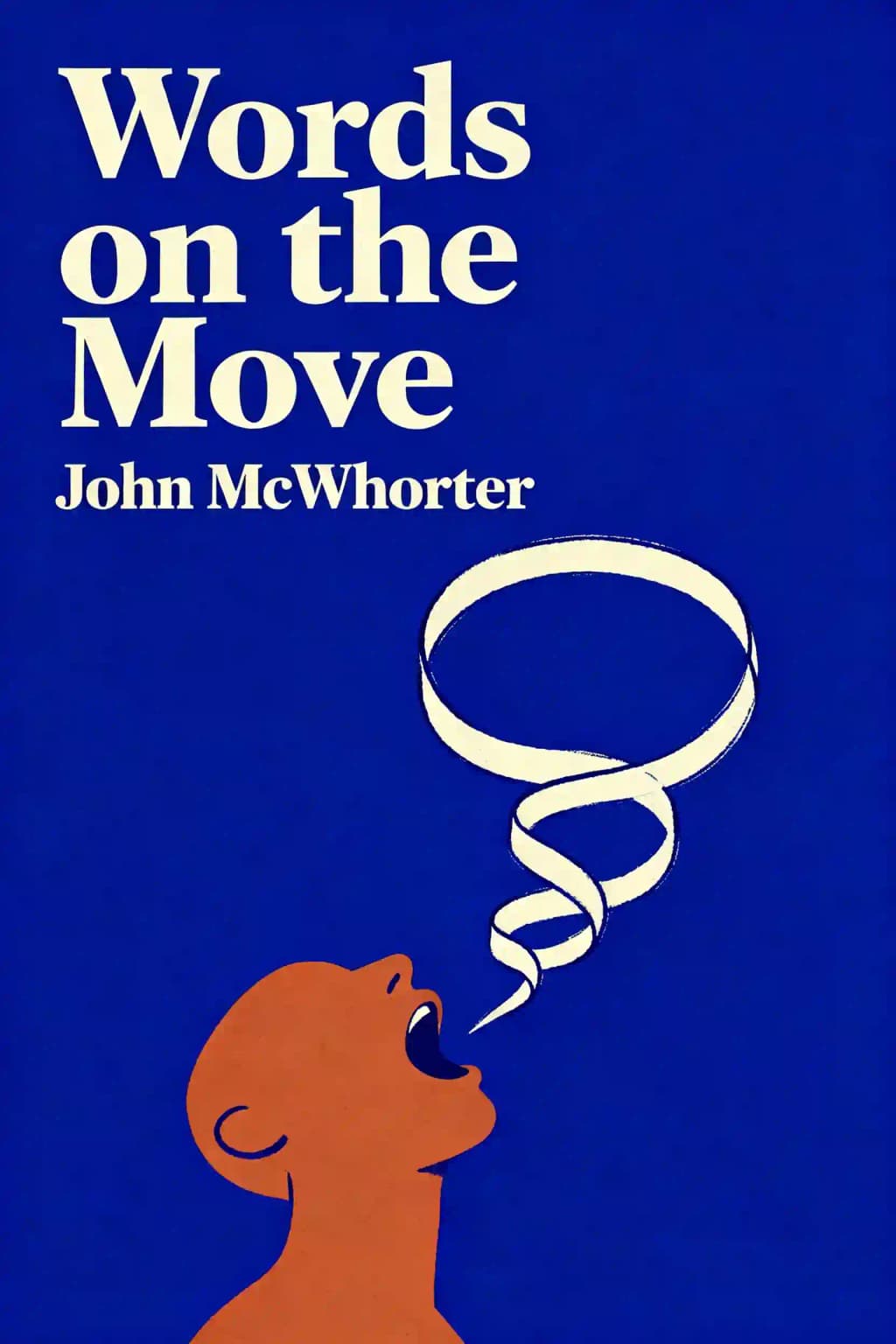
In "Words on the Move," linguist John McWhorter reveals why your grandmother's complaints about "literally" aren't valid. Language evolution isn't decay - it's natural adaptation. This Columbia professor's witty exploration makes you question: is your resistance to linguistic change actually logical?
John Hamilton McWhorter V, author of Words on the Move: Why English Won’t—and Can’t—Sit Still, is a Columbia University linguistics professor, cultural commentator, and bestselling author renowned for making language evolution accessible to general audiences.
A Stanford-trained linguist specializing in creole languages and linguistic simplicity, McWhorter bridges academic rigor with engaging storytelling, as seen in his 20+ books like The Power of Babel (a natural history of language) and Woke Racism (a critique of modern antiracism frameworks).
He hosts the Lexicon Valley podcast, writes a weekly New York Times newsletter, and has created six linguistics courses for The Great Courses. A frequent contributor to The Atlantic and Wall Street Journal, McWhorter’s insights on race, culture, and language have been featured on NPR’s Fresh Air, The Colbert Report, and TED Talks.
His work Winning the Race earned an NAACP Image Award nomination, while Our Magnificent Bastard Tongue has been widely adopted in linguistics curricula. Words on the Move builds on his signature theme of language as a dynamic, living system, reflecting his 25-year career decoding linguistic patterns for mainstream audiences.
Words on the Move explores how language evolves through shifts in word meanings, grammar, and pronunciation. John McWhorter argues that change is inevitable, using examples like slang adoption and the redefinition of words like “literally.” He challenges purist views, showing how English has transformed from Old English to modern internet-driven communication.
Linguistics enthusiasts, language students, and educators will appreciate McWhorter’s insights. It’s also accessible to general readers curious about why terms like “cool” or emojis become mainstream. The book suits anyone interested in how cultural shifts and human creativity shape communication.
Yes. McWhorter blends scholarly research with witty analogies, making complex linguistic concepts engaging. Critics praise its fresh perspective on language’s fluidity, though some find his categorization of changes overly simplistic. The Blinkist summary offers a 15-minute overview for time-constrained readers.
McWhorter identifies mechanisms like semantic drift (e.g., “awful” shifting from “awe-inspiring” to “terrible”) and grammatical simplification. He emphasizes that languages evolve organically, driven by usage rather than rigid rules, and compares this process to biological adaptation.
Some linguists argue McWhorter’s “simplicity” metrics are subjective, citing exceptions in non-European languages. Others note occasional forced examples, like the FACTUAL acronym’s uneven application.
The book contextualizes modern trends like emojis and vocal fry as natural extensions of historical patterns. McWhorter shows how digital communication continues language’s evolutionary trajectory, making it essential for understanding 21st-century discourse.
A Columbia University linguistics professor and prolific author, McWhorter combines academic rigor with media-savvy commentary. His expertise in Creole languages and race relations enriches the book’s interdisciplinary approach.
Unlike The Power of Babel (global language history) or Losing the Race (sociopolitical analysis), this book focuses on English’s mechanical evolution, offering bite-sized case studies ideal for casual readers.
Yes. McWhorter’s analysis of slang, texting, and grammatical shifts helps readers decode workplace jargon, social media trends, and generational dialects, fostering adaptability in personal and professional settings.
저자의 목소리로 책을 느껴보세요
지식을 흥미롭고 예시가 풍부한 인사이트로 전환
핵심 아이디어를 빠르게 캡처하여 신속하게 학습
재미있고 매력적인 방식으로 책을 즐기세요
Language does far more than convey information-it expresses our humanity.
Words rarely maintain their original meanings over time.
Stability being the exception rather than the rule.
Words don't just change meaning-sometimes they lose independence entirely.
Words on the Move의 핵심 아이디어를 이해하기 쉬운 포인트로 분해하여 혁신적인 팀이 어떻게 창조하고, 협력하고, 성장하는지 이해합니다.
Words on the Move을 빠른 기억 단서로 압축하여 솔직함, 팀워크, 창의적 회복력의 핵심 원칙을 강조합니다.

생생한 스토리텔링을 통해 Words on the Move을 경험하고, 혁신 교훈을 기억에 남고 적용할 수 있는 순간으로 바꿉니다.
무엇이든 물어보고, 목소리를 선택하고, 진정으로 공감되는 인사이트를 함께 만들어보세요.

샌프란시스코에서 컬럼비아 대학교 동문들이 만들었습니다
"Instead of endless scrolling, I just hit play on BeFreed. It saves me so much time."
"I never knew where to start with nonfiction—BeFreed’s book lists turned into podcasts gave me a clear path."
"Perfect balance between learning and entertainment. Finished ‘Thinking, Fast and Slow’ on my commute this week."
"Crazy how much I learned while walking the dog. BeFreed = small habits → big gains."
"Reading used to feel like a chore. Now it’s just part of my lifestyle."
"Feels effortless compared to reading. I’ve finished 6 books this month already."
"BeFreed turned my guilty doomscrolling into something that feels productive and inspiring."
"BeFreed turned my commute into learning time. 20-min podcasts are perfect for finishing books I never had time for."
"BeFreed replaced my podcast queue. Imagine Spotify for books — that’s it. 🙌"
"It is great for me to learn something from the book without reading it."
"The themed book list podcasts help me connect ideas across authors—like a guided audio journey."
"Makes me feel smarter every time before going to work"
샌프란시스코에서 컬럼비아 대학교 동문들이 만들었습니다

Words on the Move 요약을 무료 PDF 또는 EPUB으로 받으세요. 인쇄하거나 오프라인에서 언제든 읽을 수 있습니다.
Words aren't static objects frozen in dictionaries-they're living entities in constant motion. While we often imagine language as something fixed and permanent, it's actually more like a river-always flowing, shifting course, and transforming the landscape it passes through. This evolutionary process isn't random or chaotic but follows natural patterns that have shaped human communication for millennia. What many consider "errors" or "sloppiness" in modern speech are actually the same forces that transformed Latin into French or Old English into what we speak today. Language change isn't decay-it's life itself, the natural breathing of a living system adapting to human needs. When someone complains about "literally" being used figuratively or "like" appearing in new contexts, they're witnessing the same evolutionary mechanisms that have been reshaping words since humans first began speaking.
