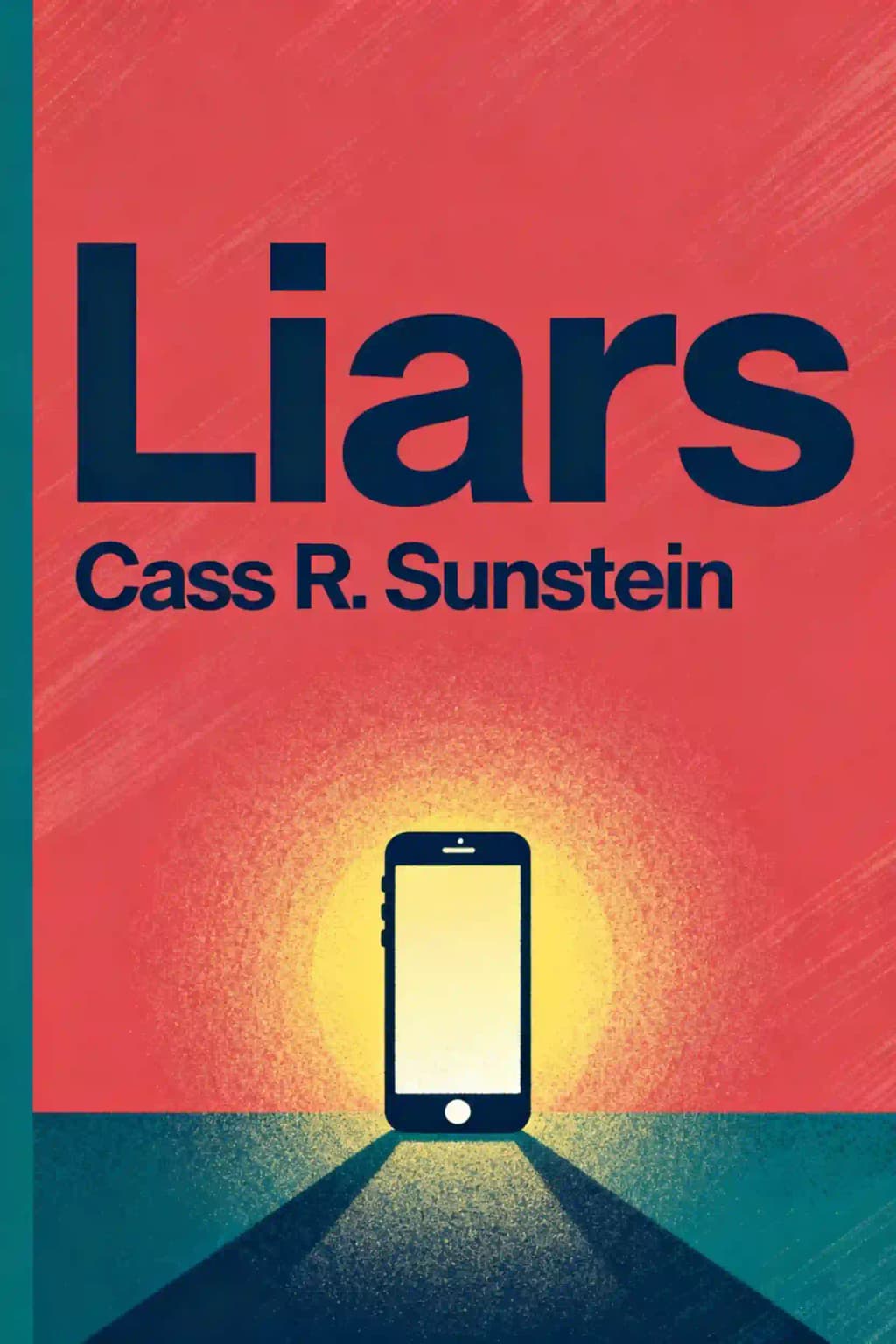
In "Liars," legal scholar Cass Sunstein tackles our misinformation crisis, exploring how social media amplifies falsehoods that threaten democracy. Can free speech survive in a world where lies spread faster than truth? The most-cited American legal scholar offers surprising solutions.
Cass R. Sunstein, bestselling author of Liars and renowned legal scholar, is the Robert Walmsley University Professor at Harvard Law School and a pioneer in behavioral economics. A former Administrator of the White House Office of Information and Regulatory Affairs under President Obama, Sunstein has shaped policies on misinformation, social influence, and decision-making frameworks. His expertise in constitutional law and behavioral science informs Liars, which explores deception’s societal impact through legal, psychological, and technological lenses.
Sunstein’s influential works include Nudge (coauthored with Richard Thaler), a global phenomenon translated into 40+ languages, and The World According to Star Wars, which dissects cultural narratives.
His other notable titles like Impeachment: A Citizen’s Guide and #Republic examine democracy’s challenges in the digital age. Recognized with the Holberg Prize—considered the Nobel equivalent for law—his research underpins initiatives at the World Health Organization and Pentagon. Over 700,000 copies of his books sell annually, cementing his status as America’s most cited legal scholar.
Cass R. Sunstein’s Liars examines how deliberate falsehoods threaten societal trust, public health, and democracy in the digital age. It analyzes legal frameworks (particularly U.S. law), ethical systems, and psychological factors that enable harmful lies—like COVID-19 hoaxes and deepfakes—to spread rapidly. The book advocates for balanced solutions, including targeted legal reforms and platform moderation, while upholding free speech principles.
Legal scholars, policymakers, and anyone concerned about misinformation’s societal impact will find this book essential. It’s also valuable for psychology enthusiasts exploring why people believe/share lies and for social media users seeking insights into platform accountability.
Yes—Sunstein combines rigorous legal analysis with behavioral science to explain how falsehoods erode democracy and offers actionable solutions. The blend of real-world examples (e.g., Trump’s lies, anti-vaccine myths) and ethical frameworks makes it a timely, thought-provoking read for navigating modern information challenges.
Sunstein argues that while most lies should remain protected speech, society must legally restrict those causing imminent harm (e.g., death threats, defamation). He emphasizes social media’s amplifying role and critiques platforms for insufficient content moderation, urging a mix of legislative action and corporate responsibility.
The book highlights how platforms like Facebook and Twitter accelerate lies by prioritizing engagement over accuracy. Sunstein proposes “nudges” like warning labels and fact-check links to reduce harm without outright censorship, balancing free expression and public safety.
Sunstein evaluates lies through utilitarianism (weighing harms vs. benefits), deontology (duty-based ethics), and virtue ethics. He prioritizes intent, magnitude of harm, and likelihood of damage, arguing that malicious falsehoods warrant stricter regulation than accidental misinformation.
Yes. Sunstein warns that AI-generated content (e.g., deepfakes) poses unprecedented risks by distorting reality convincingly. He suggests updated defamation laws and platform policies to combat synthetic media, stressing the need for rapid response mechanisms.
While Nudge focuses on behavioral economics’ role in policymaking, Liars applies similar principles to misinformation. Both emphasize “choice architecture,” but Liars prioritizes curbing deliberate deception over guiding positive decisions.
Some argue Sunstein underestimates free speech risks in government-led regulation. Others note the U.S.-centric legal analysis may lack global applicability. However, most praise its nuanced approach to balancing civil liberties and societal protection.
Yes. The book’s strategies—like promoting transparency, designating trusted fact-checkers, and reducing repetition of false claims—apply to organizations. Sunstein’s harm-prevention framework assists leaders in addressing rumors or deepfake risks internally.
As AI-generated content and geopolitical misinformation surge, Sunstein’s analysis of regulatory gaps and platform accountability remains critical. The book’s principles guide responses to emerging threats like election-interference deepfakes and climate denialism.
Notable lines include:
저자의 목소리로 책을 느껴보세요
지식을 흥미롭고 예시가 풍부한 인사이트로 전환
핵심 아이디어를 빠르게 캡처하여 신속하게 학습
재미있고 매력적인 방식으로 책을 즐기세요
When someone lies to you, they effectively 'take' something from you.
Political lies undermine the very foundation of self-government.
All silencing of discussion is an assumption of infallibility.
Liars의 핵심 아이디어를 이해하기 쉬운 포인트로 분해하여 혁신적인 팀이 어떻게 창조하고, 협력하고, 성장하는지 이해합니다.
Liars을 빠른 기억 단서로 압축하여 솔직함, 팀워크, 창의적 회복력의 핵심 원칙을 강조합니다.

생생한 스토리텔링을 통해 Liars을 경험하고, 혁신 교훈을 기억에 남고 적용할 수 있는 순간으로 바꿉니다.
무엇이든 물어보고, 목소리를 선택하고, 진정으로 공감되는 인사이트를 함께 만들어보세요.

샌프란시스코에서 컬럼비아 대학교 동문들이 만들었습니다
"Instead of endless scrolling, I just hit play on BeFreed. It saves me so much time."
"I never knew where to start with nonfiction—BeFreed’s book lists turned into podcasts gave me a clear path."
"Perfect balance between learning and entertainment. Finished ‘Thinking, Fast and Slow’ on my commute this week."
"Crazy how much I learned while walking the dog. BeFreed = small habits → big gains."
"Reading used to feel like a chore. Now it’s just part of my lifestyle."
"Feels effortless compared to reading. I’ve finished 6 books this month already."
"BeFreed turned my guilty doomscrolling into something that feels productive and inspiring."
"BeFreed turned my commute into learning time. 20-min podcasts are perfect for finishing books I never had time for."
"BeFreed replaced my podcast queue. Imagine Spotify for books — that’s it. 🙌"
"It is great for me to learn something from the book without reading it."
"The themed book list podcasts help me connect ideas across authors—like a guided audio journey."
"Makes me feel smarter every time before going to work"
샌프란시스코에서 컬럼비아 대학교 동문들이 만들었습니다

Liars 요약을 무료 PDF 또는 EPUB으로 받으세요. 인쇄하거나 오프라인에서 언제든 읽을 수 있습니다.
We live in an era where lies travel faster than truth. When was the last time you scrolled through social media and encountered something that seemed too outrageous to be true-yet was shared thousands of times? This phenomenon isn't just annoying; it's reshaping our social fabric. "Liars" arrives at a critical moment when misinformation floods our daily lives, challenging our ability to separate fact from fiction. The fundamental question becomes: how should society balance free expression against the harms of deliberate deception? This tension sits at the heart of our most pressing social challenges, from vaccine hesitancy to election integrity to climate change response. What makes this problem particularly vexing is that falsehoods aren't just harmful-they're incredibly effective at capturing our attention and spreading through our networks.
