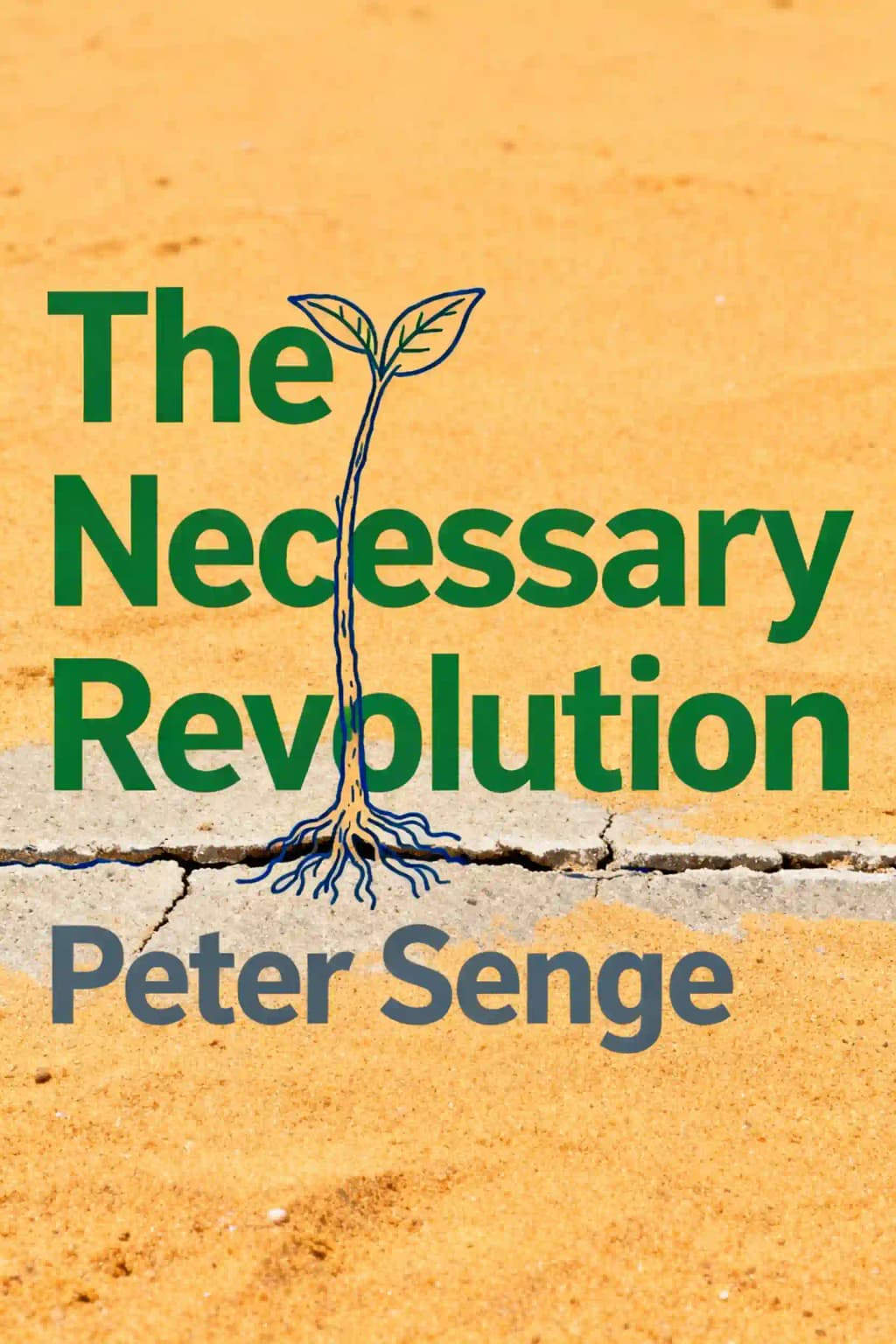
The Necessary Revolution
How Individuals and Organizations Are Working Together to Create a Sustainable World
Overview of The Necessary Revolution
The Necessary Revolution challenges our unsustainable economic model. Named "Strategist of the Century," Peter Senge reveals how businesses and nonprofits are partnering to create sustainable practices. What if the 2008 financial crisis wasn't just economic, but a wake-up call for our planet's survival?

Key Themes in The Necessary Revolution
- regenerative economy
- systems thinking
- industrial age bubble
- corporate sustainability
- resource depletion
Quotes from The Necessary Revolution
Business as usual is no longer an option.
We need to see the world as a whole, not as a collection of separate parts.
We stand at a crossroads in human history.
Life creates conditions for life.
Systems thinking isn't about fighting complexity with more complexity.
Characters in The Necessary Revolution
- Peter SengeLead author and MIT organizational learning expert
- Bryan SmithCo-author and sustainability collaborator
- Nina KruschwitzCo-author and sustainability collaborator
- Joe LaurCo-author and sustainability collaborator
- Sara SchleyCo-author and sustainability collaborator
About the Author
About the Author of The Necessary Revolution
Peter M. Senge, author of The Necessary Revolution, is a pioneering thought leader in organizational learning and systems thinking.
A senior lecturer at MIT Sloan School of Management and founding chair of the Society for Organizational Learning (SoL), Senge bridges academic rigor with practical strategies for sustainable change. His groundbreaking 1990 bestseller The Fifth Discipline redefined leadership paradigms, selling over 2.5 million copies and earning recognition from Harvard Business Review as one of the most influential management books of the 20th century.
The Necessary Revolution extends his work into collaborative solutions for global sustainability, informed by decades advising Fortune 500 companies like Ford and Shell. Senge’s later works, including Presence: Human Purpose and the Field of the Future, further explore systemic approaches to leadership and innovation.
His frameworks are taught in top MBA programs and implemented by organizations worldwide. The Fifth Discipline has been translated into 29 languages, cementing Senge’s status as a foundational voice in modern organizational theory.
Download Summary of The Necessary Revolution
Get the The Necessary Revolution summary as a free PDF or EPUB. Print it or read offline anytime.
FAQs About This Book
The Necessary Revolution by Peter Senge explores the urgent shift toward sustainable business and societal practices through systemic collaboration. It argues that environmental, economic, and social crises demand reimagining organizations as interconnected systems, prioritizing partnerships and long-term resilience over short-term gains. Key themes include systems thinking, creating shared visions, and moving beyond reactive "anti" movements to proactive, solutions-driven change.
Leaders, policymakers, and professionals in sustainability, corporate strategy, or organizational development will find actionable insights. The book appeals to those seeking frameworks for driving systemic change, fostering cross-sector collaboration, and understanding the economic imperatives of sustainability. It’s also ideal for readers interested in Peter Senge’s theories beyond The Fifth Discipline.
Yes, for its pioneering approach to sustainability as a collaborative, systemic challenge. Senge combines academic rigor with real-world case studies (e.g., Shell, Ford) to show how businesses can thrive by aligning profit with planetary health. Its focus on actionable strategies over abstract theory makes it a practical guide for change-makers.
- Systems Thinking: Addressing sustainability requires understanding interconnected social, economic, and ecological systems.
- Positive Focus: Shift from opposing harmful practices to co-creating sustainable alternatives.
- Partnerships: Cross-industry and nonprofit collaborations accelerate innovation.
- Leadership: Decentralize decision-making to empower collective action.
Senge frames sustainability as a systemic challenge, urging organizations to map interdependencies between operations, supply chains, and environmental impacts. For example, he advocates for "industrial ecosystems" where waste from one process becomes raw material for another, mirroring natural cycles.
"Autarkic marginals" describe individuals who abandon mainstream systems (e.g., corporate structures) to live sustainably but isolate themselves. Senge critiques this approach as ineffective, arguing real change requires reshaping systems from within through engagement, not withdrawal.
Partnerships are central to scaling sustainable solutions. Senge highlights cases like Procter & Gamble’s open innovation networks, where external collaborators co-develop eco-friendly products. He emphasizes pooling resources across competitors, governments, and NGOs to tackle global issues like climate change.
It redefines corporate responsibility as a strategic advantage, not a compliance burden. Companies like Harley-Davidson and Shell are cited for integrating sustainability into core operations, reducing costs while building brand loyalty and operational resilience.
Some argue the book overlooks political barriers to systemic change, like lobbying by fossil fuel industries. Others note its corporate-centric examples may not translate well to smaller organizations or developing economies lacking resources for large-scale collaborations.
While The Fifth Discipline focuses on organizational learning, The Necessary Revolution applies those principles to global sustainability. It expands Senge’s "learning organization" concept into cross-sector "learning communities," emphasizing collective action over internal culture shifts.
- Develop Shared Visions: Align stakeholders around long-term sustainability goals.
- Leverage Feedback Loops: Use data to track progress and adapt strategies.
- Build Coalitions: Partner with unlikely allies to pool expertise and resources.
As climate deadlines loom and ESG (Environmental, Social, Governance) investing grows, Senge’s frameworks help organizations navigate decarbonization, circular economies, and stakeholder capitalism. The 2025 relevance lies in its blueprint for aligning profit with purpose amid regulatory shifts and consumer demands.





