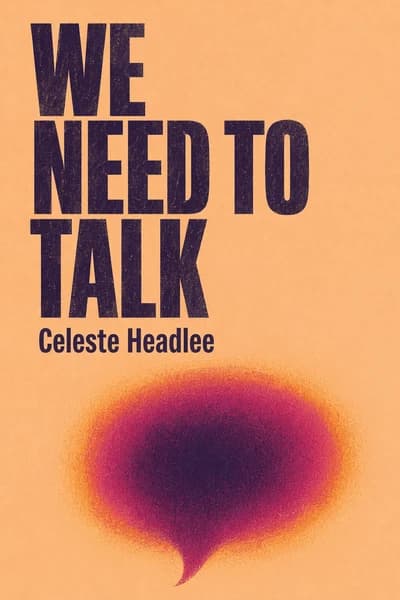
We Need to Talk
10 Rules for Speaking Less, Listening More, and Discovering What You've Been Missing in Every Conversation
Overview of We Need to Talk
In a world where we're increasingly disconnected, Celeste Headlee's TED-sensation (10M+ views) offers a masterclass in meaningful conversation. NPR's Best Book of 2017 reveals why putting down your phone might be the revolutionary act your relationships desperately need.

Key Themes in We Need to Talk
- active listening
- digital empathy gap
- conversational competence
- face-to-face connection
- verbal communication evolution
Quotes from We Need to Talk
We sang before we spoke.
We're more divided than at any time since the Civil War.
Empathy is essential for human connection.
Good conversation doesn't happen naturally.
Characters in We Need to Talk
- Celeste HeadleeAuthor and professional radio broadcaster
- Mark PagelEvolutionary biologist
- Shigeru MiyagawaLinguist and communication theorist
About the Author
About the Author of We Need to Talk
Celeste Headlee is the bestselling author of We Need to Talk: How to Have Conversations That Matter and an award-winning journalist renowned for her expertise in communication and interpersonal dialogue. A 20-year veteran of public radio, she hosted NPR programs like Talk of the Nation and All Things Considered, honing her skills in facilitating meaningful conversations on complex topics. Her TEDx Talk, 10 Ways to Have a Better Conversation, has been viewed over 34 million times, cementing her status as a leading voice in modern communication strategies.
Headlee’s work explores themes of empathy, active listening, and bridging ideological divides, informed by her career interviewing diverse voices and her advocacy for equitable discourse. She expands on these ideas in her other books, including Do Nothing: How to Break Away from Overworking, Overdoing, and Underliving and Speaking of Race: Why Everyone Needs to Talk About Racism—and How to Do It.
A trusted media commentator, she has contributed to TIME, Essence, and PBS, and advises organizations like ProCon.org and The Listen First Project. Her 2019 Media Changemaker Award underscores her influence in reshaping public dialogue.
Download Summary of We Need to Talk
Get the We Need to Talk summary as a free PDF or EPUB. Print it or read offline anytime.
FAQs About This Book
We Need to Talk by Celeste Headlee is a practical guide to revitalizing meaningful conversations in a tech-dominated world. Drawing from her NPR hosting experience, Headlee offers 10 actionable strategies to improve dialogue, including active listening, avoiding multitasking, and embracing brevity. The book addresses modern communication challenges like digital distractions and emphasizes empathy, curiosity, and presence to foster deeper connections.
This book is ideal for professionals, parents, educators, and anyone seeking to strengthen personal or workplace relationships. It’s particularly valuable for those navigating difficult discussions, improving empathy, or counteracting technology’s impact on communication. Headlee’s insights also benefit public speakers, interviewers, and leaders aiming to refine their conversational skills.
Yes—readers and critics praise its actionable advice, citing Headlee’s TED Talk-inspired strategies as transformative. Reviewers highlight its relevance for improving workplace dynamics, family communication, and social interactions. The blend of research, personal anecdotes, and concise frameworks makes it a standout in the communication genre.
Headlee’s 10 key strategies include:
- Listen without interrupting
- Avoid multitasking during conversations
- Ask open-ended questions
- Embrace silence to allow deeper reflection
- Stay brief to maintain engagement
These tools aim to reduce misunderstandings and foster genuine connections by prioritizing understanding over persuasion.
Headlee critiques smartphones and social media for fragmenting attention and reducing face-to-face dialogue. She advises setting tech boundaries (e.g., device-free meals) and prioritizing in-person interactions to rebuild conversational depth. The book warns against “phubbing” (phone snubbing) and advocates mindful tech use to preserve relational quality.
Coined in the book, this term describes redirecting conversations to oneself instead of listening. Headlee urges readers to avoid self-centered habits like one-upping stories or over-sharing. Instead, focus on asking questions like “What was that like?” to keep dialogues balanced and inclusive.
Headlee recommends:
- Acknowledge emotions without judgment
- Avoid assumptions by seeking clarity
- Stay curious rather than defensive
- Use phrases like “Help me understand” to defuse tension
These tactics aim to transform conflicts into opportunities for mutual understanding.
Some reviewers note the advice overlaps with general communication principles (e.g., active listening). Others desire more examples for niche scenarios like crisis conversations. However, most praise Headlee’s fresh perspective on tech-related challenges and her actionable tweaks to habitual behaviors.
While both address conflict resolution, Headlee’s work focuses more on everyday dialogue and tech’s societal impact. Crucial Conversations emphasizes structured frameworks for high-stakes discussions, whereas We Need to Talk prioritizes mindfulness and simplicity. Both are complementary for holistic communication growth.
Notable lines include:
- “Be interested in other people.”
- “There’s no reason to show you’re paying attention if you’re actually paying attention.”
- “The problem isn’t that we don’t talk—it’s that we don’t listen.”
These underscore Headlee’s emphasis on authenticity over performative listening.
The book advises managers to:
- Replace monologues with collaborative dialogues
- Encourage brevity in meetings to boost engagement
- Model vulnerability by admitting uncertainties
Teams adopting these practices report improved trust, creativity, and conflict resolution.
Yes—her TED Talk “10 Ways to Have a Better Conversation” distills key book concepts, like avoiding multitasking and embracing ignorance. The book expands these ideas with research, case studies, and exercises, offering a deeper dive for readers seeking lasting behavioral change.