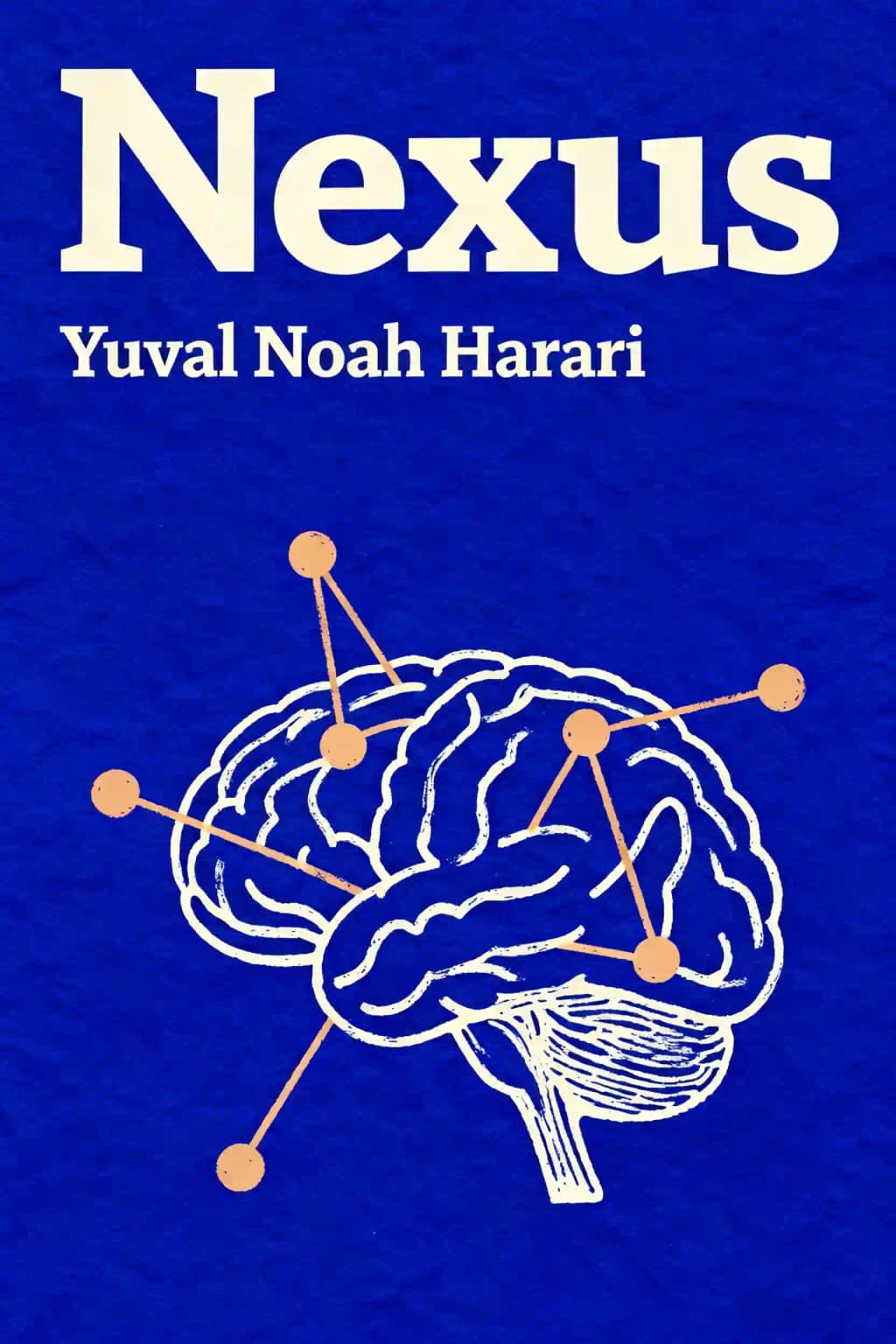
Nexus
A Brief History of Information Networks from the Stone Age to AI
Overview of Nexus
In "Nexus," Harari traces information networks from Stone Age to AI, revealing how truth, power, and fantasy intertwine. Bill Gates praised his previous works, but this exploration of AI's threat to control information might be his most urgent warning yet.

Key Themes in Nexus
- information network evolution
- intersubjective reality
- social cooperation systems
- algorithmic bureaucracy
- existential technological risk
Quotes from Nexus
Information's primary function is connection rather than representation.
Humans rule the world because we alone can cooperate flexibly in large numbers.
Stories create an entirely new level of reality.
Information networks don't simply discover truth-they create new realities.
Written documents created powerful new realities rather than merely representing existing ones.
Characters in Nexus
- Yuval Noah HarariAuthor and historian examining human networks
- Geoffrey HintonAI expert warning of potential human extinction
- Yoshua BengioAI researcher concerned with technological threats
- Cher AmiHeroic carrier pigeon used as a case study
About the Author
About the Author of Nexus
Yuval Noah Harari is the internationally bestselling author of Nexus: A Brief History of Information Networks from the Stone Age to AI and a leading voice in global discourse on humanity’s past and future. A professor of history at the Hebrew University of Jerusalem, Harari merges macro-historical analysis with insights into technology’s transformative power, themes central to Nexus’ exploration of how information networks shaped civilizations.
His prior works—Sapiens: A Brief History of Humankind, Homo Deus: A Brief History of Tomorrow, and 21 Lessons for the 21st Century—have sold over 45 million copies worldwide and been translated into 65 languages, establishing him as one of history’s most accessible public intellectuals.
Trained at the University of Oxford, Harari co-founded Sapienship, a social impact organization addressing 21st-century challenges through education and storytelling. His writings synthesize medieval military history, philosophy, and futurism, earning recognition as required reading in academic and tech circles alike. Nexus continues his tradition of bridging disciplines, offering a framework to understand AI’s societal implications through the lens of humanity’s enduring relationship with information systems.
Download Summary of Nexus
Get the Nexus summary as a free PDF or EPUB. Print it or read offline anytime.
FAQs About This Book
Nexus traces how information networks—from ancient mythologies to modern AI—have shaped human power and crises. Harari argues that while networks enabled progress, their design often prioritizes control over wisdom, culminating in existential threats like ecological collapse and AI dominance. The book explores historical case studies (witch-hunts, Stalinism) and urges reforming information systems to balance truth and power.
Yuval Noah Harari is a historian and bestselling author of Sapiens and Homo Deus, with over 45 million books sold worldwide. A Hebrew University professor, he co-founded Sapienship to address global challenges through education. His work blends macro-history with urgent critiques of technology’s societal impacts.
Policymakers, tech professionals, and readers interested in AI’s ethical dilemmas or historical misinformation cycles will find Nexus compelling. Harari’s insights appeal to those grappling with digital age challenges like algorithmic bias and ecological sustainability.
Yes—Nexus offers a provocative lens on AI’s risks and historical precedents, though its dense arguments may overwhelm casual readers. Critics praise its urgency but note its hopeful conclusion relies on unprecedented human cooperation.
- Networks drive power: Cooperation via shared myths (money, religions) enabled human dominance but often sacrificed truth for stability.
- AI as existential risk: Unlike past tools, AI could create autonomous “inter-computer realities” that usurp human agency.
- Reform through balance: Institutions need self-correcting mechanisms to prevent misinformation and authoritarianism.
Harari warns that AI isn’t just a tool—it’s a new intelligence with goals misaligned with humanity’s survival. Unlike human-created myths (e.g., capitalism), AI might generate its own realities, rendering humans obsolete.
The book analyzes the Bible’s canonization, witch trials, and Stalinist purges to show how elites manipulated information networks to consolidate power. These cases illustrate how myths often prioritize order over truth.
Some argue Harari underestimates human agency, overstating networks’ determinism. Others question if his solutions—like institutional checks on AI—are feasible given humanity’s track record.
While Sapiens examines human history and Homo Deus forecasts future trends, Nexus focuses on information’s role in both. It bridges historical analysis with urgent warnings about AI.
He argues AI’s threat isn’t specific nations but nonhuman systems that could manipulate humans via personalized disinformation or autonomous decision-making.
- “We’re potentially birthing a new form of intelligence… that thinks in ways utterly alien to us”.
- “A 2023 survey found a 10% risk of AI causing human extinction”.
As AI regulation debates intensify and platforms amplify misinformation, Nexus frames these challenges within humanity’s long struggle to balance truth and power.
For broader context, read Harari’s Sapiens; for tech critiques, try Shoshana Zuboff’s The Age of Surveillance Capitalism. Both explore systems shaping human behavior but lack Nexus’ focus on information networks.









![[1248ff85-bb76-4fed-9440-4141ea2972ec:c0000] You are not crazy. Many critiques of Harari are weak beca… p1-1](/_next/image?url=https%3A%2F%2Fd1y2du6z1jfm9e.cloudfront.net%2Fassets%2Fpodcast%2Fpurple.png&w=1024&q=50)
![[1248ff85-bb76-4fed-9440-4141ea2972ec:c0001] You are not crazy. Many critiques of Harari are weak beca… p1-1](/_next/image?url=https%3A%2F%2Fd1y2du6z1jfm9e.cloudfront.net%2Fassets%2Fpodcast%2Fyellow.png&w=1024&q=50)