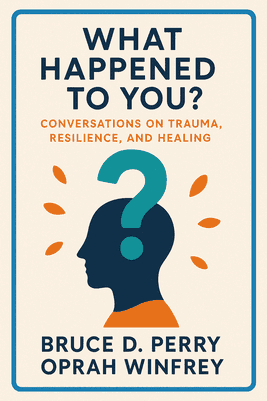
What Happened to You?: Conversations on Trauma, Resilience, and Healing

Overview of What Happened to You?
Oprah and neuroscientist Dr. Perry transform trauma psychology by asking "What happened to you?" instead of "What's wrong with you?" - a 4.45-rated revelation that's reshaping parenting, therapy, and healing generational wounds through personal stories and cutting-edge brain science.
- Shift from “What’s wrong with you?” to “What happened to you?” reframes trauma understanding.
- Neurosequential Model prioritizes regulating emotions before reasoning in trauma recovery.
- Intergenerational trauma transmits fear through behavior rather than genetic inheritance.
- First two months of life critically shape long-term mental health and resilience.
- Racism and marginalization act as prolonged stress, creating collective trauma.
- Healing requires relational connections and community-oriented support systems.
- Trauma’s impact varies by perception and controllability of stressful events.
- Somatosensory approaches like music and movement rebuild brain regulation pathways.
- Predictable, moderate stress builds resilience when paired with controllability.
- Structural biases in systems perpetuate trauma unless consciously addressed.
- “Regulate, relate, reason” sequence optimizes learning in trauma-affected individuals.
- Childhood trauma reorganizes brain networks, influencing adult behaviors and health.
About the Author of What Happened to You?
Bruce D. Perry, MD, PhD, is a renowned neuroscientist, child psychiatrist, and principal of the Neurosequential Network. He teams with media icon and philanthropist Oprah Winfrey in What Happened to You? Conversations on Trauma, Resilience, and Healing. Perry brings decades of clinical expertise from his role as senior fellow at the Child Trauma Academy and authorship of influential works like The Boy Who Was Raised as a Dog. Winfrey draws from her personal history of childhood trauma and 25-year partnership with Perry, beginning with discussions on her groundbreaking talk show. Their New York Times #1 bestselling collaboration reframes trauma understanding through brain science and lived experience, shifting focus from "What's wrong with you?" to "What happened to you?"
Winfrey’s leadership in destigmatizing trauma through platforms like her television network and philanthropic initiatives complements Perry’s pioneering Neurosequential Model of therapeutics. The psychiatrist’s prior books explore similar themes of childhood adversity and relational healing. With over one million copies sold, their work has become essential reading for mental health professionals and trauma-informed communities worldwide.
FAQs About What Happened to You?
What is What Happened to You? by Bruce D. Perry and Oprah Winfrey about?
What Happened to You? explores how childhood trauma shapes brain development and adult behavior through conversations between psychiatrist Dr. Bruce Perry and Oprah Winfrey. It reframes trauma responses by shifting from “What’s wrong with you?” to “What happened to you?” using neuroscience, personal anecdotes, and case studies to explain trauma’s long-term effects and pathways to healing.
Who should read What Happened to You??
This book is essential for trauma survivors, mental health professionals, educators, and caregivers. It offers insights for anyone seeking to understand how early adversity impacts behavior, relationships, and resilience. Oprah’s candid storytelling and Dr. Perry’s clinical expertise make complex neuroscience accessible to general readers.
What are the main concepts in What Happened to You??
Key ideas include:
- Trauma’s neurobiological impact: How adverse childhood experiences rewire brain development.
- The “Neurosequential Model”: Dr. Perry’s framework for healing trauma through regulated relationships.
- Post-traumatic wisdom: Building resilience by understanding one’s past.
How does What Happened to You? redefine trauma?
The book challenges narrow definitions of trauma, emphasizing that neglect, systemic racism, and chronic stress can be as damaging as overt abuse. It highlights how sensory triggers (e.g., smells, sounds) can reactivate trauma responses years later, as shown in the case study of Sam, a boy triggered by his teacher’s cologne.
What is the Neurosequential Model discussed in the book?
Dr. Perry’s Neurosequential Model prioritizes brain development stages when addressing trauma. It emphasizes safety, relational connection, and tailored therapeutic interventions to rebuild neural pathways disrupted by early adversity. This approach is used globally in clinical and educational settings.
How does Oprah’s personal story feature in the book?
Oprah shares her experiences with childhood abuse, poverty, and weight struggles, illustrating how unresolved trauma manifests in adulthood. Her collaboration with Dr. Perry on the 1993 “Oprah Bill” for child protection underscores their shared mission to advance trauma-informed policies.
What critiques exist about What Happened to You??
Some readers find the conversational format repetitive, while others note it lacks actionable steps for self-healing. However, its strength lies in destigmatizing trauma and advocating systemic change over individual blame.
How does What Happened to You? compare to The Body Keeps the Score?
Both books address trauma’s physiological impacts, but Perry and Oprah focus more on childhood experiences and relational healing, whereas Bessel van der Kolk’s work emphasizes somatic therapies and adult PTSD. The former uses accessible dialogue; the latter is more clinical.
What quotes from the book are most impactful?
- “Your history is not your destiny.”
- “Regulate, relate, reason.” (Dr. Perry’s mantra for trauma intervention).
These emphasize resilience and the sequential steps for effective healing.
How can What Happened to You? help parents or educators?
The book provides tools to recognize trauma symptoms in children, such as hyperactivity or withdrawal, and stresses the importance of stable, nurturing environments. It advocates for schools and caregivers to adopt trauma-informed practices.
Why is What Happened to You? relevant in 2025?
Amid rising awareness of mental health and systemic inequality, the book’s focus on empathy and societal responsibility for trauma prevention remains critical. Its lessons apply to workplace well-being, education reform, and intergenerational healing.
Are there companion resources for What Happened to You??
Dr. Perry’s Neurosequential Network offers workbooks, training programs, and research publications. Oprah’s interviews and the authors’ joint podcast episodes expand on the book’s themes for ongoing learning.
Feel the book through the author's voice
Turn knowledge into engaging, example-rich insights
Capture key ideas in a flash for fast learning
Enjoy the book in a fun and engaging way
Characters in What Happened to You?
- Oprah WinfreyCo-author who shares her personal trauma narrative
- Dr. Bruce PerryCo-author and neuroscientist
- SamuelA fourteen-year-old boy in residential care
- GloriaA mother struggling with trauma and addiction
- Mama PA nurturing foster mother
Key Themes in What Happened to You?
- childhood trauma recovery
- neuroscience of stress
- trauma-informed care
- relational resilience
- brain development biology
Quotes from What Happened to You?
Love requires being present, attentive, attuned and responsive.
Love is relational superglue that keeps our species alive.
What happened to you? provides deeper insight than what's wrong with you?
Our brains develop sequentially from bottom to top.
The capacity to give and receive love isn't something we're born with-it's built through experience.
Explore Your Way of Learning
 Quick Summary Mode
Read or listen to What Happened to You? Summary in 11 Minutes
Break down key ideas from What Happened to You? into bite-sized takeaways to understand how innovative teams create, collaborate, and grow.

 Fun Mode
What Happened to You? Lessons Told Through 20-Min Stories
Experience What Happened to You? through vivid storytelling that turns innovation lessons into moments you'll remember and apply.
 Personalize Mode
Experience What Happened to You? in your own learning style
Ask anything, choose your learning style, and co-create insights that truly resonate with you.
From Columbia University alumni built in San Francisco
"Instead of endless scrolling, I just hit play on BeFreed. It saves me so much time."


"I never knew where to start with nonfiction—BeFreed’s book lists turned into podcasts gave me a clear path."


"Perfect balance between learning and entertainment. Finished ‘Thinking, Fast and Slow’ on my commute this week."
"Crazy how much I learned while walking the dog. BeFreed = small habits → big gains."
"Reading used to feel like a chore. Now it’s just part of my lifestyle."

"Feels effortless compared to reading. I’ve finished 6 books this month already."
"BeFreed turned my guilty doomscrolling into something that feels productive and inspiring."

"BeFreed turned my commute into learning time. 20-min podcasts are perfect for finishing books I never had time for."
"BeFreed replaced my podcast queue. Imagine Spotify for books — that’s it. 🙌"

"It is great for me to learn something from the book without reading it."
"The themed book list podcasts help me connect ideas across authors—like a guided audio journey."
"Makes me feel smarter every time before going to work"
From Columbia University alumni built in San Francisco
"Instead of endless scrolling, I just hit play on BeFreed. It saves me so much time."
"I never knew where to start with nonfiction—BeFreed’s book lists turned into podcasts gave me a clear path."
"Perfect balance between learning and entertainment. Finished ‘Thinking, Fast and Slow’ on my commute this week."
"Crazy how much I learned while walking the dog. BeFreed = small habits → big gains."
"Reading used to feel like a chore. Now it’s just part of my lifestyle."
"Feels effortless compared to reading. I’ve finished 6 books this month already."
"BeFreed turned my guilty doomscrolling into something that feels productive and inspiring."
"BeFreed turned my commute into learning time. 20-min podcasts are perfect for finishing books I never had time for."
"BeFreed replaced my podcast queue. Imagine Spotify for books — that’s it. 🙌"
"It is great for me to learn something from the book without reading it."
"The themed book list podcasts help me connect ideas across authors—like a guided audio journey."
"Makes me feel smarter every time before going to work"
"Instead of endless scrolling, I just hit play on BeFreed. It saves me so much time."
"I never knew where to start with nonfiction—BeFreed’s book lists turned into podcasts gave me a clear path."
"Perfect balance between learning and entertainment. Finished ‘Thinking, Fast and Slow’ on my commute this week."
"Crazy how much I learned while walking the dog. BeFreed = small habits → big gains."
"Reading used to feel like a chore. Now it’s just part of my lifestyle."
"Feels effortless compared to reading. I’ve finished 6 books this month already."
"BeFreed turned my guilty doomscrolling into something that feels productive and inspiring."
"BeFreed turned my commute into learning time. 20-min podcasts are perfect for finishing books I never had time for."
"BeFreed replaced my podcast queue. Imagine Spotify for books — that’s it. 🙌"
"It is great for me to learn something from the book without reading it."
"The themed book list podcasts help me connect ideas across authors—like a guided audio journey."
"Makes me feel smarter every time before going to work"
"Instead of endless scrolling, I just hit play on BeFreed. It saves me so much time."
"I never knew where to start with nonfiction—BeFreed’s book lists turned into podcasts gave me a clear path."
"Perfect balance between learning and entertainment. Finished ‘Thinking, Fast and Slow’ on my commute this week."
"Crazy how much I learned while walking the dog. BeFreed = small habits → big gains."
"Reading used to feel like a chore. Now it’s just part of my lifestyle."
"Feels effortless compared to reading. I’ve finished 6 books this month already."
"BeFreed turned my guilty doomscrolling into something that feels productive and inspiring."
"BeFreed turned my commute into learning time. 20-min podcasts are perfect for finishing books I never had time for."
"BeFreed replaced my podcast queue. Imagine Spotify for books — that’s it. 🙌"
"It is great for me to learn something from the book without reading it."
"The themed book list podcasts help me connect ideas across authors—like a guided audio journey."
"Makes me feel smarter every time before going to work"

Download Summary of What Happened to You?
Get the What Happened to You? summary as a free PDF or EPUB. Print it or read offline anytime.