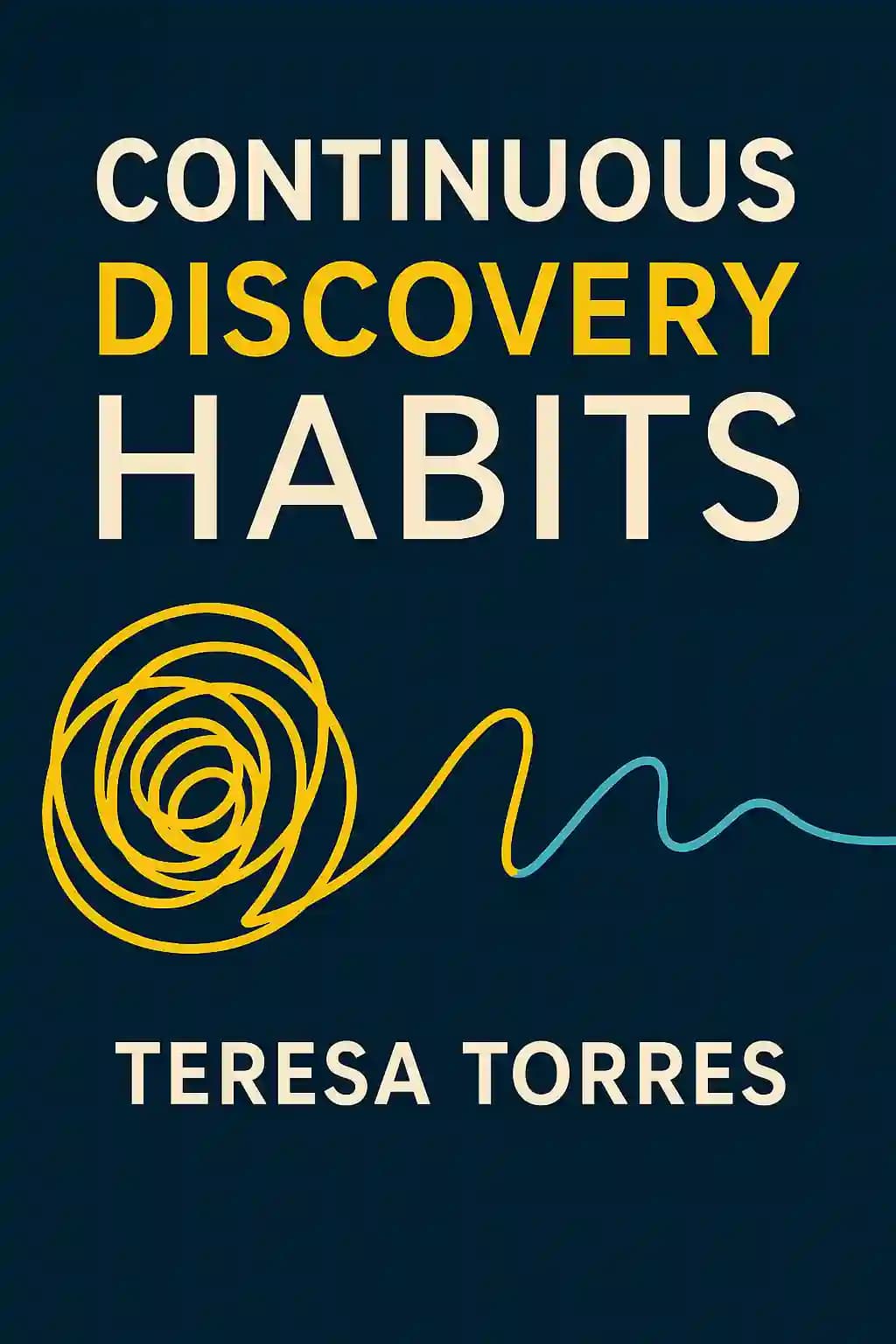
Continuous Discovery Habits
Discover Products that Create Customer Value and Business Value
Overview of Continuous Discovery Habits
Discover why product teams swear by Teresa Torres' 2021 game-changer. Her Opportunity Solution Tree framework has revolutionized how industry leaders approach customer-centric development. What secret habit do the most successful product managers share? The answer might upend everything you thought about innovation.

Key Themes in Continuous Discovery Habits
- opportunity solution mapping
- customer interview techniques
- product discovery framework
- outcome based development
- assumption testing
Quotes from Continuous Discovery Habits
Most companies overemphasize delivery while underinvesting in discovery.
Businesses should convert society's needs into opportunities.
Teams often prioritize internal stakeholder requests over customer needs.
Digital products are never truly done.
Characters in Continuous Discovery Habits
- Teresa TorresAuthor and product discovery expert
- Tim BrownIDEO CEO who endorsed the book's methodology
About the Author
About the Author of Continuous Discovery Habits
Teresa Torres, author of the influential book Continuous Discovery Habits, is a celebrated product discovery coach and innovation strategist renowned for empowering teams to build customer-centric products. With a background in cognitive sciences and over two decades of leadership roles at startups and global enterprises, Torres combines academic rigor with real-world experience. Her book, a staple in product management and business strategy, teaches sustainable frameworks for integrating customer feedback into daily workflows, reflecting her expertise in bridging user needs with organizational goals.
As the founder of Product Talk Academy, Torres has trained over 13,000 professionals, and her methods are leveraged by companies like Spotify and CarMax.
A sought-after keynote speaker, she regularly contributes to industry conferences and publishes actionable insights through her blog and workshops. Continuous Discovery Habits has become a global benchmark, praised for its pragmatic approach to iterative learning and decision-making. The book’s principles are now embedded in product teams worldwide, cementing Torres’ reputation as a leading voice in modern product innovation.
Download Summary of Continuous Discovery Habits
Get the Continuous Discovery Habits summary as a free PDF or EPUB. Print it or read offline anytime.
FAQs About This Book
Continuous Discovery Habits by Teresa Torres provides a structured framework for product teams to integrate ongoing customer research into their workflow. It emphasizes an outcome-oriented approach, teaching habits like weekly customer interviews, opportunity mapping, and assumption testing to align solutions with customer needs and business goals. The book combines practical tools (e.g., opportunity solution trees) with real-world examples to help teams build products that deliver sustained value.
Product managers, designers, software engineers, and agile leaders will benefit most from this book. It’s ideal for teams seeking to transition from output-focused to outcome-driven development, especially those struggling to validate ideas with customers or prioritize opportunities effectively. Startups and enterprises aiming to reduce wasted effort on misaligned solutions will also find actionable strategies.
Key concepts include:
- Outcome over output: Focus on metrics tied to customer and business value rather than feature delivery.
- Opportunity solution trees: Visual tools to map customer needs to potential solutions.
- Continuous interviewing: Weekly customer conversations to uncover pain points.
- Assumption testing: Rapid validation of ideas through experiments.
- The product trio: Collaboration between PMs, designers, and engineers to drive discovery.
The book shifts teams from sporadic, assumption-driven decisions to a rhythm of weekly customer engagement. By automating interview recruitment and visualizing insights, teams reduce bias and align around high-impact opportunities. Teresa Torres’ framework helps avoid building unused features by linking every solution to validated customer needs.
An opportunity solution tree is a visual map that connects desired business outcomes to customer pain points (opportunities) and potential solutions. It helps teams prioritize ideas based on evidence from interviews and experiments, ensuring alignment with both customer needs and strategic goals.
Torres advocates weekly interviews with 5–7 customers, automated through in-product prompts or scheduling tools. Interviews focus on uncovering stories about past experiences rather than hypothetical preferences. Teams use “experience mapping” to guide conversations and avoid leading questions, ensuring genuine insights.
Experiments test riskiest assumptions behind solutions, such as whether customers will adopt a feature or pay for it. Torres emphasizes lightweight tests (e.g., prototypes, concierge mockups) over lengthy builds, enabling teams to fail fast and iterate. Results are documented in opportunity solution trees to inform pivots.
Unlike waterfall methods, Torres’ approach weaves discovery and delivery into a single workflow. Instead of annual roadmaps, teams use weekly customer insights to adapt priorities. The book also rejects “build-then-validate” cycles, advocating for continuous co-creation with users.
Teams often struggle with recruiting interviewees consistently, avoiding solution bias during interviews, and transitioning from output-focused cultures. Torres provides tactics like automated recruitment flows, structured note-taking, and outcome-oriented metrics to overcome these barriers.
Teresa Torres is a product discovery coach and thought leader in evidence-based product management. A former startup founder and agency leader, she’s trained teams at companies like Spotify and Uber. Her work focuses on bridging the gap between customer needs and business strategy through habitual discovery practices.
While not explicitly focused on remote work, the book’s emphasis on visual tools (e.g., shared opportunity solution trees) and asynchronous documentation aligns well with hybrid environments. Automated interview scheduling and digital whiteboarding can adapt its practices to distributed settings.
Yes. The core principles—outcome-focused discovery, iterative learning, and customer co-creation—are relevant to any customer-facing domain, from healthcare to education. The book’s case studies center on software, but its habits apply wherever solutions require validating assumptions with end-users.