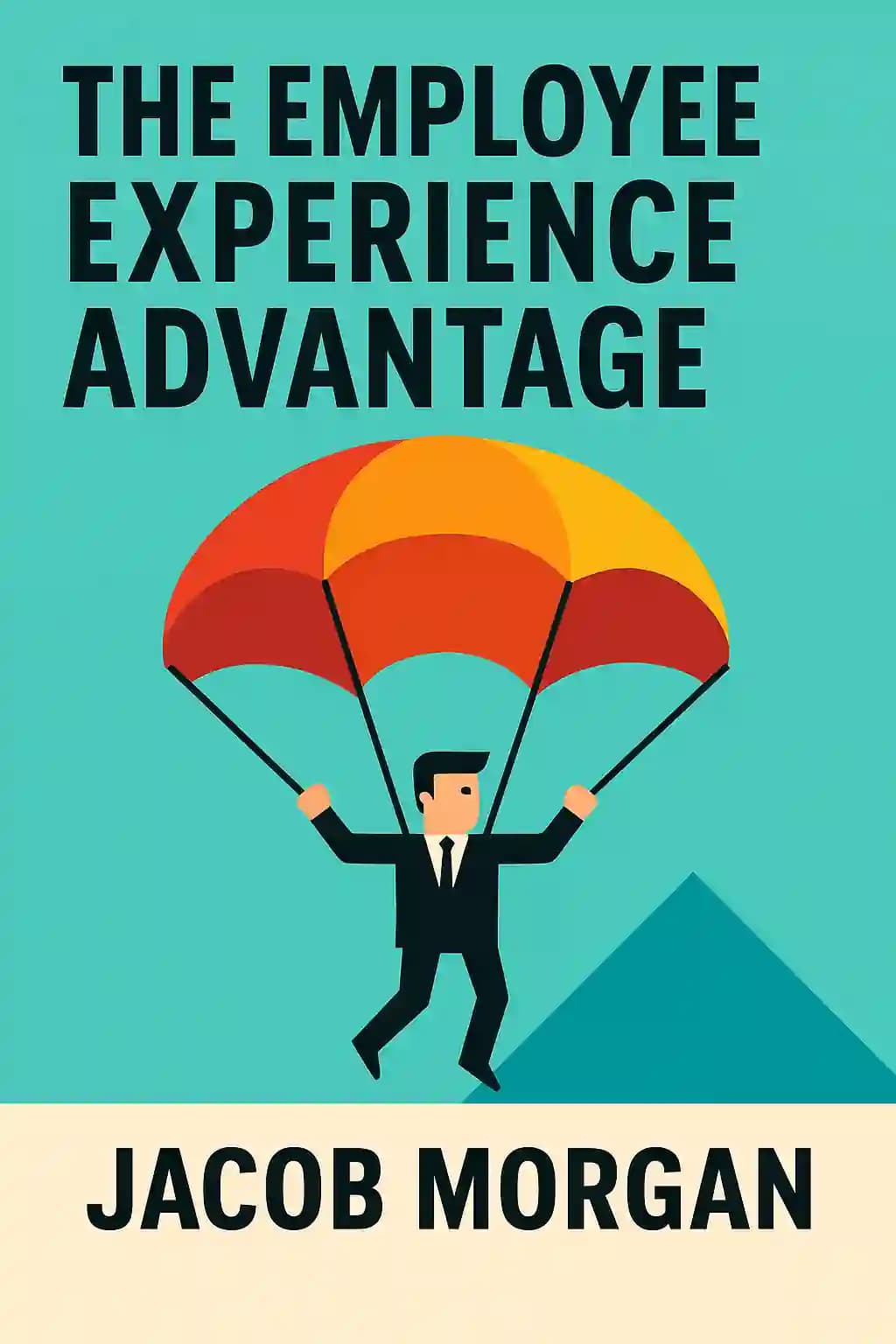
In "The Employee Experience Advantage," Jacob Morgan reveals why top companies outperform competitors by 4x in profits. Backed by research spanning 250+ organizations, this book - endorsed by leadership guru Marshall Goldsmith - shows how designing workspaces, tools, and culture reduces turnover by 40%.
Jacob Morgan, bestselling author of The Employee Experience Advantage, is a renowned futurist and leading authority on employee experience, leadership, and the future of work. Born in Melbourne, Australia, and raised in the U.S., Morgan combines his academic background in business management economics and psychology (UC Santa Cruz) with decades of research to address workplace challenges.
His work focuses on bridging technological advancements, organizational culture, and human-centric leadership, themes central to his bestselling trilogy: The Collaborative Organization (2012), The Future of Work (2014), and The Employee Experience Advantage (2017).
A sought-after keynote speaker, Morgan has delivered talks at over 50 annual conferences, including TED Academy, and advises Fortune 500 executives on adapting to trends like AI, hybrid work models, and generational shifts in the workforce. His insights are featured in proprietary frameworks and courses on employee experience design, leveraged by companies worldwide. Morgan’s content reaches over a million viewers annually, and his books are frequently cited in academic programs and corporate training curricula. The Employee Experience Advantage has become a cornerstone text for organizations prioritizing workplace culture, translated into multiple languages and adopted by industry leaders.
The Employee Experience Advantage explores how organizations can attract talent and drive business success by optimizing three environments: physical workspaces (design and amenities), technological tools (user-friendly systems), and cultural practices (values and inclusivity). Jacob Morgan argues that investing in these areas boosts engagement, innovation, and profitability, supported by frameworks like ACE (technology) and CELEBRATED (culture).
HR professionals, business leaders, and managers aiming to improve retention and workplace culture will benefit most. The book offers actionable strategies for aligning employee needs with organizational goals, making it valuable for anyone responsible for talent management or organizational design.
Yes. The book provides research-backed insights from 250+ companies, practical frameworks like the Employee Experience Score (EES), and case studies from firms like Airbnb and Cisco. It’s ideal for leaders seeking data-driven methods to enhance workplace satisfaction and productivity.
The ACE framework guides organizations in building effective technological environments:
A CELEBRATED culture includes 10 attributes: Celebrated values, Empowered employees, Leadership accessibility, Emotional connection, Belongingness, Recognition, Autonomy, Team collaboration, Engagement, and Development opportunities. These foster environments where employees feel valued and motivated.
Morgan categorizes organizations into:
Key metrics include:
Some argue the book overlooks granular workspace design factors (e.g., layout’s impact on collaboration) and scalability challenges for small businesses. However, its frameworks remain widely applicable for foundational improvements.
Engagement focuses on short-term perks, while employee experience holistically addresses daily interactions across physical, technological, and cultural environments. Morgan emphasizes long-term systemic changes over temporary fixes.
Companies like Salesforce (culture), Google (workspace design), and Microsoft (technology integration) exemplify experiential organizations. Morgan cites their 30%+ higher employee satisfaction and 2x faster innovation cycles compared to peers.
It advocates for “COOL” spaces: Collaborative, Open, Offering amenities, and Located in vibrant areas. While praised for highlighting workspace importance, critics note limited guidance on optimizing layout for specific workflows.
Morgan’s frameworks adapt well: remote teams need robust tech (ACE), virtual culture-building (CELEBRATED), and flexible workspaces. The book’s emphasis on adaptability aligns with post-pandemic trends toward personalized work environments.
Senti il libro attraverso la voce dell'autore
Trasforma la conoscenza in spunti coinvolgenti e ricchi di esempi
Cattura le idee chiave in un lampo per un apprendimento veloce
Goditi il libro in modo divertente e coinvolgente
Humans essentially took jobs meant for robots.
Engagement efforts are merely cosmetic changes.
Average becomes the ceiling rather than the baseline.
Organizations with cash could treat employees however they wanted.
Purpose should avoid mentioning shareholder value.
Scomponi le idee chiave di The employee experience advantage in punti facili da capire per comprendere come i team innovativi creano, collaborano e crescono.
Vivi The employee experience advantage attraverso narrazioni vivide che trasformano le lezioni di innovazione in momenti che ricorderai e applicherai.
Chiedi qualsiasi cosa, scegli il tuo stile di apprendimento e co-crea intuizioni che risuonano davvero con te.

Creato da alumni della Columbia University a San Francisco
"Instead of endless scrolling, I just hit play on BeFreed. It saves me so much time."
"I never knew where to start with nonfiction—BeFreed’s book lists turned into podcasts gave me a clear path."
"Perfect balance between learning and entertainment. Finished ‘Thinking, Fast and Slow’ on my commute this week."
"Crazy how much I learned while walking the dog. BeFreed = small habits → big gains."
"Reading used to feel like a chore. Now it’s just part of my lifestyle."
"Feels effortless compared to reading. I’ve finished 6 books this month already."
"BeFreed turned my guilty doomscrolling into something that feels productive and inspiring."
"BeFreed turned my commute into learning time. 20-min podcasts are perfect for finishing books I never had time for."
"BeFreed replaced my podcast queue. Imagine Spotify for books — that’s it. 🙌"
"It is great for me to learn something from the book without reading it."
"The themed book list podcasts help me connect ideas across authors—like a guided audio journey."
"Makes me feel smarter every time before going to work"
Creato da alumni della Columbia University a San Francisco

Ottieni il riassunto di The employee experience advantage in formato PDF o EPUB gratuito. Stampalo o leggilo offline quando vuoi.
Imagine spending a third of your life somewhere you dread going. That's the reality for most workers today. Jacob Morgan's research reveals a startling truth: only 6% of companies have mastered creating workplaces where people genuinely want to be. This isn't just a feel-good issue - it's a business imperative. Companies investing in employee experience outperform peers by staggering margins: 4.4x higher profits, 40% lower turnover, and consistently better stock returns. As automation reshapes work, the question becomes urgent: will your organization force humans to work like robots, or design environments that leverage uniquely human capabilities? The employer-employee relationship has undergone a dramatic transformation. We've moved through distinct eras, each representing a fundamental shift in how organizations view their people. First came the utility era - the most basic relationship where organizations provided minimal tools and employees received paychecks. Next, the productivity era emerged, where managers used stopwatches to optimize worker efficiency. The engagement era marked a revolutionary shift toward considering what employees actually care about. Yet most engagement efforts remain cosmetic - like putting fresh paint on a junkyard car without fixing the engine. Today, we're entering the employee experience era, which represents a fundamental redesign of organizations around "the intersection of employee expectations, needs, and wants and the organizational design of those expectations, needs, and wants."
Despite heavy investment in engagement initiatives, global engagement metrics remain inconsistent and low-Gallup reports just 13% worldwide engagement, while Aon claims 65%. Traditional models effectively make "average" the ceiling rather than the baseline for employee satisfaction. The talent landscape has transformed dramatically. The global economy faces a shortage of 40 million college-educated workers by 2020, while industry boundaries have dissolved-Coca-Cola now competes with Toyota for talent, and McDonald's with Airbus. Meanwhile, technology has revolutionized work patterns, and platforms like Glassdoor have shifted power dynamics by exposing workplace realities. Exceptional employee experiences start with a compelling Reason for Being-a purpose that transcends conventional business objectives. Unlike traditional mission statements focused on market leadership or shareholder value, true purpose answers: "What impact does the organization have on the world?" It should avoid mentioning profits or customers and represent an unattainable goal that drives continuous big thinking. Examples include Airbnb's "Belong Anywhere" and Google's mission "To organize the world's information and make it universally accessible and useful." Salesforce demonstrates this commitment through its 1-1-1 model, dedicating 1% of its technology, people, and resources to improving communities worldwide. This purpose, embedded in its DNA since founding, helps explain its high ranking in Morgan's research. The Reason for Being serves as the umbrella covering the three employee experience environments: physical space, technology, and culture.
The physical environment comprises 30% of employee experience, yet nearly 90% of workers worldwide remain dissatisfied with their workspaces. Exceptional physical spaces share four key characteristics, abbreviated as COOL: **C**hooses to bring in friends or visitors: When employees eagerly show off their workplace, it signals they value their environment. Organizations like Facebook and Airbnb encourage visitors, turning workspaces into recruitment tools. **O**ffers flexibility: About half of U.S. jobs allow partial telework, with 80-90% of employees desiring some remote work. Employees now rank flexibility just below competitive salary in importance - what was once a perk is now an expectation. **O**rganization's values are reflected: A workplace's physical space immediately reveals its authentic values. Facebook's open floor plans, eclectic art, and flexible workspaces visibly demonstrate values like "Be Bold" and "Be Open." **L**everages multiple workspace options: Rather than debating open versus closed offices, forward-thinking organizations offer varied spaces for different activities. Workplaces need multiple environments to support the 21 different workplace activities identified across 110,000 employees. Even with budget constraints, organizations can create engaging workspaces through employee involvement. One company gave volunteers a modest IKEA budget, resulting in cost savings and genuine pride in spaces employees helped design.
Technology serves as the "glue and nervous system" powering organizations. To create a great technological environment, focus on the "ACE" approach: **A**vailability to everyone: Organizations create frustration when they limit access to new technologies. The San Diego Zoo exemplified this principle by transforming classroom training into online learning accessible to all 3,000 employees, from cashiers to zoologists. **C**onsumer grade technology: Excessive emphasis on "enterprise grade" often results in clunky tools. The most effective enterprise tools now model themselves after consumer technologies. Ask: Would employees choose similar tools in their personal lives? **E**mployee needs versus business requirements: Most IT departments focus on technical checklists rather than understanding how employees actually work - like ordering a car with specific features but receiving a technically compliant yet unusable vehicle. Organizations averaged just a D+ grade for technological environment in Morgan's research. Technology either empowers people or renders them powerless - which outcome is your organization creating?
Culture is the environment you feel - the excitement or dread about going to work. Unlike physical and technological environments, culture exists whether you consciously design it or not, making intentional creation essential. A CELEBRATED culture encompasses ten key attributes: • **C**ompany Is Viewed Positively • **E**veryone Feels Valued • **L**egitimate Sense of Purpose • **E**mployees Feel Like They're Part of a Team • **B**elieves in Diversity and Inclusion • **R**eferrals Come From Employees • **A**bility to Learn New Things • **T**reats Employees Fairly • **E**xecutives and Managers Are Coaches • **D**edicated to Employee Health and Wellness Each element shapes how employees experience work daily. When university fundraisers met scholarship recipients who benefited from their work, productivity increased by 400% - demonstrating how connecting to purpose creates genuine meaning. Google's research identified being a good coach as the number one behavior of great managers, while Gallup found that managers account for 70% variance in employee engagement.
The data is compelling: Experiential Organizations outperform their peers across key metrics. They appear on customer service excellence lists twice as often as others combined and are recognized for innovation 4.5x more frequently. They dominate "best workplace" lists 6x more often than others. Financially, they operate with 20% fewer employees while maintaining 40% lower turnover, generating 2.1x average revenue, 4.4x average profit, and significantly higher per-employee productivity. Their stock performance consistently outperforms benchmark indices, and they pay employees 1.6x more than others. Creating exceptional employee experiences is possible for any organization regardless of size, industry, or location. Even giants like Microsoft and Apple have successfully transformed with 115,000 employees each. The journey begins with genuine care for employees - a fundamental distinction between truly Experiential Organizations and others. These companies don't invest in employee experiences primarily for business value; they invest because they genuinely care, and the business benefits follow naturally. Build experiences with employees, not just for them. Maintain transparency, seek feedback, and involve employees in the design process. As automation and organizational redesign reshape work, companies must choose: put employees at the center or continue business as usual. The future belongs to organizations that master this art - will yours be among them?