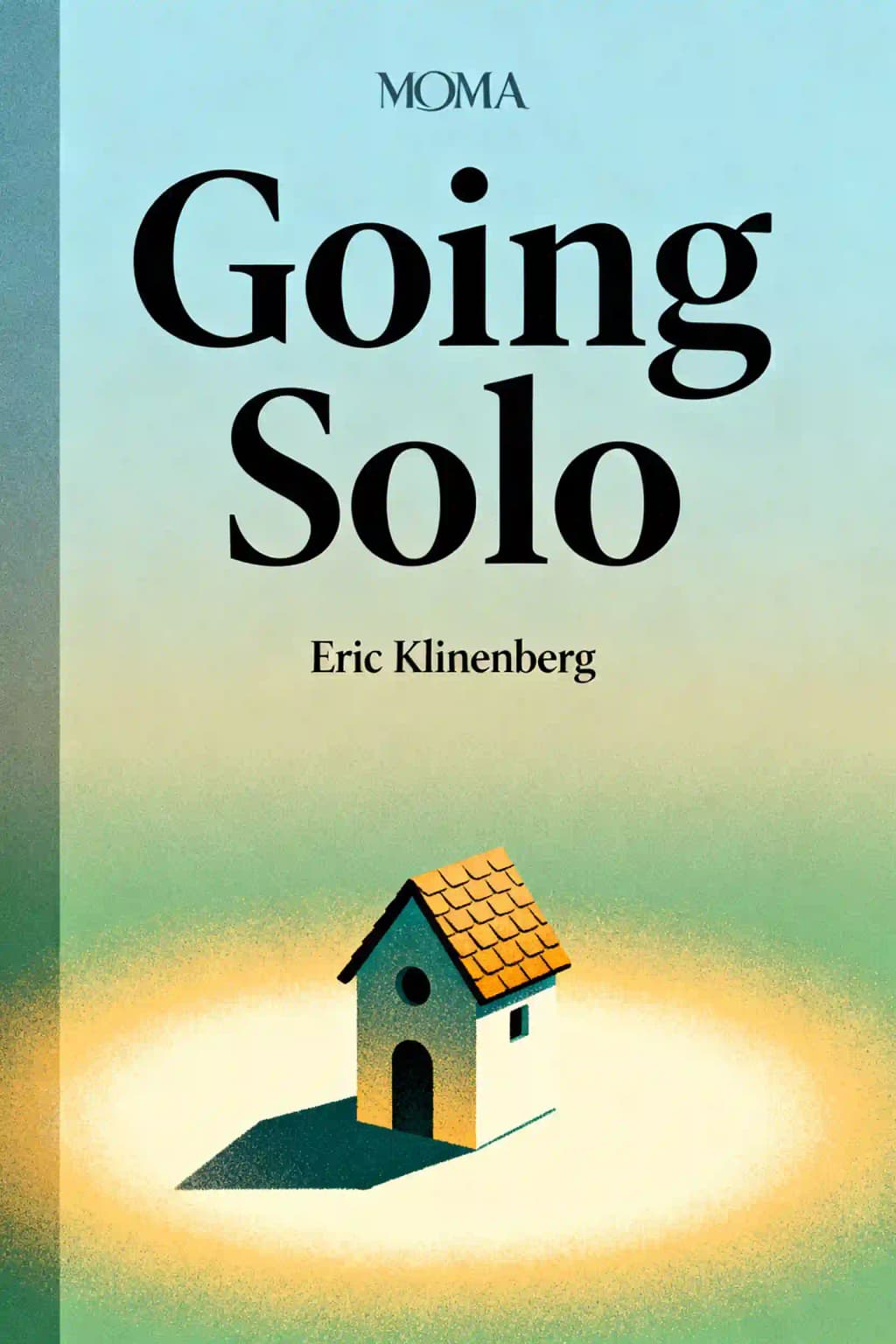
In "Going Solo," Eric Klinenberg reveals why 28% of Americans now live alone - a staggering rise from 10% in the 1950s. This isn't isolation; it's liberation. What cultural shift transformed solitude from stigma to status symbol?
Eric Klinenberg, author of Going Solo: The Extraordinary Rise and Surprising Appeal of Living Alone, is a distinguished sociologist and Helen Gould Shepard Professor of Social Science at New York University. His expertise lies in urban studies, social infrastructure, and cultural shifts, with Going Solo delving into the global phenomenon of solo living and its implications for modern society.
A bestselling author and public intellectual, Klinenberg’s research on community resilience and disaster response, including his Robert Park Book Award-winning Heat Wave: A Social Autopsy of Disaster in Chicago, has influenced urban policy and climate adaptation strategies. He co-authored the #1 New York Times bestseller Modern Romance with Aziz Ansari and directs NYU’s Institute for Public Knowledge.
Klinenberg’s work has been featured in The New Yorker, The New York Times Magazine, and Time, which named Going Solo “the number one idea changing our lives.” As research director of Rebuild by Design, he helped redevelop communities post-Hurricane Sandy. His books, translated into over a dozen languages, blend rigorous scholarship with accessible storytelling, cementing his reputation as a vital voice on social connectivity in the 21st century.
Going Solo examines the surge in single-person households, exploring why over 31 million Americans live alone and how this trend reshapes culture, politics, and urban infrastructure. Eric Klinenberg challenges stereotypes, arguing solo living fosters civic engagement, environmental sustainability, and personal fulfillment rather than isolation. The book combines demographic data, interviews, and historical analysis to reveal how modern connectivity enables this lifestyle.
This book is ideal for sociologists, urban planners, policymakers, and readers curious about shifting social norms. It appeals to singles seeking validation, professionals studying housing trends, and anyone interested in how individualism impacts community structures. Klinenberg’s accessible style also makes it suitable for general audiences.
Yes, for its groundbreaking insights into one of the 21st century’s defining social shifts. Klinenberg’s blend of rigorous research and human stories dismantles myths about loneliness while offering a fresh perspective on urban development and societal well-being.
Key arguments include:
Klinenberg contends that single-person households are now the most common U.S. domestic unit, surpassing nuclear families. He argues this reflects economic prosperity, gender equality, and digital connectivity—not societal decay.
Some critics argue the book underestimates the emotional risks of prolonged solitude or overstates the universality of singleton benefits across class lines. Others note it focuses heavily on urban contexts, neglecting rural experiences.
Singletons often occupy apartments in walkable cities, reducing reliance on cars and suburban sprawl. Their smaller homes also tend to consume less energy per capita compared to family households.
Klinenberg highlights libraries, parks, and cafes as critical spaces fostering community among solo dwellers—a concept expanded in his later work Palaces for the People. These spaces mitigate isolation while encouraging social interaction.
The book cites cases where unmarried employees face biased assumptions (e.g., smaller pay raises). One subject, Sherri, was denied a raise because her boss wrongly presumed her singleton lifestyle required less income.
These lines underscore the book’s themes of redefined connectivity and individualism.
While Going Solo focuses on individual lifestyles, Palaces examines communal spaces that bind diverse populations. Together, they explore how modern societies balance autonomy and collective life.
As remote work and urban density rise, solo living remains a practical choice for professionals valuing flexibility. The book’s insights into social infrastructure inform debates about housing crises and mental health in post-pandemic cities.
Cities can prioritize mixed-use developments, affordable micro-apartments, and public spaces that encourage casual interaction—strategies aligned with Klinenberg’s vision of “singleton-friendly” urban design.
Senti il libro attraverso la voce dell'autore
Trasforma la conoscenza in spunti coinvolgenti e ricchi di esempi
Cattura le idee chiave in un lampo per un apprendimento veloce
Goditi il libro in modo divertente e coinvolgente
Living alone allows people to do what they want, when they want, and on the schedule they want.
Living alone has become not just common but often deeply fulfilling.
Living alone is expensive.
Living alone as a form of self-protection.
They're all I have.
Scomponi le idee chiave di Going Solo in punti facili da capire per comprendere come i team innovativi creano, collaborano e crescono.
Vivi Going Solo attraverso narrazioni vivide che trasformano le lezioni di innovazione in momenti che ricorderai e applicherai.
Chiedi qualsiasi cosa, scegli il tuo stile di apprendimento e co-crea intuizioni che risuonano davvero con te.

Creato da alumni della Columbia University a San Francisco
"Instead of endless scrolling, I just hit play on BeFreed. It saves me so much time."
"I never knew where to start with nonfiction—BeFreed’s book lists turned into podcasts gave me a clear path."
"Perfect balance between learning and entertainment. Finished ‘Thinking, Fast and Slow’ on my commute this week."
"Crazy how much I learned while walking the dog. BeFreed = small habits → big gains."
"Reading used to feel like a chore. Now it’s just part of my lifestyle."
"Feels effortless compared to reading. I’ve finished 6 books this month already."
"BeFreed turned my guilty doomscrolling into something that feels productive and inspiring."
"BeFreed turned my commute into learning time. 20-min podcasts are perfect for finishing books I never had time for."
"BeFreed replaced my podcast queue. Imagine Spotify for books — that’s it. 🙌"
"It is great for me to learn something from the book without reading it."
"The themed book list podcasts help me connect ideas across authors—like a guided audio journey."
"Makes me feel smarter every time before going to work"
Creato da alumni della Columbia University a San Francisco

Ottieni il riassunto di Going Solo in formato PDF o EPUB gratuito. Stampalo o leggilo offline quando vuoi.
Living alone has transformed from a rarity to a global phenomenon. Today, over 35 million Americans maintain single-person households-more than a quarter of all homes nationwide, rising to nearly half in major cities like Manhattan. This trend extends beyond America, with Scandinavian countries leading at 40-45% of solo households, and similar patterns emerging across Europe and Asia. What's driving this massive shift? Four powerful social forces have converged: women's rising status through education and financial independence; the communications revolution enabling connection without proximity; mass urbanization creating vibrant environments where singles thrive; and increased longevity, especially for women who typically outlive their partners. This transformation reflects a fundamental value shift prioritizing personal freedom and self-fulfillment. We've embraced what sociologist Emile Durkheim called "the cult of the individual," moving from stigmatizing solitude to celebrating independence. What's remarkable is how this cuts across demographics-young professionals delaying marriage, middle-aged divorcees choosing independence, and elderly individuals preferring their own homes over living with adult children. Yet this isn't just about changing preferences-it's about economic capacity. Living alone is expensive, explaining why it's most common in wealthy nations with strong social safety nets. The rise of solo living represents both individual choice and collective achievement-a luxury that developed societies can now afford.
For many professionals, living alone provides a vital buffer against life's demands. Phil, a Manhattan journalist, has crafted his apartment into a regenerative sanctuary from his high-pressure career. His calm, television-free space enhances creativity and self-reflection. Though socially active, he views his solitary home as essential for balance. Amy, a food magazine editor, finds solace returning to an empty apartment after long workdays. Following difficult experiences with family and romance, she views solo living as self-protection until finding someone trustworthy. The experience differs for disadvantaged individuals. In single-room occupancy hotels (SROs), many practice "defensive individualism" - isolating themselves to avoid harmful relationships. This trend has grown since the 1970s due to industrial collapse, mass incarceration, and reduced social services. Greg, an unemployed man with heart disease, exemplifies this reality. Living in SROs, he positions himself in hallways during health emergencies to be found. Though sometimes lonely, he avoids former friends involved with drugs, explaining, "If he got a problem, you got a problem, because they gonna bring it to you."
A 2008 "Sex and the City" screening in San Francisco exemplified a movement celebrating singlehood as a legitimate lifestyle. The sold-out event united singles - primarily women - in communal celebration. Sasha Cagen's "Quirkyalone" concept sparked celebrations across forty cities worldwide. Though initially a champion of content singlehood, Cagen later recognized partnership's value in personal growth. Others joined the movement: Kim Calvert founded Singular Communications to challenge stereotypes, while Nicky Grist's Alternatives to Marriage Project advocates for unmarried Americans' legal rights. Organizing singles remains challenging due to their diverse identities - from those embracing solo life to those viewing it as temporary. This variety complicates political mobilization despite common concerns like workplace discrimination. Among African Americans, never-married individuals living alone - particularly women - represent the fastest-growing segment of the middle class. This shift stems from declining industrial jobs for black men, mass incarceration, and educational disparities where women increasingly outpace men in college completion.
Can "families of choice" provide the same support as traditional families during crises? Sasha Cagen confronted this question when her aunt - a successful casting agent living alone - was diagnosed with brain cancer. While friends initially stepped up, the intensive care needs ultimately required family intervention. This experience led Cagen to reframe her Quirkyalone concept to emphasize connection over independence, recognizing that genuine connection requires comfort with solitude. Her shift acknowledges that solo living, while offering freedom, demands intentional community-building. Support networks are especially crucial for elderly singles, whose numbers have tripled since 1950 - now one in three Americans over 65 lives alone. These seniors spend 10-12.5 hours daily in solitude, roughly 80% of their waking time, facing increased health risks, particularly after losing a spouse. Yet most prefer independent living. Only 2% of elderly widows and 20% of widowers remarry. While 70% of elderly widows lived with adult children a century ago, today just 20% do, preferring what gerontologists call "intimacy at a distance" - a choice reflecting both America's emphasis on independence and genuine desires for autonomy.
Singles face workplace discrimination when colleagues assume they have no competing demands. When Sherri Langburt was denied a bonus because managers thought a single woman "didn't need it," she created SingleEdition.com to combat such bias. Housing discrimination exists, especially from co-op boards. However, since the 1975 Equal Credit Opportunity Act, singles have transformed housing - by 2009, they represented 31% of home buyers, with single women accounting for 21%. While pets offer companionship to some solo dwellers, singles are less likely to own animals than families. For those who do, pets reduce anxiety, decrease health risks, and provide security. Angelina chose solo living specifically to have a cat. Though solo living can bring loneliness, young adults develop effective coping strategies that often strengthen future relationships. Many become so comfortable living alone they question giving it up - reflected in half of young singles dating once every three months or less.
Our metropolitan areas, designed for nuclear families, no longer suit today's world of working singles - especially the elderly and poor. Technology offers partial solutions. Pearl, a four-foot-tall robotic assistant, helps elderly residents with balance, medications, and emergencies. While robotic pets can reduce loneliness in nursing homes, they shouldn't replace human caregivers. Rosanne Haggerty's Common Ground shows effective housing solutions through projects like the Times Square Hotel "vertical village" - 652 units with shared spaces including gardens, community rooms, and gyms. Cities need fundamental redesign: compact apartments instead of single-family homes, walkable neighborhoods with nearby services, inviting public spaces, and social venues. Good public transit completes this vision - benefiting all residents but especially those living alone.
The rise of living alone challenges common assumptions. While researchers initially feared it would breed isolation and selfishness, evidence shows most solo dwellers prefer their living arrangement, despite occasional loneliness. The popular narrative linking solo living to civic decline is misleading. Urban singletons often enhance public life through increased community engagement. Solo living enables women's independence and can be more environmentally sustainable than suburban family homes. Solitude, as philosophers from the Stoics to transcendentalists noted, enables meaningful connections and original thinking. In our hypernetworked world, having private space offers productive retreat that can inspire better ways of living together. The solo living trend presents an opportunity. By designing cities, technologies, and policies that support both independence and community, we can transform this perceived crisis into an achievement - enabling people to live alone without loneliness, maintaining independence while staying connected.