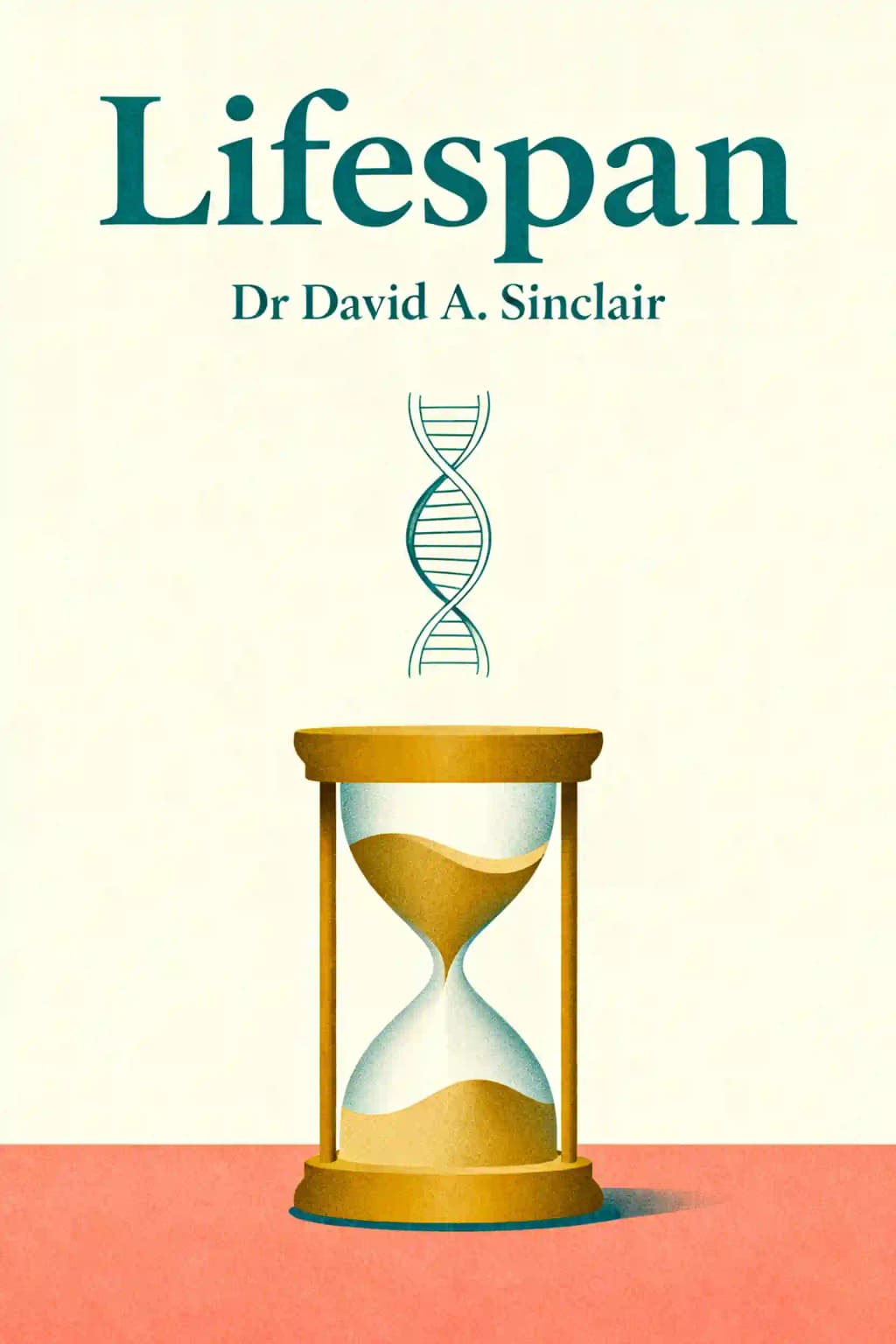
Lifespan
Why We Age – and Why We Don’t Have To
Overview of Lifespan
Harvard geneticist Dr. Sinclair's bestselling manifesto challenges aging as inevitable. What if your 80-year-old body could feel 40? Praised by The Wall Street Journal as "brilliant," this book reveals why scientists believe we're finally unlocking the secrets to reversing time itself.

Key Themes in Lifespan
- information theory of aging
- epigenetic landscape
- longevity protocols
- sirtuin activation
- dna repair mechanisms
Quotes from Lifespan
Aging is a disease, and that disease is treatable.
Aging isn't inevitable.
Aging itself is a disease.
Aging has a singular cause.
We age because natural selection's power weakens.
Characters in Lifespan
- David SinclairHarvard professor and geneticist studying aging
- Thomas KirkwoodBiologist who proposed the Disposable Soma Theory
- Conrad WaddingtonScientist who created the epigenetic landscape
About the Author
About the Author of Lifespan
Dr. David A. Sinclair, acclaimed Harvard Medical School professor and pioneering longevity researcher, is the New York Times bestselling author of Lifespan: Why We Age—and Why We Don’t Have To. A leading voice in aging biology, Sinclair’s work redefines aging as a treatable condition rather than an inevitability.
As co-director of the Paul F. Glenn Center for the Biology of Aging, he has authored over 200 scientific papers and co-founded multiple biotechnology companies, including Liberty Biosecurity and Life Biosciences. His groundbreaking research on sirtuins, NAD+, and epigenetic reprogramming underpins the book’s thesis, blending cutting-edge science with actionable insights.
Sinclair hosts the Lifespan Podcast, distilling complex aging research for general audiences, and has been featured on 60 Minutes, TED Talks, and in TIME magazine’s “100 Most Influential People” list. A recipient of the Australian Medical Research Medal and NIH Director’s Pioneer Award, he translates decades of lab work into strategies for extending healthspan.
Lifespan has sold over 1 million copies worldwide, translated into 35 languages, and is frequently cited in longevity science discussions. His ideas have inspired documentaries and are integrated into research programs at institutions like MIT and Stanford.
Download Summary of Lifespan
Get the Lifespan summary as a free PDF or EPUB. Print it or read offline anytime.
FAQs About This Book
Lifespan argues aging is a treatable disease caused by epigenetic information loss, proposing lifestyle changes (fasting, cold exposure) and emerging therapies to extend healthspan. David Sinclair, a Harvard genetics professor, challenges traditional views on aging by presenting scientific breakthroughs that could revolutionize longevity medicine.
This book is ideal for anyone interested in longevity science, healthcare professionals, or readers seeking evidence-based strategies to improve aging. Sinclair blends personal anecdotes with research on sirtuins, NAD+, and epigenetics, making complex topics accessible to non-scientists.
Yes, for its groundbreaking perspective on aging as reversible. Critics like Charles Brenner question Sinclair’s emphasis on resveratrol and NAD+ boosters, but the book remains a seminal work for its actionable advice (e.g., intermittent fasting) and vision of a future with 150-year lifespans.
Sinclair’s theory posits aging stems from epigenetic "noise" corrupting cellular repair. Analogous to a scratched DVD, our epigenome loses precision over time, disrupting gene expression. His lab demonstrated restoring epigenetic backups can reverse aging in mice, offering hope for human applications.
Key strategies include:
- Intermittent fasting (1 meal/day for Sinclair) to activate sirtuins
- Cold exposure and exercise to boost NAD+ levels
- Avoiding excessive protein to inhibit mTOR pathways
Sinclair discusses resveratrol and NMN (NAD+ booster) but clarifies he doesn’t provide medical advice. Critics argue these lack robust human trial data, though preclinical studies show promise for cellular repair mechanisms.
Healthspan refers to years spent disease-free, while lifespan is total longevity. Sinclair emphasizes extending healthspan through therapies targeting aging’s root causes, not just treating age-related diseases like Alzheimer’s or cancer.
The book acknowledges aging reversal is experimental. While Sinclair defends his research, scientists like Brenner criticize oversimplification of NAD+ biology and premature promotion of unproven therapies.
Sinclair highlights:
- Epigenetic reprogramming using Yamanaka factors
- Senolytics to清除衰老细胞
- Gene therapies to enhance DNA repair
Sinclair’s work underpins popular biohacks: fasting mimics ancestral survival states to activate longevity genes, while cold exposure triggers mitochondria-boosting pathways. These align with 2025 trends in metabolic health optimization.
“Aging is a disease, and that disease is treatable.” Sinclair uses this mantra to reframe aging from inevitability to solvable biological challenge.
While Elizabeth Blackburn focuses on telomeres’ role in aging, Sinclair prioritizes epigenetics and metabolic pathways. Both agree lifestyle modulates aging, but differ on primary mechanisms and intervention strategies.





