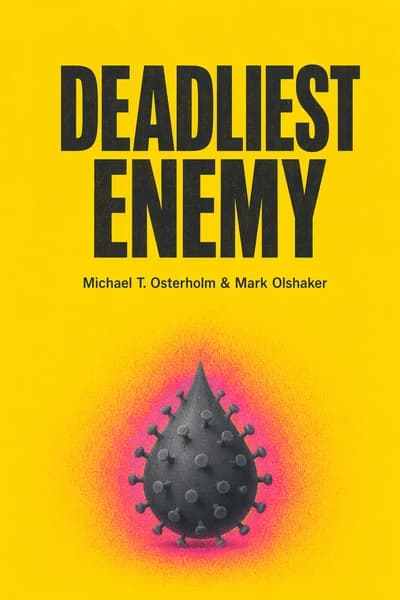
Deadliest Enemy
Our War Against Killer Germs
Overview of Deadliest Enemy
Before COVID-19 struck, Osterholm's "Deadliest Enemy" chillingly predicted our pandemic reality. Praised by Anthony Fauci and dubbed the "Paul Revere of pandemics," this Johns Hopkins-acclaimed blueprint reveals how unprepared we remain for the next inevitable outbreak - and what must change.

Key Themes in Deadliest Enemy
- pandemic preparedness
- infectious disease epidemiology
- public health policy
- global health security
- outbreak investigation
Quotes from Deadliest Enemy
Evidence, knowledge, and logic weren't always enough to change human behavior.
The AIDS epidemic serves as a dire warning about what's possible.
The public health agenda isn't preventing death—which remains 100% inevitable.
When you know how to relieve torment and don't, then you become the tormentor.
Data can be easily misinterpreted without proper context.
Characters in Deadliest Enemy
- Michael T. OsterholmEpidemiologist and author focused on pandemics
- Dr. Bill FoegePublic health hero who helped eradicate smallpox
- Sister Romana Marie RyanThe author's aunt who died from AIDS
- Mark OlshakerCo-author of the book
- Secretary HecklerOfficial who made early vaccine promises
About the Author
About the Author of Deadliest Enemy
Michael Thomas Osterholm, PhD, MPH, and Mark Olshaker are the acclaimed authors of Deadliest Enemy: Our War Against Killer Germs, a New York Times bestselling exploration of pandemic threats and public health strategy. Osterholm, a world-renowned epidemiologist and director of the Center for Infectious Disease Research and Policy (CIDRAP) at the University of Minnesota, brings decades of frontline experience combating outbreaks like Ebola and advising institutions such as the World Health Organization. Olshaker, an Emmy-winning documentary filmmaker and bestselling coauthor of Mindhunter, lends his narrative expertise to translate complex science into gripping prose.
Their collaboration merges Osterholm’s authoritative analysis of bioterrorism, antimicrobial resistance, and emerging pathogens with Olshaker’s skill in crafting investigative narratives. The book builds on their prior work, including Living Terrors: What America Needs to Know to Survive the Coming Bioterrorist Catastrophe, cementing their reputation as essential voices in global health discourse.
Deadliest Enemy has been translated into 12 languages, endorsed by Pulitzer Prize-winning historians, and featured in Wired and Johns Hopkins Bloomberg School of Public Health’s best books list. Osterholm’s TED Talks and frequent appearances on CNN and NPR amplify the book’s urgent message about pandemic preparedness.
Download Summary of Deadliest Enemy
Get the Deadliest Enemy summary as a free PDF or EPUB. Print it or read offline anytime.
FAQs About This Book
Deadliest Enemy examines infectious diseases as humanity’s greatest threat, blending epidemiology, historical outbreaks like AIDS and Ebola, and policy critiques. Coauthored with Mark Olshaker, it argues for proactive global health strategies to combat emerging pathogens, antibiotic resistance, and bioterrorism. The book uses real-world case studies, such as the toxic shock syndrome and raw milk outbreaks, to highlight systemic vulnerabilities.
Public health professionals, policymakers, and general readers interested in pandemic preparedness will find this book essential. It offers actionable insights for managing outbreaks and critiques bureaucratic failures, making it valuable for those studying epidemiology or global security. The accessible storytelling also appeals to fans of nonfiction like The Hot Zone.
Dr. Osterholm is a renowned epidemiologist, Regents Professor at the University of Minnesota, and director of CIDRAP. With over 40 years of experience, he advised the Biden administration on COVID-19 and authored bestselling books on bioterrorism and infectious diseases. His fieldwork includes investigating AIDS, Ebola, and foodborne outbreaks.
The threat matrix refers to diseases prioritized by their potential to cause societal disruption, not just mortality rates. Osterholm argues that novel pathogens (e.g., pandemic influenza) and antibiotic-resistant superbugs pose greater risks than familiar threats like heart disease, yet receive less public attention due to misaligned fear responses.
The book warns that overuse of antibiotics in medicine and agriculture accelerates resistance, creating “superbugs” immune to treatments. Osterholm cites MRSA and untreatable gonorrhea as examples, urging stricter regulations and reduced nonessential antibiotic use to avert a post-antibiotic era.
This analogy references John Snow’s 1854 cholera response, where removing a contaminated water pump halted the outbreak. Osterholm applies it to modern epidemiology, advocating for immediate action even without perfect data, as seen in his raw milk outbreak investigation.
Unlike The Hot Zone’s narrative focus, Deadliest Enemy combines scientific analysis with policy roadmaps. It parallels Spillover in exploring zoonotic diseases but emphasizes preparedness over storytelling, offering specific strategies for mitigating biological threats.
Osterholm’s warnings about pandemic unpreparedness, published in 2017, proved prescient during COVID-19. The book critiques fragmented global responses and underfunded health systems, providing a framework to address gaps exposed by recent crises.
Some reviewers note the book’s dense policy discussions may overwhelm casual readers. Others argue it underestimates non-infectious health threats like chronic diseases, though Osterholm counters that pandemics uniquely risk collapsing societal infrastructure.
Key strategies include:
- Investing in universal flu vaccines
- Restricting antibiotic overuse in livestock
- Establishing a global CDC-like organization
- Prioritizing pathogen research and stockpiling medical supplies
Each chapter opens with a thematic quote (e.g., from Sherlock Holmes or Bob Dylan), framing epidemiology as detective work. Case studies, like the AIDS crisis and Minnesota measles outbreaks, illustrate concepts without relying on chronological narrative.
- “The next pandemic threat is already on its way.”
- “Antibiotic resistance is the slow-motion pandemic.”
- “We need to stop chasing ghosts and focus on the real monsters.”
These lines underscore the book’s urgent, action-oriented tone.





