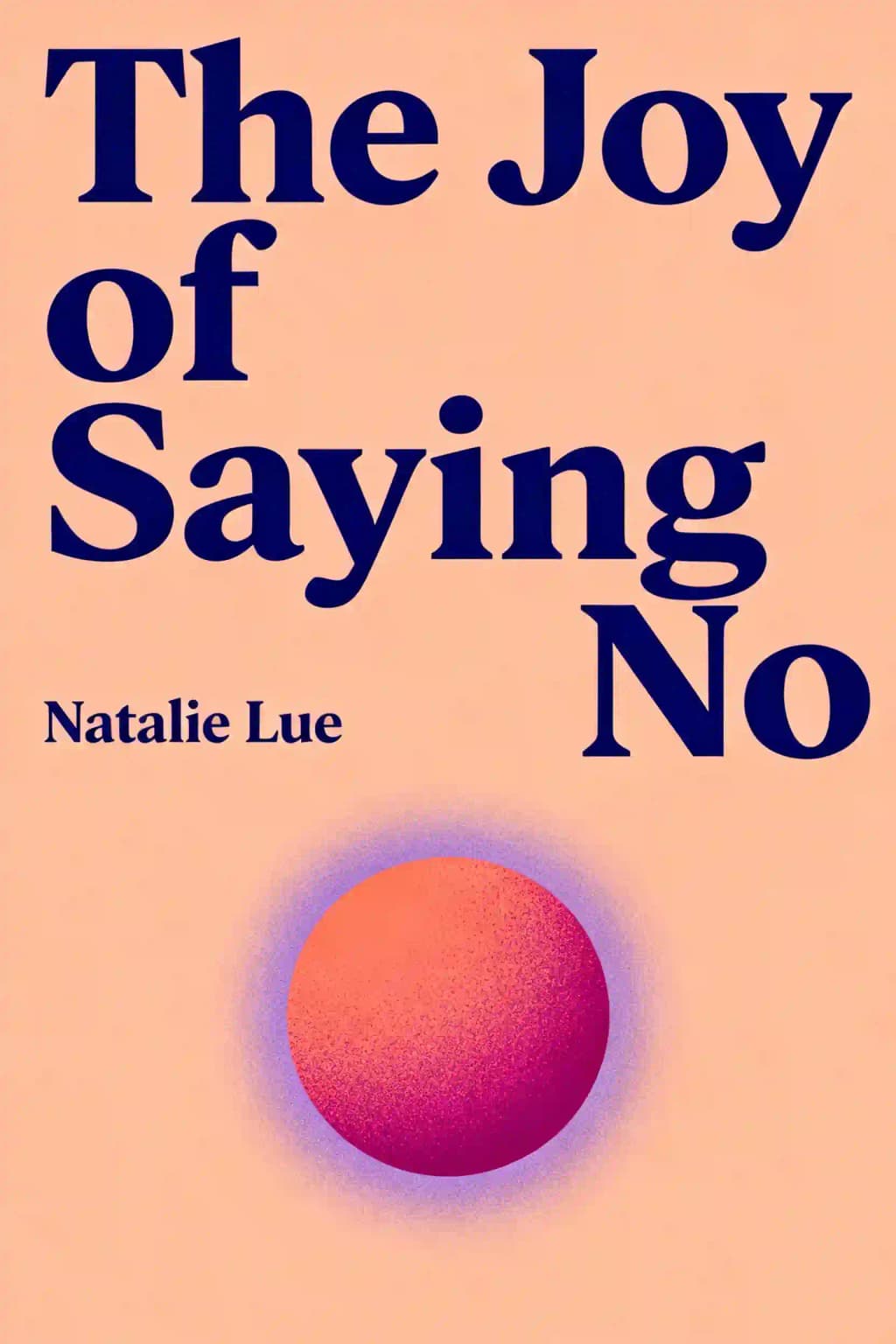
Discover the liberating power of boundaries with Natalie Lue's transformative guide to breaking free from people-pleasing. Endorsed by Good Morning Britain's Susanna Reid, this six-step framework tackles the hidden health costs of saying "yes" when your soul screams "no."
Natalie Lue is the bestselling author of The Joy of Saying No and a leading voice in self-help, relationships, and emotional wellness.
A former chronic people pleaser, Lue draws on her 17-year journey of reclaiming boundaries to craft this guide on overcoming perfectionism and unfulfilling relationships. Her no-nonsense yet compassionate approach, honed through platforms like the long-running Baggage Reclaim blog and The Baggage Reclaim Sessions podcast (4.5M+ downloads), has established her as a trusted resource for navigating emotional unavailability and self-worth.
Lue’s earlier works—including Mr. Unavailable and the Fallback Girl and Love, Care, Trust and Respect—have collectively sold over 150,000 copies, resonating with readers across 140 countries. Featured in The New York Times, NPR, and BBC, she blends personal experience with actionable strategies.
The Joy of Saying No, published by HarperCollins, distills her signature framework for asserting boundaries into a roadmap for living authentically.
The Joy of Saying No provides a six-step framework to overcome people-pleasing habits, reclaim boundaries, and prioritize authentic living. Natalie Lue identifies four compliance styles (Over-Giver, Fixer, Avoidant, Sufferer) rooted in childhood conditioning, offering actionable strategies to break toxic patterns and foster healthier relationships through self-awareness and assertive communication.
This book is ideal for chronic people-pleasers, caregivers, and anyone struggling with guilt around setting boundaries. It’s particularly relevant for millennials and Gen Xers raised in the “Age of Obedience” who want to unlearn passive compliance in relationships, work, or family dynamics.
Yes—readers praise its relatable examples, clear frameworks, and practical exercises. Reviewers highlight its effectiveness in addressing low self-worth and anxiety-driven behaviors, though some note the advice can feel repetitive for those already versed in boundary-setting concepts.
Lue categorizes four compliance styles:
The method involves:
This metaphor contrasts superficial concessions (“crumbs”) with meaningful boundaries (“crust”). Lue argues that accepting minimal effort from others perpetuates resentment, while clearly defined limits create space for mutually respectful relationships.
Unlike theoretical guides, Lue combines psychological insights with autobiographical examples from her 17-year recovery journey. It uniquely addresses how cultural obedience norms (e.g., “good girl” conditioning) fuel modern people-pleasing.
Yes—the book provides scripts for declining extra assignments, handling micromanagers, and avoiding overachiever burnout. Lue emphasizes aligning professional commitments with personal values rather than seeking external validation.
Some reviewers feel Lue oversimplifies complex trauma responses or overemphasizes individual responsibility. Others find the tone overly prescriptive when discussing family dynamics.
The Baggage Reclaim Sessions expands on book concepts with listener Q&As and deep dives into emotional baggage. Episodes 210-215 specifically break down the six-step framework.
Lue describes this as generational conditioning where children were taught blind compliance to authority figures. The book shows how this upbringing creates adults who prioritize others’ needs over their own well-being.
Siente el libro a través de la voz del autor
Convierte el conocimiento en ideas atractivas y llenas de ejemplos
Captura ideas clave en un instante para un aprendizaje rápido
Disfruta el libro de una manera divertida y atractiva
Your boundaries aren't just personal preferences-they're essential survival tools.
Children learned quickly that their worth was tied to their ability to meet others' expectations.
We mistakenly assume our reactions are based in the present.
Who am I without people pleasing? The answer: yourself.
They hide their true selves behind performances of goodness.
Desglosa las ideas clave de Joy of Saying No en puntos fáciles de entender para comprender cómo los equipos innovadores crean, colaboran y crecen.
Experimenta Joy of Saying No a través de narraciones vívidas que convierten las lecciones de innovación en momentos que recordarás y aplicarás.
Pregunta cualquier cosa, elige tu estilo de aprendizaje y co-crea ideas que realmente resuenen contigo.

Creado por exalumnos de la Universidad de Columbia en San Francisco
"Instead of endless scrolling, I just hit play on BeFreed. It saves me so much time."
"I never knew where to start with nonfiction—BeFreed’s book lists turned into podcasts gave me a clear path."
"Perfect balance between learning and entertainment. Finished ‘Thinking, Fast and Slow’ on my commute this week."
"Crazy how much I learned while walking the dog. BeFreed = small habits → big gains."
"Reading used to feel like a chore. Now it’s just part of my lifestyle."
"Feels effortless compared to reading. I’ve finished 6 books this month already."
"BeFreed turned my guilty doomscrolling into something that feels productive and inspiring."
"BeFreed turned my commute into learning time. 20-min podcasts are perfect for finishing books I never had time for."
"BeFreed replaced my podcast queue. Imagine Spotify for books — that’s it. 🙌"
"It is great for me to learn something from the book without reading it."
"The themed book list podcasts help me connect ideas across authors—like a guided audio journey."
"Makes me feel smarter every time before going to work"
Creado por exalumnos de la Universidad de Columbia en San Francisco

Obtén el resumen de Joy of Saying No como PDF o EPUB gratis. Imprímelo o léelo sin conexión en cualquier momento.
Your throat tightens before answering a simple question. Your stomach churns when someone asks for "just one more favor." That mysterious rash that no doctor can explain? Your body might be staging a rebellion against years of silent compliance. This physical revolt isn't weakness-it's your system desperately trying to protect you from a pattern that's slowly eroding your health, relationships, and sense of self. People pleasing operates like a low-grade fever, constantly present but easy to ignore until it becomes a full-blown crisis. The most dangerous part? We've been conditioned to see our accommodation as virtue, our exhaustion as dedication, and our silence as kindness. But there's nothing virtuous about disappearing.
Nobody chooses to become a people pleaser-this pattern gets wired during childhood, particularly for those raised in "the Age of Obedience," when compliance equaled love and questioning authority was unthinkable. We learned our worth was conditional, tied to meeting others' expectations. The physical toll is staggering. People pleasing locks us in perpetual fight-or-flight mode, flooding bodies with cortisol-manifesting as tinnitus, anxiety, IBS, panic attacks, migraines, and mysterious illnesses. Your body keeps the score of every unexpressed no. Your subconscious operates on outdated survival strategies that once kept you safe but now keep you small. We treat feelings as facts when they're actually childhood programming that automatically activates whenever present situations echo past experiences. We adopt roles-peacemaker, achiever, invisible child-and these masks become our identities. Breaking these patterns feels wrong because it seems disloyal. You wonder, "Who am I without people pleasing?" The answer: yourself-an authentic individual capable of healthy boundaries and genuine relationships based on mutual respect rather than obligation.
People pleasing manifests in five distinct styles, each representing different strategies for managing relationships indirectly. While you might recognize yourself in multiple patterns, one or two typically dominate. **Gooders** are reputation managers who perform as "good people" to control perceptions. They hide behind facades of goodness, following rules even when they feel differently inside, avoiding no to protect their carefully constructed image. **Efforters** use achievement and perfectionism to create self-worth. Typically eldest or most responsible children, they learned value lies in productivity. They avoid saying no for fear of appearing lazy, wearing exhaustion as a badge of honor. **Avoiders** minimize discomfort through evasion. Unlike other styles driven by image or achievement, avoiders primarily want to avoid conflict, criticism, and others' discomfort. Many experienced family trauma where certain topics became forbidden, learning silence was safer than truth. **Savers** try to be the solution to everyone's problems, taking on others' responsibilities to feel needed. They shouldered adult responsibilities prematurely, making themselves indispensable through enmeshment, often choosing "fixer-upper" partners. **Sufferers** deliberately position themselves in hardship to appear good and signal unmet needs. They use pain as proof of worthiness, proving worth through martyrdom rather than self-advocacy.
Breaking free begins with awareness-you can't change what you don't know, and until you know your no, you can't know your yes. Spend two weeks gathering data about where you spend your energy. In week one, notice what energizes or drains you, where you automatically say yes, what causes rumination, and what triggers anxiety. Review daily to spot patterns. In week two, attempt to cut your yes in half. You won't achieve 50 percent, but identifying opportunities to say no reveals your pattern. Notice where saying no feels fine, where you feel compelled to justify yourself, and who seems entitled to your yes. Try alternatives: "I don't have the bandwidth," "I'm unavailable," "That's not going to work for me," or "Thank you for thinking of me, but I can't attend." People pleasing is fundamentally about anxiety. When your pleaser emerges, acknowledge what you're anxious about: not being liked, letting people down, being hurt, or getting in trouble. Behind this anxiety often lies old anger-rage at being unseen, unheard, or undervalued. What you say no to defines what you can say yes to. Your bandwidth fluctuates based on sleep, stress, and self-care. Don't compare yourself to others who seem to do "more"-you don't know the toll their choices take.
Emotional baggage fuels people-pleasing and blocks healthy boundaries. Instead of confronting this baggage, we build walls through people-pleasing-thinking we're boundaried when we're actually saying, "I'm still hurt, so if I please you, maybe you won't disappoint me." Each style reveals specific baggage: Gooders must ask who taught them appearances ensure getting what they want. Efforters need to identify whose validation they still crave. Avoiders should question who taught them not to make things harder for others. Savers must recognize who they failed to save. Sufferers need to identify who they're trying to get to acknowledge their pain. For boundaries to work, they must be mutual. When you don't say no to what isn't working, your options remain limited to suffering silently, battling over who's right, or cutting people off. When you clean up your side regardless of what others do, your options expand-you can engage from a boundaried place, continue with distance, opt out temporarily, or opt out permanently. Boundaries are for you, not for controlling others. Stop depleting yourself by doing for others what you won't give yourself. If you don't express your true feelings with someone, you're not as close as you think. No boundaries, no intimacy. The relationships that survive your boundaries are the ones worth keeping-they were built on genuine connection, not your performance of agreeability.
As awareness grows, we face a new challenge: knowing when to say no and identifying what we genuinely want. After prioritizing others' needs our entire lives, trusting our own feelings feels foreign. The crucial insight-if we don't say yes authentically, we say it resentfully or fearfully, creating more problems than if we'd said no initially. We must either "make it a desire, or say no"-the gap between what we want and what others expect creates tension. Notice physical cues like shoulder tension, stomach knots, or immediate anxiety revealing when you're acting from obligation rather than choice. Test your motives: "If I didn't get the hoped-for response, would I still want to do this?" If no, revise your motivations or communicate expectations clearly. Taking even a brief pause interrupts habitual responses. "Let me get back to you" creates space to consider your bandwidth and true desires. True giving is a full transfer without expectations-like a gift freely given with no strings attached. People-pleasing often involves indirect communication, hinting at needs because it feels safer than vulnerability. But hinting creates an unspoken debt we expect others to repay. To navigate boundary-setting effectively, practice compassion (including yourself), congruency (aligning words with intentions), clarity (being direct), ownership (taking responsibility for your feelings), and grace (expressing truth with respect).
Recovery from people pleasing is ongoing, not a one-time fix. Avoid expecting instant results, anticipating gratitude for boundaries, or believing self-work prevents all future problems. Suppressing yourself is like an overheated pressure cooker - eventually you'll implode through internal crisis or explode through uncharacteristic behavior. When eruptions happen, skip the shame spiral. Ask yourself about the baggage behind your reaction and what you truly need. You've got to feel to heal - when you don't let yourself feel, you erupt. Life forces boundaries when we avoid setting them. Though we'll occasionally slip into people-pleasing, we'll learn from these moments. People will feel what they feel regardless of our efforts - we might as well be authentically ourselves. "Being you" means being everything you would be if you weren't busy pleasing everyone else. In a world that rewards accommodation and punishes authenticity, saying no becomes revolutionary. Your boundaries aren't selfishness - they're self-preservation. Every no you speak is a yes to yourself. Start small. Start messy. Start scared. Just start. Because the life waiting on the other side of your boundaries isn't just better - it's actually yours.