Capítulo 1
The Power of Stepping Back: Why Humility is the Ultimate Leadership Superpower
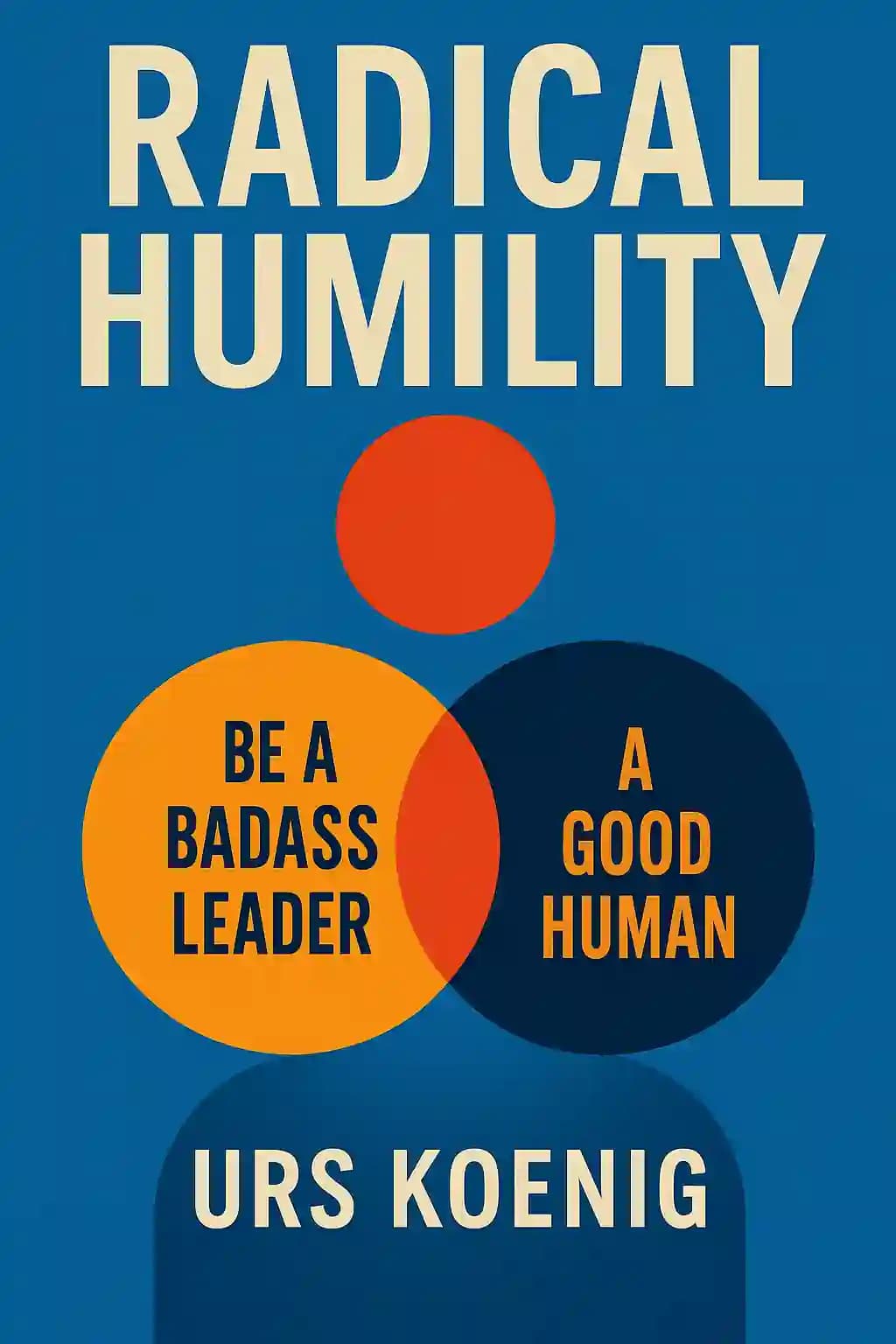
In a world that often celebrates brash confidence and self-promotion, "Radical Humility" offers a refreshing counternarrative. Author Urs Koenig's journey from dropping his flak jacket as a military peacekeeper in Kosovo to becoming a leadership expert reveals how humility transforms not just leaders but entire organizations. This book has quietly become required reading at companies like Microsoft and Amazon, where leaders are recognizing that command-and-control approaches no longer work in our complex, fast-moving world. Even celebrities like Brene Brown and Simon Sinek have praised its counterintuitive message: the strongest leaders are those who acknowledge they don't have all the answers.
Capítulo 2
From Battlefield to Boardroom: The Birth of Radical Humility
Koenig's interest in humility began early in his career as an ultraendurance athlete and businessman, where he noticed humble achievers consistently outperformed their boastful counterparts. But it was his military peacekeeping deployment to Kosovo that crystallized his understanding of humility's power. Arriving with confidence in his knowledge of the region's conflict, he was profoundly humbled watching schoolchildren reenact war atrocities to applause. His questions evolved from self-centered concerns to "How might we reimagine our role as peacekeepers to move this young nation to lasting peace?"
This transformation mirrors what effective leaders experience in today's business environment. We've moved from the predictable Industrial Age through the Information Age into today's Network Age, characterized by nonlinear relationships, fast-moving networks, and global interconnectivity. Meanwhile, workforce demographics are shifting dramatically, with younger generations seeking meaningful work beyond paychecks, and increasing diversity across dimensions like ethnicity, gender, and political outlook.
Despite these changes, much leadership philosophy remains rooted in the Industrial Age mindset where the leader sits atop the organizational chart as the sole know-it-all expert. This "heroic" leadership model creates bottlenecks when leaders try to be sole decision-makers in a complex, fast-moving environment. By the time decisions leave the leader's desk, they're already outdated.
General Stanley McChrystal faced this reality in Iraq when a suicide attack killed thirty-five children near his command center. Despite having superior troops, training, and equipment, allied forces were struggling against Al Qaeda's decentralized network. McChrystal had the humility to question why they were failing against an underresourced insurgency. He recognized their traditional hierarchical structure made them too slow to adapt to a nimbler enemy. Instead of doubling down on command-and-control leadership, McChrystal transformed his approach from "chess master" to "gardener"-creating the right environment for his people to thrive through trusting relationships, transparent information sharing, and intentional culture building. His humble leadership shift improved the task force's effectiveness by a factor of seventeen.
Capítulo 3
The Five Shifts: Transforming Leadership for Today's World
Koenig's extensive research identified Five THEN to NOW Shifts that are essential for leading with Radical Humility. Traditional THEN Leadership relied heavily on authoritarian, top-down command-and-control structures that centralized power and decision-making authority. In contrast, NOW Leadership embraces a more nuanced and collaborative approach focused on personal growth, emotional intelligence, and shared responsibility.
These shifts manifest in several key ways: leaders prioritize deep self-awareness and continuous personal development; they actively seek input through thoughtful questioning rather than imposing solutions; they distribute power across teams and empower others to lead; they practice radical transparency in communication and decision-making; they invest time in building authentic, trust-based relationships; they see employees as whole people with lives beyond work; and they maintain clear accountability while sharing both successes and failures.
The shifts support three defining dimensions of humble leadership that work in concert: Self-Knowledge/Growth Mindset involves constant self-reflection and openness to learning; Leading Relationally-Team/Growth Mindset focuses on building strong collaborative relationships and developing others; and Leading Relationally-Organization/Growth Mindset extends these principles to shaping organizational culture and systems. Importantly, these dimensions challenge common misconceptions about humble leadership - humility can coexist with and even enhance ambition, assertiveness, and making tough decisions. A humble leader can set aggressive goals, make difficult choices, and drive high performance while remaining open to feedback and acknowledging limitations.
The business world often points to seemingly successful arrogant leaders like Steve Jobs, Steve Ballmer, and Elon Musk as evidence that humility isn't necessary for leadership success. However, this represents a correlation fallacy - their success doesn't prove their leadership style caused it. Many factors contribute to business success, and these leaders may have succeeded either because of specific strengths that offset their arrogance or despite their lack of humility. We can't run the counterfactual experiment to see if these companies would have achieved even greater success under more humble leadership. Even Jobs, despite his notorious ego, demonstrated moments of intellectual humility, as evidenced by his quote: "I don't really care about being right; I just care about success." This suggests that even apparently arrogant leaders may incorporate elements of humble leadership when it serves their goals.
The shift toward humble leadership reflects a deeper understanding of what drives sustainable organizational success in today's complex, fast-changing business environment. It acknowledges that no single leader can have all the answers and that collective intelligence, psychological safety, and genuine collaboration are crucial for innovation and adaptation.
Capítulo 4
Focus Like an Elite Athlete: The Power of Saying No
To lead with humility, you must focus like an elite athlete-achieving anything you set your mind to while acknowledging you cannot do everything. Our culture celebrates busyness as a status symbol, yet productivity and results are what truly matter. We introduce ourselves at networking events by emphasizing how "busy" we are, treating it as a badge of honor when it's actually the antithesis of focus.
Olympic medalists like Jeremiah Brown (who learned rowing just four years before winning silver) demonstrate the power of eliminating distractions. They compartmentalize completely during training and competition, focusing solely on their athletic performance rather than their many other life roles.
Greg McKeown's "Essentialism" offers three mindset shifts to help focus your energy: recognize your power of choice ("We choose to" not "We have to"), accept that few things truly matter ("Only a few things really matter" not "It's all important"), and embrace trade-offs ("I can do almost anything but not everything" not "I can do both").
The stop-doing list is a simple yet powerful tool for freeing up time and energy. To create your own, commit to eliminating one personal and one professional activity. Share these commitments with family and colleagues to establish accountability.
Many leaders fall into the trap of adding new activities without eliminating existing ones-a mathematical impossibility that leads to overwhelm. You must systematically evaluate options before committing to any, distinguishing "the vital few from the trivial many." Identify which 20% of your efforts produce 80% of your results, then double down on those high-value activities while eliminating the rest.
Drafting your WHY statement creates clarity about which projects to pursue and which to let go. Your goals must cascade from your WHY-daily goals support weekly goals, which support monthly goals, which support annual goals, which ultimately feed into your three-year goals and WHY statement.
Apply the same rigorous focus to relationships. Most of us have at least one "energy vampire" relationship ripe for elimination. When your motivation for seeing someone stems primarily from obligation or guilt, that relationship belongs on your stop-seeing list.
Capítulo 5
Give a Damn About Others: Relationships as Strategic Assets
Building strong relationships isn't just ethical-it's strategically essential for leadership. When Swiss Colonel Franz Gander faced a PLUTO emergency-a team member suffering a life-threatening heart attack in Kosovo-his prior relationship-building proved invaluable. Faced with choosing between an unfamiliar local hospital or a potentially fatal delay transferring the patient to Switzerland, the colonel activated his network. He called the Swiss ambassador who verified the local hospital's quality, contacted a friend who knew the best heart surgeon, arranged government jets on standby, and secured an Italian military plane as backup. Within hours, a comprehensive medical response was coordinated across multiple countries, demonstrating how relationship networks can literally save lives.
This crisis exemplifies the Swiss military motto "In Krisen, Kopfe kennen" (In crises, know the heads). Building relationships before crises occur creates the trust and connections needed when speed is essential. Military leaders consistently emphasize that battlefield success often depends more on pre-existing relationships than formal chains of command.
Studies show employees are most engaged when they feel their work matters and their leaders genuinely care about them. A Glassdoor survey revealed over 67% of global respondents value strong relationship-based culture above salary, with this preference rising to 74% among millennials and Gen Z workers. Additional research from Gallup indicates that employees who report having a "best friend at work" are seven times more likely to be engaged in their jobs.
Common complaints about bosses include not knowing basic personal details about their team members' lives, such as their children's names or significant life events. Being tender on people doesn't require emotional vulnerability-it simply means acknowledging people exist beyond their work functions. Ask about spouses, children, hobbies, and aspirations. These seemingly mundane questions show you see them as whole people. Leaders who maintain regular "connection conversations" with team members report 23% higher retention rates and 31% better productivity outcomes.
Organizations with meaningful, cross-departmental relationships adapted more quickly to pandemic-forced virtual work. When you know someone in IT from chatting about photography or have connections in finance from discussing your children's soccer teams, solving problems becomes easier. Companies with strong internal networks reported 40% faster problem resolution during the pandemic transition. Strong relationships create resilient organizations that grow stronger under pressure-like immune systems. Research from MIT's Sloan School of Management found that companies with robust internal social networks were 3.5 times more likely to successfully navigate major organizational changes.
Relationship-building isn't just about being nice - it's about creating organizational antibodies that protect against crisis, enhance innovation through collaboration, and enable rapid response to challenges. Smart leaders systematically invest in relationship development through structured networking events, cross-functional projects, and regular informal interactions that build the social capital essential for organizational success.
Capítulo 6
Fail Successfully: Transforming Setbacks into Growth
The author shares his personal story of failing to complete the Race Across America (RAAM), a grueling 3,000-mile nonstop cycling race considered harder than climbing Mount Everest. Despite months of intensive preparation and putting his business on hold, Koenig was forced to withdraw after developing life-threatening pulmonary edema that reduced his oxygen saturation to 42%.
When processing failure, resist the urge to immediately "get over it" or minimize your loss. Though well-intentioned, thoughts like "it could have been worse" or "it's just a bike race" are unhelpful in the immediate aftermath. You must give your emotions of disappointment and grief the time and space they deserve.
The ABCD model helps process failure by acknowledging both emotions and beliefs. After Adversity hits, we experience shattered Beliefs about ourselves, leading to emotional Consequences. The key is to Dispel unrealistic beliefs through sharing and self-reflection.
Building resilience requires shifting from backward-looking cause-oriented thinking to forward-looking response-oriented thinking. While analyzing what went wrong is necessary-like discovering sodium overload caused pulmonary edema-dwelling on failure emotions prevents progress.
After processing failure emotions and shifting to response-oriented thinking, applying a growth mindset is essential for moving forward. People with growth mindsets see challenges as learning opportunities rather than threats to fixed abilities. As Michael Jordan famously noted about his thousands of missed shots, "I've failed over and over and over again in my life. And that is why I succeed."
A year after his RAAM DNF and near-death experience, Koenig completed his most successful ultracycling season ever-winning the Ring of Fire 24-hour race (419 miles), setting course records in the 750-mile race around Washington state, and winning the 508-mile Race Across Oregon as part of a two-man team. The lessons from his biggest athletic disappointment fueled his greatest successes.
Capítulo 7
Have Your People Rock the Boat: Creating Psychological Safety
Psychological safety is the shared belief among team members that they're in a safe space for interpersonal risk-taking without fear of negative consequences. It's about being candid, acknowledging mistakes, and asking for help regardless of rank. It's not about lowering standards or "singing Kumbaya"-it's about creating the foundation for a fearless culture.
Peter Skillman's marshmallow challenge reveals why psychological safety matters. Four-person teams must build the tallest structure using spaghetti, tape, string, and a marshmallow. Kindergarteners consistently outperformed business students, lawyers, and even CEOs. Why? Business students were distracted by status management and fear of looking stupid, while kindergarteners focused solely on the task, taking risks and experimenting freely without concern for status.
Google's Project Aristotle, researching 180 global teams over five years, found psychological safety was the most important factor in team effectiveness-more important than individual skills, team size, or tenure. While fear may have motivated workers in assembly-line days, today's complex, team-based work requires cooperation and learning that fear inhibits.
Despite its benefits, psychological safety remains rare. The Boeing 737 Max crashes, VW's "Dieselgate," and Wells Fargo's cross-selling scandal all stemmed from cultures where employees feared speaking up about serious problems. Our human instincts make psychological safety difficult-we want to be liked, avoid conflict, and are loss-averse.
Though challenging to create, psychological safety can be achieved with deliberate effort. The benefits-better decision-making, more innovation, higher engagement, and faster execution-are well-documented. As a radically humble leader in a VUCA world, you can't succeed alone. You need your team to feel safe sharing concerns, asking hard questions, and taking risks.
Capítulo 8
Build Fearless Teams: The Four-Step Framework
The Fearless Team in 4 Steps (FT4S) framework provides a structured approach to creating psychological safety and building fearless teams. The four steps are: 1) Reframe failure as an opportunity to learn rather than something shameful; 2) Encourage speaking up; 3) Acknowledge and thank team members; and 4) Train psychological safety through experiential learning together.
Building on the individual failure strategies, leaders must reframe failure for their entire team. Since fear of failure indicates low psychological safety, leaders must establish that failures are opportunities for growth and learning, not sources of shame or things to hide.
Not all failures are equal, and each type requires a different leadership response. Edmondson distinguishes between preventable failures (requiring disciplinary action or training), complex failures (requiring thorough analysis and system improvements), and intelligent failures (worth celebrating for their learning value).
When Alan Mulally took over at Ford, he discovered that despite massive losses, all business indicators were reported as "green" in leadership meetings. When Mark Fields finally had the courage to report a "red" status on the Edge car launch, Mulally applauded him rather than criticizing him. This transformed the team's willingness to share problems.
To encourage speaking up, humble leaders must acknowledge their own knowledge gaps, ask powerful questions, and listen intently. Powerful questions are open-ended, thought-provoking, expose assumptions, create new possibilities, and come from curiosity rather than judgment. Questions like "What are we missing here?" or "If we had nothing to lose, what would we do?" unlock deeper thinking.
Though simple in concept, acknowledging and thanking team members who speak up is challenging in practice-especially when their input challenges your beliefs. Yet this step is crucial for psychological safety. Even if you disagree with the point raised, your initial response must always be "Thank you for bringing this up."
The final step in building a fearless team is creating opportunities for experiential learning together. Simple activities like cooking and eating together can foster psychological safety. Studies with firefighter and surgical teams show significantly better job performance when they share meals. At Bank of America call centers, synchronizing coffee breaks and replacing small tables with larger ones increased productivity by 20 percent and reduced turnover from 40 to 12 percent.
Capítulo 9
Know Thyself: The Journey to Self-Awareness
The Johari window model helps discover blind spots by dividing self-knowledge into four quadrants: Public Self (known to self and others), Private Self (known to self but concealed from others), Blind Spots (unknown to self but known to others), and Unknown Self (unknown to both). The most critical quadrant for humble leaders is Blind Spots-aspects about yourself that everyone else knows but you don't.
The most effective tool for discovering blind spots is the 360-degree feedback survey, gathering input from everyone around you-direct reports, peers, bosses, and customers. Even without a formal survey, you can conduct informal 360s by asking trusted colleagues what you do well and could do better, or using the Start-Stop-Continue framework.
For meaningful change, you need to follow up with regular check-ins with team members. The Stakeholder Centered Coaching process involves choosing 8-15 diverse stakeholders, holding a kickoff meeting to share your developmental goals, and gathering both feedback (assessment of past performance) and feedforward (suggestions for future improvement). Monthly fifteen-minute follow-ups with stakeholders help shape perception and demonstrate your commitment to growth.
Journaling is a powerful complement to stakeholder feedback for deepening self-awareness. By writing down thoughts and feelings, you externalize them and create distance that allows for more objective self-observation. Successful leaders from Barack Obama to Richard Branson swear by this practice.
Engaging in transparent feedback and feedforward with stakeholders may feel intimidating, but it's essential to humble leadership. Knowing yourself requires putting your ego aside, vulnerably asking for input, and owning your weaknesses. Humble leadership isn't for the faint-hearted-it's a contact sport that requires you to be in the ring, getting bruised and occasionally knocked down.
Capítulo 10
Build a Leadership Factory: Developing Tomorrow's Leaders
As a young PhD student at the University of Zurich, Koenig faced the difficult task of telling his professor he needed to quit his research assistant position after just a few months to pursue fieldwork in Australia. Despite his anxiety about disappointing his mentor who valued loyalty, he was surprised when his professor not only accepted his decision but supported it wholeheartedly-even offering to rehire him upon his return.
Though leaders might fear losing talented people by making them more employable, the opposite often occurs. When you stretch strong performers and coach them toward their next career step, you typically keep them longer while better preparing them for advancement. This approach turns you into a talent magnet as word spreads about your development-focused leadership.
Instead of lamenting when top performers leave, embrace the potential benefits. These departing team members often become valuable connections in new organizations, serving as ambassadors for your cause and people you can reach out to for help when needed.
Many employees leave only to discover their new role isn't what they expected. Studies show over a quarter of "new" hires are actually boomerang employees who resigned within the past three years. When you part ways positively by supporting their growth, they're more likely to consider returning.
When Mary supported her strong performer Johanna's application for a senior finance role, she lost a team member but gained a valuable ally. Whenever Mary's team needed something from finance, they could bypass slow bureaucratic channels by calling Johanna directly. Johanna actively worked to make life easier for Mary's team, becoming Mary's ambassador within finance.
Building a leadership factory attracts and grows exceptional talent, allowing you to delegate effectively and lead strategically. Senior leaders take immense pride in the successes of those they've developed. Despite being eighty years old, Professor Elsasser-Hans to his former students-still organizes annual reunions, proud of the legacy he's created through his leadership factory approach.
Capítulo 11
The Vulnerability Advantage: How Sharing Weakness Builds Strength
The author introduces the chapter by sharing how his coaching client Michelle bravely shared her negative 360-feedback with her team, acknowledging her controlling behavior and emotional volatility. Despite initial discomfort, her vulnerability earned immediate respect and led to significant improvement over nine months. This example demonstrates how authentic vulnerability, rather than projecting perfection, builds trust and respect.
Many leaders view vulnerability as weakness and believe they must have all answers, creating bottlenecks and slowing progress. The author references Brene Brown's work on vulnerability as showing up authentically while seeking improvement. The section contrasts perfection-chasing (focused on others' opinions) with self-improvement (focused on growth). Leaders like Microsoft's Satya Nadella, Oprah Winfrey, and former New Zealand PM Jacinda Ardern demonstrate how vulnerability-centered leadership creates success.
In today's business environment that demands constant learning and agility, leaders must recognize their limitations. Humble leaders focus on getting it right rather than being right, admit mistakes, welcome feedback, and create cultures where development is encouraged. The author shares how Intuit's CEO Brad Smith exemplified this by sharing his 360 assessment results with his board, executive team, and entire company.
The author describes using a "penny exercise" at team retreats where participants share significant life events from the year on their penny. This vulnerability-sharing creates deeper connections even among long-time colleagues. When leaders model vulnerability first, it creates a "vulnerability loop" where team members respond with their own openness, establishing norms of higher vulnerability and increased trust. Contrary to common belief, vulnerability precedes trust rather than requiring trust first.
While vulnerability builds trust, it must be balanced with competence. Humble leaders must demonstrate they're capable of guiding their teams through challenges. In certain situations-particularly in autocratic cultures, with teams used to all-knowing leaders, or when your qualifications are questioned-you might need to establish competence before displaying vulnerability.