Capítulo 1
Your Life's Greatest Work Lies Ahead
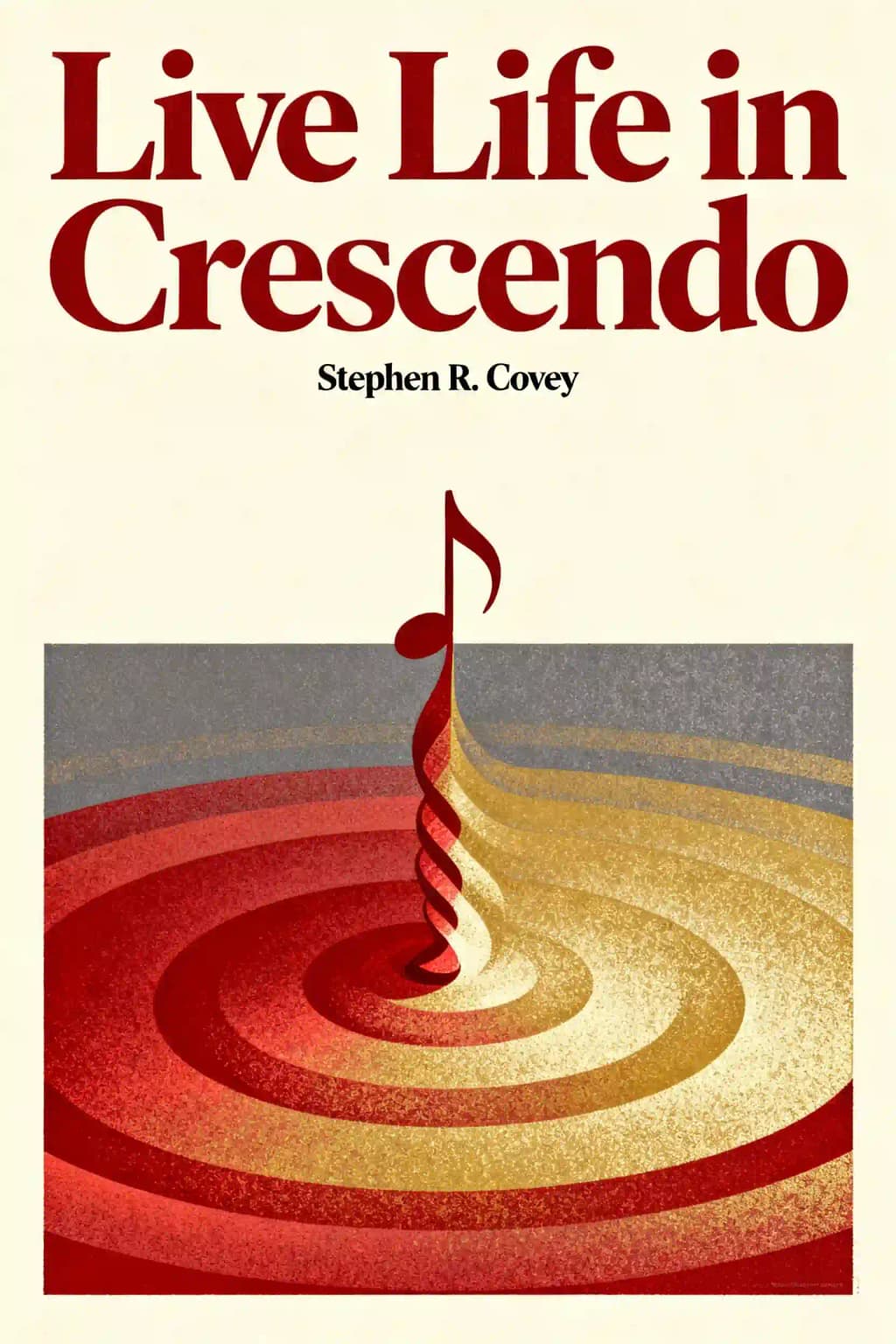
Have you ever felt that your best days are behind you? That after reaching a certain age or accomplishment, it's time to coast through the rest of life? Stephen R. Covey's final work challenges this diminishing view of life with a powerful alternative perspective. "Live Life in Crescendo" presents his culminating philosophy-that your most important work is always ahead of you, regardless of age or circumstance. This book, completed by his daughter Cynthia after his passing, represents Covey's "last lecture" and final contribution to the world. It's no wonder the book has resonated with readers across generations, from CEOs to retirees, and has been endorsed by luminaries like Oprah Winfrey, who called it "a beautiful reminder that we can choose growth over decline at any age." The book's principles have been incorporated into leadership programs at companies like Google, Microsoft, and Amazon, where executives use the Crescendo Mentality to foster innovation and purpose-driven cultures.
Capítulo 2
The Crescendo Mentality: A Revolutionary Approach to Life's Stages
In music, crescendo means to continually swell and grow in grandeur, increasing in energy and vigor. Applied to life, this mentality means believing your contributions, learning, and influence can continuously expand rather than contract. This perspective stands in stark opposition to society's common "diminuendo" approach, where we expect decline and decreased relevance with age.
The Crescendo Mentality isn't just positive thinking-it's a principle of action focused on making meaningful contributions to others while always looking forward to what's next. It's about rejecting the notion that your value and potential contributions diminish over time. Instead, like Picasso said, "The meaning of life is to find your gift. The purpose of life is to give it away."
This mentality applies across four pivotal life stages where we face critical choices: the midlife struggle (comparing where we are to where we want to be), the pinnacle of success (deciding whether to coast or continue growing), life-changing setbacks (choosing how to respond to tragedy), and the second half of life (determining how to use our remaining time).
What makes this approach revolutionary is its rejection of conventional life planning. Rather than working toward retirement and leisure, the Crescendo Mentality suggests our greatest achievements may still await us, regardless of age or circumstance. This isn't about denying the reality of aging or hardship, but about maintaining an optimistic perspective that we can always contribute meaningfully to the world around us.
Capítulo 3
Life Is a Mission, Not a Career
Like George Bailey in "It's a Wonderful Life," many of us face moments when we question whether our lives truly matter. This midlife crisis typically strikes between forty and sixty, manifesting as depression, burnout, lack of purpose, and sometimes self-centered behavior. Some respond by making impulsive decisions-buying flashy cars, changing careers, or even abandoning families-but running away rarely solves the underlying issue.
Instead, Covey suggests redefining success by writing our own obituaries. What do you want said about you at your funeral? What accomplishments will bring you the most satisfaction? What legacy do you want to leave? This exercise helps clarify what truly matters to you and whether your current path aligns with these deeper values.
True success isn't measured by wealth or career prominence but by our impact on others, especially family. Clayton Christensen, after watching many successful Harvard classmates experience personal failures, observed: "It's actually really important that you succeed at what you're succeeding at, but that isn't going to be the measure of your life."
Covey's grandfather taught him the powerful principle that "Life is a mission, not a career." When we align our definition of success with our values and follow our conscience, we discover our unique mission. Universal principles like honesty, fairness, and integrity serve as our compass, providing direction amid conflicting voices.
Consider Ernie Nix, who transformed his life by losing 173 pounds in a single year. His example inspired colleagues to follow suit, and he improved school lunch options and physical education programs. Eventually losing 220 pounds total and becoming a marathon runner featured in Runner's World, Nix demonstrated that "I choose not to be miserable-it is a choice."
Similarly, at age 51, Covey mortgaged his home and cabin to start Stephen R. Covey & Associates when he felt stagnant in his university career. This risky move with children at home and in college led to consulting success and eventually "The 7 Habits of Highly Effective People." Like the crescendo sign in music, midlife should be about continual progression, broadening opportunities, and anticipating new accomplishments.
Capítulo 4
Love to Serve: Finding Purpose Through Contribution
When life seems to be passing you by, looking outside yourself to serve others can be transformative. John Kralik's story exemplifies this principle. At 53, his law firm was failing, he faced a second divorce, was estranged from his children, lived in a tiny uncomfortable apartment, was overweight, and had just been dumped. Inspired by a thank-you note from his ex-girlfriend, he committed to writing 365 thank-you notes in a year to anyone who'd shown him kindness.
As he expressed gratitude through handwritten notes to friends, coworkers, attorneys, and even service workers, his life dramatically improved-financially, physically, and emotionally. Despite the economic collapse, his life turned around, and he eventually achieved his dream of becoming a Los Angeles Superior Court judge. His book, "A Simple Act of Gratitude," has inspired countless others.
Jorge Fierro demonstrates another aspect of service. Coming to America from Mexico with nothing, he built his Rico Brand into a multimillion-dollar corporation selling authentic Mexican food. Remembering his own experience with homelessness, Jorge founded Burrito Project SLC, which delivers up to 1,400 warm burritos weekly to the homeless. "Often we don't realize how blessed we are," Jorge explains, seeing his service as paying forward the help he received.
Mentoring represents another powerful form of service. Michael Clapier has mentored nearly two thousand young wrestlers, spending extra unpaid time helping them build skills and confidence. He and his wife Linda brought many of these athletes into their home, providing love and attention they often lacked from their own families. Without recognition, they bought clothes, equipment, and regularly fed several boys for years.
Country music star Garth Brooks exemplifies prioritizing what matters most. At the height of his career, he shocked fans by retiring in 2000 to focus on raising his three young daughters after recognizing he'd lost touch with them. For fourteen years, he prioritized fatherhood over fame, working with his ex-wife to ensure their daughters had both parents present daily. After his youngest left for college, Brooks returned to music, fearing no one would show up. Instead, his comeback tour sold 140,000 tickets in three hours, and he won Entertainer of the Year three more times.
Capítulo 5
People Are More Important Than Things
When contractor Chip Smith was building the Coveys' cabin in Montana while going through a painful divorce, Stephen and Sandra drove 350 miles just for a two-hour meeting about the project. Despite Chip's prepared agenda and materials, Sandra immediately focused on his personal struggles instead of the cabin details. When Chip tried redirecting to business matters, Sandra took his hand and said, "What you're going through now is so much more important to us than worrying about decisions for the cabin."
Overwhelmed by their genuine care, Chip broke down in tears, spending the next three hours discussing his problems rather than the cabin. This moment showed him that to the Coveys, people truly mattered more than things. Years later, when Stephen passed away and the family discovered a bat problem at the cabin, Chip immediately brought a crew, fixed everything, and refused payment, saying it was his chance to repay the Coveys for being there during his darkest time.
True happiness comes from contribution, not accumulation. No one on their deathbed wishes they'd spent more time at the office, but many regret missed opportunities to serve others and build relationships. When we die, all that remains is the good we've done and the relationships we've built-that's our legacy.
Karl Rabeder exemplifies this principle-an Austrian entrepreneur who, despite his wealth and luxury lifestyle, felt miserable until he sold his possessions worth millions and invested in microcredit charities helping entrepreneurs in Central and Latin America. Similarly, in "The Quiltmaker's Gift," a greedy king discovers joy only when giving away his possessions to those in need, eventually declaring, "I may look poor, but my heart is full to bursting with memories of happiness I've given and received."
The Gates Foundation demonstrates this principle on a grand scale. Their vaccination initiatives cut childhood deaths from 12 million to 6 million annually, with Melinda Gates asserting, "We believe all lives had equal value, but we saw that the world didn't act that way." Their polio eradication efforts reduced cases by 99.9%, from 350,000 annually to below 20 cases in just two countries.
In 2010, Bill Gates and Warren Buffett created the Giving Pledge, inviting wealthy individuals to commit most of their wealth to philanthropy. By 2021, 231 signatories from 28 countries had joined. Gates committed to give away 95% of his wealth; Buffett pledged 99%, saying "Were we to use more than 1% of my claim checks on ourselves, neither our happiness nor our well-being would be enhanced."
Capítulo 6
Leadership Is Communicating Worth and Potential
After Stephen Covey's death, John Nuness, who maintained the Covey family's vacation equipment in Montana, revealed something touching to Cynthia: "Stephen was the only person who truly appreciated what I do for a living. He made me feel so good about myself and sincerely valued my skills." This simple act of genuine appreciation had profound meaning, demonstrating how acknowledging others' worth can be transformative.
The story of Don Quixote teaches us about believing in another's potential. When Don Quixote meets Aldonza, a peasant and prostitute, he sees beyond her current reality and calls her "Dulcinea," affirming her potential as a virtuous woman. Though skeptical at first, she gradually embraces this new identity and transforms into the person he believed she could be. This "self-fulfilling prophecy" demonstrates how people often become what we truly believe of them.
Stephen identifies three methods of true mentorship influence: Model by Example (where people see what we do), Build Caring Relationships (where people feel what we do), and Mentor by Instruction (where people hear what we say). He emphasizes preparing yourself before mentoring situations, choosing pleasantness and attentiveness, and teaching the "Law of the Harvest"-that meaningful results require consistent effort with no shortcuts.
John Wooden exemplifies leadership as character-building, not just achievement. Despite his first losing season, he went on to unprecedented success with UCLA basketball, winning ten NCAA championships. Yet Wooden considered teaching character his highest calling, believing mentorship could be "any action that inspires another." He carried his father's seven-point creed throughout life, which included "Make each day your masterpiece" and "Help others." Wooden defined success as making your best effort and developing character rather than reputation. Until age 96, he continued writing, speaking, and mentoring others.
Capítulo 7
Work to Expand Your Circle of Influence
Proactive people focus their efforts within their Circle of Influence rather than worrying about things they cannot control. By applying positive energy to what they can affect, they gradually expand their influence in ever-widening circles. Each person possesses unique gifts to offer others within their sphere, creating opportunities to stretch, learn, contribute and help others do the same.
William Wilberforce exemplifies expanding one's influence, persistently fighting for twenty years to abolish slavery in Britain despite overwhelming opposition, ultimately succeeding through determination and appealing to others' conscience. Covey introduces his 8th Habit: "Find your voice and inspire others to find their voice." You must discover your own voice before effectively helping others find theirs.
When you genuinely listen and show openness to others, you begin to influence them. Your actions impact more than your words. Thomas Edward Brown mentored William Ernest Henley, a tuberculosis sufferer who lost his leg at twelve. Brown's kindness and encouragement inspired Henley to write poetry, including "Invictus," which later inspired Nelson Mandela during his imprisonment. This chain of influence demonstrates how one voice gives rise to others, creating ripples of positive change.
Paul Newman exemplified Living Life in Crescendo, continuing his acting career into his seventies while building his greatest legacy through philanthropy. After creating Newman's Own salad dressing in 1980, he committed 100% of profits to charity with the motto "Shameless exploitation in pursuit of the common good." His foundation continues his mission after his death, donating over $570 million to thousands of charities worldwide.
Muhammad Yunus demonstrates similar impact through microfinance. After witnessing Bangladesh's devastating famine in 1974, he lent $27 to forty-two village women, discovering that tiny loans could help people escape poverty. His Grameen Bank has provided $4.7 billion to 4.4 million families, with 94% of loans going to women. Yunus received the Nobel Peace Prize in 2006, and his model has been replicated worldwide. Even at 75, he continues working toward putting "poverty in a museum."
Capítulo 8
Choose to Live in Crescendo, Not Diminuendo
Anthony Ray Hinton's story illustrates the power of choosing one's response to devastating setbacks. Wrongfully convicted and sentenced to death row in Alabama in 1985, Ray spent nearly thirty years in prison before being exonerated by the Supreme Court in 2015. Initially consumed by anger and despair, Ray remained silent for three years until compassion awakened within him when he heard another inmate crying.
He realized that while he couldn't control his circumstances, he could choose his response-hope, faith, compassion and love were all choices available to him even on death row. For the next twenty-seven years, Ray became a beacon of light for fellow inmates, transforming the environment around him through kindness and humor. After his release, instead of harboring bitterness, Ray chose forgiveness, saying "They took my thirties, my forties, my fifties-but what they couldn't take was my joy!"
Nelson Mandela exemplifies Living Life in Crescendo despite twenty-seven years of imprisonment. After his release at age seventy-one, Mandela left bitterness behind, saying "If I didn't leave my bitterness and hatred behind, I'd still be in prison." Four years later, he became South Africa's first Black president in the country's first multiracial election. As president, Mandela made powerful gestures of reconciliation, including wearing the previously despised Springboks rugby jersey during the World Cup, causing the overwhelmingly white crowd to chant "Nelson! Nelson!"
Dave's Killer Bread exemplifies the power of second chances. After serving time for drug offenses and other crimes, Dave Dahl returned to his family's bakery business where his brother gave him a second chance. Dave developed a special bread that became wildly successful, growing from a farmers market favorite to a national brand. One-third of the company's employees have felony convictions, demonstrating Dave's philosophy: "We believe everyone is capable of greatness."
Anna Beninati's story demonstrates the power of choice after tragedy. After losing both legs in a train-hopping accident, she made a conscious choice to move forward rather than wallow in self-pity. Remarkably, Anna discovered she was happier after her accident, embracing a wide range of activities including hand cycling, weightlifting, horseback riding, and even bungee jumping. She now coaches disabled people through sports programs and mentors youth symphony members.
Capítulo 9
Find Your 'Why'
After losing his wife and two young children in the 1985 Air India bombing, Dr. Chandrasekhar Sankurathri transformed his grief into purpose. At age sixty-four, he quit his job in Ottawa, sold his possessions, and returned to India to address blindness and lack of education in rural communities. He established the Sankurathri Foundation, creating both the Sarada Vidyalayam School (named after his daughter) which has educated thousands of rural students free of charge with a zero dropout rate, and the Srikiran Institute of Ophthalmology (named after his son) which has served 3.5 million patients and performed 34,000 surgeries, 90% free to the needy.
Viktor Frankl, Holocaust survivor and author of Man's Search for Meaning, discovered that humanity's primary motivating force is finding purpose. While imprisoned, he mentally visualized himself lecturing to future students about his experiences, giving him hope to endure. Frankl observed that the key factor determining survival in concentration camps wasn't intelligence or health but having a sense of future purpose-something significant still to accomplish. As Frankl concluded, "He knows the 'why' for his existence, and will be able to bear almost any 'how.'"
People who overcome seemingly insurmountable obstacles succeed because they believe they have a choice. Rick Bradshaw, paralyzed in a diving accident at twenty-two, learned that "failure is a sign of engagement and looks more like success than abstinence" as he adapted to his new limitations. Through "thousands of leaps of faith," Rick rejected government assistance to work at the hospital where he was treated, completed a PhD, and discovered his life mission: "to set a good example to those watching."
The cycle of destructive family scripting can stop with you. By becoming self-aware of negative patterns-whether abuse, abandonment, or destructive behaviors-you can break free and become a Transition Person whose decisions benefit future generations. As Abraham Maslow noted, "What is necessary to change a person is to change his awareness of himself." Regardless of circumstances, you determine your life's direction through the Crescendo Mentality.
Capítulo 10
Keep Your Momentum Going!
Retirement should never mean retiring from making meaningful contributions. Barbara Bowman exemplifies this principle-at 79 she oversaw early childhood education programs for 30,000 children in Chicago, and at 91 remains active in educational causes while hosting weekly family dinners. She believes age gives you the advantage of doing what's right without career worries and creates a sense of urgency about using time wisely.
The goal isn't to guilt anyone but to inspire a transition from career to contribution. George Bernard Shaw captured this spirit: "I want to be thoroughly used up when I die... Life is no brief candle to me. It's a sort of splendid torch which I have got hold of for the moment." This doesn't mean everyone must work until they drop-taking up hobbies, traveling and spending time with family are valuable-but rather adopting a "Crescendo paradigm" that focuses on meaningful contribution.
The Longevity Project, an eight-decade study, revealed surprising findings: happiness results from engagement rather than causing health; productive stress is beneficial; and those who stay highly engaged in meaningful endeavors live longer. The study debunks retirement myths, showing that over 70% of pre-retirees want to continue working, and nearly 60% of retirees launch into new lines of work.
While you may retire from a career, you should never retire from serving others. The travel industry promotes passivity to seniors: "Retirement! You've worked for it. You deserve it. And at last you can kick back-and do nothing!" But this leads to purposelessness. Balance is key-enjoy leisure activities while still engaging in meaningful contribution.
Primary Greatness contrasts with Secondary Greatness (popularity, title, position, fame). While secondary greatness makes headlines, primary greatness reveals who you really are-your character, integrity, and deepest motives. It's about who a person is rather than what they have, radiating goodness rather than displaying titles. As Theodore Roosevelt said, "Do what you can with what you have where you are."
Capítulo 11
Detect Your Purpose
Rabbi Harold Kushner notes our souls hunger for meaning, not fame or wealth-we want our lives to matter. Charlie and Dorothy Hale, both in their mid-eighties, exemplify purposeful living by repairing and donating nearly one thousand musical instruments to Rochester schools. Richard Leider explains that purpose isn't a luxury but essential for health, happiness and longevity. As Pablo Picasso suggested, "The meaning of life is to find your gift. The purpose of life is to give it away."
Viktor Frankl taught that instead of asking "What do I want from life?" we should ask "What does life want from me?" We discover purpose by creating meaningful work, experiencing connection, and maintaining positive attitudes toward suffering. Jimmy and Rosalynn Carter exemplify the Crescendo Mentality, establishing the Carter Center after leaving the White House and volunteering with Habitat for Humanity for 35 years. Rather than retiring to leisure, they've built over 4,390 homes in fifteen countries, with Jimmy authoring more than forty books after his presidency.
The truth about living in crescendo during life's second half is that this stage offers tremendous options and potential for contribution. By planning ahead and remaining curious, you can make this time productive, exciting and meaningful. Stephen Covey felt a sacred stewardship to contribute rather than retire to leisure, believing his most important legacy was being someone consistently making a difference.
Creating meaningful memories with loved ones forms the foundation of a rich life in its second half. Despite professional success, Stephen Covey observed that world leaders and executives derived their greatest joy from family relationships, while their deepest pain came from lacking these connections. The Covey family prioritized faith and family, creating traditions that spanned generations. These shared experiences-whether at a cabin, camping, traveling, or serving others-build stability, confidence, self-esteem, and a family culture that helps weather life's challenges.
Capítulo 12
Living the Legacy of Crescendo
The Crescendo Mentality was Stephen Covey's final big idea-his "Last Lecture"-which he deeply believed could enrich lives. He lived by the principle that "your most important work is always ahead of you" regardless of life stage.
Cynthia Covey Haller shares her family's deeply personal journey with her father Stephen's dementia and her mother Sandra's wheelchair confinement. Despite these challenges, both parents exemplified living in Crescendo. Stephen worked on multiple writing projects including this book and remained fully engaged with family until his mental decline made it impossible. Sandra, despite being confined to a wheelchair for twelve years following back surgery complications, lived by her motto "It is not finished!" She maintained an active social life, led book clubs, served on university committees, attended sporting events, celebrated holidays elaborately, and personally delivered gifts to sixty friends just weeks before her passing.
Two months after Stephen Covey's death, his granddaughter Rachel Covey passed away at age 21 due to depression. Despite their grief, her parents Sean and Rebecca chose to honor Rachel's memory by founding Bridle Up Hope, a foundation helping young women struggling with anxiety, depression, and low self-worth through equestrian training. The 14-week program combines horseback riding with Sean's "7 Habits of Highly Effective Teens" curriculum, helping girls develop confidence and resilience. The foundation has transformed over a thousand girls' lives and is expanding globally.
As Sean says, after tragedy, you have three choices: let it destroy you, define you, or strengthen you. He and Rebecca chose the third path, finding healing by celebrating Rachel's memory and helping others through their foundation. This perfectly embodies the Crescendo Mentality-the belief that regardless of age, circumstance, or setback, your most important work is always ahead of you.