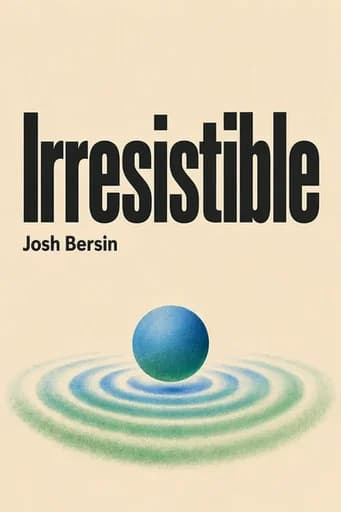
In "Irresistible," HR guru Josh Bersin reveals seven secrets of enduring organizations after seven years of research. Adam Grant calls it "a road map for humane workplaces" - the blueprint for people-centered leadership that's transforming how industry titans build lasting, engaged teams.
Josh Bersin, renowned HR analyst and bestselling author of Irresistible, is a global authority on workplace transformation, talent management, and leadership innovation. The book, grounded in business and management genres, explores themes like employee experience, adaptive leadership, and systemic HR practices—topics Bersin has shaped through decades as a researcher, consultant, and founder of The Josh Bersin Company.
A Cornell and Stanford engineering graduate with an MBA from UC Berkeley, Bersin previously authored The Blended Learning Handbook and The Training Measurement Book, establishing frameworks still used in corporate learning. His insights regularly feature in Forbes, Harvard Business Review, and The Wall Street Journal, and he advises organizations worldwide through his eponymous academy, which has trained over 50,000 HR professionals.
Bersin’s work is celebrated for merging data-driven HR strategies with human-centric leadership principles, reflected in his 795,000+ LinkedIn followers and the global adoption of his "Big Reset" initiatives during the pandemic. Irresistible distills his 20+ years of research into actionable insights for building thriving, future-ready organizations.
Irresistible by Josh Bersin reveals seven evidence-based principles for building enduring, high-performing organizations by prioritizing employee experience. Drawing from decades of research, Bersin shows how companies like Microsoft, Starbucks, and Cedars Sinai thrive by replacing hierarchies with agile teams, fostering growth over promotions, and aligning work with purpose. The book combines management theory with actionable frameworks to improve retention, innovation, and profitability.
HR leaders, executives, and managers seeking to redesign organizations around employee needs will benefit from this book. It’s also valuable for entrepreneurs building scalable cultures and professionals interested in trends like hybrid work, burnout reduction, and network-based organizational design. Bersin’s practical examples and discussion questions make it a handbook for driving transformational change.
The seven principles include:
The book tackles burnout, labor shortages, and hybrid work by advocating for systemic redesigns rather than superficial fixes. Bersin argues that companies must shift from rigid hierarchies to flexible networks of teams, prioritize continuous learning, and align roles with employees’ purpose—key strategies for adapting to economic uncertainty and technological disruption.
Bersin highlights Walmart’s workforce reskilling, Microsoft’s cultural transformation under Satya Nadella, and LEGO’s innovation-driven team structures. These case studies illustrate how focusing on employee development, psychological safety, and autonomy leads to higher customer satisfaction and profitability.
Unlike traditional management guides, Irresistible focuses on redesigning organizations rather than optimizing individual productivity. It complements books like Measure What Matters (OKRs) by addressing structural and cultural enablers for agility, making it a blueprint for holistic organizational change.
Yes—Bersin emphasizes that agility and employee-centricity are scalable. Small businesses can adopt practices like flat team structures, coaching-based leadership, and purpose-driven roles to foster innovation without bureaucratic overhead. Examples include local firms using apprenticeship models to upskill teams.
Key frameworks include:
Yes—Bersin recommends redesigning workflows around outcomes (not hours), investing in collaboration tools, and training managers to coach dispersed teams. Examples include companies using AI to match skills with projects and redesigning offices for flexible collaboration.
With its blend of research, case studies, and actionable tools, Irresistible is a must-read for leaders navigating talent shortages and rapid change. Reviewers praise its practicality, with one calling it “a handbook for building companies where people want to work”—a key differentiator in competitive markets.
The book argues leaders should act as coaches and architects rather than top-down decision-makers. By empowering teams, fostering psychological safety, and aligning roles with purpose, leaders drive engagement and adaptability—a stark contrast to traditional command-and-control models.
Siente el libro a través de la voz del autor
Convierte el conocimiento en ideas atractivas y llenas de ejemplos
Captura ideas clave en un instante para un aprendizaje rápido
Disfruta el libro de una manera divertida y atractiva
Rapid market entry and iteration now determine success.
We've become a service economy.
Work happens everywhere regardless of whether people have traditional 'jobs'.
Automation is transforming them to be more human.
The agile model has proven successful across diverse industries.
Desglosa las ideas clave de Irresistible en puntos fáciles de entender para comprender cómo los equipos innovadores crean, colaboran y crecen.
Experimenta Irresistible a través de narraciones vívidas que convierten las lecciones de innovación en momentos que recordarás y aplicarás.
Pregunta cualquier cosa, elige tu estilo de aprendizaje y co-crea ideas que realmente resuenen contigo.

Creado por exalumnos de la Universidad de Columbia en San Francisco
"Instead of endless scrolling, I just hit play on BeFreed. It saves me so much time."
"I never knew where to start with nonfiction—BeFreed’s book lists turned into podcasts gave me a clear path."
"Perfect balance between learning and entertainment. Finished ‘Thinking, Fast and Slow’ on my commute this week."
"Crazy how much I learned while walking the dog. BeFreed = small habits → big gains."
"Reading used to feel like a chore. Now it’s just part of my lifestyle."
"Feels effortless compared to reading. I’ve finished 6 books this month already."
"BeFreed turned my guilty doomscrolling into something that feels productive and inspiring."
"BeFreed turned my commute into learning time. 20-min podcasts are perfect for finishing books I never had time for."
"BeFreed replaced my podcast queue. Imagine Spotify for books — that’s it. 🙌"
"It is great for me to learn something from the book without reading it."
"The themed book list podcasts help me connect ideas across authors—like a guided audio journey."
"Makes me feel smarter every time before going to work"
Creado por exalumnos de la Universidad de Columbia en San Francisco

Obtén el resumen de Irresistible como PDF o EPUB gratis. Imprímelo o léelo sin conexión en cualquier momento.
Here's a startling fact: the average company lifespan has crashed from 61 years to less than 18. While executives scramble to explain this collapse through market forces and digital disruption, they're missing the real story unfolding in their own hallways. Employees are voting with their feet-35% of the U.S. workforce walked away from their jobs in 2021 alone. What's driving this exodus isn't just better pay elsewhere. People are fleeing organizations that treat them like cogs in a machine rather than humans with potential. The old playbook-hierarchical control, rigid job descriptions, annual performance reviews-has become a liability in a world where innovation determines survival. Companies built on 20th-century management principles are crumbling while a new breed of organization is emerging, one that understands a fundamental truth: the path to profits runs through purpose, and the road to productivity winds through human flourishing. Think about how most organizations still operate. Someone at the top makes a decision, passes it down through layers of management, and months later something finally happens-usually too late to matter. This industrial-era hierarchy worked brilliantly when the goal was producing identical widgets at scale. But today's challenges demand something entirely different: speed, creativity, and the ability to pivot on a dime. The solution isn't tweaking the org chart-it's fundamentally reimagining how work gets done. Progressive companies are organizing around networks of small, empowered teams rather than departments and divisions. Think of it like the difference between a classical orchestra and a jazz ensemble. The orchestra needs a conductor telling everyone exactly what to play and when. But a jazz band? Each musician knows their role, listens intently to others, and improvises together toward a shared vision. Spotify cracked this code with their "squad" model-teams of eight or fewer people working together physically with clear missions. These squads operate autonomously but remain "loosely coupled but tightly aligned." When ANZ Bank adopted this approach, CEO Shayne Elliott watched as "very quickly the way of work changes." Hierarchies flattened, departments dissolved, and suddenly people were organizing around customer outcomes rather than functional silos.
The traditional career ladder is crumbling. Today, 59 million Americans work in the gig economy, and two-thirds of younger workers maintain side hustles. Progressive organizations now function like consulting firms, with people working on projects rather than occupying fixed positions. Deloitte uses just seven generic job levels, enabling fluid movement between projects. Even management roles rotate-client partners might lead for 3-5 years before returning to client work. A quarter of U.S. occupations now show strong "hybridization"-marketing managers become data scientists, salespeople master AI platforms, designers learn to code. The command-and-control manager is obsolete. In today's economy, where 85% of stock market value comes from innovation and intellectual property, leaders can't dictate their way to success. The new model: leader as coach, developing talent rather than consuming it. Southwest Airlines exemplifies this-their employees radiate enthusiasm because each crew is empowered to make decisions. By 2015, 75% of companies had redesigned performance management around coaching and development. When Adobe pioneered this approach in 2012, removing annual reviews freed managers for more meaningful development conversations.
Most offices overflow with rulebooks covering everything from dress codes to vacation policies - all rooted in distrust. But rules create the problems they're meant to solve: they signal distrust, breed disengagement, and demand more rules. Irresistible companies replace rules with culture - shared values that guide behavior more effectively than any manual. Johnson & Johnson's "Corporate Athlete" program teaches stress management and resilience, proving that when people are healthy, productivity soars. Physical workspace design matters profoundly. Steelcase found near-perfect correlation between employee control over their workspace and engagement. This doesn't mean private offices for all - it means choices. Apple and Google design spaces enabling serendipitous encounters while providing quiet zones for deep work. Diversity has evolved from HR checkbox to business imperative. When Salesforce discovered an 11% gender pay gap, CEO Marc Benioff immediately spent $3 million to close it. Deloitte's research shows diverse teams outperform peers by 80%. Recognition transforms culture more powerfully than mission statements. High-recognition cultures see 30% lower turnover because gratitude produces oxytocin, making people happier and more collaborative. Modern recognition happens through social tools offering "likes" and "kudos" rather than annual ceremonies.
Abraham Maslow observed that humans face constant tension between safety and growth. Traditional career models resolved this through predictable advancement-work hard, wait your turn, climb the ladder. But this bargain has broken down as hierarchies flatten and skill half-lives shrink. The highest-performing companies have embraced a radical alternative: prioritize growth over promotion. Employees increase responsibility, expertise, and compensation without climbing into management. Careers become experiences rather than ladders-a series of learning cycles where you master new skills, apply them to challenging projects, then move to the next learning frontier. This addresses a crucial insight: "not learning anything" is the top reason people leave companies, with learning opportunities three times more important than salary for millennials. When you're stuck doing the same tasks year after year, even generous paychecks feel like golden handcuffs. Microsoft's transformation under Satya Nadella illustrates this power. He emphasized a "growth mindset" where "potential is nurtured, not predetermined." This cultural shift encouraged experimentation and learning from mistakes, transforming Microsoft from "a company of the smartest people in the room" to "the best listeners in the room." The result? Stock price quadrupled and innovation flourished. Creating a true learning culture requires building learning into workflow through stretch assignments, cross-functional projects, and mentorship. Leaders must model continuous learning, measuring success not just by quarterly results but by how much collective capability has grown.
Industries with the highest employee engagement-education, government, healthcare-aren't the highest-paying. They offer purpose instead. People endure difficult conditions and modest pay when their work matters, while employees at prestigious firms often feel empty despite material success. In a world concerned about inequality and climate change, employees and customers expect companies to stand for something beyond shareholder returns. Recent research reveals 64% of consumers choose, switch, avoid, or boycott brands based on social stances, and 72% of Americans trust their employer to do what's right. This shift toward "citizenship"-caring for employees, customers, shareholders, and communities-isn't just idealism. Companies with excellent employee experiences consistently outperform others because employees willingly sacrifice during downturns and excel during growth. Salesforce demonstrates this connection: despite hypergrowth from $1 billion to $10 billion in sales between 2009 and 2017, it maintained a 4.5 Glassdoor rating by focusing on volunteer time off, gender pay equity, transparent diversity metrics, and community investment. These weren't distractions from business success-they were the foundation of it.
Google's research on high-performing teams identified five crucial elements: psychological safety (taking risks without fear), dependability (teammates deliver), structure and clarity (knowing your role), meaningful work (personal significance), and impact (broader significance). Psychological safety emerged as the foundation - without it, people hide mistakes and avoid risks; with it, they experiment boldly and challenge assumptions. Creating psychological safety requires intentional leadership: respond to failures with curiosity rather than blame, ask questions that invite diverse perspectives, and model vulnerability by admitting mistakes. Establish norms where dissent is welcomed, junior members speak up, and smart risks are celebrated regardless of outcome. Teams with high psychological safety adapt faster because members feel safe acknowledging knowledge gaps and requesting help - creating a virtuous cycle where learning accelerates and collective capability compounds.
The shifts from hierarchy to teams, jobs to work, boss to coach, rules to culture, promotion to growth, profits to purpose, and output to employee experience aren't separate initiatives-they're interconnected elements of a fundamentally different management philosophy. The COVID-19 pandemic validated this in real time. Companies embracing these principles-trusting teams, empowering innovation, focusing on wellbeing-adapted quickly and emerged stronger. Organizations clinging to command-and-control models struggled as rigid structures couldn't handle chaos. Creating an irresistible organization requires courage because it means surrendering traditional control. You can't micromanage empowered teams or enforce culture through policy manuals. This work demands authenticity, vulnerability, and genuine belief that when you create conditions for people to thrive, business results follow. Ask yourself: Is your organization a place where people can't wait to arrive each morning? Do they love telling friends about it? Would they never want to leave? If not, you know what needs to change. The future belongs to companies understanding that unleashing human potential isn't just good ethics-it's the only sustainable path to enduring success.