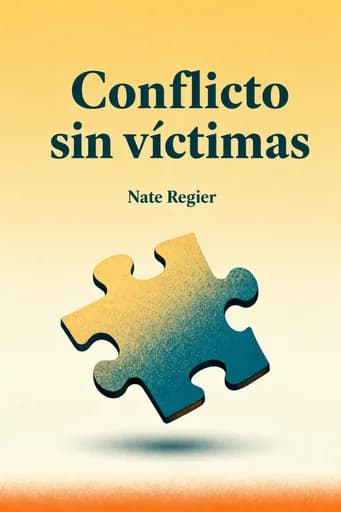
Discover how conflict becomes a creative force in "Conflict Without Casualties." Endorsed by Dan Pink and Marshall Goldsmith, Nate Regier's revolutionary approach transforms workplace drama into innovation. What if the energy you waste avoiding conflict could actually fuel your greatest breakthroughs?
Nate Regier, Ph.D., author of Conflict Without Casualties: A Field Guide for Compassionate Accountability, is a clinical psychologist, leadership consultant, and CEO of Next Element Consulting.
Specializing in transforming workplace conflict into productive collaboration, Regier blends behavioral science with his unique upbringing as the son of missionaries in Africa—an experience that shaped his passion for reconciling accountability with compassion. His expertise spans organizational culture, communication, and social-emotional intelligence, honed through decades of clinical practice and global advisory work.
Regier’s other notable works include Compassionate Accountability: How Leaders Build Connection and Get Results and Seeing People Through: Unleash Your Leadership Potential With the Process Communication Model. He hosts the On Compassion with Dr. Nate podcast and writes a weekly blog on leadership dynamics.
A certified Process Communication Model® master trainer, Regier’s frameworks are taught in corporate training programs and leadership curricula worldwide. His books have been endorsed by industry leaders and adopted by organizations seeking to build psychologically safe, high-performing teams.
Conflict Without Casualties by Nate Regier provides a roadmap for transforming destructive conflict into productive energy using compassionate accountability. The book introduces frameworks like the Compassion Cycle and the ORPO Method (Open, Resourceful, Persistent, Open) to help leaders navigate disagreements without drama. It also explores the Drama Triangle (Persecutor, Victim, Rescuer) and offers strategies to shift teams toward healthier communication.
This book is ideal for leaders, HR professionals, and teams seeking to improve workplace dynamics. It’s particularly valuable for those managing high-stakes conflicts, fostering collaboration, or building resilient cultures. Coaches and trainers focused on emotional intelligence or conflict resolution will also find actionable tools.
Yes, readers praise its practical frameworks and real-world applications, rating it 4/5 stars. The ORPO method and Drama Triangle insights are highlighted as transformative for improving communication and reducing workplace drama. Its blend of psychology and leadership tactics makes it a standout resource for conflict resolution.
The Compassion Cycle teaches leaders to balance empathy with accountability. It involves:
This model helps teams channel conflict into creative problem-solving.
Regier redefines the Drama Triangle (Persecutor, Victim, Rescuer) as a toxic pattern that derails teams. The book provides strategies to:
The ORPO Method (Open, Resourceful, Persistent, Open) is a four-step framework to resolve conflicts constructively:
This approach minimizes casualties and maximizes collaboration.
While both books emphasize self-awareness in conflict, Regier’s work focuses more on actionable tools (e.g., ORPO) and team dynamics. Leadership and Self-Deception by Arbinger Institute highlights mindset shifts, whereas Regier blends psychology with practical leadership strategies.
Notable quotes include:
These emphasize reframing conflict as a catalyst for growth.
Yes, its principles apply to virtual settings by:
Some readers note the corporate-focused examples may less resonate with small teams or nonprofits. However, the core frameworks are broadly adaptable. A few find the Drama Triangle concept repetitive if familiar with prior psychology literature.
Regier’s clinical psychology doctorate and leadership consulting expertise inform the book’s blend of academic rigor and real-world applications. His experience as CEO of Next Element ensures strategies are tested in organizational settings.
For further reading, consider:
Siente el libro a través de la voz del autor
Convierte el conocimiento en ideas atractivas y llenas de ejemplos
Captura ideas clave en un instante para un aprendizaje rápido
Disfruta el libro de una manera divertida y atractiva
Conflict is fundamentally a gap between what we want and what we experience.
Toxic workers actually cause more damage.
Not all helping is actually helpful.
True compassion means 'co-suffering' or 'struggling with'
Drama creates enormous costs.
Desglosa las ideas clave de Conflict Without Casualties en puntos fáciles de entender para comprender cómo los equipos innovadores crean, colaboran y crecen.
Experimenta Conflict Without Casualties a través de narraciones vívidas que convierten las lecciones de innovación en momentos que recordarás y aplicarás.
Pregunta cualquier cosa, elige tu estilo de aprendizaje y co-crea ideas que realmente resuenen contigo.

Creado por exalumnos de la Universidad de Columbia en San Francisco
"Instead of endless scrolling, I just hit play on BeFreed. It saves me so much time."
"I never knew where to start with nonfiction—BeFreed’s book lists turned into podcasts gave me a clear path."
"Perfect balance between learning and entertainment. Finished ‘Thinking, Fast and Slow’ on my commute this week."
"Crazy how much I learned while walking the dog. BeFreed = small habits → big gains."
"Reading used to feel like a chore. Now it’s just part of my lifestyle."
"Feels effortless compared to reading. I’ve finished 6 books this month already."
"BeFreed turned my guilty doomscrolling into something that feels productive and inspiring."
"BeFreed turned my commute into learning time. 20-min podcasts are perfect for finishing books I never had time for."
"BeFreed replaced my podcast queue. Imagine Spotify for books — that’s it. 🙌"
"It is great for me to learn something from the book without reading it."
"The themed book list podcasts help me connect ideas across authors—like a guided audio journey."
"Makes me feel smarter every time before going to work"
Creado por exalumnos de la Universidad de Columbia en San Francisco

Obtén el resumen de Conflict Without Casualties como PDF o EPUB gratis. Imprímelo o léelo sin conexión en cualquier momento.
Imagine a world where conflict isn't something to avoid but a powerful energy source waiting to be tapped. This revolutionary perspective forms the foundation of "Conflict Without Casualties." Conflict itself isn't inherently destructive-it's simply the gap between what we want and what we experience. This gap generates energy that can either destroy relationships or catalyze remarkable growth. The difference lies entirely in how we channel it. When we misuse conflict energy, we create drama-a state where people struggle against themselves or others to justify negative behavior. But what if we could transform this same energy into a creative force? This isn't just theoretical-organizations like Microsoft and Coca-Cola have made this approach required reading in their leadership programs, with executives reporting transformative results in how they handle disagreement. The key insight? Conflict itself isn't the problem-drama is. And drama follows predictable patterns we can learn to recognize and redirect.
We've all experienced toxic conflicts that follow predictable patterns. Psychologist Stephen Karpman named this the "Drama Triangle," where people cycle through three roles: The Persecutor ("I'm OK, you're not OK") who criticizes and controls others; the Victim ("I'm not OK, you are OK") who surrenders assertiveness and accepts blame; and the Rescuer ("I'm OK, and others would be if they'd let me help") who offers unsolicited solutions that ultimately disempower. The triangle's power comes from how each role recruits others - a Persecutor needs a Victim, a Victim needs a Rescuer, and a Rescuer needs someone to fix. The triangle balances on its point, reflecting its instability as we shift between roles to justify our behavior. Behind these external roles lies an internal triangle of voices from our past - authority figures whose messages shape our responses. Recognizing when we're caught in this pattern is the first step toward breaking free.
Drama isn't just emotionally exhausting - it's financially devastating. U.S. organizations lose approximately $359 billion annually dealing with conflict. Harvard research reveals that toxic workers cause more damage than star employees add value. A toxic employee costs about $12,500 in turnover expenses, compared to the $5,300 in added value from top performers. The actual difference is likely greater when considering litigation, lower morale, and customer dissatisfaction. Drama profoundly shapes organizational culture. Leaders operating from the Drama Triangle create predictable patterns: Victim leaders avoid conflict and foster risk-averse cultures; Rescuer leaders position themselves as indispensable experts, creating excessive meetings and poor collaboration; Persecutor leaders rule through fear, breeding secrecy, competition, and high turnover. Drama transforms entire organizational ecosystems. What would it mean for your workplace if this energy could be redirected toward innovation and growth instead?
Have you ever tried to help someone only to make things worse? Not all helping is actually helpful. Help offered from drama positions creates negative consequences despite good intentions. Victims help to soothe their need to be needed rather than empowering others - they struggle instead of you, not with you. Rescuers operate from the myth "I can make you feel good emotionally" with the belief "I'm OK. You're only OK if you let me fix you," creating dependency while maintaining emotional distance. The Drama Triangle spreads through Drama Allies who play the same role as you, validating negative behavior, and Drama Adversaries who play complementary roles validating each other's myths. A Persecutor believing "I can make you feel bad emotionally" perfectly matches a Victim believing "You can make me feel bad emotionally." When confronted, people often switch roles to maintain justification - like the CEO who regularly played Victim by arriving late and complaining about crises, but instantly became the Persecutor when challenged. What drama roles do you find yourself playing when trying to help others?
True compassion means "co-suffering" or "struggling with" - getting in the trenches together as equals. Gandhi, Mandela, and King practiced this form of compassion. The Compassion Cycle offers three interdependent ways of feeling, thinking, and acting that work together as alternatives to drama roles. Openness (alternative to Victim) is "a state of non-judgmental receptivity to your own and others' experiences." It conveys "You and I are worthwhile" through transparency, courage, and empathy. Practice openness by asking about feelings, validating others' experiences without judgment, and disclosing your authentic feelings. Resourcefulness (antidote to Rescuing) is "the curious collection, assessment, and utilization of resources to guide action." Be resourceful by gathering multiple ideas before sharing yours, building on past successes, and leveraging personal strengths for new problems. Persistence (alternative to Persecutor) holds self and others accountable while respecting dignity. Practice persistence by clearly stating boundaries before issues arise, maintaining consistency between promises and actions, and accepting responsibility without excuses.
The Compassion Cycle operates according to three fundamental rules. Rule 1: Start at Open - Beginning with openness creates safety, reduces defensiveness, and engages empathy. This starting point is challenging during conflict because it requires vulnerability. When we bypass openness, we create defensiveness by ignoring the emotional foundation needed for problem-solving. Rule 2: Movement is Necessary - Each compassion skill is vital but insufficient alone. Openness creates safety but doesn't solve problems. Resourcefulness generates options without implementing them. Persistence implements solutions but requires returning to Openness for evaluation. Unresolved workplace disputes are often stuck in one part of the cycle. Rule 3: The Only Way Forward is Forward - The Compassion Cycle moves counter-clockwise from Openness to Resourcefulness to Persistence and back to Openness. Moving backward results in endless planning without execution or continuous discussion without action. The cycle's effectiveness balances emotional intelligence with practical action, meeting both human and organizational needs.
The Formula for Compassionate Conflict provides a powerful O-R-P-O framework (Open-Resourceful-Persistent-Open). Consider Jamie, a trainer confronting a disruptive CFO. Rather than surrendering to drama, Jamie clearly stated her feelings, needs, and boundaries: "I'm feeling angry because I'm working hard to teach willing participants. I want to maintain a safe environment. Will you discontinue criticism or leave?" After tense silence, the CFO apologized and participated positively - shocking the group who had never seen anyone successfully stand up to him. Building resilience against drama requires awareness of key risk factors: overrelying on your strongest Compassion Skill during stress, navigating rapid change without adequate skills, facing drama recruitment, and depleting emotional reserves. The solution involves strengthening all Compassion Skills and engaging in activities that energize your best self. Compassion may be what keeps humanity alive. The Compassion Cycle affirms human potential while providing a roadmap for recognizing where we are and what to do next. Maturity means living a "mythless life" - rejecting myths that we can control others' emotions or that they control ours. This approach enables conflict without casualties because we recognize that people are worthwhile, capable, and accountable. What if we transformed conflict from a destructive force into a creative one?