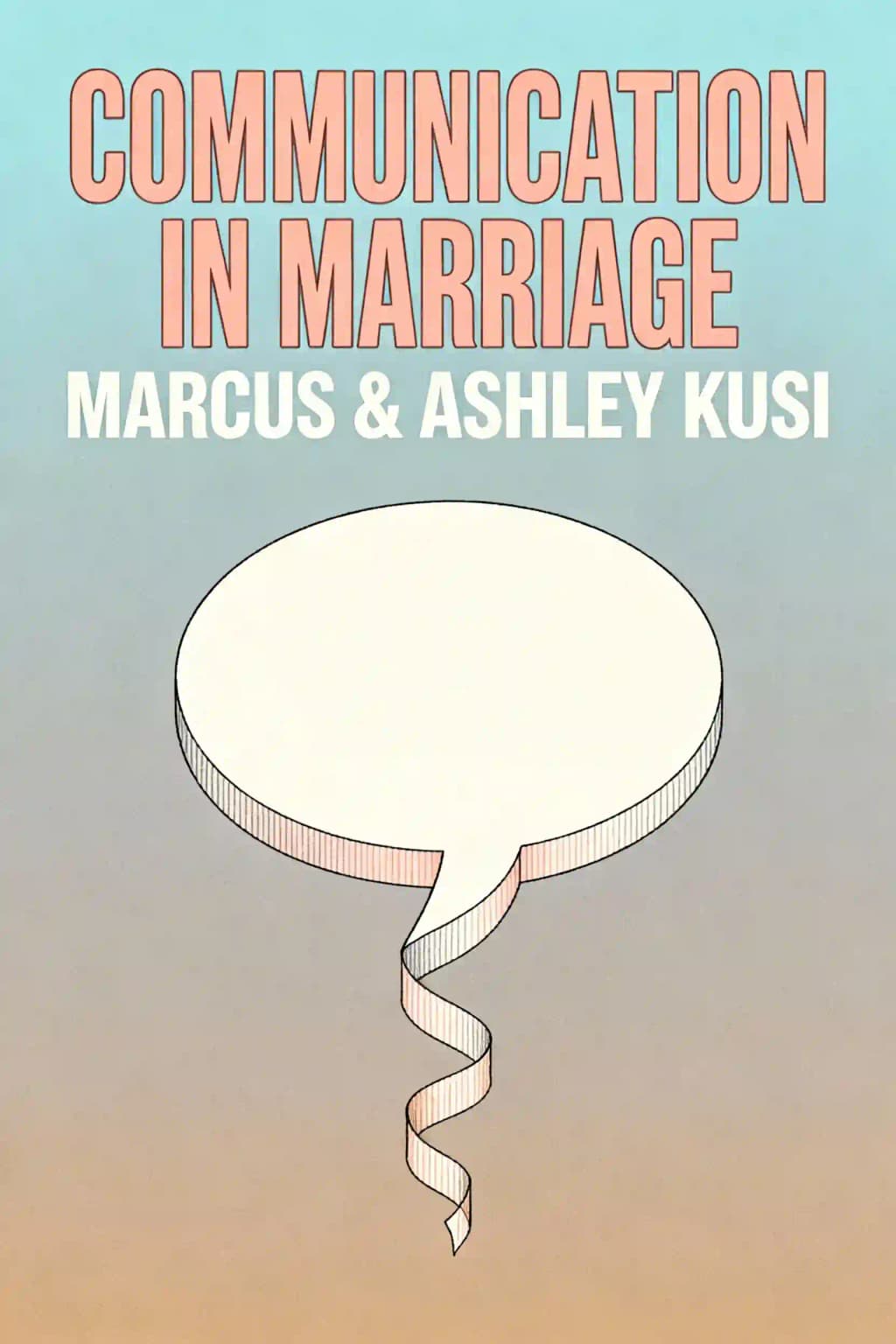
Struggling to connect with your spouse? "Communication in Marriage" offers transformative strategies endorsed by relationship experts Tony and Alisa DiLorenzo. Even couples married 51 years discovered new insights. What communication style is sabotaging your relationship without you realizing it?
Marcus Kusi and Ashley Kusi, bestselling authors of Communication in Marriage: How to Communicate with Your Spouse Without Fighting, are acclaimed marriage mentors and advocates for healthy relationship dynamics. Drawing from their multicultural background—Marcus hails from Ghana, while Ashley is a Vermont native—they combine Marcus’s analytical expertise as a Business Analyst and Ashley’s psychology education to offer practical strategies for conflict resolution and emotional connection. Their work is rooted in their own marriage journey since 2010 and parenthood experiences, giving their advice relatable authenticity.
The couple co-hosts the First Year Marriage Show podcast and runs the popular blog Our Peaceful Family, where they share actionable tools for building resilient partnerships. Alongside Communication in Marriage, they authored First Year of Marriage: The Newlywed’s Guide to Building a Strong Foundation and Our Bucket List Adventures: A Journal for Couples, fostering both practical and creative marital growth.
Their books, celebrated for their no-nonsense, empathy-driven approach, have become essential resources for couples worldwide, blending research-backed methods with real-world application. Over 100,000 readers follow their blog for monthly insights, cementing their reputation as trusted voices in modern relationship guidance.
Communication in Marriage by Marcus and Ashley Kusi tackles modern marital communication breakdowns that contribute to rising infidelity rates. The book emphasizes trust-building, adaptive communication styles, and navigating sensitive topics like finances or intimacy. It provides actionable frameworks for fostering emotional safety, resolving conflicts, and sustaining long-term connection through intentional dialogue strategies.
This book is ideal for couples seeking to strengthen trust, improve conflict resolution, or rebuild after breaches like dishonesty. It’s particularly valuable for partners struggling with mismatched communication styles (e.g., emotional vs. solution-focused) or those navigating high-stakes discussions about parenting, sex, or financial stress.
Yes—the Kusi’s blend research-backed strategies with real-world examples from their marital and counseling experience. Readers gain tools like empathy-first listening, trust-repair protocols, and structured dialogue formats for contentious topics. The focus on actionable steps over abstract theory makes it practical for immediate application.
Key frameworks include:
The Kusis advocate a 3-phase approach:
Notable insights include:
The book provides a phased reconciliation roadmap:
Some reviewers note the strategies require significant emotional labor from both partners, which may challenge couples in crisis. Others highlight the faith-neutral approach lacks spiritual integration desired by religious audiences.
While both address relational dynamics, the Kusis focus specifically on dialogue mechanics rather than broader love expression. Communication in Marriage offers more conflict-resolution templates, whereas Chapman’s work emphasizes emotional preference alignment.
Yes—the book details a 4-step financial dialogue protocol:
As an interracial couple and former marriage coaches, they blend personal experience with clinical insights. Their dual-gender perspectives address common communication pitfalls between masculine (solution-focused) and feminine (emotion-centered) styles.
The book addresses modern stressors like texting misinterpretations and social media secrecy. Solutions include “device-free dialogue hours” and mutual access agreements to prevent digital mistrust.
Siente el libro a través de la voz del autor
Convierte el conocimiento en ideas atractivas y llenas de ejemplos
Captura ideas clave en un instante para un aprendizaje rápido
Disfruta el libro de una manera divertida y atractiva
Wives need love and husbands need respect.
Most people don't listen with the intent to understand; they listen with the intent to reply.
Desglosa las ideas clave de Communication in Marriage en puntos fáciles de entender para comprender cómo los equipos innovadores crean, colaboran y crecen.
Experimenta Communication in Marriage a través de narraciones vívidas que convierten las lecciones de innovación en momentos que recordarás y aplicarás.
Pregunta cualquier cosa, elige tu estilo de aprendizaje y co-crea ideas que realmente resuenen contigo.

Creado por exalumnos de la Universidad de Columbia en San Francisco
"Instead of endless scrolling, I just hit play on BeFreed. It saves me so much time."
"I never knew where to start with nonfiction—BeFreed’s book lists turned into podcasts gave me a clear path."
"Perfect balance between learning and entertainment. Finished ‘Thinking, Fast and Slow’ on my commute this week."
"Crazy how much I learned while walking the dog. BeFreed = small habits → big gains."
"Reading used to feel like a chore. Now it’s just part of my lifestyle."
"Feels effortless compared to reading. I’ve finished 6 books this month already."
"BeFreed turned my guilty doomscrolling into something that feels productive and inspiring."
"BeFreed turned my commute into learning time. 20-min podcasts are perfect for finishing books I never had time for."
"BeFreed replaced my podcast queue. Imagine Spotify for books — that’s it. 🙌"
"It is great for me to learn something from the book without reading it."
"The themed book list podcasts help me connect ideas across authors—like a guided audio journey."
"Makes me feel smarter every time before going to work"
Creado por exalumnos de la Universidad de Columbia en San Francisco

Obtén el resumen de Communication in Marriage como PDF o EPUB gratis. Imprímelo o léelo sin conexión en cualquier momento.
When was the last time you felt truly understood by your partner? Not just heard, but deeply comprehended? Communication breakdowns represent the hidden crisis in modern marriages, with research showing that the average couple spends just 4 minutes per day in meaningful conversation. The revolutionary premise of Marcus Kusi's approach is deceptively simple yet profoundly challenging to implement: no one can read your mind - not even the person who loves you most. This fundamental truth underpins every successful marriage, yet remains stubbornly difficult to practice in our daily lives. Whether your communication feels broken or you simply want to elevate it from good to extraordinary, understanding effective marital communication can transform your relationship from a battlefield of misunderstandings into a sanctuary of connection.
Have you ever explained something perfectly clearly to your spouse, only to have them respond as if you'd spoken in Klingon? This isn't coincidence - men and women often communicate with fundamentally different objectives. Men typically approach conversations with a problem-solving orientation, while women frequently communicate to process emotions and build connection. In a common scenario: A wife describes a frustrating conflict with her colleague. Her husband immediately jumps in with advice. The wife becomes frustrated - not because the advice is bad, but because she needed someone to listen and validate her feelings first. The breakthrough comes with one simple question: "Do you want me to just listen, or would you like my suggestions?" Remember that body language accounts for approximately 90% of our communication - your crossed arms or diverted eyes might communicate more than your words. This connects to Dr. Emerson Eggerichs' love and respect dynamic - women typically prioritize feeling loved while men prioritize feeling respected. When a wife feels genuinely loved, she naturally responds with respect; when a husband feels truly respected, he more readily shows love. This creates a virtuous cycle that transforms communication patterns.
In our distraction-filled world, giving someone your complete attention has become almost countercultural. Yet this simple act-listening with your full being-might be the most powerful communication skill in marriage. Empathic listening means temporarily stepping out of your perspective to understand your spouse's experience from within. As Stephen Covey noted, "Most people don't listen with the intent to understand; they listen with the intent to reply." When you listen to understand rather than formulate your response, you create space for your spouse to fully express themselves. You notice the hesitations, emotional undertones, and unspoken concerns that often contain more truth than the words themselves. Practical listening involves eliminating distractions: put down your phone, turn off screens, and make eye contact. Simple techniques help: touch your spouse's arm to signal attention; suggest "Let me know when you're ready to listen" rather than demanding immediate attention; and show genuine interest through questions. Our expectations about communication shape our marriage, yet most couples never discuss them explicitly. These expectations form silently, influenced by family backgrounds, past relationships, and cultural contexts. Without awareness, they become invisible tripwires. How did your family communicate? Did your parents discuss issues calmly or escalate into shouting? These patterns become our default templates unless consciously examined. The solution begins with making the implicit explicit. Have direct conversations about communication expectations: How do you prefer receiving feedback? What does respectful disagreement look like to you? How much alone time do you need after conflict? These discussions prevent disappointment from unmet, unspoken expectations.
What if conflict could actually strengthen your marriage rather than threaten it? This perspective shift transforms how couples approach disagreements. Two unique individuals will inevitably disagree. The key isn't avoiding conflict but communicating through it effectively - fighting fair by attacking problems rather than each other. Healthy conflict excludes screaming, name-calling, and character assassination. Focus on specific behaviors rather than making sweeping judgments about your spouse. Use your differences to complement rather than compete with each other. Speak in a measured tone, as raised voices trigger defensive responses. Never compare your spouse unfavorably to others - these comparisons create lasting wounds. For recurring conflicts, look beyond surface disagreements to identify root causes. What appears to be an argument about chores often reflects deeper concerns about respect or appreciation. Avoid keeping score in your marriage by tracking wrongs. Marriage isn't a competition but a partnership where you succeed or fail together.
Imagine trying to build a house without a foundation - no matter how beautiful the structure, it would eventually collapse. Similarly, communication without trust may appear functional temporarily but inevitably breaks down under pressure. Trust forms the essential foundation for all marital communication. Without trust, partners withhold vulnerable thoughts and feelings, creating emotional distance that prevents authentic connection. This emotional security enables the deep intimacy that gives marriage meaning. Without it, conversations remain superficial, with partners presenting edited versions of themselves. Building complete trust requires intentional effort. Practice radical honesty about your past, present circumstances, and future plans. Be trustworthy in small matters - admit when you've overspent or failed to keep commitments. Even small lies erode trust disproportionately, with the deception itself often damaging the relationship more than what's being concealed. Trust creates the foundation for emotionally naked communication that makes marriage fulfilling. By eliminating deception, keeping promises, and listening without judgment, you create the psychological safety necessary for your relationship to flourish through honest expression without fear of rejection.
Respect manifests in how you speak to and about your spouse, both privately and publicly. It means honoring their opinions, acknowledging their contributions, and valuing their perspectives - even during disagreements. Sometimes respect must be given before it feels earned, representing a profound act of selflessness in marriage. Love in communication extends beyond words to include actions, attitudes, and intentions. It means thinking before speaking, wanting the best for your spouse, and showing grace during difficult conversations. The expressions that most powerfully communicate love vary by individual - what Gary Chapman calls "love languages." Communication expectations span all marriage areas - finances, intimacy, household responsibilities, social activities, and conflict resolution. Regular check-ins about goals create opportunities for compromise through patience, understanding, listening, and teamwork.
The journey to better communication requires effort but promises growth and connection when approached as a shared mission. Effective communication creates a relationship where both partners feel heard, valued, respected, and loved - building a foundation strong enough to support life's challenges. When communication flows freely, marriage becomes a profound connection between two people who choose each other daily, cultivated through countless conversations where partners practice truly seeing and hearing each other. This journey never ends. Couples who prioritize communication continue discovering new depths in each other even after decades together. Each conversation becomes an opportunity to know your spouse more fully and be known more completely. This ongoing revelation makes marriage not just endurable but extraordinary. Will you have the courage to speak honestly and listen completely? Your relationship deserves nothing less.