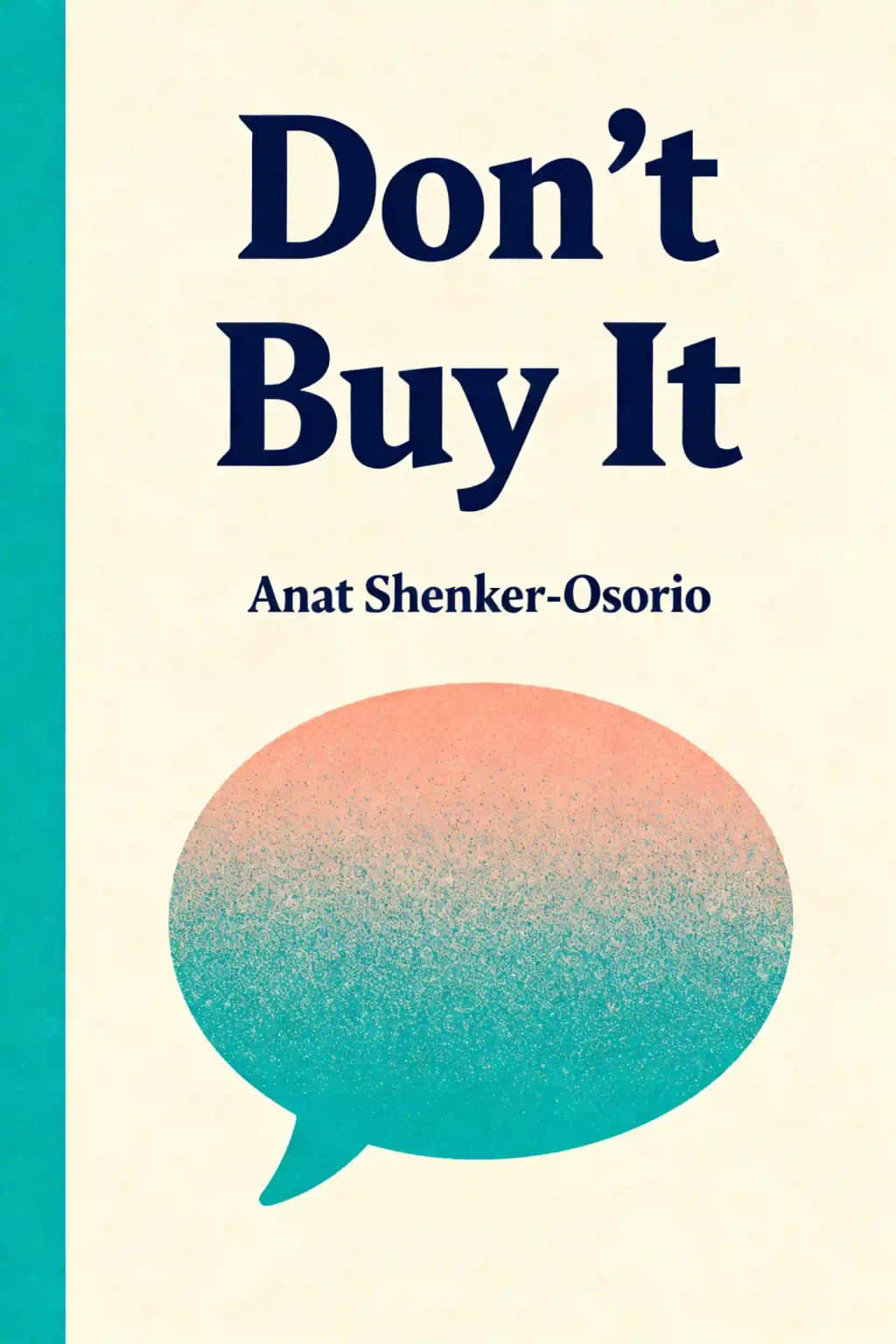
Don't buy it
the trouble with talking nonsense about the economy
Overview of Don't buy it
Discover why economists speak nonsense. Shenker-Osorio's groundbreaking work exposes how language shapes economic policy, influencing UC Berkeley's policy discussions. What if our economic metaphors aren't just wrong, but actively harmful? Reframe the economy as your vehicle, not your boss.

Key Themes in Don't buy it
- economic metaphor
- political messaging
- systemic inequality
- narrative framing
- capitalist dogma
Quotes from Don't buy it
We've been conditioned to worry about 'hurting the economy' rather than hurting actual people.
The rules clearly benefit those who make them.
We haven't created a compelling economic storyline to counter the conservative free-market fable.
This narrowing has made economics increasingly 'dismal.'
We've essentially conceded the economic battlefield.
Characters in Don't buy it
- Anat Shenker-OsorioAuthor and expert on economic narratives
- Kelley Williams-BolerMother jailed for school district residency fraud
- Lilly LedbetterPlaintiff in a landmark pay discrimination case
- Thomas SowellConservative economist and social theorist
About the Author
About the Author of Don't buy it
Anat Shenker-Osorio, author of Don’t Buy It: The Trouble with Talking Nonsense About the Economy, is a political strategist and messaging expert renowned for her evidence-based approach to communication.
A Columbia University and UC Berkeley graduate with a background in public policy and cognitive linguistics, she founded ASO Communications to help progressive causes craft winning narratives. Her work on economic justice, racial equity, and democratic reform has shaped campaigns worldwide, including Ireland’s Together For Yes abortion rights victory and New Zealand’s Labour Party resurgence under Jacinda Ardern.
Shenker-Osorio hosts the Words to Win By podcast, dissecting successful narrative strategies, and her insights have been featured in The New York Times, The Atlantic, and The Guardian. A former Open Society Foundations fellow, she advises institutions like the Ford Foundation and Congressional Progressive Caucus.
Don’t Buy It—praised for dismantling misleading economic rhetoric—has influenced policy debates and grassroots movements across five continents.
Download Summary of Don't buy it
Get the Don't buy it summary as a free PDF or EPUB. Print it or read offline anytime.
FAQs About This Book
Don't Buy It critiques flawed economic discourse that frames the economy as an uncontrollable force or living entity, exposing how such metaphors perpetuate conservative policies. Anat Shenker-Osorio argues for progressive messaging reframing, advocating terms like “inequality as a barrier” instead of “gaps” to shift blame from individuals to systemic inequities. The book provides actionable strategies to reshape public perception of fiscal policies.
Progressives, policymakers, and activists seeking to counter conservative economic narratives will benefit from this book. It’s also valuable for communications professionals interested in metaphor-driven messaging and readers analyzing how language shapes policy debates. Shenker-Osorio’s insights are particularly relevant for those advocating wage reform, corporate accountability, or equitable economic systems.
Yes—the book offers a compelling blend of linguistic analysis and political strategy, equipping readers to dismantle harmful economic myths. Its critique of terms like “economic health” and practical frameworks for progressive messaging make it a resource for impactful advocacy. Critics note occasional repetitiveness but praise its actionable takeaways.
Shenker-Osorio challenges metaphors like “the economy as a living being” or “market forces,” which imply inevitability. She proposes alternatives:
- Inequality as a barrier (not a “gap”), emphasizing systemic exclusion.
- Economy as a garden, requiring active cultivation via policy.
These reframes redirect focus to human agency and structural change.
The book argues against framing inequality as a natural “gap,” which obscures systemic causes. Shenker-Osorio redefines it as a man-made barrier—highlighting how policies and power imbalances restrict access to opportunity. This shift urges solutions like taxing wealth hoarding and strengthening labor rights.
She identifies conservative messaging flaws:
- Personifying the economy as a fragile entity needing appeasement.
- Fatalistic terms like “market forces” that discourage intervention.
These frames, she argues, normalize austerity and corporate favoritism while sidelining equity.
- "The economy isn’t a creature—it’s a collection of choices."
- "Inequality isn’t a gap; it’s a wall someone built."
These lines encapsulate the book’s call to replace passive metaphors with language emphasizing human agency and accountability.
Some reviewers note the book’s repetitive emphasis on metaphor analysis over broader policy solutions. Others argue its progressive lens may overlook bipartisan common ground. However, its messaging strategies are widely praised for empirical rigor and real-world applicability.
The book’s focus on narrative control aligns with current debates about AI-driven disinformation, gig economy exploitation, and wealth inequality. Its tools for reframing “economic necessity” arguments are critical for addressing climate policy and corporate tax evasion.
Anat Shenker-Osorio is a political strategist, founder of ASO Communications, and host of the Words to Win By podcast. With a master’s in public policy from UC Berkeley, she advises progressive groups on messaging for economic justice, racial equity, and climate action.
The book teaches how to:
- Replace fatalistic terms with proactive language.
- Expose coded phrases like “fiscal responsibility” as austerity dog whistles.
- Center systemic culprits (e.g., corporations) over individual blame.
These tactics empower advocates to steer conversations toward structural solutions.
For readers interested in narrative strategy, consider:
- George Lakoff’s Don’t Think of an Elephant (framing in politics).
- Naomi Klein’s The Shock Doctrine (economic crisis exploitation).
- Robert Reich’s Saving Capitalism (reforming economic systems).