Capítulo 1
Your Brain: A User's Manual for Peak Performance
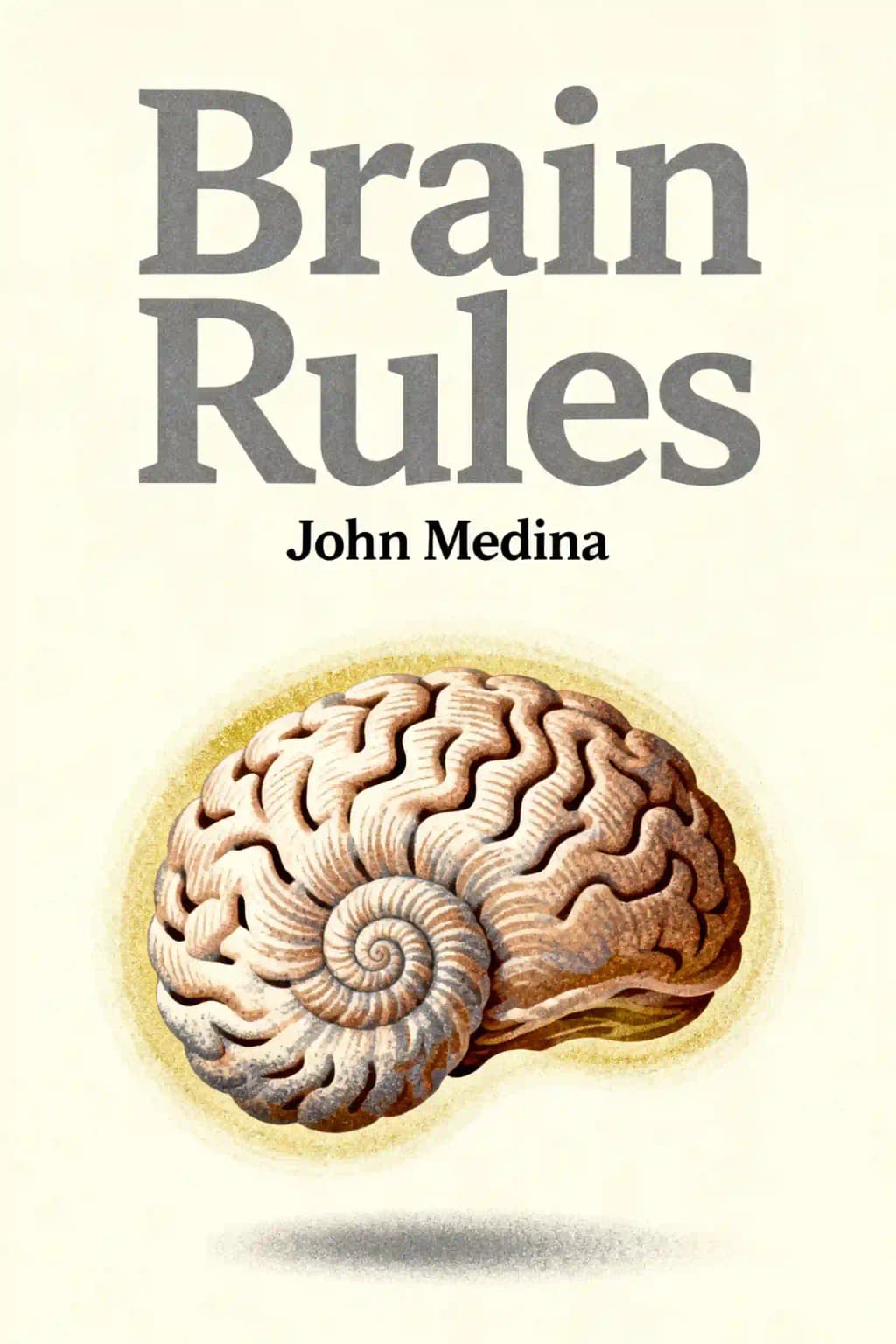
Have you ever wondered why you can't remember where you left your keys, yet can recall every lyric to a song from 20 years ago? Or why that afternoon slump hits like clockwork at 3 PM? The answers lie in the remarkable three-pound universe between your ears. John Medina's "Brain Rules" has become a cornerstone text in neuroscience education, selling over a million copies and appearing on reading lists from business schools to psychology departments. This molecular biologist's straightforward approach to brain science has made him a sought-after speaker for organizations like Boeing, Microsoft, and the Gates Foundation. What makes this book particularly compelling is how Medina translates complex neuroscience into practical applications for everyday life. Unlike many pop-science books that oversimplify, "Brain Rules" maintains scientific integrity while remaining accessible-a balance that's earned praise from both academic researchers and business leaders looking to optimize human performance.
Capítulo 2
Evolution Shaped Our Brains for Movement, Not Sitting
Our brains evolved while walking 12 miles daily across the African savannah, not while sitting in classrooms or cubicles. This evolutionary mismatch explains why exercise dramatically impacts cognitive function. Jack LaLanne, the fitness pioneer who remained mentally sharp into his 90s, embodied this connection between physical activity and brain health.
Consider two men in their 80s: nursing home resident Jim with vacant eyes versus architect Frank Lloyd Wright designing the Guggenheim Museum with brilliant clarity at the same age. The difference? Their physical activity levels. Research consistently shows that active people outperform sedentary ones in tests measuring long-term memory, reasoning, attention, and problem-solving.
Our ancestors' nomadic lifestyle required constant adaptation to new environments. Homo erectus and later Homo sapiens rapidly expanded their territories, crossing rivers, deserts, and mountains without maps or tools. This physical movement directly shaped our cognitive development-our sophisticated brains evolved not while lounging around but while actively navigating challenging environments.
Exercise improves brain function through multiple mechanisms. Though only 2% of body weight, the brain consumes 20% of our energy and requires constant oxygen. Exercise stimulates blood vessels to produce nitric oxide, creating new vessels that penetrate deeper into brain tissues, particularly the hippocampus-critical for memory formation. It also increases BDNF (Brain Derived Neurotrophic Factor), a protein that keeps neurons healthy and promotes new neural connections-essentially fertilizing the brain.
The implications are clear: our sedentary lifestyle represents a dramatic departure from our evolutionary heritage. Exercise doesn't make us smarter-it restores us to our natural cognitive state. Schools cutting physical education to focus on test scores are employing a counterproductive strategy, as studies show students with regular physical activity perform better academically. Progressive companies like Boeing are implementing exercise breaks during work hours, with teams hitting more performance targets as a result.
The solution might be as simple as twice-daily exercise breaks in schools and workplaces, or even treadmill-equipped classrooms and offices where people could walk at 1-2 mph while learning or meeting. These approaches naturally increase oxygen supply to the brain and improve cognitive performance-bringing us closer to the conditions under which our remarkable brains evolved.
Capítulo 3
Symbolic Thinking: The Human Superpower
What truly separates humans from other animals isn't our strength but our symbolic reasoning-our ability to attribute characteristics to things that don't possess them naturally. This "Dual Representational Theory" enables us to transform objects mentally (like seeing a stick as a sword), create language, develop mathematics, and produce art.
This cognitive superpower didn't emerge suddenly but evolved as a survival strategy in response to climate change. After millions of years in stable tropical environments, our ancestors faced at least 17 Ice Ages. As Northern and Eastern Africa transformed from tropics to dusty plains, early humans found themselves vulnerable prey in unfamiliar grasslands. Rather than becoming stronger, we became smarter-growing "fangs in the head rather than the mouth."
Bipedalism was crucial to this evolutionary shift. Walking upright proved energy-efficient, using fewer calories than four-legged locomotion. Our bodies redirected this energy surplus not to muscles but to our brains, which now consume 20% of our energy despite being only 2% of body weight. This led to the development of our prefrontal cortex, which governs uniquely human "executive functions": problem-solving, attention maintenance, and emotional impulse control.
Humans dominated not through individual strength but through cooperation. By forming alliances, we effectively doubled our biomass without doubling individual strength. This cooperative strategy required understanding others' motivations-the foundation of Theory of Mind. This uniquely human ability to infer others' mental states demands tremendous intelligence and brain activity, leading to our capacity for symbolic thinking.
Our evolutionary history suggests learning is deeply rooted in relationships, with performance affected by emotional environments. When students don't feel safe with teachers, or employees with bosses, performance suffers. This principle applies even to highly intellectual ventures-success depends fundamentally on feelings of safety and connection.
Any learning environment that ignores either our database instincts or improvisatory abilities is doomed to fail. Schools and workplaces that focus only on rote learning stifle creativity, while those emphasizing creativity without building knowledge produce people who "play intellectual air guitar." The most effective environments balance both structured knowledge and creative exploration-just as our ancestors needed both to survive.
Capítulo 4
Every Brain Is Uniquely Wired
Why could Michael Jordan dominate basketball but fail at baseball, while Ken Griffey Jr. excelled at baseball during the same period? The answer lies in how their brains were wired-how neurons communicate with muscles and skeletons to create specialized talents.
Our brains contain approximately 100 billion neurons, each resembling a smashed star with extended points-cell bodies with dendrites, axons, and terminals. These neurons communicate across synaptic clefts through neurotransmitters, forming up to 10,000 connections in a small space. This creates a dense, branching forest of neural connections that's uniquely configured in each person.
Nobel Prize winner Eric Kandel discovered that learning physically changes brain wiring. As neurons learn, they swell, sway, split, break connections, and form new ones-constantly reorganizing themselves. Like muscles, brains grow larger and more complex with activity. Violin players develop enlarged neural regions controlling their left hands (which perform complex movements) while regions controlling their bow-drawing right hands remain less developed.
The human brain comes only partially constructed at birth, requiring years to fully develop. Major construction continues into our early twenties, with fine-tuning extending into our mid-forties. Brain development follows a double-humped pattern-intense neural growth and pruning during the "terrible twos" and again during the "terrible teens."
Our brains contain "experience-dependent" wiring that forms in response to our unique experiences. Researchers discovered neurons that respond only to specific people-like a "Jennifer Aniston neuron" that fired when viewing her image but ignored 80 other images. Even identical twins watching the same movie develop different neural patterns based on their slightly different perspectives and prior experiences.
Neurosurgeon George Ojemann's work with electrical stimulation mapping reveals that no two brains are wired identically in structure or function. Even language is stored differently in each person-from nouns to verbs to grammar. Bilingual people store different languages in different brain regions. Ojemann found these individual neural maps are established early in life and remain stable throughout.
Given this evidence, traditional education systems that treat all brains identically seem fundamentally flawed. The author proposes smaller class sizes to leverage teachers' Theory of Mind skills and customized instruction through adaptive software, which has proven highly effective when combined with standard teaching. For businesses, he suggests screening leaders for empathy and treating employees as individuals to maximize their unique talents.
Capítulo 5
The Brain's Spotlight: How Attention Works
The brain pays closest attention to things that arouse it, as demonstrated by our vivid memories of emotionally charged events. Research consistently shows that better attention equals better learning across all academic subjects. Yet studies reveal people typically lose focus after just 10 minutes of a presentation, creating an 80% "failure rate" for lectures.
Posner's Trinity Model explains how we pay attention through three integrated brain systems: the Alerting Network (monitoring for unusual activities), the Orienting Network (gathering information about stimuli), and the Executive Network (deciding what to do). This model reveals four key insights about attention:
First, emotions powerfully capture our focus. When the brain detects an emotionally charged event, the amygdala releases dopamine, essentially placing a chemical "Remember this!" Post-It note on the information. The brain universally pays attention to three questions: "Can I eat it? Will it eat me?", "Can I mate with it? Will it mate with me?", and "Have I seen it before?" The 1984 Apple commercial masterfully used all three principles-threat (totalitarian society), sex appeal (female runner), and pattern matching (references to Orwell's novel)-creating one of advertising's most memorable moments.
Second, we remember the gist before details. The brain focuses on the essence of encounters, not literal records. Words presented in logical, hierarchical structures are remembered 40% better than random words. This principle separates novices from experts-experts organize knowledge around core concepts rather than isolated facts.
Third, multitasking is a myth when it comes to attention. Our brains are biologically incapable of processing attention-rich inputs simultaneously. When we attempt to multitask, our brain must go through a four-step sequential process: shift alert, rule activation for the first task, disengagement, and rule activation for the second task. Studies show interrupted people take 50 percent longer to complete tasks and make up to 50 percent more errors.
Fourth, the brain needs regular breaks from information overload. Most experts make the mistake of relating too much information without allowing time for mental processing. The solution is the "10-minute rule," breaking content into discrete 10-minute modules, each covering a single core concept. After each segment, the presenter must provide an "emotionally competent stimulus" or "hook" that triggers emotion, remains relevant to the material, and serves as a transition between modules.
Capítulo 6
Memory's Hidden Architecture
Memory isn't just an evolutionary advantage but what makes us consciously aware and human. It preserves our identities, relationships, and language abilities. Hermann Ebbinghaus's pioneering work revealed the depressing fact that people forget 90% of what they learn within 30 days, with most forgetting happening within hours. His research demonstrated that memories have varying lifespans and that spaced repetition significantly outperforms massed learning in creating persistent memories.
Declarative memory follows four sequential steps: encoding, storing, retrieving, and forgetting. During encoding, contrary to our belief that the brain works like a recording device, information is actually fragmented and distributed throughout different brain regions. A stroke patient who could write consonants but not vowels demonstrates this fragmentation, revealing that even language elements are stored separately.
The quality of encoding-those earliest moments of learning-powerfully predicts later recall success. Information is remembered best when it's elaborate, meaningful, and contextual. The more a learner focuses on meaning, the more elaborate the encoding process becomes. Using relevant real-world examples embedded within information dramatically improves recall. Personal examples work best-they create richer encoding by connecting to information already present in the learner's brain.
The initial moments of exposure to new information play a disproportionately important role in later recall. A professor dramatically illustrated this by partially undressing during a film class to demonstrate emotional vulnerability-an extreme but unforgettable introduction. Memory of an event is stored in the same brain structures initially recruited to perceive it, so creating compelling introductions recruits more neural pathways.
Learning and retrieval work best under matching conditions. Environmental cues present during encoding become embedded in the memory trace, creating additional "handles" for later recall. This explains why creating dedicated learning environments (like a "Spanish Room" for language learning) can be effective. Marketing professionals exploit this by creating strong environmental associations with their products.
Memory traces begin fragile and flexible but can strengthen over time through consolidation. Working memory has multiple components: the phonological loop for auditory information, the visuo-spatial sketchpad for visual information, the central executive that coordinates activities, and possibly an episodic buffer for stories. All working memory systems have limited capacity and duration unless transformed into more durable long-term memory forms through consolidation.
Our memory retrieval systems work in two ways: the passive "library model" where memories are accessed like books from shelves, and the active "crime scene model" where memories are reconstructed from fragments like a detective piecing together evidence. Initially after learning, we can reproduce specific details, but over time, we shift to reconstructive retrieval, filling gaps with inferences and sometimes unrelated memories.
Repetition is the key to creating reliable long-term memories. The typical human brain can only hold about seven pieces of information for less than 30 seconds. Simple maintenance rehearsal extends this briefly, but elaborative rehearsal-thinking or talking about information in detail immediately after exposure-creates robust, retrievable memories. The most effective approach is spaced repetition rather than cramming, as it allows neural networks to gradually build representations without interfering with existing information.
Capítulo 7
Sleep: The Brain's Essential Maintenance Mode
Despite sleep occupying one-third of our lives, we still don't fully understand why we need it. What we do know is that sleep deprivation devastates cognitive function. An A-student getting under seven hours of sleep on weekdays can plummet to the bottom 9% of performers. Military studies show one night's sleep loss causes a 30% drop in cognitive skills; two nights, 60%.
Contrary to expectations, the brain isn't resting during sleep-it's extraordinarily active, displaying greater rhythmical activity than when awake. Only during the deepest parts of non-REM sleep (about 20% of the cycle) does brain energy consumption decrease. This creates a paradox: sleep feels restorative, yet the brain remains highly active.
About 10% of humans are "larks" (early chronotypes) who feel most alert around noon, while 20% are "owls" (late chronotypes) who feel most alert around 6pm. These patterns appear genetically determined and detectable in early childhood. The remaining 70% are "hummingbirds" with intermediate patterns.
The "nap zone"-that midafternoon period of sleepiness-isn't just a response to lunch but appears to be evolutionary. NASA research shows a 26-minute nap improves pilot performance by 34%, while other studies demonstrate 30-45 minute naps boost cognitive function for up to six hours. Traffic accidents peak during this time, suggesting real cognitive consequences when we ignore our natural rhythms.
Sleep particularly enhances learning. In one remarkable study, students learning math problems were three times more likely to discover an easier solution method if they slept between sessions (60% vs. 20%). Sleep especially enhances procedural learning, visual discrimination, and motor sequencing tasks.
Businesses and schools should take sleep needs seriously, considering the $100 billion annual cost of sleep deprivation to U.S. businesses. We could match chronotypes to work schedules, freeing the 20% of workers who are sub-optimal in the 9-to-5 model. Companies could also embrace midday naps, avoiding scheduling important meetings during biological nap zones. Organizations might also tackle difficult problems by having teams sleep on them-presenting a problem, then allowing eight hours of sleep before brainstorming solutions.
Capítulo 8
Stress: When the Brain's Alarm System Goes Haywire
Stress profoundly affects learning, with some types hurting learning while others boost it. Researchers Kim and Diamond created a three-part definition of harmful stress: 1) There must be a measurable aroused physiological response, 2) The stressor must be perceived as aversive, and 3) The person must feel they lack control over the stressor. The less control one feels, the more severe the stress becomes.
When stressed, your body responds with racing pulse and rising blood pressure as adrenaline floods your bloodstream. This begins when your brain's hypothalamus detects stress and signals the adrenal glands to release adrenaline, triggering the fight-or-flight response. Cortisol follows as the "elite strike force" of our stress response. This system evolved for immediate threats lasting seconds-not the prolonged stresses of modern life.
Chronic stress damages more than our brains. While acute stress can temporarily boost cardiovascular performance, long-term stress creates rough spots in blood vessels that can lead to heart attacks and strokes. It cripples the immune system, first mobilizing white blood cells but eventually decreasing their numbers and effectiveness. Stressed individuals get sick three times more often.
For the brain, stress initially improves performance, helping form lightning-fast memories of threatening situations. But prolonged stress devastates learning-impairing math skills, language processing, memory, problem-solving, and concentration by up to 50 percent.
The battle between stress and learning features cortisol as the villain and Brain Derived Neurotrophic Factor (BDNF) as the hero. Stress hormones target the hippocampus, crucial for learning, where they can disconnect neural networks, prevent new neuron growth, and even kill cells. BDNF normally protects neurons like a military armed with Miracle Gro, keeping them alive despite stress. But when too many stress hormones persist too long, they overwhelm these defenses.
Home stress profoundly affects classroom and workplace performance. Children find unresolved marital conflict deeply disturbing, responding physiologically with faster heart rates and higher blood pressure. Studies show kids witnessing parental fighting have more stress hormones in their urine and struggle with emotional regulation. Teachers report these children appear emotionally distracted and unable to concentrate on schoolwork.
Marriage researcher John Gottman can predict relationship outcomes with nearly 90% accuracy within three minutes of observing couples interact. Gottman and researcher Alyson Shapiro developed the "Bringing Baby Home" intervention for expectant couples, applying marital interventions before the typical post-baby hostility and depression emerged. Their research revealed remarkable differences in babies from intervention households-these infants cried less, had stronger attention-shifting behaviors, and responded to stressors more stably.
The author proposes several interventions based on the Brain Rule that stressed brains learn differently. These include teaching parents first (before children enter school), offering Gottman's protocols as early as in maternity wards, and creating partnerships between health and education systems. For businesses, offering family counseling and on-site childcare could help talented employees during their most productive years, which often coincide with family formation.
Capítulo 9
The Power of Multisensory Learning
Our brains constantly integrate information from all senses to create coherent perceptions of our environment. Ancient Greeks like Aristotle believed the brain merely cooled the body while the heart did the important work. Modern understanding reveals how our brains process overwhelming sensory information-from the pounding music, laser lights, smells, and emotions in a nightclub to the cacophony of Manhattan streets.
Scientists propose different theories for sensory integration, ranging from centralized processing to distributed processing. Current evidence suggests the senses help one another in a precisely coordinated fashion rather than working independently.
Perception involves both bottom-up and top-down processing. When reading a sentence, bottom-up processors first analyze visual features like lines and curves to identify letters and words. Then top-down processing interprets this information based on previous knowledge and experience. This explains why two people can perceive the same input differently.
Our senses evolved to work together in our multisensory East African environment. Even in synesthesia-where senses cross-connect, causing people to taste words or see sounds-this collaborative wiring is evident. Experiments show that visual inputs influence auditory processing even with sound turned off, and tactile stimulation boosts visual perception.
Cognitive psychologist Richard Mayer has demonstrated that multisensory learning environments consistently outperform unisensory ones. Students exposed to information through multiple senses show more accurate recall, better problem-solving (generating 50-75% more creative solutions), and longer retention-even 20 years later. These improvements exceed what you'd predict from simply adding individual sensory inputs-a "supra-additive integration" effect.
Mayer's research has yielded practical multimedia presentation principles: (1) Students learn better from words and pictures than words alone; (2) Corresponding words and pictures should be presented simultaneously rather than successively; (3) Related words and pictures should be positioned near each other on the page or screen; (4) Extraneous material should be excluded; (5) Students learn better from animation and narration than from animation and on-screen text.
The power of smell to evoke memory-known as the Proust effect-can be astonishing. Studies show smell-exposed groups can retrieve up to twice as many memories as control groups, with particularly strong effects on emotional and autobiographical memories. Unlike other sensory systems, smell signals bypass the thalamus and go directly to the amygdala, which explains why smells so powerfully trigger emotions and memories.
Multisensory approaches could revolutionize learning environments. Since opening moments of lectures capture maximum attention, presenting information through multiple senses during this critical time could dramatically increase retention. Combining visual, auditory, and kinesthetic presentations in timed intervals might boost the already powerful effects of repetition.
Capítulo 10
Vision: The Brain's Dominant Sense
We do not see with our eyes. We see with our brains. This fact was demonstrated when researchers gave red-dyed white wine to 54 wine professionals. Despite their expertise, every taster used red wine vocabulary to describe it, showing how visual input dominated their other highly trained senses.
Vision is deceptively complex. Rather than functioning like a camera, our visual system processes information in specialized tracks. The retina doesn't passively collect data-it actively processes patterns into "movies" of specific features like outlines, motion, or shadows. These visual streams flow through the thalamus and divide into thousands of neural tributaries that feed into specific regions of the visual cortex, each responding to incredibly specific visual elements.
Our brains actively hallucinate, filling in missing information. Each eye has a blind spot where no visual information is collected, but we never see these holes because our brain calculates what should be there and fills it in. This creative tendency can go awry, as in Charles Bonnet Syndrome, where people (often elderly with visual pathway damage) see things that aren't there-tiny policemen, angels, or clowns-though they typically know these visions aren't real.
Vision's dominance over our other senses is demonstrated through phantom limb experiences. In one remarkable experiment, amputees with "frozen" phantom limbs looked at a mirror reflection of their functioning hand, which appeared to be their missing limb. When they moved their normal hand while watching the reflection, they could feel their phantom limb move too. This visual input was so powerful it could even alleviate phantom limb pain.
Pictures dramatically outperform text and oral presentations in memory tests-a phenomenon called the pictorial superiority effect (PSE). People can remember more than 2,500 pictures with 90% accuracy days after seeing them for just 10 seconds each, with 63% accuracy even a year later. While people remember only 10% of oral information after 72 hours, adding pictures increases retention to 65%. Text is inefficient because our brains process words as tiny pictures, analyzing each letter's features individually-creating a bottleneck regardless of reading experience.
The power of visual communication is demonstrated by USA Today's success story. Despite initial criticism for its "less text, more pictures" approach in 1982, the newspaper became America's most-read publication within a decade. This success stems from pictures being more efficient information delivery mechanisms than text-especially valuable in an overworked society. Research using infrared eye-tracking technology on 3,600 consumers confirmed that pictorial information captures attention more effectively than text, regardless of size.
Capítulo 11
Born Explorers: How Curiosity Drives Learning
Humans are born explorers, as demonstrated by children's natural curiosity and experimentation. This tendency is so powerful it turns us into lifelong learners, most clearly visible in our youngest citizens.
Babies possess an unquenchable need to know-a drive as powerful as hunger or thirst. Before their first birthday, they systematically analyze objects using every available sense: feeling, kicking, tearing apart, and mouthing items to gather information about physical properties. Their experiments grow increasingly sophisticated, as shown when babies given rakes to retrieve toys quickly lost interest in the toys themselves, instead experimenting with the relationship between objects and how one could influence another.
Andy Meltzoff revolutionized infant psychology in 1979 when he discovered newborns just 42 minutes old could imitate tongue protrusion. This revealed babies innately know they have tongues, recognize others have tongues, and can coordinate nerves to mirror the action-contradicting the blank slate theory.
Around 18 months, babies begin to understand that others have different preferences from their own. After age two, children begin testing boundaries deliberately, not out of defiance, but as a sophisticated research program. They push limits repeatedly to understand the dimensions of others' preferences, occasionally repeating experiments to verify boundaries remain stable.
The neural basis for imitation behaviors was discovered when researchers studying macaques noticed that when a researcher picked up a raisin, the monkey's brain fired in the same pattern as if it had picked up the raisin itself. These "mirror neurons" reflect surroundings and respond to subtle cues. Mirror neurons exist in humans too, scattered across the brain with some involved in action recognition like babies imitating tongue movements.
Our thirst for knowledge never disappears with age. Despite losing some neural connections as we age (nearly 30,000 neurons daily), our brains continue creating neurons in learning regions throughout life, retaining plasticity and the ability to change structure and function in response to experience.
Google harnesses exploration by allowing employees to spend 20% of their time following their curiosity, resulting in 50% of new products including Gmail and Google News. For education, the author proposes a medical school-inspired model with three components: consistent exposure to the real world, teachers who actively work in their field, and practical research programs. This structure naturally harnesses human exploratory instincts, as students witness firsthand the application of their studies and participate in research born from real-world questions.
If we could visit the University of Bologna from the 11th century, we'd find their biology labs laughably primitive by today's standards. Yet their lecture halls would look remarkably familiar-a lectern surrounded by chairs, nearly identical to modern classrooms. This suggests our educational methods haven't evolved despite our scientific progress. The greatest Brain Rule may be the importance of curiosity, which should be central to redesigning both classrooms and businesses.