Capítulo 1
Rewiring the Learning Brain: Surprising Truths About How We Learn
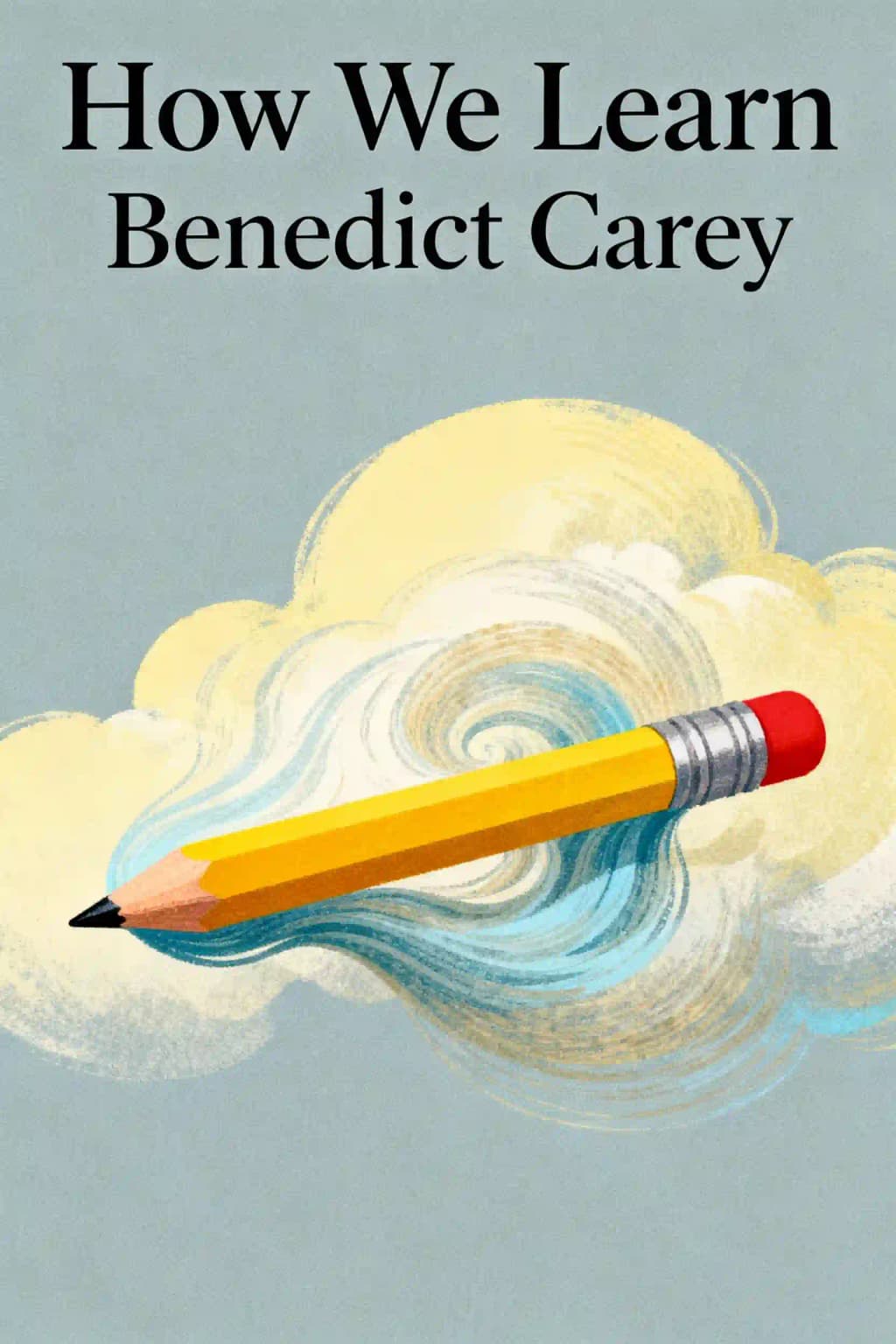
Learning is often portrayed as a rigid, disciplined process - the student hunched over textbooks in a quiet room, focused and determined. But what if everything we thought we knew about learning is wrong? Benedict Carey's journey from anxious grind to confident student mirrors a fundamental shift in our understanding of how the brain actually learns. His transformation began when he noticed those rare students who maintained cool heads during exams without that "hunted-animal look" of desperation.
The book "How We Learn" has garnered praise from cognitive scientists and educators alike, with Daniel Willingham calling it "a rare combination of science and practicality." Since its 2014 publication, it has influenced educational approaches in schools nationwide. Carey's work draws on his 28 years as a science reporter, during which he discovered researchers investigating seemingly trivial effects on learning - background music, study locations, even naps - that collectively revealed a revolutionary truth: the brain isn't like a muscle at all. It's sensitive to mood, timing, location, and works best when its quirks are exploited rather than fought against.
Capítulo 2
The Brain's Memory Systems: Networks That Transform With Use
Our brains are miracles of complexity-100 billion neurons forming networks with storage capacity equivalent to a million gigabytes. Even at rest, the brain uses 90% of the energy it burns during active problem-solving, constantly working behind the scenes to process information. Rather than functioning as a single unit, the brain operates like a specialized film crew with different modules handling specific tasks: the entorhinal cortex filtering incoming information, the hippocampus initiating memory formation, and the neocortex storing conscious memories.
Memories exist as networks of linked neurons that fire together like Christmas lights, creating patterns the brain reads as images, thoughts, and feelings. These networks include many of the same cells that activated when the memory first formed, with connections (synapses) strengthening through repeated use. Scientists at UCLA confirmed this by recording individual brain cells as patients watched and later recalled video clips, observing identical firing patterns during both viewing and remembering.
The theory that memory was uniformly distributed throughout the brain collapsed when researchers studied Henry Molaison (H.M.), who lost his ability to form new memories after having both hippocampi surgically removed. Though H.M. could remember pre-surgery events and maintain short-term memory, he experienced each new encounter as if for the first time. Yet remarkably, he could improve at mirror-drawing tasks without remembering practicing them, revealing that different memory systems exist in the brain - conscious memories requiring the hippocampus while motor skills developing without it.
What's particularly fascinating is that memories aren't static files but dynamic networks that transform with each retrieval. The brain's "interpreter" module creates coherent narratives from available information, not just interpreting current experiences but reconstructing memories, slightly altering them each time they're recalled. Using our memories changes our memories in ways we don't anticipate - a phenomenon that has profound implications for how we approach learning.
Capítulo 3
Forgetting as Learning's Essential Partner
Forgetting isn't just memory's enemy-it's learning's essential partner. Our brains use forgetting as a sophisticated spam filter, allowing important information to surface while filtering distractions. Even memory champions would struggle with everyday recall questions not because they're absentminded, but because effective memory requires selective forgetting.
This "focused forgetting" happens constantly: blocking old passwords to remember new ones, suppressing native language words when learning a foreign one, or blanking on common words when deeply focused on a task. As William James noted, "If we remembered everything, we should on most occasions be as ill off as if we remembered nothing."
Recent research has revealed forgetting serves two vital functions: it filters background noise so important signals stand out, and it creates necessary breakdown that strengthens learning upon review-like muscle building requires some breakdown first. Memory is never static; each retrieval alters its accessibility and often its content. This emerging understanding forms what might better be called the "Forget to Learn" theory.
Robert and Elizabeth Ligon Bjork developed this comprehensive theory explaining memory phenomena. Their model proposes that any memory has two distinct strengths: storage strength and retrieval strength. Storage strength measures how well something is learned and continuously builds with study and use. Crucially, storage strength never decreases - meaning deliberately committed memories remain permanently stored, even if inaccessible. This explains why seemingly forgotten details can suddenly resurface when triggered by the right cue.
Retrieval strength measures how easily information comes to mind. Unlike storage strength, it's fickle - building quickly but also weakening rapidly without reinforcement. The brain can only maintain high retrieval strength for a limited number of items at once.
The interaction between these strengths explains why forgetting actually enables deeper learning by filtering distractions and creating beneficial breakdown that strengthens memory when reused. This "desirable difficulty" principle shows that harder retrieval efforts lead to greater subsequent learning.
Capítulo 4
Breaking the Consistency Myth: Why Varying Study Environments Works
Don't forget your brain vitamins. In college, that's what passed for exam-taking advice among those frequenting a hippified pill shop in Boulder. The not-so-secret ingredient in "Study Aid" was likely speed, delivering focus but risking sudden sleep during exams. Students developed theories about maintaining the same "brain chemistry" when studying and testing-a concept that, while self-justifying, aligns with traditional advice about consistency in study habits.
This consistency principle has been education gospel since the 1900s: develop rituals, find quiet spaces, block distractions. But groundbreaking research has demolished this doctrine. In 1975, psychologists Godden and Baddeley conducted an experiment having scuba divers memorize word lists twenty feet underwater. Divers who later took the recall test underwater remembered about 30% more words than those tested on dry land, supporting "reinstatement theory"-the idea that returning to the original learning environment provides memory cues.
While this seemed to support consistency, further research revealed something more surprising. In a landmark experiment by Steven Smith, Robert Bjork, and Arthur Glenberg, students who studied word lists in two different rooms recalled 40% more words than those who studied twice in the same room. This striking improvement occurred even when tested in a neutral third location.
The researchers theorized that multiple environments either encode different subsets of information or double the contextual cues linked to each memory. These findings suggest that our natural restlessness during study sessions might actually enhance learning rather than hinder it. Varying your study environment - whether through different locations, positions (standing vs. sitting), methods (typing vs. handwriting), or even background music - enriches learning and makes knowledge more accessible long-term.
As philosopher John Locke noted about a man who could only dance when a particular trunk was in the room, we need to "take the trunk out" to make our skills independent of specific surroundings. The research points to a powerful conclusion: the brain constantly tracks both the main focus of study and peripheral environmental details that later serve as retrieval cues. By deliberately varying these contexts, we create more robust, accessible knowledge.
Capítulo 5
The Power of Spacing: Distributing Learning Over Time
The spacing effect - distributing study time rather than cramming - is one of learning science's oldest and most powerful techniques. People learn at least as much, and retain it much longer, when they space their study time rather than concentrate it. In certain situations, this technique can double retention without requiring additional time or effort.
Hermann Ebbinghaus discovered the power of spacing, finding he could learn nonsense syllables with far fewer repetitions when they were distributed over days rather than concentrated. Adolf Jost formalized this as "Jost's Law": studying material after a delay strengthens memory more than immediate review. Unfortunately, for decades researchers focused on trivial short-interval experiments rather than practical applications.
During the social upheaval of the 1970s, psychologist Harry Bahrick challenged this tradition, wanting to test spacing over meaningful timeframes with real-world knowledge. He recruited his wife and daughters for a groundbreaking family experiment studying Spanish vocabulary with different spacing intervals - ranging from two weeks to two months between sessions. After studying words on different schedules for five years, they scored highest (76%) on words reviewed once every two months for twenty-six sessions, compared to just 56% for words studied every two weeks.
The spacing effect works through several mechanisms depending on the interval length. With very short intervals (seconds or minutes), the brain becomes progressively less interested in repeated information. For intermediate intervals (days or weeks), forgetting actually aids learning by filtering competing facts and allowing subsequent practice to deepen learning. Longer intervals help identify weaknesses in memory and develop better cues and associations.
By 2008, researchers led by Melody Wiseheart and Harold Pashler finally answered the crucial question about optimal timing. In a study of 1,354 people learning obscure facts, they determined that the ideal spacing interval depends on when you'll need to remember the information. If testing occurs in a week, split study sessions between today and tomorrow. For a test in a month, study today and a week from today. The further away the exam, the larger the optimal interval between sessions.
While cramming may help for the next day's test, the knowledge quickly vanishes - like "overstuffing a cheap suitcase" where everything soon falls out. Unlike cramming, which works short-term but doesn't last, spaced study creates durable learning with the same time investment.
Capítulo 6
Testing as Learning: The Hidden Power of Retrieval Practice
We all know the Student Who Tests Well Without Trying, who scores 99% while claiming "I hardly even studied." But rather than envying this type or working harder, developing test-taking skill requires understanding what testing truly is - and it has more dimensions than most realize.
The best way to overcome the fluency illusion - the mistaken belief that because facts are easily recalled now, they'll remain that way tomorrow - is through testing itself. This technique has ancient roots - Francis Bacon noted in 1620 that attempting to recite material from memory rather than merely rereading it produces better learning. William James observed in 1890 that "active repetition" through recollection beats "passive repetition" through rereading.
In 1917, Columbia psychologist Arthur Gates used Who's Who in America entries to determine the ideal ratio between reading (memorizing) and reciting (rehearsal). He found that the best results came from spending about 40% of time reading and 60% reciting - with older students benefiting from even less reading time (closer to 33%). This approach improved learning by about 30% over reading alone.
Herbert Spitzer expanded on Gates's work in 1938, recognizing that recitation was essentially self-examination - testing as a form of studying. He conducted what may be history's largest pop quiz experiment, enlisting 3,605 sixth graders across 91 Iowa schools. Students studied passages about peanuts or bamboo once, then were divided into groups that took surprise tests at different intervals. The results were clear: students who took tests soon after reading (within the first week) retained about 50% of the material two months later, while those who weren't tested until two weeks or more after studying scored below 30%.
Despite initial neglect, research has now firmly established that testing enhances learning more effectively than additional study. In experiments using science passages about the sun and sea otters, students who studied once and then tested themselves performed significantly better on delayed tests than those who studied twice. While the testing advantage was minimal after five minutes, it grew dramatically for tests given after two days or a week.
Testing works better than restudying because it creates desirable difficulty. When retrieving information, the brain works harder than when merely reviewing it, deepening both storage and retrieval strength. Successful retrieval actually re-stores information differently, creating new neural connections that link the memory to other related facts we've retrieved. The very act of using our memory changes our memory in ways we don't anticipate.
Capítulo 7
The Upside of Distraction: How Incubation Drives Insight
Graham Wallas's groundbreaking work in creative problem-solving identified four distinct stages that have become foundational to understanding how insights emerge. In the preparation stage, individuals immerse themselves deeply in a problem, often working until mental exhaustion. This is followed by incubation, where the problem is temporarily abandoned. The illumination stage manifests as the sudden "aha!" moment of breakthrough, and finally, verification involves testing and refining the solution. Wallas's revolutionary insight wasn't just identifying these stages, but recognizing that incubation represents active mental processing occurring beneath our conscious awareness.
Norman Maier's ingenious rope-tying experiment provided compelling evidence for this subconscious processing. Participants were tasked with connecting two ropes hanging from the ceiling that couldn't be reached simultaneously. When stuck, Maier would casually set one rope swinging. Most participants who subsequently discovered the pendulum solution failed to recognize they'd received a hint, demonstrating how our brains unconsciously process environmental cues during incubation periods. This experiment revealed that solutions often emerge from subtle environmental triggers processed without conscious awareness.
Karl Duncker's famous "candle problem" further illuminated how incubation helps overcome cognitive barriers. Participants needed to attach a candle to a wall using only a box of tacks and matches. The solution - using the box as a platform - became significantly more obvious when boxes were presented empty rather than filled with materials. This demonstrated how incubation helps break "functional fixedness," our tendency to see objects only in their typical role. The mental reset during incubation allows us to perceive alternative functions and possibilities.
Steven Smith and Steven Blankenship's sophisticated Remote Associates Test experiments revealed crucial insights about optimal incubation conditions. Participants attempted to find words connecting seemingly unrelated terms. When initially given misleading hints, those who took a five-minute reading break doubled their success rate compared to those who continued working. This supported their "selective forgetting" theory - incubation periods allow misleading associations to fade, creating space for new connections. The process mirrors how stepping away from confusing instructions often leads to clearer understanding upon return.
A comprehensive meta-analysis by Sio and Ormerod revealed that incubation's effectiveness varies by problem type and conditions. Mathematical and spatial problems benefit from any form of break, while linguistic puzzles show optimal results when the break involves mild cognitive engagement through activities like gaming or television viewing. Their research established that longer incubation periods (20 minutes) consistently outperform shorter ones (5 minutes), but critically, only when preceded by sufficient initial struggle with the problem. The analysis also revealed that incubation is most effective when the initial problem-solving attempt has been thorough enough to create mental fatigue.
These findings fundamentally challenge our cultural bias against taking breaks during intensive work. Rather than representing lost productivity, strategic breaks emerge as crucial tools for insight generation and problem-solving. The guilt many feel about stepping away from work appears increasingly misplaced as research continues to demonstrate that incubation periods are not just helpful but often essential for breakthrough thinking and creative solutions.
Capítulo 8
The Zeigarnik Effect: Harnessing the Power of Interruption
The Zeigarnik effect not only helps us remember unfinished tasks but also activates goal-oriented perception. When we interrupt work at a crucial moment, we propel that assignment to the top of our minds. This heightened awareness creates a "tuned mind" that magnetizes relevant information from our environment. As novelist Eudora Welty explained, "Once you're into a story, everything seems to apply-what you hear on the city bus is exactly what your character would say on the page you were writing."
This tuning process doesn't just collect external information but enhances our internal dialogue about the subject. When working on a paper about the Emancipation Proclamation, we become more attuned to racial dynamics around us and our own reactions to them, providing valuable fodder for our work.
Professor Ronda Leathers Dively demonstrated this process by restructuring her writing course. Instead of having students write six separate essays on different topics, she had them focus on one topic for an entire semester with five "prewriting" assignments and journal entries tracking their reactions to sources. The result was transformative-students developed "an expert persona" and questioned authoritative sources rather than merely borrowing others' opinions.
Percolation involves three key elements: interruption (creating the Zeigarnik effect), a tuned mind that scavenges relevant information, and conscious reflection through journaling or similar practices. This demystifies the "creative process"-no muse required, just vigilance in collecting perceptions and thoughts relevant to our project.
For learning strategy, this means starting large projects early and stopping when stuck, confident we're initiating percolation rather than quitting. Starting difficult work first shrinks the psychological burden of the task. By working a little each day and stopping mid-section when stalled, we can use "procrastination" to our advantage, allowing our tuned minds to deliver solutions when we return.
Capítulo 9
Interleaving: The Counterintuitive Path to Mastery
Most learning experts and educators long assumed that focused, repetitive practice was the optimal way to master skills - a belief that shaped traditional teaching methods for generations. But a groundbreaking 1978 experiment by Kerr and Booth challenged this fundamental assumption with an elegantly simple beanbag tossing test. They divided thirty-six eight-year-olds into two groups: one practiced throwing at a single target three feet away, while the other practiced on two different targets (two and four feet away). When tested on the three-foot target, the mixed-practice group performed significantly better, despite never having practiced at that exact distance. This counterintuitive result suggested that variation, not repetition, might be the key to skill acquisition.
The researchers repeated the experiment with twelve-year-olds and found even more dramatic results. The mixed-practice group showed superior accuracy and adaptability, demonstrating that varied practice enhances "movement awareness" by forcing children to internalize general rules of motor adjustment rather than memorizing a single, specific movement. This cognitive engagement in understanding the underlying principles, rather than just memorizing specific motions, proved crucial for skill development.
This finding was later reinforced by a landmark 1986 badminton study at Louisiana State University. Researchers divided thirty young women into three practice groups: one practiced serves in blocks (all short serves, then all long serves, then all drives), another in serial order (short-long-drive repeated), and the third practiced randomly. After three weeks of training, the random practice group dramatically outperformed the others, especially when tested from an unfamiliar court position. The results were particularly striking because during the practice sessions, the blocked group appeared to be learning faster and performing better.
The key insight is that interference during practice - whether through varied targets, random skill selection, or changing contexts - forces continual mental and physical adjustments that build deeper learning and better transfer to new situations. This process, known as interleaving, works because it requires the brain to continuously engage in active problem-solving rather than falling into automatic repetition. While repetitive practice creates an illusion of rapid improvement through temporary performance gains, varied practice produces slower apparent progress but superior long-term results and flexibility.
Recent studies have extended these findings beyond motor skills to academic subjects like mathematics and music. For example, students learning to identify artists' painting styles show better retention when examples from different painters are mixed together rather than studied one artist at a time. Similarly, mathematics students demonstrate better problem-solving abilities when practice problems from different topics are interleaved rather than grouped by type. This suggests that the benefits of interleaving are universal across different types of learning and skill acquisition.
Capítulo 10
The Foraging Brain: Embracing Our Natural Learning Style
The author explains why our instincts about learning are often wrong: formal education is a recent invention in human history. While humans have existed for at least a million years, structured learning environments are only thousands of years old. For most of human existence, we've been preoccupied with basic survival - foraging, avoiding predators, and finding shelter. As Steven Pinker puts it, life for foragers is "a camping trip that never ends."
Our foraging past shaped how we learn. Hunting and tracking were our reading and writing. Mapping the environment was geometry. The "curriculum" included botany and animal behavior. Most learning came through experience - listening, watching, and exploring the world in widening circles. Our brains evolved to absorb survival lessons with maximum efficiency, becoming foragers for information and strategies.
Scientists believe the neural networks that once helped us find our way back to campsites have been "repurposed" to navigate academic domains. One encompassing theory is called the Meaning Maintenance Model: being lost or confused creates distress, which motivates the brain to find patterns and meaning.
In one experiment, researchers found that deliberately confusing college students by having them read a nonsensical Kafka story improved their performance by almost 30% on pattern recognition tests. The improvements were subconscious. Being "lost" in a subject isn't necessarily the end of learning - it can actually heighten mental sensitivity, activating circuits behind incubation, percolation, and nocturnal insights.
After 28 years as a science reporter, the author was compelled to write this book because learning science offers practical tools that validate his own successful but unconventional study habits from college. The findings aren't merely surprising but specific and immediately useful without requiring significant additional time, effort, or investment in special classes or tutors.
The author sees learning science as a great equalizer. While we can't control many factors affecting learning (genes, teachers, family environment), we can control how we learn. The science shows that "spaced study" - doing a little here and there throughout the day - results in more efficient, deeper learning. It liberates us from the pressure of constant laser-focused practice, acknowledging that learning is inherently restless in both timing and content.
The author encourages letting go of what we feel we should be doing - all that repetitive, overscheduled, focused ritual - and embracing how the presumed enemies of learning (ignorance, distraction, interruption, restlessness, quitting) can work in our favor. Learning is, after all, what we do.