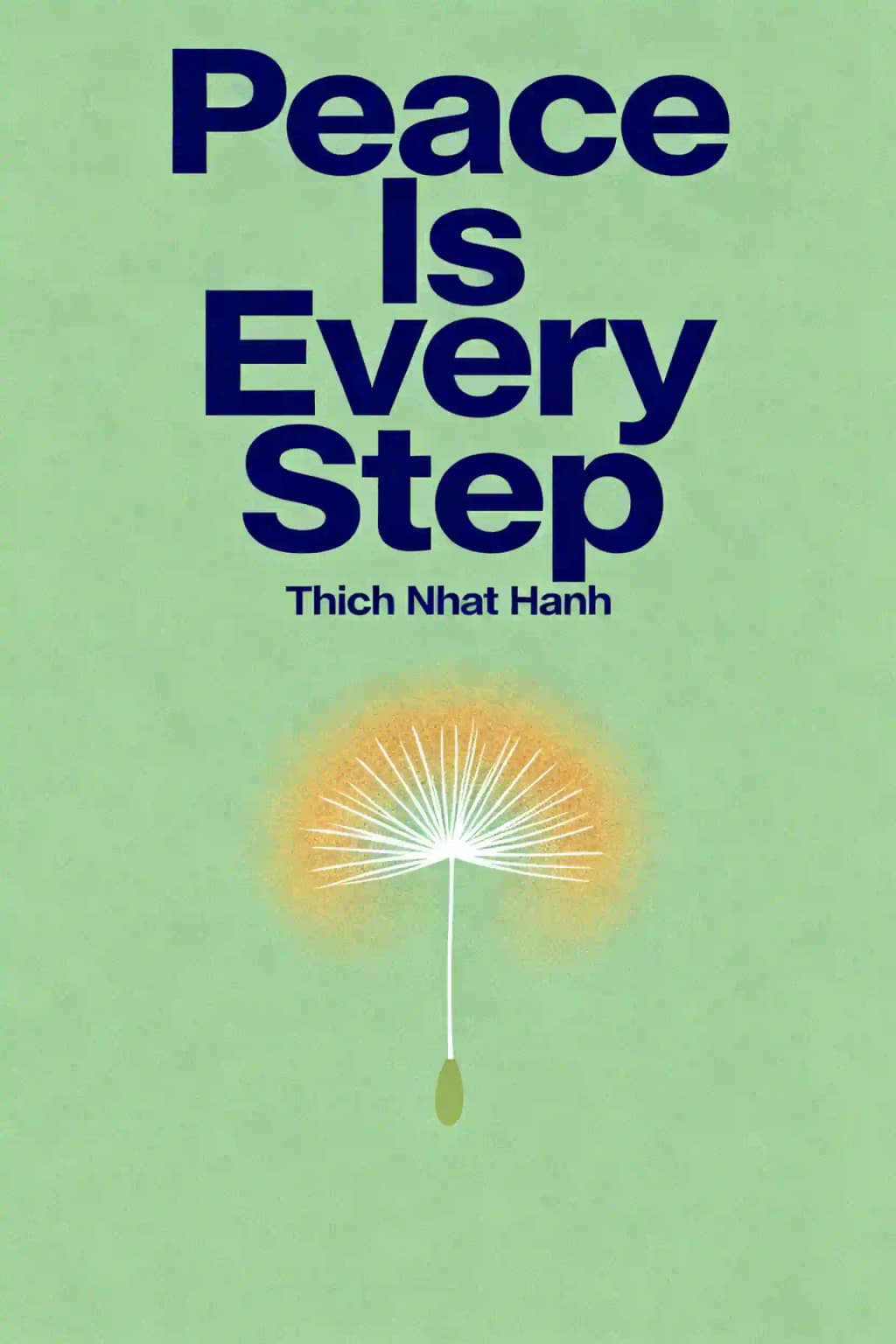
Peace Is Every Step
The Path of Mindfulness in Everyday Life
Overview of Peace Is Every Step
In "Peace Is Every Step," Zen master Thich Nhat Hanh reveals how mindfulness transforms ordinary moments into profound peace. Nominated for the Nobel Peace Prize by Martin Luther King Jr., his teachings influenced the Dalai Lama, who called it "a book that can change individual lives and society."

Key Themes in Peace Is Every Step
- conscious breathing
- present moment awareness
- engaged buddhism
- daily ritual meditation
- inner peace
Quotes from Peace Is Every Step
Washing the dishes is at the same time a means and an end; that is, not only do we wash the dishes in order to have clean dishes, we also wash the dishes just to wash the dishes.
The present moment is filled with joy and happiness. If you are attentive, you will see it.
Every one of us already has the seed of mindfulness.
Feelings come and go like clouds in a windy sky. Conscious breathing is my anchor.
Breathe, you are alive!
Characters in Peace Is Every Step
- Thich Nhat HanhBuddhist monk and influential spiritual teacher
About the Author
About the Author of Peace Is Every Step
Thich Nhat Hanh, the globally revered Zen master and author of Peace Is Every Step: The Path of Mindfulness in Everyday Life, was a pioneering voice in mindfulness and socially engaged Buddhism. A Vietnamese monk, peace activist, and founder of the Plum Village meditation community, he dedicated his life to bridging ancient Buddhist practices with modern struggles like conflict, injustice, and environmental crises. His work in Peace Is Every Step reflects his core philosophy of transforming everyday moments into opportunities for peace, rooted in his experiences during the Vietnam War and his development of the Engaged Buddhism movement.
Hanh’s influential works, including The Miracle of Mindfulness and The Heart of the Buddha’s Teaching, have sold millions of copies worldwide and been translated into over 40 languages.
Nominated for the Nobel Peace Prize by Dr. Martin Luther King Jr. in 1967, he spent 39 years in exile for advocating nonviolence, later teaching mindfulness at institutions like Harvard and Columbia. His teachings remain foundational in psychology, education, and corporate wellness programs, with Peace Is Every Step hailed as a modern spiritual classic.
Download Summary of Peace Is Every Step
Get the Peace Is Every Step summary as a free PDF or EPUB. Print it or read offline anytime.
FAQs About This Book
Peace Is Every Step offers practical guidance on integrating mindfulness into daily life. It teaches readers to cultivate inner calm through conscious breathing, mindful observation, and compassionate action, even amid chaos. The book’s three sections—focused on presence, emotional healing, and peace-building—blend Zen wisdom with accessible practices like walking meditation and gratitude journaling.
This book is ideal for anyone seeking stress relief, emotional balance, or spiritual grounding. Beginners to mindfulness will appreciate its simplicity, while seasoned practitioners gain fresh perspectives. It’s particularly valuable for those navigating personal challenges, social activism, or seeking non-religious approaches to inner peace.
Yes—it’s a timeless primer on mindfulness, praised for its clarity and practicality. Unlike theoretical texts, it provides actionable steps (e.g., “washing dishes meditation”) to transform mundane tasks into moments of awareness. Critics and readers alike highlight its gentle tone and universal relevance.
Key practices include:
- Conscious breathing: Using breath to anchor attention to the present.
- Walking meditation: Focusing on each step to connect mind and body.
- Mindful observation: Noticing emotions without judgment (“I am the feeling”).
These methods aim to dissolve stress and foster equanimity.
Thich Nhat Hanh advocates “non-dual” awareness: emotions are neither rejected nor clung to but acknowledged as transient. For anger, he suggests whispering, “Hello, my anger, I will care for you,” to dissolve its intensity through compassionate attention.
Notable lines include:
- “The present moment is filled with joy and happiness.”
- “Feelings come and go like clouds in a windy sky.”
These emphasize impermanence and the power of mindful presence.
It distills core themes from his broader teachings (e.g., The Miracle of Mindfulness) into bite-sized reflections. While less academic than The Art of Communicating, it retains his signature blend of poetic simplicity and profound insight.
Some readers find its advice overly simplistic for complex problems, though fans argue its strength lies in making mindfulness accessible. A minority note repetition in concepts, but this reinforces key principles for beginners.
The book reframes anxiety as a call to return to the breath. By practicing “stopping” (pausing to breathe during stress), readers learn to interrupt spiraling thoughts and regain emotional control.
Unlike clinical guides, it frames mindfulness as a joyful, creative act—not just a coping tool. Stories like “tangerine meditation” (savoring fruit slowly) show how ordinary moments become portals to peace.
Thich Nhat Hanh links inner tranquility to societal change: “Peace in oneself, peace in the world.” He advocates “engaged Buddhism,” urging readers to address injustice from a centered, non-reactive stance.
Yes—it teaches “deep listening” to understand others without judgment. By mindfully responding (not reacting), conflicts dissolve into opportunities for connection.