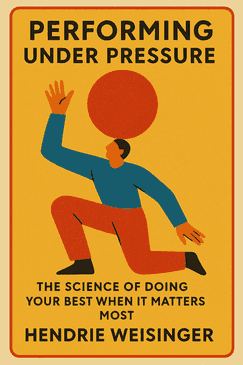
Performing under pressure: the science of doing your best when it matters most by Hendrie Weisinger Summary

Overview of Performing under pressure
Discover why 12,000 elite performers - from Navy SEALs to Fortune 500 leaders - debunk the myth that we perform better under pressure. This New York Times bestseller reveals 22 science-backed strategies that transformed IBM and Olympic athletes alike. Ready to excel when it matters most?
- Confidence grows through practiced self-awareness and intentional power poses.
- Pressure triggers include perceived importance, uncertainty, and personal responsibility.
- The COTE of Armor model combines confidence, optimism, tenacity, and enthusiasm.
- No one performs better under pressure—myth-busting neuroscience proves otherwise.
- Visualization techniques rewire your brain to handle high-stakes scenarios calmly.
- Optimism requires balancing positivity with realistic expectations to avoid overconfidence.
- Tenacity emerges from focused goal-setting and adaptive coping strategies.
- Enthusiasm thrives when reframing pressure as opportunity rather than threat.
- Physiological arousal management prevents fight-or-flight responses during critical tasks.
- Pressure-proof your mindset using the book’s 22 actionable daily habits.
- Link self-talk patterns to measurable performance outcomes under stress.
- Transform pressure into a competitive edge using tactical distraction avoidance.
About the Author of Performing under pressure
Hendrie Weisinger, Ph.D., is a New York Times bestselling author, clinical psychologist, and pioneering authority on pressure management and emotional intelligence. His book Performing Under Pressure: The Science of Doing Your Best When It Matters Most combines decades of research in organizational psychology with practical strategies to thrive in high-stakes environments.
Weisinger’s expertise stems from consulting Fortune 500 companies like IBM and Warner-Lambert, teaching executive programs at UCLA and Wharton, and developing groundbreaking frameworks like criticism training. He previously authored influential works such as Nobody’s Perfect and Emotional Intelligence at Work, establishing him as a leader in behavioral science applications for professional success.
A frequent media contributor featured on The Today Show, Oprah, and in The Wall Street Journal, Weisinger translates complex psychological concepts into actionable insights. His pressure management techniques have been adopted by Olympic athletes, corporate leaders, and military professionals. Notably, Performing Under Pressure became an instant New York Times bestseller and evolved into a state-of-the-art online workshop, solidifying its status as a modern classic in performance psychology. The son of Superman’s longtime story editor, Weisinger credits his interdisciplinary approach to blending storytelling with scientific rigor.
FAQs About Performing under pressure
What is Performing Under Pressure by Hendrie Weisinger about?
Performing Under Pressure examines the science of thriving in high-stakes situations, offering evidence-based strategies to manage stress and avoid performance decline. The book introduces 22 pressure catalysts like uncertainty and negativity bias, alongside tools like the COTE of Armor framework (Confidence, Optimism, Tenacity, Enthusiasm) to build psychological resilience. It blends case studies from sports, healthcare, and business with actionable tactics for immediate use.
Who should read Performing Under Pressure?
Professionals in high-stress fields (executives, athletes, healthcare workers), students facing exams, and anyone seeking to improve decision-making under pressure. The book’s blend of psychology and practical exercises makes it valuable for leaders aiming to foster resilient teams or individuals navigating career transitions, competitions, or personal challenges.
Is Performing Under Pressure worth reading?
Yes—ranked a New York Times bestseller, it provides scientifically validated methods to combat pressure’s cognitive and emotional effects. Readers gain tools like “cognitive reframing” to reinterpret stress and “pressure solutions” for real-world scenarios, making it a standout in leadership and self-help genres.
What are the main concepts in Performing Under Pressure?
Key ideas include:
- Pressure paradox: The better you perform, the more pressure you attract.
- COTE of Armor: A mental shield built through Confidence, Optimism, Tenacity, and Enthusiasm.
- The 5x5 Rule: Prioritizing stressors to avoid overreaction.
- Micro-pressure moments: Small daily practices to build resilience.
How does Performing Under Pressure help with workplace stress?
The book teaches techniques like “pressure-proofing” workflows through preparation rituals and minimizing “distorted thinking” traps. Examples include reframing deadlines as opportunities and using pre-performance routines to stabilize focus—critical for managers addressing team burnout or tight project timelines.
What quotes from Performing Under Pressure are most impactful?
- “Pressure is inevitable; choking is optional.” Emphasizes proactive mindset shifts.
- “Confidence is the first casualty of pressure.” Highlights the need to pre-build self-assurance.
- “Pressure doesn’t just reveal character; it builds it.” Encourages embracing challenges as growth tools.
How does Performing Under Pressure compare to Grit by Angela Duckworth?
While Grit focuses on long-term perseverance, Performing Under Pressure targets acute stress management. Weisinger’s work offers immediate tactical interventions (e.g., breath control, visualization), whereas Duckworth emphasizes cultivating passion and stamina over years. Both complement resilience-building but serve different intent stages.
What are criticisms of Performing Under Pressure?
Some reviewers note the strategies require consistent practice to master, which may frustrate readers seeking quick fixes. Others suggest the corporate-centric case studies lack diversity in addressing systemic pressures like socioeconomic barriers.
Can Performing Under Pressure improve personal relationships?
Yes—the book’s communication tactics, like “decatastrophizing” conflicts and using optimism to defuse tension, apply to familial or romantic dynamics. For example, reframing arguments as collaborative problem-solving reduces emotional escalation.
Why is Performing Under Pressure relevant in 2025?
With remote work and AI-driven productivity demands increasing stress globally, its focus on micro-habits (e.g., 2-minute mindfulness drills) aligns with modern needs for scalable resilience. The science-backed approach resonates in an era prioritizing mental health.
How does Performing Under Pressure relate to emotional intelligence?
Weisinger, a pioneer in emotional intelligence, integrates EQ principles like self-regulation and empathy. The COTE framework expands traditional EQ models by adding tenacity and enthusiasm as pressure-specific safeguards.
What are 3 actionable tips from Performing Under Pressure?
- Pre-performance routines: A 60-second breathing exercise to stabilize heart rate.
- “Pressure journals”: Track stressors to identify patterns and solutions.
- The 5-second reframe: Replace negative thoughts with “I’ve prepared for this” mantras.
Feel the book through the author's voice
Turn knowledge into engaging, example-rich insights
Capture key ideas in a flash for fast learning
Enjoy the book in a fun and engaging way
Key Themes in Performing under pressure
Quotes from Performing under pressure
Nobody actually performs better under pressure.
Pressure evolved as a selection mechanism determining who advances in life.
Uncertainty proves to be particularly devastating to performance.
Social pain activates the same neural pathways as physical pain.
Characters in Performing under pressure
Quick Summary Mode - Read or listen to Performing under pressure Summary in 9 Minutes

Break down key ideas from Performing under pressure into bite-sized takeaways to understand how innovative teams create, collaborate, and grow.

Flash Card Mode - Top 10 Insights from Performing under pressure in a Nutshell

Distill Performing under pressure into rapid-fire memory cues that highlight key principles of candor, teamwork, and creative resilience.

Fun Mode - Performing under pressure Lessons Told Through 23-Min Stories

Experience Performing under pressure through vivid storytelling that turns innovation lessons into moments you'll remember and apply.
Personalize Mode - Read or listen to Performing under pressure Summary in 0 Minutes

Ask anything, pick the voice, and co-create insights that truly resonate with you.

From Columbia University alumni built in San Francisco
"Instead of endless scrolling, I just hit play on BeFreed. It saves me so much time."


"I never knew where to start with nonfiction—BeFreed’s book lists turned into podcasts gave me a clear path."


"Perfect balance between learning and entertainment. Finished ‘Thinking, Fast and Slow’ on my commute this week."
"Crazy how much I learned while walking the dog. BeFreed = small habits → big gains."
"Reading used to feel like a chore. Now it’s just part of my lifestyle."

"Feels effortless compared to reading. I’ve finished 6 books this month already."
"BeFreed turned my guilty doomscrolling into something that feels productive and inspiring."

"BeFreed turned my commute into learning time. 20-min podcasts are perfect for finishing books I never had time for."
"BeFreed replaced my podcast queue. Imagine Spotify for books — that’s it. 🙌"

"It is great for me to learn something from the book without reading it."
"The themed book list podcasts help me connect ideas across authors—like a guided audio journey."
"Makes me feel smarter every time before going to work"
From Columbia University alumni built in San Francisco
"Instead of endless scrolling, I just hit play on BeFreed. It saves me so much time."
"I never knew where to start with nonfiction—BeFreed’s book lists turned into podcasts gave me a clear path."
"Perfect balance between learning and entertainment. Finished ‘Thinking, Fast and Slow’ on my commute this week."
"Crazy how much I learned while walking the dog. BeFreed = small habits → big gains."
"Reading used to feel like a chore. Now it’s just part of my lifestyle."
"Feels effortless compared to reading. I’ve finished 6 books this month already."
"BeFreed turned my guilty doomscrolling into something that feels productive and inspiring."
"BeFreed turned my commute into learning time. 20-min podcasts are perfect for finishing books I never had time for."
"BeFreed replaced my podcast queue. Imagine Spotify for books — that’s it. 🙌"
"It is great for me to learn something from the book without reading it."
"The themed book list podcasts help me connect ideas across authors—like a guided audio journey."
"Makes me feel smarter every time before going to work"
"Instead of endless scrolling, I just hit play on BeFreed. It saves me so much time."
"I never knew where to start with nonfiction—BeFreed’s book lists turned into podcasts gave me a clear path."
"Perfect balance between learning and entertainment. Finished ‘Thinking, Fast and Slow’ on my commute this week."
"Crazy how much I learned while walking the dog. BeFreed = small habits → big gains."
"Reading used to feel like a chore. Now it’s just part of my lifestyle."
"Feels effortless compared to reading. I’ve finished 6 books this month already."
"BeFreed turned my guilty doomscrolling into something that feels productive and inspiring."
"BeFreed turned my commute into learning time. 20-min podcasts are perfect for finishing books I never had time for."
"BeFreed replaced my podcast queue. Imagine Spotify for books — that’s it. 🙌"
"It is great for me to learn something from the book without reading it."
"The themed book list podcasts help me connect ideas across authors—like a guided audio journey."
"Makes me feel smarter every time before going to work"
"Instead of endless scrolling, I just hit play on BeFreed. It saves me so much time."
"I never knew where to start with nonfiction—BeFreed’s book lists turned into podcasts gave me a clear path."
"Perfect balance between learning and entertainment. Finished ‘Thinking, Fast and Slow’ on my commute this week."
"Crazy how much I learned while walking the dog. BeFreed = small habits → big gains."
"Reading used to feel like a chore. Now it’s just part of my lifestyle."
"Feels effortless compared to reading. I’ve finished 6 books this month already."
"BeFreed turned my guilty doomscrolling into something that feels productive and inspiring."
"BeFreed turned my commute into learning time. 20-min podcasts are perfect for finishing books I never had time for."
"BeFreed replaced my podcast queue. Imagine Spotify for books — that’s it. 🙌"
"It is great for me to learn something from the book without reading it."
"The themed book list podcasts help me connect ideas across authors—like a guided audio journey."
"Makes me feel smarter every time before going to work"

Get the Performing under pressure summary as a free PDF or EPUB. Print it or read offline anytime.