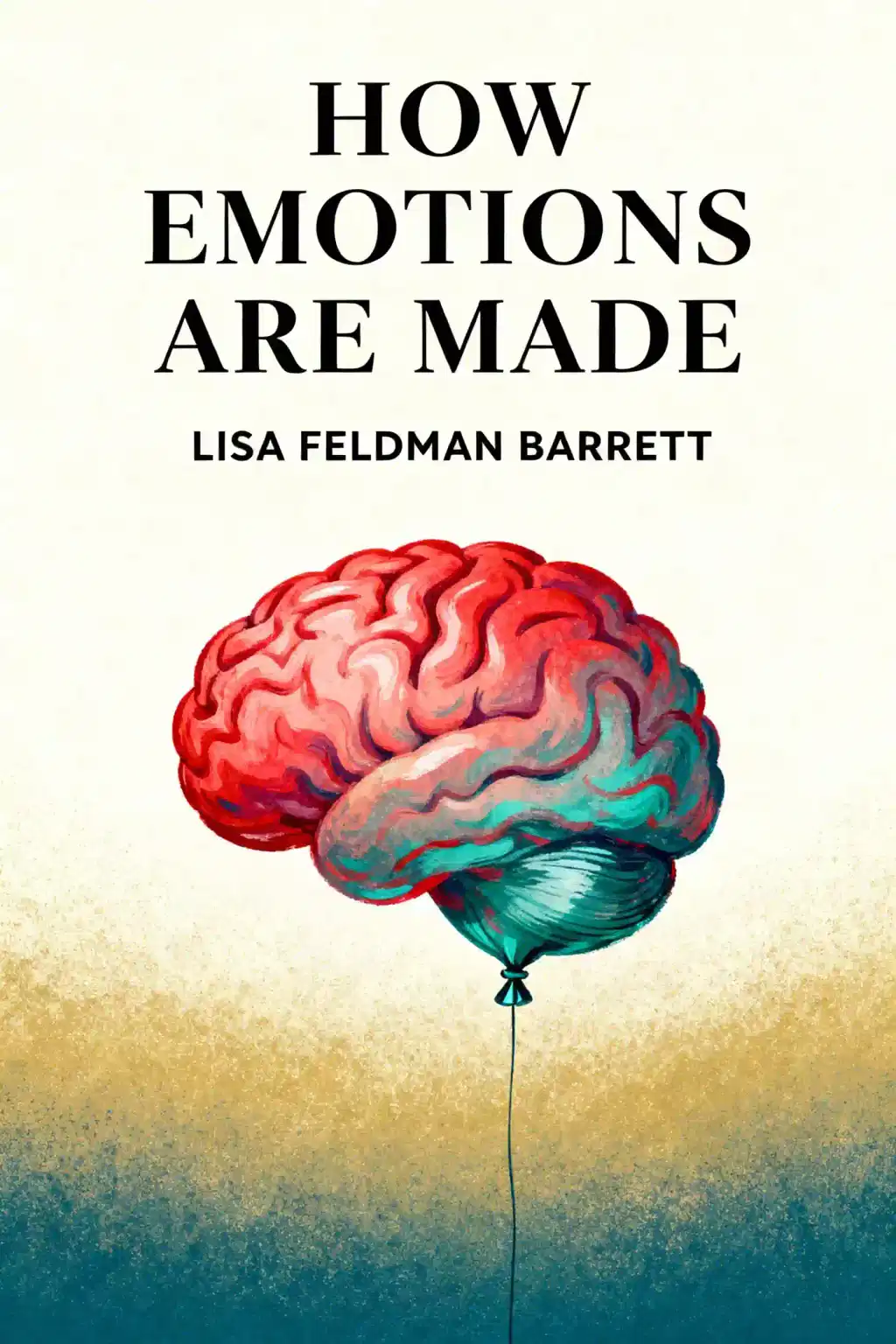
How Emotions Are Made by Lisa Feldman Barrett Summary

Overview of How Emotions Are Made
Neuroscientist Lisa Feldman Barrett shatters conventional wisdom: emotions aren't universal reactions but sophisticated brain constructions. Featured in The New Yorker, this paradigm-shifting work challenges facial recognition technology and legal judgments based on "reading" emotions. What if everything you know about feelings is wrong?
- Emotions emerge from brain predictions, not reactions to external events
- No universal fear or anger—emotional experiences vary by culture
- Your brain constructs emotions using concepts from past experiences
- Facial expressions don’t reveal emotions—they’re learned social signals
- “Affective realism” makes feelings feel like facts about the world
- Emotions aren’t triggered events but predictive brain simulations
- The amygdala isn’t a fear center—emotions use whole-brain states
- Body budgeting shapes emotional responses through metabolic forecasting
- Emotional granularity helps brains create precise, adaptive experiences
- Social reality turns abstract concepts into shared emotional truths
- Emotional construction rewrites “fight-or-flight” as predictive storytelling
- Lisa Feldman Barrett’s theory overturns 2,000 years of emotion science
About the Author of How Emotions Are Made
Lisa Feldman Barrett, author of How Emotions Are Made: The Secret Life of the Brain, is a pioneering psychologist and neuroscientist whose work reshapes our understanding of the human mind. A University Distinguished Professor at Northeastern University with appointments at Massachusetts General Hospital and Harvard Medical School, Barrett combines decades of clinical, social, and neuroscience research to challenge long-held assumptions about emotion.
Her groundbreaking theory of constructed emotion—which posits that emotions are not universal but created by the brain in context—has influenced fields from mental health to legal reform.
Barrett’s expertise extends to her bestselling follow-up, Seven and a Half Lessons About the Brain, and her widely viewed TED Talk, ranked among the top 25 most popular globally. A former president of the Association for Psychological Science and recipient of the NIH Director’s Pioneer Award, she frequently appears on platforms like The Andrew Huberman Lab Podcast and PBS’s Tell Me More with Kelly Corrigan. Her work, translated into over 20 languages, has cemented her status as one of the top 1% most-cited scientists worldwide.
FAQs About How Emotions Are Made
What is How Emotions Are Made about?
How Emotions Are Made by Lisa Feldman Barrett challenges the classical view that emotions are universal, innate reactions. Instead, Barrett’s Theory of Constructed Emotion posits emotions are created in-the-moment by the brain, combining sensory input, past experiences, and cultural concepts. This groundbreaking perspective reshapes understanding of emotions, with implications for psychology, neuroscience, and everyday life.
Who should read How Emotions Are Made?
This book is ideal for psychologists, neuroscientists, and readers interested in emotion science, mental health, or personal growth. It’s also valuable for professionals in law, education, or healthcare seeking insights into human behavior. Barrett’s accessible writing caters to both experts and general audiences curious about how emotions shape decisions and relationships.
Is How Emotions Are Made worth reading?
Yes, for its revolutionary ideas and interdisciplinary approach. Critics praise Barrett’s ability to synthesize complex research, though some note repetitiveness or oversimplification of opposing theories. The book’s impact on emotion research and practical applications—from managing anxiety to improving empathy—makes it a thought-provoking read despite debated nuances.
What is the Theory of Constructed Emotion?
The Theory of Constructed Emotion argues emotions aren’t hardwired but built by the brain using past experiences, bodily signals (interoception), and social context. For example, “fear” isn’t triggered automatically but constructed from a combination of physical sensations, memories, and cultural labels. This challenges the idea of universal emotions like “anger” or “sadness”.
How does culture influence emotions according to the book?
Barrett emphasizes that cultural concepts shape how emotions are perceived and expressed. For instance, some cultures lack words for “fear” but have distinct terms for emotion blends. This variation supports the idea that emotions are learned, socially negotiated categories rather than biological universals.
What role does interoception play in emotions?
Interoception—the brain’s tracking of bodily states like heartbeat or hunger—forms the basis of emotional experiences. Barrett explains that the brain predicts and interprets these signals to construct emotions. For example, a racing heart might be labeled “excitement” or “anxiety” depending on context.
What are the main criticisms of How Emotions Are Made?
Critics argue Barrett overstates evidence against classical emotion theories and underplays overlapping research. Some find the writing repetitive, while others note limited discussion of neurobiological mechanisms. Despite this, the book is widely recognized for sparking critical debate in emotion science.
How can the book’s ideas apply to mental health?
By viewing emotions as constructed, individuals can reframe experiences like anxiety as malleable interpretations, not fixed reactions. Therapies targeting interoceptive awareness (e.g., mindfulness) align with Barrett’s framework, offering tools to regulate emotions by updating predictive patterns.
How does How Emotions Are Made compare to Thinking, Fast and Slow?
Both books explore brain processes influencing behavior, but Barrett focuses on emotion construction, while Kahneman examines decision-making biases. Barrett’s theory complements Kahneman’s work by explaining how emotional predictions shape intuitive “fast thinking”.
What are key quotes from How Emotions Are Made?
While direct quotes are limited in summaries, Barrett’s themes include:
- “Emotions are not reactions to the world; they are your constructions of the world.”
- “Your brain’s most important job is to regulate your body’s energy needs.”
What is Lisa Feldman Barrett’s background?
Lisa Feldman Barrett is a Northeastern University distinguished professor, Harvard Medical School affiliate, and award-winning author. With over 250 peer-reviewed papers, she’s among the top 1% of cited scientists globally. Her research blends psychology, neuroscience, and anthropology.
How does the book challenge traditional emotion views?
Barrett disputes the notion of “emotion centers” in the brain (e.g., amygdala for fear) and universal facial expressions. Instead, she argues emotions arise from dynamic, whole-brain networks and vary culturally—a significant shift from theories like Paul Ekman’s basic emotions model.
Feel the book through the author's voice
Turn knowledge into engaging, example-rich insights
Capture key ideas in a flash for fast learning
Enjoy the book in a fun and engaging way
Key Themes in How Emotions Are Made
Quotes from How Emotions Are Made
You are an architect of your experience.
Emotions aren't built-in reactions we discover but sophisticated constructions we create.
Emotions aren't things with fingerprints but categories of diverse instances.
Emotions aren't simple reactions to the world-you actively construct them.
Without concepts, sensory inputs would just be meaningless noise.
Characters in How Emotions Are Made
Quick Summary Mode - Read or listen to How Emotions Are Made Summary in 9 Minutes

Break down key ideas from How Emotions Are Made into bite-sized takeaways to understand how innovative teams create, collaborate, and grow.

Flash Card Mode - Top 10 Insights from How Emotions Are Made in a Nutshell

Distill How Emotions Are Made into rapid-fire memory cues that highlight key principles of candor, teamwork, and creative resilience.

Fun Mode - How Emotions Are Made Lessons Told Through 24-Min Stories

Experience How Emotions Are Made through vivid storytelling that turns innovation lessons into moments you'll remember and apply.
Personalize Mode - Read or listen to How Emotions Are Made Summary in 0 Minutes

Ask anything, pick the voice, and co-create insights that truly resonate with you.

From Columbia University alumni built in San Francisco
"Instead of endless scrolling, I just hit play on BeFreed. It saves me so much time."


"I never knew where to start with nonfiction—BeFreed’s book lists turned into podcasts gave me a clear path."


"Perfect balance between learning and entertainment. Finished ‘Thinking, Fast and Slow’ on my commute this week."
"Crazy how much I learned while walking the dog. BeFreed = small habits → big gains."
"Reading used to feel like a chore. Now it’s just part of my lifestyle."

"Feels effortless compared to reading. I’ve finished 6 books this month already."
"BeFreed turned my guilty doomscrolling into something that feels productive and inspiring."

"BeFreed turned my commute into learning time. 20-min podcasts are perfect for finishing books I never had time for."
"BeFreed replaced my podcast queue. Imagine Spotify for books — that’s it. 🙌"

"It is great for me to learn something from the book without reading it."
"The themed book list podcasts help me connect ideas across authors—like a guided audio journey."
"Makes me feel smarter every time before going to work"
From Columbia University alumni built in San Francisco
"Instead of endless scrolling, I just hit play on BeFreed. It saves me so much time."
"I never knew where to start with nonfiction—BeFreed’s book lists turned into podcasts gave me a clear path."
"Perfect balance between learning and entertainment. Finished ‘Thinking, Fast and Slow’ on my commute this week."
"Crazy how much I learned while walking the dog. BeFreed = small habits → big gains."
"Reading used to feel like a chore. Now it’s just part of my lifestyle."
"Feels effortless compared to reading. I’ve finished 6 books this month already."
"BeFreed turned my guilty doomscrolling into something that feels productive and inspiring."
"BeFreed turned my commute into learning time. 20-min podcasts are perfect for finishing books I never had time for."
"BeFreed replaced my podcast queue. Imagine Spotify for books — that’s it. 🙌"
"It is great for me to learn something from the book without reading it."
"The themed book list podcasts help me connect ideas across authors—like a guided audio journey."
"Makes me feel smarter every time before going to work"
"Instead of endless scrolling, I just hit play on BeFreed. It saves me so much time."
"I never knew where to start with nonfiction—BeFreed’s book lists turned into podcasts gave me a clear path."
"Perfect balance between learning and entertainment. Finished ‘Thinking, Fast and Slow’ on my commute this week."
"Crazy how much I learned while walking the dog. BeFreed = small habits → big gains."
"Reading used to feel like a chore. Now it’s just part of my lifestyle."
"Feels effortless compared to reading. I’ve finished 6 books this month already."
"BeFreed turned my guilty doomscrolling into something that feels productive and inspiring."
"BeFreed turned my commute into learning time. 20-min podcasts are perfect for finishing books I never had time for."
"BeFreed replaced my podcast queue. Imagine Spotify for books — that’s it. 🙌"
"It is great for me to learn something from the book without reading it."
"The themed book list podcasts help me connect ideas across authors—like a guided audio journey."
"Makes me feel smarter every time before going to work"
"Instead of endless scrolling, I just hit play on BeFreed. It saves me so much time."
"I never knew where to start with nonfiction—BeFreed’s book lists turned into podcasts gave me a clear path."
"Perfect balance between learning and entertainment. Finished ‘Thinking, Fast and Slow’ on my commute this week."
"Crazy how much I learned while walking the dog. BeFreed = small habits → big gains."
"Reading used to feel like a chore. Now it’s just part of my lifestyle."
"Feels effortless compared to reading. I’ve finished 6 books this month already."
"BeFreed turned my guilty doomscrolling into something that feels productive and inspiring."
"BeFreed turned my commute into learning time. 20-min podcasts are perfect for finishing books I never had time for."
"BeFreed replaced my podcast queue. Imagine Spotify for books — that’s it. 🙌"
"It is great for me to learn something from the book without reading it."
"The themed book list podcasts help me connect ideas across authors—like a guided audio journey."
"Makes me feel smarter every time before going to work"

Get the How Emotions Are Made summary as a free PDF or EPUB. Print it or read offline anytime.