Chapter 1
The Dance Between Life and Death: A Journey Through Realms
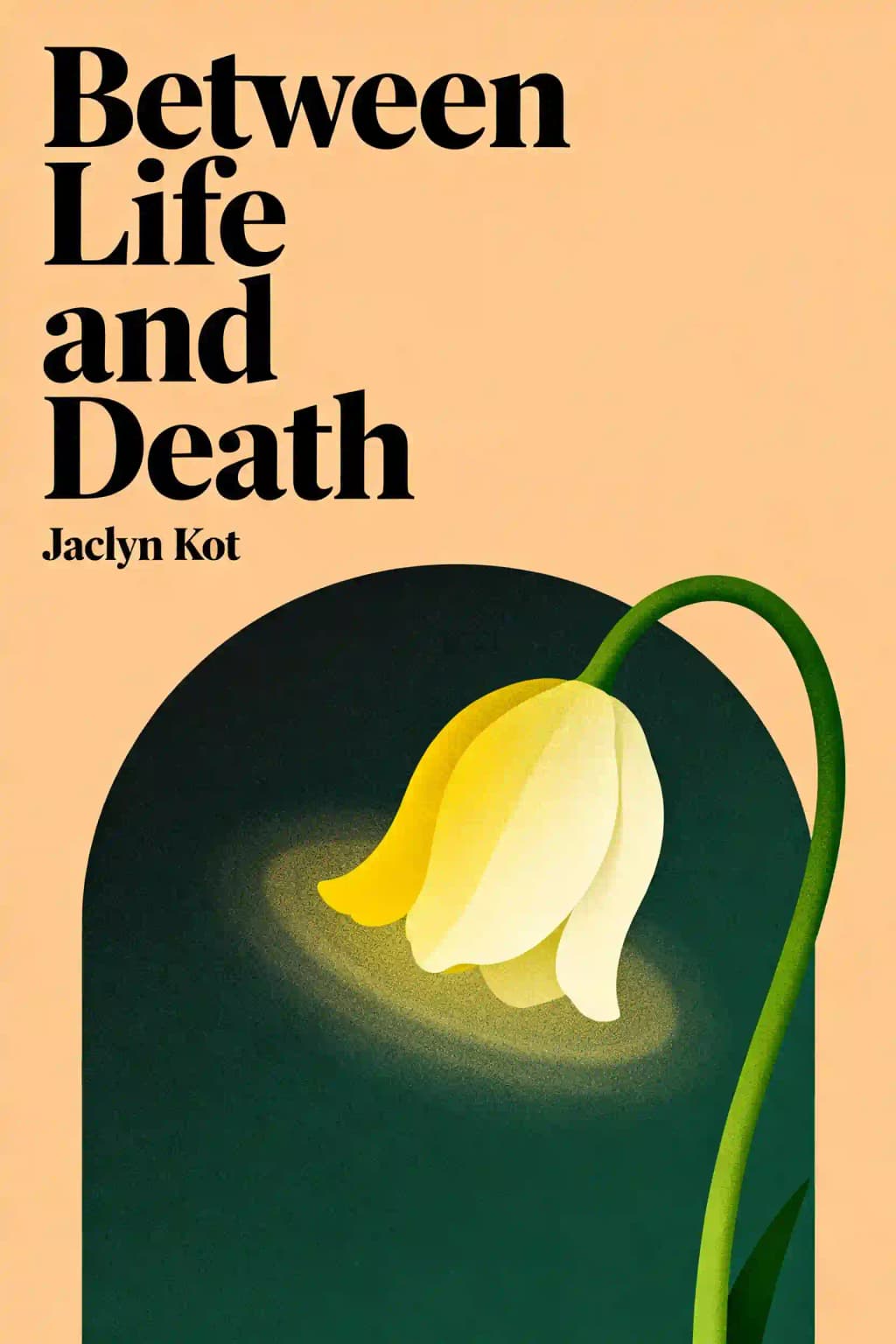
Between Life and Death captivates from its first haunting scene-a fair-haired girl dragged to a pyre in the village of Meristone, accused of bearing the "Curse." This powerful opening introduces us to Sage, our protagonist with secrets of her own, and her brother-in-everything-but-blood, Kaleb. The novel has garnered a passionate following on BookTok, with readers particularly drawn to the slow-burn romance and morally complex characters. Author Jaclyn Kot masterfully weaves elements of fantasy, romance, and philosophical questions about mortality into a tale that resonates deeply with readers seeking both escapism and emotional depth.
Chapter 2
A World Where Magic Is Condemned
In Edenvale, being "Cursed" means possessing magical abilities-and facing execution. The novel brilliantly establishes this oppressive world through Sage's eyes as she watches public "Cleansings" where the accused are burned alive. We learn that these powers were once called "Gifts" and celebrated-those with Air Curse guided lost fishermen home, Fire-Cursed kept villagers warm in winter, Earth-Cursed ensured forests remained full of game, Water-Cursed aided farmers with rain, and Mind-Cursed healed mental illnesses.
The shift from reverence to persecution began centuries ago when mystical beings called Demi Gods-children of the Old Gods-arrived in Edenvale. Though initially welcomed, tensions arose when locals began abandoning the royal family's New Religion for the Demi Gods' Old Religion. The Crown declared the Old Religion illegal, branded the Demi Gods evil, and hunted them down after discovering their weakness to fire and iron-beginning what would become the Cleansings.
Sage lives with her blind caretaker Ezra and Kaleb in a woodland cottage, hiding a dangerous secret-she possesses the Water Curse. Every morning before dawn, she sneaks to a secluded glade to practice combat movements taught by Ezra, then bathes in a lake where she can freely use her water magic, creating swirling hurricanes around herself. This daily ritual reveals both her determination and the constant fear of discovery that shapes her life.
The novel's world-building is particularly effective in showing how persecution transforms society. When Sage encounters a homeless woman whose husband was taken for being Air-Cursed, we see the human cost of the kingdom's policies. Even the architecture reflects this history-in Norwood, a town once predominantly Cursed, early Cleansings created generational poverty visible in its deteriorating structures. These details create a rich backdrop that elevates the story beyond typical fantasy fare.
Chapter 3
Family Bonds and Painful Sacrifices
At its heart, this novel explores the powerful bonds of chosen family. Sage and Kaleb, though not blood-related, share an unbreakable connection formed through childhood experiences and mutual protection. Their relationship is portrayed through small, meaningful moments-like their secret hand language developed as children or Sage's frustration with Kaleb's unmade bed that later becomes something she desperately misses.
One of the most moving sequences describes twelve-year-old Sage venturing into a blizzard to find Kaleb after he leaves to gather firewood. When she collapses in despair, Ezra appears and encourages her to use her Curse to save him. This flashback reveals how Sage's powers emerged from love and desperation, establishing early that her magic is tied to her deepest emotions.
Ezra's role as their caretaker is complex and gradually revealed. She found both children as babies-taking Kaleb from a mother who didn't want a child born out of wedlock and finding Sage abandoned in a bassinet by the lake. She closed her village apothecary to raise them in seclusion, sacrificing her former life to protect them. Later, we discover Ezra has been a Cursed rebel all along, even sacrificing her vision for the rebel cause. When Sage expresses guilt over Ezra's blindness, Ezra insists: "Being different is not a curse. It is a gift. You are a gift."
The novel doesn't shy away from exploring grief when Kaleb is killed during a rescue attempt. Sage's raw emotion as she lies beside her dying brother, pressing his hand to her heart as his chest stops moving, is devastating. Her subsequent ritual of preparing his body, washing away the blood, and burying him beneath an oak tree where he used to chop wood creates a powerful meditation on loss and remembrance. The image of his trusty axe marking his grave becomes a poignant symbol of a life cut short.
Chapter 4
The Rebellion Against Tyranny
When Kaleb is conscripted into the king's army, Sage's world shatters. This catalyst propels her into the underground rebellion of the Cursed, where she meets a colorful cast of characters including the twins Harper and Ryker, Harper's shy partner Lyra, and the young Soren. Each rebel possesses unique magical abilities that complement their personalities - Harper's flame archery reflects her fierce determination, Ryker's ability to manipulate shadows mirrors his enigmatic nature, Lyra's gift for healing stems from her deep empathy, and Soren's power to communicate with animals showcases his gentle soul.
The rebellion operates from a network of hidden properties throughout Edenvale, ranging from abandoned mills to secret caves beneath the ancient forest. They use their Curses strategically to undermine the king's authority, with each safehouse specializing in different aspects of resistance. The northern outpost focuses on intelligence gathering, while the riverside camp serves as a training ground for new recruits. Harper demonstrates her masterful skill with a flame bow during nighttime raids, her arrows cutting brilliant arcs through darkness. Meanwhile, Ryker's flirtatious confidence masks his own painful history with the Crown - his parents were executed for harboring Cursed children during the initial purge.
The group's dynamics reveal the complex moral landscape of resistance as they debate tactics in their underground war room. Some advocate for aggressive action like kidnapping royal officials, while others push for subtle sabotage of supply lines. Each choice carries potentially deadly consequences, forcing them to weigh their ideals against practical risks. During strategy sessions, Lyra's quiet voice often proves the most persuasive, reminding others that their fight isn't just about survival - it's about proving they deserve acceptance.
One particularly effective scene shows the rebels executing a coordinated attack on a training barracks. Harper's flame arrows ignite strategic points while Ryker's shadow manipulation conceals their movements. Soren's animal allies provide crucial surveillance, and Lyra stands ready to treat any wounded. The operation demonstrates both their capabilities and limitations - they can create impressive chaos but lack the numbers for direct confrontation with the king's forces. This guerrilla approach to rebellion feels authentic in a world where the Cursed are vastly outnumbered and must rely on cunning over brute force.
The novel deeply explores how resistance movements create found family among the marginalized. When Harper explains that many rebels, including herself and Ryker, lost their parents in "The Battle for the Red Rose" - a failed rebellion fifteen years earlier that ended in a massacre at Dawn Square - we understand how shared trauma binds these fighters together. Their communal meals in the underground dining hall, playful banter about making cracker sandwiches with stolen royal preserves, and fierce protection of one another create a portrait of resilience in the face of oppression. These quiet moments between missions reveal how they've built something precious within their resistance - a place where being Cursed means being valued rather than feared.
Chapter 5
Dangerous Bargains and Binding Magic
One of the novel's most fascinating elements is its system of magical bargains, represented by tattooed vines that appear on the skin. When Sage kisses the mysterious Von, she discovers a thorny vine tattoo on her arm that wasn't there before. Harper explains these tattooed bargains are binding magic from the Old Gods-the marks won't disappear until the terms are fulfilled.
This magical contract system creates both narrative tension and metaphorical depth. Von's body is covered in intricate tattoos representing countless deals he's made throughout his existence. When Sage asks if carrying so many obligations is overwhelming, he reveals they guide him through darkness when he's lost, waiting for "his light" to return-a beautiful metaphor for how our promises and commitments can anchor us during difficult times.
The bargains also serve as plot devices that force characters into difficult situations. When Sage makes a deal with the king's advisor Arkyn to find information about Kaleb, she becomes bound by two competing bargains-one with Von and one with Arkyn. This creates a triangle of obligation that drives much of the middle narrative, as Sage must navigate her growing feelings for Von while fulfilling her promise to Arkyn.
The Crown of Thorns represents the ultimate bargain-a nightmarish artifact supposedly crafted by the God of Death that can "unstitch" a Curse from one's cells, though few survive the process. When Ryker shares how he once sought this crown to remove his Curse for love, we see the desperate lengths people will go to escape persecution. His story of being found "covered in blood, his veins like shattered glass beneath his skin" after attempting to use the crown creates a visceral image of the price of such magic.
Chapter 6
Identity and Self-Discovery
Throughout the novel, Sage struggles with profound questions of identity that resonate on both personal and cosmic levels. Born with multiple Curses - including the rare and powerful Dream Curse that allows her to see past, present, and future through dreams and communicate with ghosts - she grapples with understanding her own extraordinary nature. Strange black feathers with golden fragments like "stars in an onyx sky" appear mysteriously in her path, calling to something buried deep within her consciousness. These feathers serve as physical manifestations of her suppressed memories, each one carrying a whisper of her true divine nature.
The complexity of Sage's identity crisis manifests in various ways throughout the narrative. Her healing abilities, which exceed normal Cursed powers, often activate instinctively in moments of extreme emotion. She experiences fragments of memories that don't align with her known past - glimpses of ancient temples, celestial battles, and intimate moments with Von that span centuries. These disconnected pieces of her identity create a profound sense of displacement, making her question everything she believes about herself.
When Sage approaches the Endless Mist - the impenetrable black barrier surrounding Edenvale - shadowy hands form and repeatedly ask, "Who are you?" Her inability to answer with certainty speaks to her journey of self-discovery. This moment becomes a recurring motif throughout the novel, with the question echoing in different forms: in her dreams, in the whispers of ghosts, and in Von's cryptic statements about their shared past. Later, when she's captured and strapped to a pyre, her memories finally break through the centuries-old barriers, revealing her true identity as the Goddess of Life, counterpart to Von's God of Death.
This revelation transforms the narrative from a story of rebellion to one of cosmic balance and reincarnation. Sage's recurring dreams, her collection of mysterious feathers, and her inexplicable connection to Von suddenly crystallize as fragments of her divine nature breaking through. The novel suggests that true identity isn't something we create but something we remember - a powerful theme that resonates beyond the fantasy elements into philosophical questions about the nature of self and consciousness.
Sage's journey also explores how we define ourselves through relationships. Her fierce protection of Kaleb demonstrates her inherent nurturing nature, while her complicated feelings toward Ezra after learning of her deceptions reveal her capacity for both compassion and judgment. Her magnetic attraction to Von, which persists despite their apparent opposition, speaks to the deep truth of their cosmic connection. When she finally acknowledges her love for Von after his apparent death, she completes an important part of her self-recognition - accepting that even gods can love across ancient divides and that sometimes the greatest truths about ourselves are revealed through our connections to others.
Chapter 7
The Bathhouse: Gender Politics and Survival
Some of the novel's most thought-provoking scenes take place in a luxurious bathhouse where Sage and Harper go undercover to extract information from the king's advisor. This setting becomes a microcosm for examining gender politics and female survival strategies in a patriarchal world. The establishment's opulent facade - with its marble fountains and gilded mirrors - masks deeper tensions about power, agency, and survival.
The bathhouse, though scented with jasmine and rose water, "reeks of tainted coin and sex." The women who work there represent different responses to limited options - some have chosen this work to escape homelessness, others to support families, and still others to gain proximity to power brokers. When a young courtesan named Vera explains her desperate circumstances, she notes: "As women in a man's world, we do what we must to keep ourselves afloat." Her story reveals she once trained as a scholar but found all doors closed due to her gender. Through Vera's narrative, Sage realizes these women are warriors fighting for survival, carrying the curses of poverty and gender inequality alongside any magical Curses they might possess.
The social hierarchy within the bathhouse itself reflects broader societal structures. The madame maintains order through a complex system of favors and threats, while seasoned courtesans mentor younger women in the arts of manipulation and self-preservation. Even the clothing becomes symbolic - workers wear diaphanous silks in jewel tones that signal their status, while wealthy patrons parade in elaborate robes that mark their social position.
This section cleverly subverts expectations when Sage discovers the king's advisor, Arkyn, merely uses the private baths for solitude rather than pleasure. He pays the girls handsomely for their silence while he sits alone with his thoughts - revealing complexities in a character initially presented as a straightforward antagonist. Through careful observation, Sage learns that Arkyn visits during times of political crisis, suggesting the bathhouse serves as a neutral ground where even powerful men can show vulnerability.
The architecture itself carries symbolic weight - the main bathing area features stone columns carved with nude females whose arms stretch toward the ceiling. These figures, weathered by steam and time, tell their own story of endurance. Sage appreciates the symbolism: "These women, though naked and part of the bathhouse's erotic nature, are literally holding up the roof, just as women often keep their homes and families from crashing down." This observation connects the fantasy world's gender politics to real-world experiences of women's invisible labor. The columns become a powerful metaphor for how women's strength often goes unacknowledged despite being foundational to society's functioning.
Throughout these scenes, the bathhouse emerges as a space where traditional power dynamics become fluid and negotiable. Women find ways to exercise agency even within constrained circumstances - through information trading, strategic alliances, and careful manipulation of their circumstances. The steam-filled rooms and whispered conversations reveal a complex web of relationships where survival often depends on one's ability to read between the lines and leverage limited resources.
Chapter 8
The Complicated Romance of Life and Death
The slow-burn romance between Sage and Von forms the emotional core of the novel, unfolding through a masterfully crafted progression from hostility to magnetic attraction. Their initial encounter sets the tone for their dynamic relationship - when they first meet, she throws a candlestick at him and attempts to attack him with her water powers, showcasing both her fierce independence and his unshakeable composure. Their early interactions crackle with tension, marked by sharp verbal sparring and moments of unexpected vulnerability that hint at deeper connections.
Von's character exemplifies the complexity of the "morally grey" love interest that has become a cornerstone of contemporary fantasy romance. His possessive nature manifests in bold declarations like "your lips belong to me" and "I will collect what is mine," yet these potentially domineering statements are consistently balanced by his profound respect for Sage's autonomy. Even in moments of intense desire, he maintains careful boundaries, demonstrated in scenes where he steps back when Sage shows hesitation or uncertainty. Their physical encounters are characterized by Von's measured control - he pleasures her while remaining clothed himself, establishing dominance while ensuring her satisfaction and comfort. This dynamic creates a compelling tension between power and vulnerability.
What truly distinguishes this romance is its cosmic significance, revealed as the story unfolds. As the God of Death and Goddess of Life, Von and Sage embody fundamental opposing forces in the universe, their attraction representing a profound metaphysical truth. Their connection transcends their current incarnations, suggesting that even the most fundamental dichotomies in existence - life and death - are inextricably linked. This cosmic dimension adds layers of meaning to their every interaction, from their heated arguments about the nature of existence to tender moments where they acknowledge their complementary roles in the universal order.
The novel's sophisticated exploration of consent within this complex power dynamic deserves particular attention. Despite Von's supernatural abilities and dominant personality, he demonstrates unwavering respect for Sage's agency. Each escalation in their relationship is marked by explicit consent, creating a framework of trust within their power dynamic. When Sage impetuously offers him "anything... everything" in exchange for a kiss, Von's response is telling - he pauses to warn her about the weight of such promises, ensuring she understands the implications of her choices. This careful attention to consent extends beyond their physical relationship to their larger cosmic roles, examining how free will operates within predetermined destinies.
Their romance also explores themes of balance and complementarity. Just as life cannot exist without death, their relationship demonstrates how seemingly opposing forces can create harmony. Through their evolving connection, the novel suggests that true partnership doesn't require one party to diminish but rather allows both individuals to fully embody their nature while finding strength in their differences.
Chapter 9
The Thin Veil Between Worlds
The novel's title-Between Life and Death-perfectly captures its preoccupation with the boundaries between realms. The Endless Mist surrounding Edenvale represents one such boundary-a physical manifestation of the separation between worlds. Von's ability to "shadow walk" through a mystical realm of stars and clouds that he calls "common ground," a place "where life and death can meet," provides another perspective on these liminal spaces.
Death itself is portrayed not as an ending but as a transition. When Kaleb dies, a glowing raven appears and extracts a glass orb from his chest-"swirling with yellow and brown, the colors of his essence." When Sage asks if she'll see him again, the raven answers, "We all are reunited in the Spirit Realm." This concept is fulfilled when Kaleb returns as a reaper who collects souls, explaining that after death, he awoke in the Spirit Realm where Von helped him transition.
The Dream Curse represents another way the novel explores the veil between worlds. This rare ability allows Sage to see past, present, and future through dreams, and to communicate with ghosts. Ezra warns that "the Dream Curse has made a lot of people go mad" because "it's not natural for the living to talk to the dead." This suggestion that our sanity depends on maintaining certain boundaries between realms adds psychological depth to the fantasy elements.
Perhaps most poignantly, love itself is portrayed as a force that transcends the boundary between life and death. When Joe speaks of his enduring love for Ezra, explaining that "the heart wants what the heart wants," Sage contemplates what true love feels like-something that persists beyond physical presence or absence. This theme culminates in the novel's ending, where Von's apparent death is revealed to be yet another boundary crossed rather than a final ending.
Chapter 10
The Promise of Continued Adventures
The novel concludes with Kaleb's earth-shattering revelation that Von is still alive, prompting Sage's characteristically wry response: "That sneaky bastard." This ending masterfully balances resolution with anticipation - we've witnessed Sage's journey of self-discovery, her acceptance of her true identity as a Death Walker, and her evolution from denying to embracing her feelings for Von. The knowledge of Von's survival creates not just hope but a compelling momentum toward future adventures, leaving readers simultaneously satisfied and hungry for more.
The final chapters particularly shine in their careful attention to loose ends while weaving new mysteries. We learn the truth about the ancient prophecy that bound Sage and Von together, yet questions remain about the exact nature of their shared destiny. The revelation of Von's survival raises intriguing possibilities about the limits of death itself in this world - if a Life Walker can survive what seemed like certain death, what other assumptions about the fundamental laws of this universe might be challenged?
Between Life and Death delivers a rich fantasy experience that transcends typical genre boundaries, elevating itself beyond standard romantic fantasy tropes. Through intricate worldbuilding and nuanced character development, Jaclyn Kot creates a universe where magic feels both wondrous and grounded in emotional truth. By exploring themes of identity, sacrifice, and the permeable boundaries between opposing forces, she crafts a world that feels both magically distant and emotionally immediate. The novel's sophisticated handling of duality - life/death, love/duty, fate/free will - adds layers of complexity to what could have been a simple good-versus-evil narrative.
The story reminds us that even in the most fantastical settings, the most powerful magic comes from connection - whether between siblings who protect each other like Sage and Kaleb, rebels who fight together for a greater cause, or cosmic forces that find themselves inexplicably drawn to their opposites. The relationship between Sage and Von serves as a metaphor for the broader theme that apparent opposites often contain elements of each other, and that the most profound truths lie in the space between extremes.
As readers close the final page, they're left with the tantalizing sense that Sage and Von's story - like life and death themselves - is part of an eternal cycle that will continue to unfold in unexpected ways. The dance between these fundamental forces promises to continue, with each new turn revealing deeper truths about the nature of existence and the power of love to transcend even the most absolute boundaries. The ending suggests that while one chapter may be complete, the larger story of balance, power, and love in this richly imagined world is far from over.