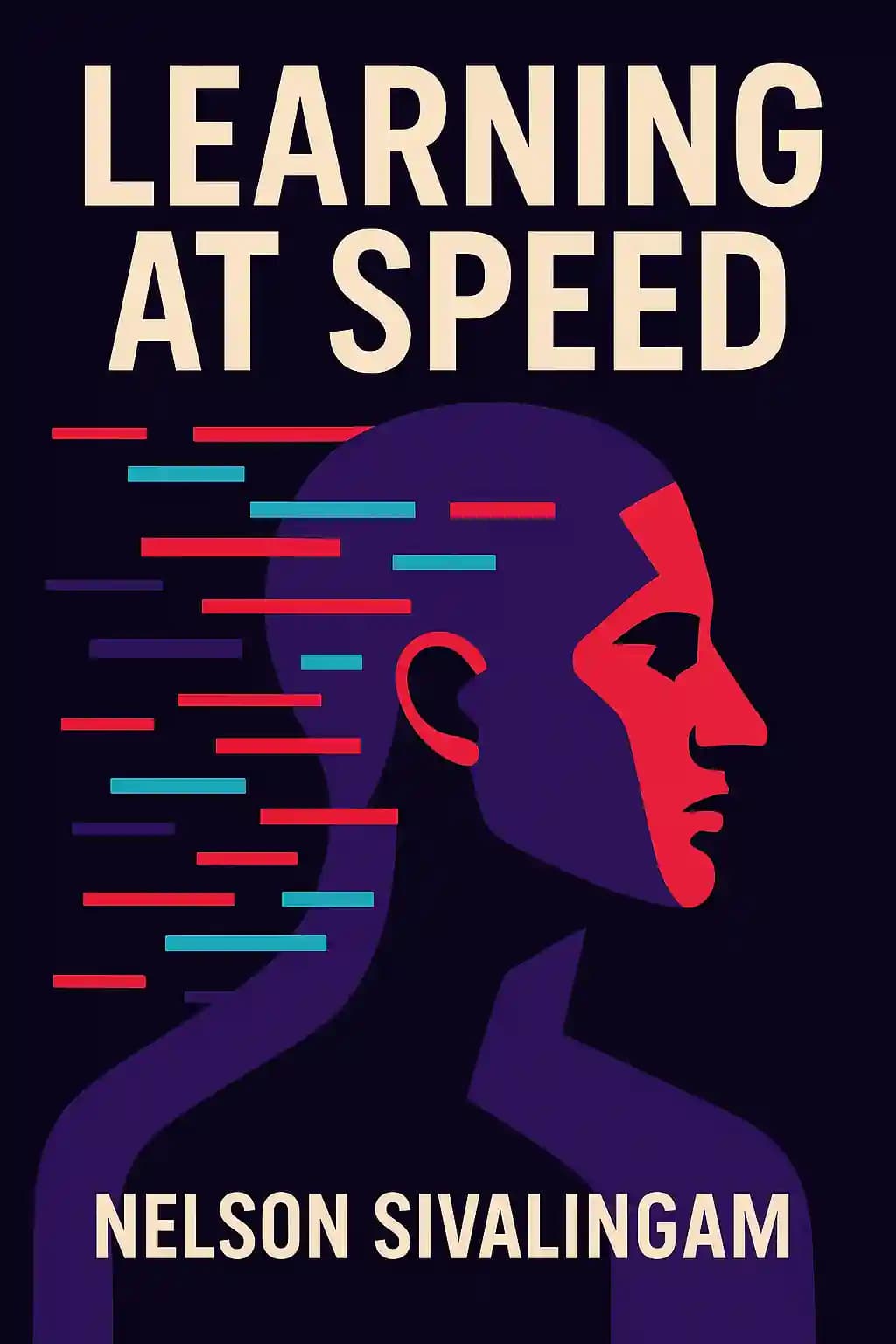
In a world where 75% of managers hate their L&D programs, "Learning at Speed" revolutionizes workforce development with lean learning principles. Shortlisted for getAbstract's 2023 awards, Sivalingam's guide transforms how companies upskill employees when only 12% apply training effectively.
Nelson Sivalingam, award-winning author of Learning at Speed: How to Upskill and Reskill Your Workforce at Pace to Drive Business Performance, is a leading expert in organizational learning and performance strategy. The book blends lean methodologies with agile practices, reflecting his decade-long experience in transforming workplace learning through technology and strategic innovation.
As CEO and Co-Founder of HowNow, a learning experience platform utilized by global enterprises such as Gymshark, Deloitte, and Investec, Sivalingam bridges technological innovation with practical workforce development strategies.
A sought-after speaker featured at Google Campus and Bloomberg documentaries, he hosts the L&D Disrupt Podcast, sharing cutting-edge insights on modern skill-building approaches. Recognized among KPMG’s Asian Stars in Tech and Virgin Media’s 30 Under 30 UK innovators, his work has been featured in The Guardian, The Telegraph, and academic circles.
Learning at Speed has become essential reading for L&D professionals, establishing Sivalingam as a pivotal voice in redefining corporate learning ecosystems for the digital age.
Learning at Speed provides a lean, agile framework for organizations to rapidly upskill workforces amid technological disruption. Nelson Sivalingam combines startup-inspired methodologies with L&D strategies, emphasizing the 5C framework (Continuous Learning, Curiosity, Collaboration, Creativity, Courage) and actionable tools like the Learning Flywheel. The book addresses measuring ROI, overcoming learning barriers, and building future-proof talent pipelines.
This book is essential for L&D professionals, HR leaders, and managers in fast-evolving industries like tech, finance, or healthcare. It’s particularly valuable for organizations facing skill gaps, digital transformation challenges, or needing cost-effective training strategies. Sivalingam’s insights also benefit startup founders aiming to scale learning cultures.
Yes—it’s a practical guide for aligning L&D with business outcomes. Sivalingam’s lean learning approach, real-world examples, and tools like the Learning Experience Bullseye help organizations prioritize high-impact training. The focus on metrics like learning velocity and engagement makes it a standout resource for data-driven talent development.
The book introduces:
Sivalingam prioritizes metrics like learning velocity (speed of skill application), business impact (productivity gains), and engagement rates. He advocates linking L&D outcomes to KPIs, using tools like the Minimum Value Learning process to validate assumptions before scaling initiatives.
Leaders must model continuous learning, create psychological safety for experimentation, and integrate L&D into daily workflows. Sivalingam emphasizes decentralizing learning ownership and aligning it with strategic goals, such as reducing time-to-competency for critical roles.
The book tackles issues like limited budgets and resistance to change by advocating microlearning, leveraging free/open resources, and embedding “learning moments” into workflows. Sivalingam also recommends involving employees in content creation to boost buy-in.
Some reviewers note the book leans heavily on startup analogies, which may not directly translate to large enterprises. Others highlight the need for more case studies on long-term implementation of the 5C framework.
Unlike traditional L&D guides, Sivalingam’s approach merges agile methodologies with talent development, focusing on speed and adaptability. It complements books like Atomic Habits (behavior change) but is distinct in its operational frameworks for organizational learning.
With AI accelerating skill obsolescence, the book’s emphasis on rapid reskilling and AI-assisted learning remains critical. Its strategies help organizations navigate remote/hybrid work challenges and build resilience against economic uncertainty.
Sivalingam is CEO of HowNow, a top edtech platform used by companies like Gymshark and Deloitte. Recognized by Forbes and KPMG, he combines hands-on experience scaling learning ecosystems with insights from hosting the L&D Disrupt Podcast.
The book’s frameworks help individuals identify transferable skills, leverage mentorship networks, and create personalized learning paths. Sivalingam’s “Jobs-To-Be-Done” methodology assists in aligning upskilling efforts with market demands.
通过作者的声音感受这本书
将知识转化为引人入胜、富含实例的见解
快速捕捉核心观点,高效学习
以有趣互动的方式享受这本书
A company's speed of learning creates competitive advantage.
Organizations that aren't prepared to fail aren't prepared to learn.
Measure what matters.
Prioritize outcomes over outputs.
Love the problem rather than the solution.
将《Learning at Speed》的核心观点拆解为易于理解的要点,了解创新团队如何创造、协作和成长。
将《Learning at Speed》提炼为快速记忆要点,突出坦诚、团队合作和创造力的关键原则。

通过生动的故事体验《Learning at Speed》,将创新经验转化为令人难忘且可应用的精彩时刻。
随心提问,选择声音,共同创造真正与你产生共鸣的见解。

"Instead of endless scrolling, I just hit play on BeFreed. It saves me so much time."
"I never knew where to start with nonfiction—BeFreed’s book lists turned into podcasts gave me a clear path."
"Perfect balance between learning and entertainment. Finished ‘Thinking, Fast and Slow’ on my commute this week."
"Crazy how much I learned while walking the dog. BeFreed = small habits → big gains."
"Reading used to feel like a chore. Now it’s just part of my lifestyle."
"Feels effortless compared to reading. I’ve finished 6 books this month already."
"BeFreed turned my guilty doomscrolling into something that feels productive and inspiring."
"BeFreed turned my commute into learning time. 20-min podcasts are perfect for finishing books I never had time for."
"BeFreed replaced my podcast queue. Imagine Spotify for books — that’s it. 🙌"
"It is great for me to learn something from the book without reading it."
"The themed book list podcasts help me connect ideas across authors—like a guided audio journey."
"Makes me feel smarter every time before going to work"

免费获取《Learning at Speed》摘要的 PDF 或 EPUB 版本。可打印或随时离线阅读。
In today's exponentially changing world, the ultimate competitive advantage isn't capital or technology - it's learning velocity. When Arcadia Group collapsed in 2020, ASOS quadrupled profits and acquired Topshop brands. The difference? How quickly they learned and adapted. This revelation forms the foundation of "Learning at Speed," a practical framework for thriving amid disruption. With 54% of employees needing reskilling and 40% of core skills changing within five years, traditional approaches to workplace learning simply can't keep pace. What happens when the world changes faster outside your organization than inside it? Extinction becomes inevitable. The solution isn't shorter courses or faster content production - it's a fundamental shift to what's called "Lean Learning," an approach that helps teams learn what matters in the shortest time, apply it in moments that shape performance, and iterate based on feedback until solving business problems. Most L&D functions operate like failing startups - building solutions nobody wants. Despite organizations spending over $350 billion annually on training, 75% of managers remain dissatisfied with L&D, and only 12% of employees apply newly learned skills. Why? Because L&D often creates content without understanding the context in which learning occurs. Every organization has one of three learning cultures, each with distinct limitations: compliance-driven cultures focus solely on meeting regulatory requirements; process-driven cultures respond to every challenge with a course; and skills-driven cultures focus on building capabilities but through event-based programs that take employees away from their jobs.