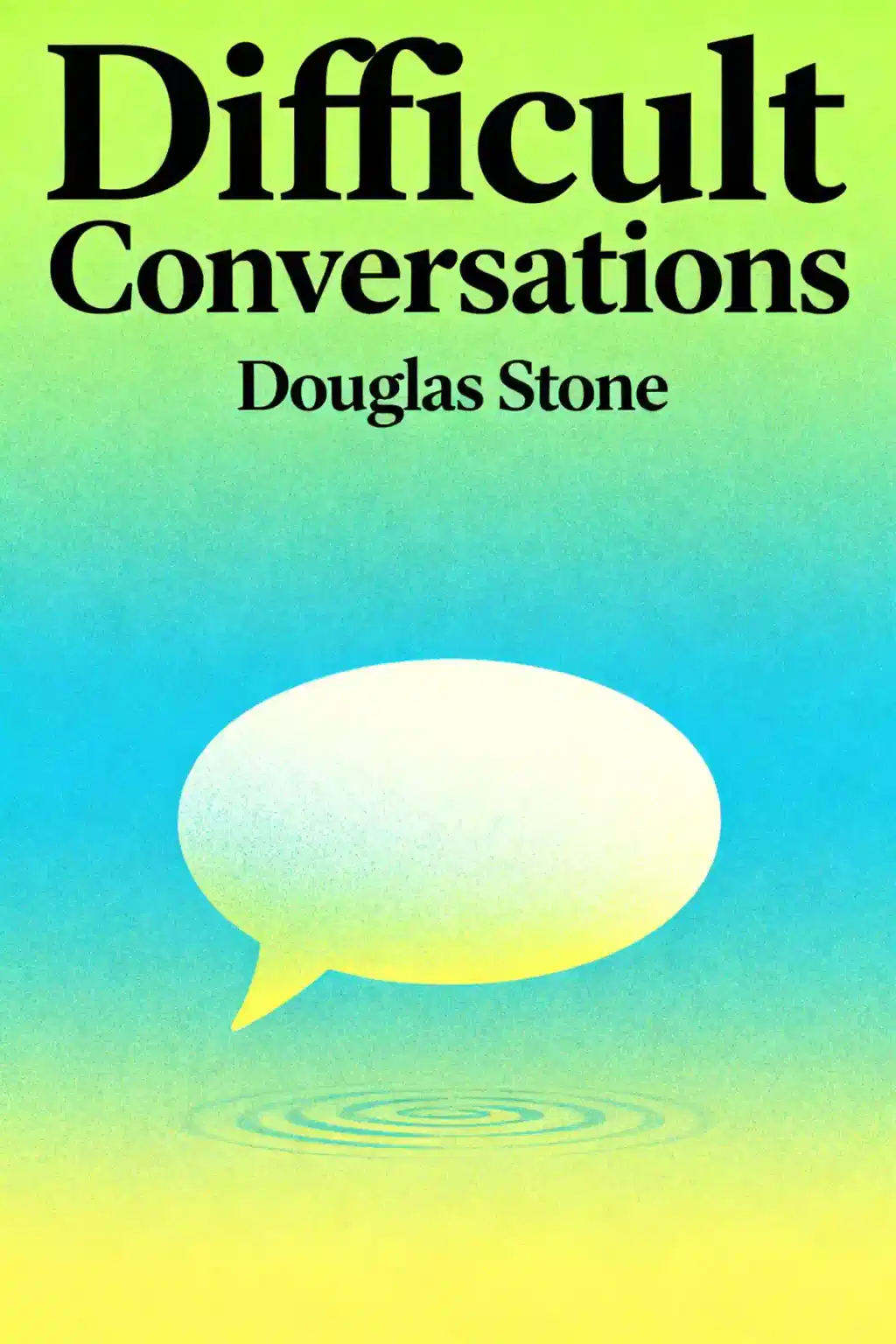
Difficult Conversations by Douglas Stone Summary

Overview of Difficult Conversations
Every difficult conversation hides three crucial dialogues beneath the surface. This groundbreaking framework, endorsed by Olympic coach Ben Hunt-Davis, has revolutionized conflict resolution worldwide. Master the "learning stance" that transforms confrontations into opportunities - the same approach reshaping leadership training from boardrooms to military academies.
- Replace "right vs. wrong" with the Three Conversations framework (What Happened, Feelings, Identity)
- Start difficult talks from the Third Story—neutral ground a mediator would describe
- Shift from certainty to curiosity with “Help me understand” instead of defending your view
- Separate intent from impact to resolve clashes between good intentions and hurt feelings
- Avoid blame by focusing on contributions—how both sides shaped the problem
- Name unspoken emotions to prevent feelings from hijacking the conversation
- Reframe identity threats by acknowledging your fears without letting them control you
- Use “And Stances” instead of “But” to validate others’ perspectives while sharing yours
- Prepare using Stone’s purpose checklist: Learn, Express, Problem-Solve—in that order
- Spot the “Identity Conversation”—when the conflict threatens your self-image as fair/competent
- End stonewalling by naming the dynamic: “I notice we’re stuck—can we reset?”
- Transform arguments into learning by asking “What information do they have that I don’t?”
About the Author of Difficult Conversations
Douglas Stone is the co-author of the bestselling book Difficult Conversations: How to Discuss What Matters Most and a leading authority in communication strategies and conflict resolution. A lecturer at Harvard Law School for nearly three decades, Stone teaches negotiation and co-founded Triad Consulting Group, advising organizations like Apple, Google, and the White House on high-stakes dialogues. His work blends academic rigor with real-world application, emphasizing empathy, active listening, and reframing adversarial interactions—themes central to Difficult Conversations.
Stone’s expertise extends to his other acclaimed book, Thanks for the Feedback: The Science and Art of Receiving Feedback Well, which explores interpersonal dynamics in professional and personal contexts. A trusted consultant for Fortune 500 companies and government agencies, he has shaped communication frameworks used by educators, executives, and policymakers worldwide.
Difficult Conversations has sold over 1 million copies, been translated into 20+ languages, and remains a cornerstone text in business schools and corporate training programs.
FAQs About Difficult Conversations
What is Difficult Conversations by Douglas Stone about?
Difficult Conversations provides a structured framework to transform emotionally charged discussions into productive dialogues. It breaks tough conversations into three layers: analyzing facts (“What Happened”), addressing emotions (“Feelings”), and managing self-perception (“Identity”). The book teaches strategies to shift from adversarial debates to collaborative problem-solving, emphasizing curiosity and empathy.
Who should read Difficult Conversations?
This book is essential for professionals, managers, and anyone navigating high-stakes personal or workplace discussions. It’s particularly valuable for HR teams, mediators, and leaders managing conflicts, negotiations, or feedback sessions. The actionable techniques apply to scenarios like salary negotiations, relationship issues, or addressing problematic behavior.
Is Difficult Conversations worth reading?
Yes—it’s a New York Times bestseller recommended by Harvard Law School and Fortune 500 companies. The framework is backed by 30+ years of research at the Harvard Negotiation Project, offering timeless tools for improving communication and reducing conflict in both professional and personal contexts.
What are the three conversations in Difficult Conversations?
- The “What Happened” Conversation: Unpacks conflicting interpretations of events.
- The Feelings Conversation: Addresses unspoken emotions driving tensions.
- The Identity Conversation: Explores how the discussion impacts self-image (e.g., “Am I competent?”).
Mastering these layers helps disentangle misunderstandings and reduce defensiveness.
How does Difficult Conversations suggest starting a tough discussion?
Begin with the “Third Story”—a neutral narrative that acknowledges both perspectives without blame. For example: “I’d like to discuss how we handle project deadlines. I know we both want success, but I’ve noticed some challenges we might resolve together.” This approach fosters collaboration over confrontation.
Can Difficult Conversations help in workplace conflicts?
Absolutely. The book’s problem-solving steps—preparing by mapping all three conversations, inviting joint exploration, and co-creating solutions—are widely used in corporate settings. Companies like Microsoft, IBM, and Shell have applied these methods to improve team dynamics and leadership communication.
What are common criticisms of Difficult Conversations?
Some argue the framework requires significant emotional labor and practice to implement effectively. Critics note it may oversimplify deeply entrenched conflicts, and the emphasis on mutual understanding can be challenging in power-imbalanced scenarios (e.g., employer-employee disputes).
How does Difficult Conversations compare to Crucial Conversations?
While both address high-stakes communication, Difficult Conversations focuses more on deconstructing dialogue layers and identity concerns, whereas Crucial Conversations emphasizes creating psychological safety. Both are complementary; Stone’s work is often preferred for complex interpersonal dynamics, while Crucial Conversations is cited for team settings.
What is a key quote from Difficult Conversations?
“The single most important thing you can do is to shift your internal stance from ‘I understand’ to ‘Help me understand.’” This mantra encapsulates the book’s core philosophy of replacing assumptions with genuine curiosity.
Why is the “Identity Conversation” critical in difficult discussions?
Identity threats (e.g., feeling disrespected or incompetent) often trigger defensiveness. The book teaches reframing these threats by separating behavior from self-worth: “This mistake doesn’t mean I’m a failure—it’s a specific incident I can address.” This reduces emotional escalation.
How relevant is Difficult Conversations in 2025?
With remote work and AI-driven communication tools increasing misunderstandings, the book’s emphasis on emotional literacy and clarity remains vital. Updated editions address digital communication pitfalls, making it a go-to resource for hybrid teams and cross-cultural collaborations.
What other books complement Difficult Conversations?
For a holistic communication toolkit, pair with:
- Thanks for the Feedback (also by Stone) for receiving criticism.
- Nonviolent Communication by Rosenberg for empathetic language.
- Never Split the Difference by Voss for negotiation tactics.
Feel the book through the author's voice
Turn knowledge into engaging, example-rich insights
Capture key ideas in a flash for fast learning
Enjoy the book in a fun and engaging way
Key Themes in Difficult Conversations
Quotes from Difficult Conversations
Every difficult conversation contains three underlying conversations.
Difficult conversations aren't about delivering messages but about learning.
Both sides make perfect sense within their own stories.
Moving beyond the argument about who's right requires shifting from certainty to curiosity.
We judge others' actions largely based on our assumptions about their intentions.
Characters in Difficult Conversations
Quick Summary Mode - Read or listen to Difficult Conversations Summary in 12 Minutes

Break down key ideas from Difficult Conversations into bite-sized takeaways to understand how innovative teams create, collaborate, and grow.

Flash Card Mode - Top 11 Insights from Difficult Conversations in a Nutshell

Distill Difficult Conversations into rapid-fire memory cues that highlight key principles of candor, teamwork, and creative resilience.

Fun Mode - Difficult Conversations Lessons Told Through 24-Min Stories

Experience Difficult Conversations through vivid storytelling that turns innovation lessons into moments you'll remember and apply.
Personalize Mode - Read or listen to Difficult Conversations Summary in 0 Minutes

Ask anything, pick the voice, and co-create insights that truly resonate with you.

From Columbia University alumni built in San Francisco
"Instead of endless scrolling, I just hit play on BeFreed. It saves me so much time."


"I never knew where to start with nonfiction—BeFreed’s book lists turned into podcasts gave me a clear path."


"Perfect balance between learning and entertainment. Finished ‘Thinking, Fast and Slow’ on my commute this week."
"Crazy how much I learned while walking the dog. BeFreed = small habits → big gains."
"Reading used to feel like a chore. Now it’s just part of my lifestyle."

"Feels effortless compared to reading. I’ve finished 6 books this month already."
"BeFreed turned my guilty doomscrolling into something that feels productive and inspiring."

"BeFreed turned my commute into learning time. 20-min podcasts are perfect for finishing books I never had time for."
"BeFreed replaced my podcast queue. Imagine Spotify for books — that’s it. 🙌"

"It is great for me to learn something from the book without reading it."
"The themed book list podcasts help me connect ideas across authors—like a guided audio journey."
"Makes me feel smarter every time before going to work"
From Columbia University alumni built in San Francisco
"Instead of endless scrolling, I just hit play on BeFreed. It saves me so much time."
"I never knew where to start with nonfiction—BeFreed’s book lists turned into podcasts gave me a clear path."
"Perfect balance between learning and entertainment. Finished ‘Thinking, Fast and Slow’ on my commute this week."
"Crazy how much I learned while walking the dog. BeFreed = small habits → big gains."
"Reading used to feel like a chore. Now it’s just part of my lifestyle."
"Feels effortless compared to reading. I’ve finished 6 books this month already."
"BeFreed turned my guilty doomscrolling into something that feels productive and inspiring."
"BeFreed turned my commute into learning time. 20-min podcasts are perfect for finishing books I never had time for."
"BeFreed replaced my podcast queue. Imagine Spotify for books — that’s it. 🙌"
"It is great for me to learn something from the book without reading it."
"The themed book list podcasts help me connect ideas across authors—like a guided audio journey."
"Makes me feel smarter every time before going to work"
"Instead of endless scrolling, I just hit play on BeFreed. It saves me so much time."
"I never knew where to start with nonfiction—BeFreed’s book lists turned into podcasts gave me a clear path."
"Perfect balance between learning and entertainment. Finished ‘Thinking, Fast and Slow’ on my commute this week."
"Crazy how much I learned while walking the dog. BeFreed = small habits → big gains."
"Reading used to feel like a chore. Now it’s just part of my lifestyle."
"Feels effortless compared to reading. I’ve finished 6 books this month already."
"BeFreed turned my guilty doomscrolling into something that feels productive and inspiring."
"BeFreed turned my commute into learning time. 20-min podcasts are perfect for finishing books I never had time for."
"BeFreed replaced my podcast queue. Imagine Spotify for books — that’s it. 🙌"
"It is great for me to learn something from the book without reading it."
"The themed book list podcasts help me connect ideas across authors—like a guided audio journey."
"Makes me feel smarter every time before going to work"
"Instead of endless scrolling, I just hit play on BeFreed. It saves me so much time."
"I never knew where to start with nonfiction—BeFreed’s book lists turned into podcasts gave me a clear path."
"Perfect balance between learning and entertainment. Finished ‘Thinking, Fast and Slow’ on my commute this week."
"Crazy how much I learned while walking the dog. BeFreed = small habits → big gains."
"Reading used to feel like a chore. Now it’s just part of my lifestyle."
"Feels effortless compared to reading. I’ve finished 6 books this month already."
"BeFreed turned my guilty doomscrolling into something that feels productive and inspiring."
"BeFreed turned my commute into learning time. 20-min podcasts are perfect for finishing books I never had time for."
"BeFreed replaced my podcast queue. Imagine Spotify for books — that’s it. 🙌"
"It is great for me to learn something from the book without reading it."
"The themed book list podcasts help me connect ideas across authors—like a guided audio journey."
"Makes me feel smarter every time before going to work"

Get the Difficult Conversations summary as a free PDF or EPUB. Print it or read offline anytime.