Tao of Physics
Overview of Tao of Physics
Where quantum physics meets Eastern mysticism - a groundbreaking exploration that's captivated minds across 23 languages. Joseph Campbell called it "magnificent," while sparking both admiration and controversy by revealing the surprising parallels between subatomic reality and ancient spiritual wisdom.

Key Themes in Tao of Physics
- quantum mysticism
- interconnected web
- mechanistic worldview crisis
- rational versus intuitive knowledge
- subatomic particle dance
Quotes from Tao of Physics
The Tao which can be expressed in words is not the eternal Tao.
The basic oneness of the universe is not only the central characteristic of the mystical experience, but is also one of the most important revelations of modern physics.
Modern physics has confirmed most dramatically one of the basic ideas of Eastern mysticism; that all the concepts we use to describe nature are limited, that they are not features of reality itself, as was believed, but creations of the mind; parts of the map, not of the territory.
The most important characteristic of the Eastern world view – one could almost say the essence of it – is the awareness of the unity and mutual interrelation of all things and events – the experience of all phenomena as manifestations of a basic oneness.
The foundations of physics have started moving.
Characters in Tao of Physics
- Fritjof CapraAuthor and physicist who bridges science and Tao
- Werner HeisenbergPhysicist noted for the shifting foundations
About the Author
About the Author of Tao of Physics
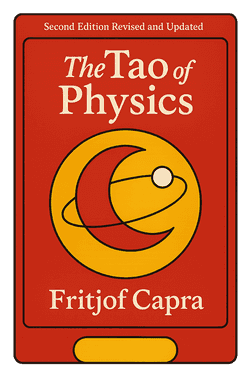
Fritjof Capra is an Austrian-born physicist and the bestselling author of The Tao of Physics: An Exploration of the Parallels Between Modern Physics and Eastern Mysticism, a work renowned for bridging science and spirituality.
Capra earned a Ph.D. from the University of Vienna and went on to conduct pioneering research in particle physics at prestigious institutions, including the Stanford Linear Accelerator Center and Imperial College London.
His seminal work connects quantum mechanics and relativity theory to the philosophies of Hinduism, Buddhism, and Taoism. This reflects his expertise in systems theory and ecological education, which he further developed as the founding director of the Center for Ecoliteracy.
Capra’s influential writings also include The Systems View of Life and The Science of Leonardo, in which he analyzes Leonardo da Vinci’s interdisciplinary methods. The Tao of Physics has been translated into over 40 languages and remains a cultural landmark, notably referenced at CERN alongside a statue of Shiva, symbolizing principles of cosmic dance.
Download Summary of Tao of Physics
Get the Tao of Physics summary as a free PDF or EPUB. Print it or read offline anytime.
FAQs About This Book
The Tao of Physics explores the striking parallels between modern physics (particularly quantum theory and relativity) and Eastern mystical traditions like Taoism, Buddhism, and Hinduism. Capra argues that both disciplines reveal a universe defined by interconnectedness, dynamic change, and the limitations of rigid materialism, offering a holistic view of reality.
This book is ideal for readers curious about the intersection of science and spirituality, including those without a physics background. It appeals to philosophers, spiritually minded individuals, and scientists interested in Eastern thought’s philosophical implications.
Yes—it remains a seminal work for sparking dialogue between science and mysticism. Despite mixed academic reviews, its accessibility and innovative comparisons make it a thought-provoking read for understanding universal interconnectedness.
Capra highlights how quantum physics’ “web of relations” mirrors Eastern views of reality as an indivisible whole. For example, subatomic particles’ dual wave-particle nature echoes Taoist concepts like yin and yang, where opposites coexist dynamically.
Yin and yang symbolize the Taoist principle of cyclical, complementary forces shaping reality. Capra links this to physics’ wave-particle duality and quantum field theory, where contrasting phenomena unite to form a coherent system.
Relativity’s unified spacetime continuum aligns with Eastern views of a fluid, interconnected cosmos. Capra notes that both frameworks reject absolute separation, emphasizing relativity of perspective and the illusion of fixed boundaries.
Critics argue Capra oversimplifies both physics and mysticism, forcing parallels where none exist. Some scientists dismiss the comparisons as metaphorical rather than substantive, while traditionalists question misrepresentations of Eastern philosophies.
Capra likens the Tao to a quantum field—a boundless, creative void giving rise to all forms. Lao Tzu’s “hollow valley” metaphor mirrors the field’s dual nature: empty yet infinitely generative, sustaining and dissolving particles.
Capra suggests physics and mysticism both point to consciousness as integral to reality. Quantum observations’ dependency on the observer parallels Eastern teachings where mind and cosmos are inseparable.
The book popularized science-spirituality dialogue, inspiring documentaries, art, and later works on quantum mysticism. Its enduring appeal lies in bridging empirical inquiry with existential wonder.
Key examples include Lao Tzu’s “The Tao that can be told is not the eternal Tao” and Buddhist sutras on impermanence. Capra ties these to physics’ emphasis on process over static matter.
No—Capra explains concepts accessibly, avoiding complex math. The book is structured to guide lay readers through physics basics while drawing clear connections to mystical ideas.
Capra critiques reductionist, mechanistic models, advocating for holistic frameworks akin to Eastern thought. He argues physics’ evolution (e.g., quantum theory) inherently challenges materialism.