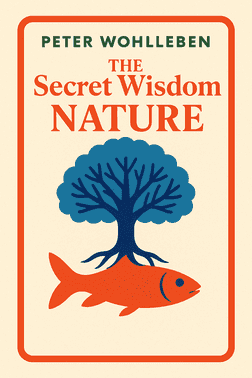
The Secret Wisdom of Nature: Trees, Animals, and the Extraordinary Balance of All Living Things -_ Stories from Science and Observation by Peter Wohlleben Summary

Overview of The Secret Wisdom of Nature
Discover how trees communicate, forests influence rainfall, and all living things intertwine in this NYT bestseller. Jane Goodall herself fell "in love with" Wohlleben's revelations about nature's hidden networks - where deciduous trees affect Earth's rotation and humans can restore ecological balance by simply stepping back.
- Forests thrive through fungal “wood wide web” networks sharing nutrients and threat alerts.
- Trees communicate via chemical signals to warn neighbors of insect infestations.
- Industrial forestry disrupts nature’s balance by prioritizing profit over ecological resilience.
- Animals maintain forest health through seed dispersal and nutrient cycling.
- Natural forest management preserves biodiversity without heavy machinery or human interference.
- Predator-prey dynamics prevent overgrazing and sustain plant diversity in ecosystems.
- Human actions like deforestation unravel finely tuned interspecies communication systems.
- Conservation requires wildlife corridors to protect genetic diversity and animal migration.
- Local communities play vital roles in sustaining forest ecosystems through stewardship.
- Nature’s interconnectedness transforms decaying trees into life-giving resources for new growth.
- Bees demonstrate geographical intelligence by optimizing flower-finding routes for colonies.
- The Secret Wisdom of Nature reveals how every organism supports Earth’s life systems.
About the Author of The Secret Wisdom of Nature
Peter Wohlleben, bestselling author of The Secret Wisdom of Nature and a globally recognized forester, explores humanity’s interconnectedness with ecosystems in this revelatory work on ecological balance.
A forestry graduate and former government wood ranger, Wohlleben spent decades managing forests before becoming a vocal advocate for sustainable practices through his Forest Academy in Hümmel, Germany. His expertise in arboreal communication and environmental stewardship stems from hands-on experience, detailed in his New York Times bestseller The Hidden Life of Trees—a groundbreaking book revealing tree social networks, translated into over 40 languages and adapted into a documentary.
Wohlleben’s works, including The Inner Life of Animals and The Heartbeat of Trees, blend scientific rigor with accessible storytelling, earning features in major media like NPR and TED Talks. A recipient of the Bavarian Nature Conservation Medal, he challenges conventional forestry through lectures, TV appearances, and his magazine Wohlleben’s World. His books have sold over 3 million copies worldwide, cementing his role as a leading voice in redefining humanity’s relationship with nature.
FAQs About The Secret Wisdom of Nature
What is The Secret Wisdom of Nature about?
The Secret Wisdom of Nature by Peter Wohlleben explores the intricate connections within ecosystems, revealing how trees, animals, and microorganisms interact to sustain life. Through scientific insights and personal anecdotes, Wohlleben highlights nature’s self-regulating systems—from predator-prey dynamics to forest communication networks—and warns against human interference in these delicate balances. The book emphasizes biodiversity’s role in environmental stability.
Who should read The Secret Wisdom of Nature?
Nature enthusiasts, ecology students, and readers curious about environmental interconnectedness will find value in this book. It’s ideal for fans of Wohlleben’s prior works like The Hidden Life of Trees and those seeking accessible, narrative-driven science. Critics of anthropomorphism in science writing may still appreciate its conservation-focused messaging.
Is The Secret Wisdom of Nature worth reading?
Yes, for its engaging blend of ecological storytelling and urgent conservation themes. While some critique Wohlleben’s anthropomorphic style as unscientific, others praise his ability to make complex concepts relatable. The book offers actionable insights into coexisting with nature, making it a thought-provoking read despite occasional repetitiveness.
What are the key concepts in The Secret Wisdom of Nature?
- Interdependence: How species rely on one another for survival (e.g., wolves regulating forest health).
- Self-regulation: Natural systems’ ability to rebound without human intervention.
- Biodiversity’s value: Diverse ecosystems as buffers against climate crises.
- Human impact: The dangers of disrupting ecological balances through industrialization.
How does The Secret Wisdom of Nature differ from Wohlleben’s The Hidden Life of Trees?
While both books anthropomorphize nature, The Secret Wisdom of Nature broadens its scope beyond forests to examine entire ecosystems, including animal behavior and microbial roles. It also addresses human-nature conflict more directly, advocating for reduced interference rather than focusing solely on tree communication.
What critiques exist about The Secret Wisdom of Nature?
Critics argue Wohlleben’s anthropomorphic metaphors oversimplify scientific rigor, potentially misleading readers. Some note repetitive themes from his earlier works and a lack of in-depth citations. However, defenders argue his style fosters public empathy for conservation.
Does The Secret Wisdom of Nature discuss climate change?
Indirectly—it frames biodiversity loss and ecosystem disruption as root causes of environmental crises. Wohlleben argues that preserving natural self-regulation mechanisms (e.g., rewilding predators) could mitigate climate impacts more effectively than technological solutions.
What quotes summarize The Secret Wisdom of Nature?
- “Nature is like a clock—every species is a gear, and losing one stops the whole mechanism.”
- “We protect nature best when we leave it alone.”
These lines encapsulate the book’s themes of interconnectedness and minimalist conservation.
How does Wohlleben support his claims in the book?
He combines peer-reviewed studies (e.g., trophic cascade research) with decades of forestry observations. Case studies include wolf reintroduction in Yellowstone and forest recovery post-industrialization. However, some theories remain speculative, reflecting his emphasis on wonder over hard data.
Can The Secret Wisdom of Nature help with environmental activism?
Yes—it provides compelling arguments for rewilding and policy changes. By illustrating nature’s resilience when undisturbed, Wohlleben empowers advocates to prioritize ecosystem preservation over short-term economic gains.
Is The Secret Wisdom of Nature part of a series?
Yes, it concludes Wohlleben’s “Mysteries of Nature” trilogy, following The Hidden Life of Trees and The Inner Life of Animals. Each book explores different ecological layers, building toward a holistic view of natural systems.
Why is The Secret Wisdom of Nature relevant in 2025?
As climate policies shift toward technological fixes, Wohlleben’s case for low-intervention conservation offers a counterpoint. The book’s warnings about biodiversity collapse align with recent IPCC reports, making it a timely read for eco-conscious audiences.
Feel the book through the author's voice
Turn knowledge into engaging, example-rich insights
Capture key ideas in a flash for fast learning
Enjoy the book in a fun and engaging way
Key Themes in The Secret Wisdom of Nature
Quotes from The Secret Wisdom of Nature
Nature's network is vastly more complex than any clock.
The wisest approach may be to minimize our interference.
Wolves didn't just reduce elk numbers through predation.
The wolves' impact touches species they never directly interact with.
The wolf's return brings something intangible but valuable.
Characters in The Secret Wisdom of Nature
Quick Summary Mode - Read or listen to The Secret Wisdom of Nature Summary in 9 Minutes

Break down key ideas from The Secret Wisdom of Nature into bite-sized takeaways to understand how innovative teams create, collaborate, and grow.

Flash Card Mode - Top 8 Insights from The Secret Wisdom of Nature in a Nutshell

Distill The Secret Wisdom of Nature into rapid-fire memory cues that highlight key principles of candor, teamwork, and creative resilience.

Fun Mode - The Secret Wisdom of Nature Lessons Told Through 24-Min Stories

Experience The Secret Wisdom of Nature through vivid storytelling that turns innovation lessons into moments you'll remember and apply.
Personalize Mode - Read or listen to The Secret Wisdom of Nature Summary in 0 Minutes

Ask anything, pick the voice, and co-create insights that truly resonate with you.

From Columbia University alumni built in San Francisco
"Instead of endless scrolling, I just hit play on BeFreed. It saves me so much time."


"I never knew where to start with nonfiction—BeFreed’s book lists turned into podcasts gave me a clear path."


"Perfect balance between learning and entertainment. Finished ‘Thinking, Fast and Slow’ on my commute this week."
"Crazy how much I learned while walking the dog. BeFreed = small habits → big gains."
"Reading used to feel like a chore. Now it’s just part of my lifestyle."

"Feels effortless compared to reading. I’ve finished 6 books this month already."
"BeFreed turned my guilty doomscrolling into something that feels productive and inspiring."

"BeFreed turned my commute into learning time. 20-min podcasts are perfect for finishing books I never had time for."
"BeFreed replaced my podcast queue. Imagine Spotify for books — that’s it. 🙌"

"It is great for me to learn something from the book without reading it."
"The themed book list podcasts help me connect ideas across authors—like a guided audio journey."
"Makes me feel smarter every time before going to work"
From Columbia University alumni built in San Francisco
"Instead of endless scrolling, I just hit play on BeFreed. It saves me so much time."
"I never knew where to start with nonfiction—BeFreed’s book lists turned into podcasts gave me a clear path."
"Perfect balance between learning and entertainment. Finished ‘Thinking, Fast and Slow’ on my commute this week."
"Crazy how much I learned while walking the dog. BeFreed = small habits → big gains."
"Reading used to feel like a chore. Now it’s just part of my lifestyle."
"Feels effortless compared to reading. I’ve finished 6 books this month already."
"BeFreed turned my guilty doomscrolling into something that feels productive and inspiring."
"BeFreed turned my commute into learning time. 20-min podcasts are perfect for finishing books I never had time for."
"BeFreed replaced my podcast queue. Imagine Spotify for books — that’s it. 🙌"
"It is great for me to learn something from the book without reading it."
"The themed book list podcasts help me connect ideas across authors—like a guided audio journey."
"Makes me feel smarter every time before going to work"
"Instead of endless scrolling, I just hit play on BeFreed. It saves me so much time."
"I never knew where to start with nonfiction—BeFreed’s book lists turned into podcasts gave me a clear path."
"Perfect balance between learning and entertainment. Finished ‘Thinking, Fast and Slow’ on my commute this week."
"Crazy how much I learned while walking the dog. BeFreed = small habits → big gains."
"Reading used to feel like a chore. Now it’s just part of my lifestyle."
"Feels effortless compared to reading. I’ve finished 6 books this month already."
"BeFreed turned my guilty doomscrolling into something that feels productive and inspiring."
"BeFreed turned my commute into learning time. 20-min podcasts are perfect for finishing books I never had time for."
"BeFreed replaced my podcast queue. Imagine Spotify for books — that’s it. 🙌"
"It is great for me to learn something from the book without reading it."
"The themed book list podcasts help me connect ideas across authors—like a guided audio journey."
"Makes me feel smarter every time before going to work"
"Instead of endless scrolling, I just hit play on BeFreed. It saves me so much time."
"I never knew where to start with nonfiction—BeFreed’s book lists turned into podcasts gave me a clear path."
"Perfect balance between learning and entertainment. Finished ‘Thinking, Fast and Slow’ on my commute this week."
"Crazy how much I learned while walking the dog. BeFreed = small habits → big gains."
"Reading used to feel like a chore. Now it’s just part of my lifestyle."
"Feels effortless compared to reading. I’ve finished 6 books this month already."
"BeFreed turned my guilty doomscrolling into something that feels productive and inspiring."
"BeFreed turned my commute into learning time. 20-min podcasts are perfect for finishing books I never had time for."
"BeFreed replaced my podcast queue. Imagine Spotify for books — that’s it. 🙌"
"It is great for me to learn something from the book without reading it."
"The themed book list podcasts help me connect ideas across authors—like a guided audio journey."
"Makes me feel smarter every time before going to work"

Get the The Secret Wisdom of Nature summary as a free PDF or EPUB. Print it or read offline anytime.