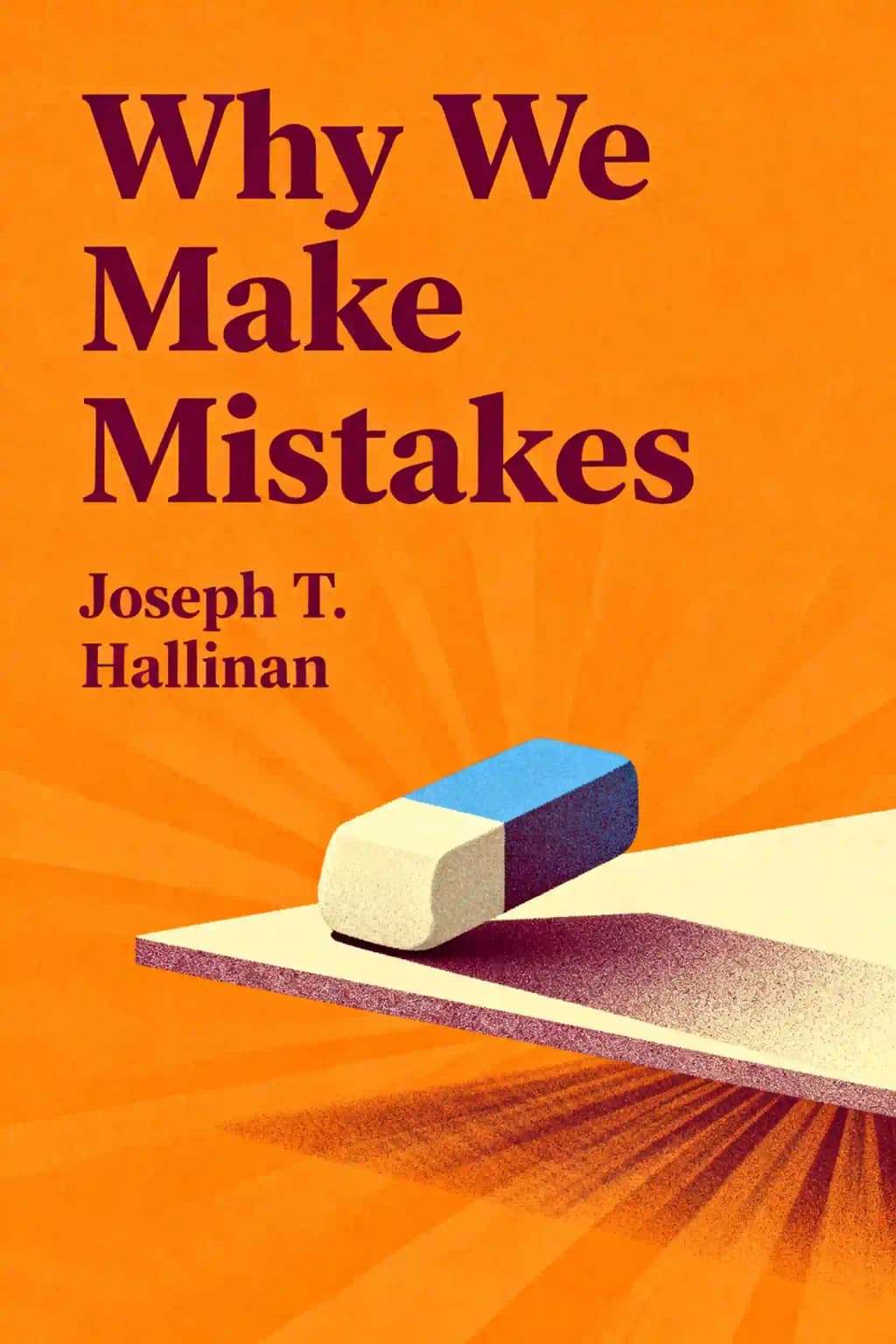
Why We Make Mistakes
How We Learn and Why We Don't
Обзор книги Why We Make Mistakes
Ever wonder why you misplace keys or make bad decisions? "Why We Make Mistakes" reveals the science behind our flawed brains, showing how cognitive biases sabotage our daily choices. A must-read that transforms self-awareness into practical error-prevention strategies across industries.

Ключевые темы в Why We Make Mistakes
- cognitive bias
- human error
- selective perception
- memory distortion
- change blindness
Цитаты из Why We Make Mistakes
Our confidence in our visual abilities is wildly misplaced.
Names, like penny features, are forgettable because they lack inherent meaning.
Our minds struggle with meaningless information.
We consistently overestimate our ability to remember meaningless information.
Our brains automatically make connections and form perceptions without our conscious awareness.
Персонажи в Why We Make Mistakes
- Joseph T. HallinanPulitzer Prize-winning journalist and author
- Hermann EbbinghausPsychologist who studied memory and forgetting
- Nickerson and AdamsResearchers who studied memory of common objects
- ShepardCreator of the 'Turning the Tables' visual illusion
Об авторе
Об авторе книги Why We Make Mistakes
Joseph T. Hallinan, Pulitzer Prize-winning journalist and bestselling author of Why We Make Mistakes, specializes in exploring human behavior through the lens of cognitive psychology and decision-making. A former reporter for The Wall Street Journal and The New York Times, Hallinan combines rigorous investigative skills with accessible storytelling to unpack why people overlook errors, misjudge risks, and cling to false confidence. His expertise stems from years analyzing systemic failures in medicine, criminal justice, and everyday life—including his Pulitzer-winning investigation into medical malpractice that revealed critical gaps in healthcare oversight.
Hallinan’s other works include Going Up the River: Travels in a Prison Nation, a groundbreaking exploration of mass incarceration named a New York Times Notable Book, and Kidding Ourselves: The Hidden Power of Self-Deception, which examines how biases shape reality.
As a visiting professor at Vanderbilt University and frequent commentator on NPR’s Fresh Air and CBS News, he bridges academic research with public understanding. Why We Make Mistakes has sold over 100,000 copies in the U.S. alone and been translated into 12 languages, cementing its status as a seminal work in behavioral science.
Скачать резюме книги «Why We Make Mistakes»
Получите резюме книги «Why We Make Mistakes» в формате PDF или EPUB бесплатно. Распечатайте или читайте офлайн в любое время.
Часто задаваемые вопросы об этой книге
Why We Make Mistakes examines the science behind human error, revealing how cognitive biases, memory limitations, and environmental factors lead to predictable mistakes. Joseph T. Hallinan combines psychology research and real-world examples—from aviation errors to financial misjudgments—to explain why we overlook details, overestimate abilities, and repeat errors. The book offers actionable strategies to mitigate these pitfalls.
This book is ideal for:
- Psychology enthusiasts interested in decision-making flaws.
- Professionals in healthcare, finance, or aviation seeking error-reduction strategies.
- General readers aiming to improve self-awareness and avoid everyday mistakes.
Yes—it’s a bestselling work translated into over a dozen languages, praised for blending academic rigor with engaging storytelling. Hallinan’s insights into cognitive illusions and practical tips (like using checklists) make it valuable for personal and professional growth.
Joseph T. Hallinan is a Pulitzer Prize-winning journalist and author renowned for exploring human behavior. A former Wall Street Journal reporter, he’s written acclaimed books like Kidding Ourselves and Going Up the River. His expertise in investigative reporting lends credibility to his analysis of error mechanisms.
Key themes include:
- Overconfidence: Why we underestimate risks.
- Attention failures: How we miss obvious details.
- Memory flaws: The unreliability of recall.
- Context dependence: How environments shape decisions.
Hallinan highlights reconstructive memory—how brains fill gaps with assumptions—leading to inaccuracies. For example, eyewitness testimony often misrembers events due to stress or suggestion. Context shifts (e.g., learning info in one room but recalling it elsewhere) exacerbate these errors.
Overconfidence blinds us to our limitations, causing preventable mistakes. The book cites examples like investors misjudging market risks or doctors dismissing second opinions, emphasizing that 70% of people rate themselves "above average" in skill—a statistical impossibility.
Strategies include:
- Using checklists to avoid oversight.
- Slowing down during complex tasks.
- Seeking external feedback to counter blind spots.
- Redesigning environments (e.g., clearer signage) to minimize contextual errors.
Situational cues heavily impact choices: Hospital layouts affect nurse errors, while supermarket lighting alters purchasing habits. Hallinan argues that small environmental tweaks—like simplifying forms—can drastically reduce mistakes.
Yes, including:
- Aviation disasters caused by attentional tunneling.
- Medical misdiagnoses linked to overconfidence.
- Financial crises stemming from herd mentality.
Unlike Daniel Kahneman’s Thinking, Fast and Slow (focused on decision-making systems) or Charles Duhigg’s The Power of Habit, Hallinan’s work specifically dissects error mechanisms, offering a unique lens on prevention. It complements these works by addressing practical mitigation over theoretical models.
In an era of AI-driven decisions, the book reminds readers that human cognitive limits persist. Its lessons on mitigating bias and attention lapses remain critical for professionals navigating complex systems—from healthcare algorithms to financial AI tools.







![[PDF] Toward a Theory of Behavioral Operations - Harvard Business School](/_next/image?url=https%3A%2F%2Fd1y2du6z1jfm9e.cloudfront.net%2Fassets%2Fpodcast%2Fblue.png&w=1024&q=50)