Глава 1
When Killer Whales Teach Management: The Power of Positive Reinforcement
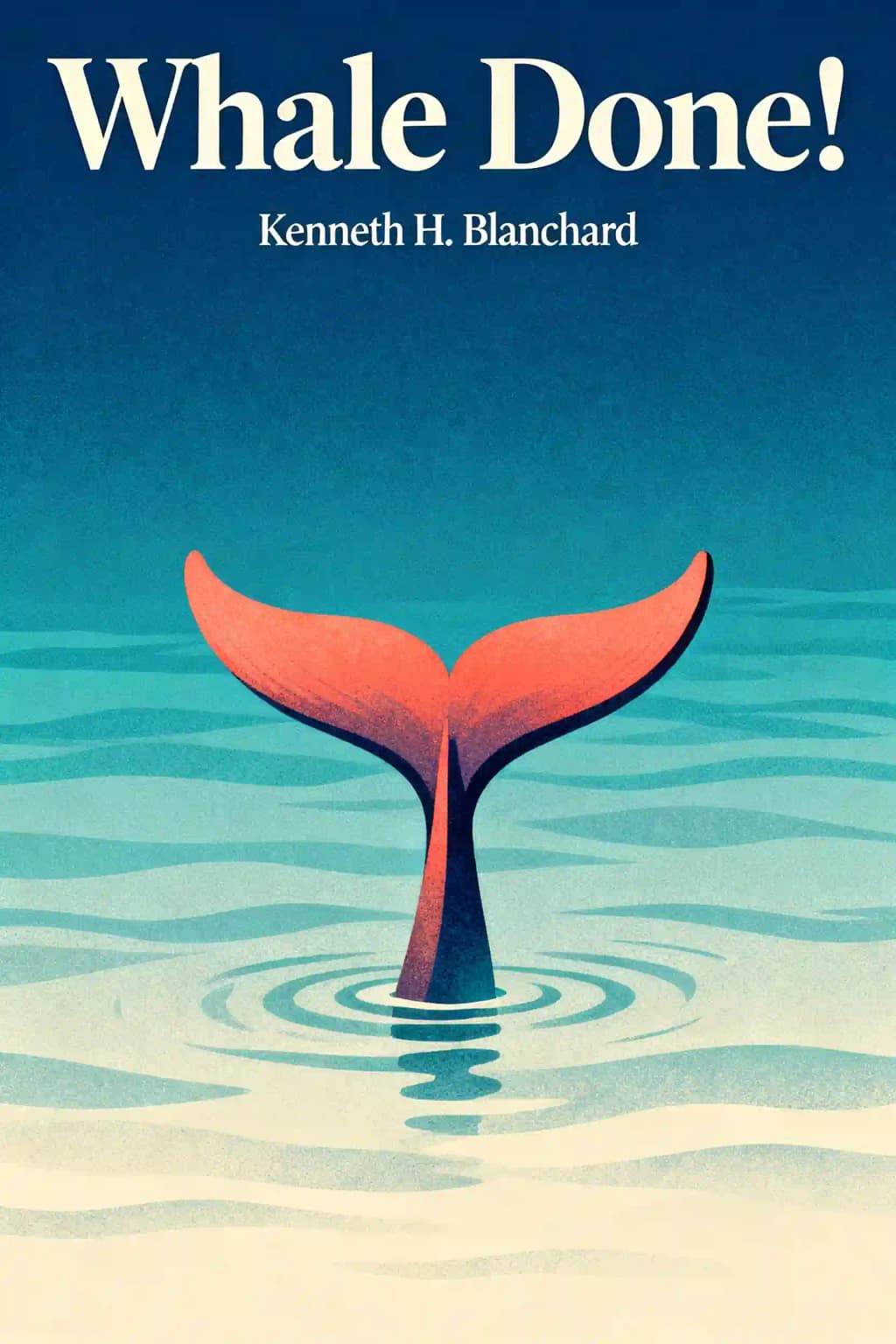
Have you ever wondered how SeaWorld trainers get 11,000-pound killer whales to perform spectacular feats with apparent joy? This question captivated Ken Blanchard during a 1976 family trip to SeaWorld San Diego, sparking a journey that would revolutionize his approach to management and relationships. The resulting book, "Whale Done," has become a cornerstone text in positive leadership philosophy, endorsed by Fortune 500 executives and featured in Harvard Business Review. Even Oprah Winfrey once highlighted it as a transformative read for workplace culture. What makes this book so powerful is its elegant simplicity: the same principles that build trust with the ocean's apex predators can transform how we interact with colleagues, employees, and family members. The secret? Catch people doing something right.
Глава 2
The GOTcha Culture: Why Punishment Fails
Most workplaces operate on what Blanchard calls the "GOTcha" approach to management. Leaders hover like hawks, waiting to swoop down at the first sign of a mistake. This approach stems from a fundamental misunderstanding about motivation and behavior. When managers focus primarily on errors, they create an environment of fear and defensiveness rather than growth and innovation.
The GOTcha culture is pervasive because it feels intuitive-if someone makes a mistake, surely pointing it out will prevent future errors. However, this approach ignores a fundamental truth about human psychology: what receives attention tends to be repeated. By focusing exclusively on mistakes, managers inadvertently reinforce negative behavior patterns.
Consider what happens in a typical workplace scenario: An employee completes nine tasks perfectly but makes one error. The manager ignores the successes and focuses entirely on the mistake. This interaction leaves the employee feeling unappreciated and defensive, creating a negative association with the manager's feedback. Over time, this dynamic erodes trust and diminishes performance.
The same pattern plays out in families. Parents who primarily notice when children misbehave but rarely acknowledge positive behavior create a household where children learn that negative behavior is the most reliable way to get attention. As Blanchard observed at SeaWorld, this approach would be disastrous with killer whales-you simply cannot intimidate or punish an 11,000-pound predator into compliance.
What makes the GOTcha approach particularly insidious is how it becomes self-reinforcing. When people feel constantly criticized, they become risk-averse, hiding mistakes rather than learning from them. Innovation stalls because trying new approaches carries too much risk of failure and subsequent criticism. The organization or family becomes trapped in a cycle of underperformance, with relationships deteriorating under the weight of accumulated negative interactions.
The most damaging aspect of the GOTcha culture is what it does to human potential. People begin to define themselves by their failures rather than their capabilities. They set their sights lower, aim for adequacy rather than excellence, and ultimately deliver exactly what the negative expectations predict-mediocre performance.
Глава 3
Building Trust: The Foundation of Any Relationship
Before SeaWorld trainers attempt to teach killer whales complex behaviors, they focus on establishing trust. This process involves consistent, predictable interactions that demonstrate reliability and positive intent. The same principle applies to human relationships, whether in the workplace or at home.
Trust develops through a series of positive exchanges that create psychological safety. In the workplace, this means creating an environment where employees feel secure enough to take risks, voice concerns, and admit mistakes without fear of punishment or humiliation. Leaders build trust by being consistent in their behavior, transparent in their communication, and reliable in following through on commitments.
The trainers at SeaWorld understand that trust is fragile and easily broken. A single negative interaction can undo the goodwill built through many positive ones. This asymmetry-where negative experiences outweigh positive ones-means leaders must be especially mindful of how they respond when things go wrong. A harsh reaction to a mistake can shatter trust that took months to establish.
Trust also requires understanding individual preferences and needs. SeaWorld trainers study each whale's unique personality and preferences, adapting their approach accordingly. Similarly, effective managers take time to understand what motivates each team member rather than applying one-size-fits-all incentives. Some employees might value public recognition, while others prefer private acknowledgment or increased autonomy.
In family settings, trust builds when parents respond consistently and positively to their children's needs. When Wes and Joy implemented the WHALE DONE approach at home, they started by acknowledging past mistakes and committing to a new way of interacting. This honesty created space for rebuilding trust with their daughters, who had grown accustomed to primarily receiving attention for negative behaviors.
Perhaps most importantly, trust requires authenticity. Both whales and humans can detect insincerity. When Anne Marie warned Wes about the dangers of manipulative praise, she highlighted a crucial truth: effective positive reinforcement must be genuine. People quickly sense when recognition is merely a management technique rather than a sincere appreciation of their efforts.
The foundation of trust creates a platform for growth and development. Only when people feel secure in a relationship can they take the risks necessary for learning and improvement. This psychological safety transforms the relationship from one based on compliance and fear to one built on collaboration and mutual respect.
Глава 4
The ABC's of Performance: A Framework for Understanding Behavior
To systematically improve performance, we need to understand what drives behavior in the first place. Anne Marie Butler introduced Wes to the ABC framework: Activator, Behavior, and Consequence. This simple but powerful model provides a structure for analyzing and influencing any performance situation.
The Activator is whatever triggers a behavior-it could be a request, a situation, or even a feeling. For example, a manager might ask an employee to complete a report (Activator), the employee then works on the report (Behavior), and the manager either acknowledges the work or ignores it (Consequence). While most management training focuses on the Activator-giving clear instructions or setting expectations-the Consequence actually has the greatest impact on whether the behavior will be repeated.
There are four types of consequences that follow any behavior: No Response, Negative Response, Redirection, and Positive Response. The most common consequence in both workplaces and families is No Response-people simply don't acknowledge when things go right. This absence of feedback creates a vacuum that people often fill with self-doubt or assumptions that their efforts aren't valued.
Negative Responses, while sometimes necessary, tend to damage relationships and create resistance. They may temporarily suppress unwanted behavior but rarely inspire improvement or initiative. When Jim Barnes criticized Wes about declining sales figures, it created defensiveness rather than motivation to improve.
The Positive Response-the WHALE DONE approach-acknowledges and reinforces desired behaviors, increasing the likelihood they'll be repeated. This isn't just about saying "good job" but providing specific, timely feedback that connects the behavior to positive outcomes. When Wes began catching his team members doing things right, their performance improved not because they feared punishment but because they felt valued and recognized.
Perhaps the most innovative aspect of the ABC framework is Redirection-the technique SeaWorld trainers use when whales exhibit undesired behaviors. Instead of punishing mistakes, trainers immediately redirect the whale's energy toward something positive they can reinforce. In human terms, this means acknowledging the effort behind a mistake while guiding the person toward a more effective approach.
For example, when Joy complained about Wes coming home late, she was inadvertently reinforcing the very behavior she wanted to change by creating a negative association with coming home. Dave suggested she instead redirect by positively acknowledging when Wes came home earlier, gradually shaping the desired behavior through positive reinforcement.
Understanding the ABC framework transforms how we approach performance improvement. Rather than focusing exclusively on giving better instructions (Activators), we recognize that what happens after the behavior (Consequence) ultimately determines whether that behavior will continue or change.
Глава 5
The WHALE DONE Response: Four Steps to Effective Praise
The WHALE DONE Response isn't just about being nice-it's a structured approach to reinforcing positive behavior. This four-step process transforms vague compliments into powerful motivational tools that drive continuous improvement. When implemented correctly, these steps create a virtuous cycle of positive behavior and recognition.
The first step is to praise immediately. Timing matters tremendously in reinforcement. At SeaWorld, trainers blow a whistle and provide a fish reward the instant a whale performs a desired behavior. This immediate feedback creates a clear connection between the action and the reward. In human interactions, delayed praise loses much of its impact as the connection between behavior and recognition becomes fuzzy. When Wes began implementing WHALE DONE at work, he made a point of acknowledging positive contributions during meetings rather than waiting for performance reviews.
The second step is being specific about what was done right. Vague praise like "good job" provides little guidance about what exactly should be repeated. Specific recognition-"I appreciate how you thoroughly researched those market trends before making your recommendation"-clearly identifies the valued behavior. This specificity helps people understand exactly what aspects of their performance are most appreciated, allowing them to intentionally repeat those actions.
The third step involves sharing positive feelings about the behavior. This emotional component transforms mechanical feedback into a meaningful human connection. When a manager says, "I feel confident presenting these numbers to the executive team because of your thorough analysis," it adds a personal dimension that strengthens the impact. This step helps people understand not just that their work meets standards, but that it genuinely matters to others.
The final step is encouraging continued good work. This forward-looking element transforms a moment of recognition into ongoing motivation. Rather than treating the praise as closure on a completed task, this step opens the door to continued growth. A simple "I look forward to seeing your approach on the next project" communicates confidence in the person's abilities and establishes positive expectations for the future.
What makes the WHALE DONE Response particularly powerful is how it contrasts with our natural tendency to take positive performance for granted while pouncing on mistakes. As Anne Marie explained to Wes, positive attention functions like sunshine-what we shine our attention on tends to grow and flourish. By systematically applying the four steps of the WHALE DONE Response, managers and parents create an environment where excellence becomes the norm rather than the exception.
The approach works because it taps into fundamental human needs for recognition and meaning. People want to know that their efforts matter and that others notice their contributions. The structured nature of the WHALE DONE Response ensures that recognition is specific and actionable rather than generic and forgettable.
Глава 6
Redirection: The Art of Handling Mistakes Positively
Perhaps the most revolutionary aspect of the WHALE DONE philosophy is its approach to mistakes. Rather than viewing errors as opportunities for criticism, the redirection technique transforms them into opportunities for growth. This approach fundamentally changes the emotional dynamics around failure, creating psychological safety that encourages innovation and learning.
Redirection begins with a crucial mindset shift: mistakes are not moral failings but learning opportunities. When a killer whale performs incorrectly, SeaWorld trainers don't get angry or punitive-they simply redirect the whale's energy toward a behavior they can reinforce positively. This same principle applies powerfully to human interactions.
The technique involves three key elements. First, remain calm rather than reacting emotionally to the error. This emotional neutrality prevents the situation from escalating into conflict. Second, redirect attention to what should be done rather than dwelling on what went wrong. Third, reinforce positively when the person moves in the right direction.
Consider how this played out when Joy helped her friend Sharon apply redirection with her teenage son Hugh. Rather than criticizing Hugh for coming home late, Sharon learned to acknowledge his arrival without negative comments, then later discuss her concerns calmly while redirecting toward desired behavior. When Hugh subsequently came home on time, Sharon provided specific positive reinforcement, gradually reshaping the behavior pattern.
In the workplace, redirection transforms how managers handle performance issues. Instead of the traditional "criticism sandwich" approach (praise-criticize-praise), which often leaves people focusing only on the negative middle, redirection keeps the interaction constructive. When Wes noticed an employee's report contained errors, rather than highlighting every mistake, he acknowledged the effort invested and redirected attention to specific improvements that would make the next report even stronger.
What makes redirection particularly powerful is how it preserves relationships during challenging situations. Traditional criticism creates defensive reactions that damage trust. Redirection maintains psychological safety while still addressing performance issues, keeping the relationship intact while improving outcomes.
The approach also recognizes an important truth about human behavior: people rarely perform poorly on purpose. Most mistakes stem from misunderstanding, lack of training, or unclear expectations. By focusing on redirection rather than punishment, managers and parents address the underlying causes of poor performance rather than merely suppressing symptoms.
Perhaps most importantly, redirection creates an environment where people feel safe admitting mistakes rather than hiding them. This transparency accelerates organizational learning and prevents small problems from growing into major crises. When Wes implemented redirection at work, he noticed employees became more forthcoming about challenges they were facing, allowing issues to be addressed proactively rather than reactively.
Глава 7
Praise Progress, Not Just Perfection: The Power of Incremental Recognition
One of the most counterintuitive yet powerful aspects of the WHALE DONE approach is recognizing that waiting for perfect performance before offering praise severely limits development. SeaWorld trainers don't wait until a whale performs a perfect backward flip before providing reinforcement-they praise each small step in the right direction, gradually shaping behavior toward the ultimate goal.
This principle of "praising progress" transforms how we approach development, whether with employees, children, or ourselves. Traditional performance management often focuses exclusively on end results, missing countless opportunities to reinforce positive movement along the way. By acknowledging incremental improvements, leaders accelerate development and maintain motivation throughout the learning process.
When Wes reflected on teaching his daughters to walk, he realized he had intuitively applied this principle. He and Joy hadn't waited until the girls could walk perfectly before celebrating-they had cheered for wobbly first steps, applauded when they stood up after falling, and celebrated each small advancement. Yet somehow, this intuitive understanding often disappears in professional contexts, where managers withhold recognition until someone achieves flawless performance.
Praising progress works because it maintains motivation during extended learning curves. When goals require significant time and effort to achieve, waiting until completion for recognition creates long motivation deserts where people receive no positive feedback. This approach also recognizes that development rarely follows a linear path-progress often comes in fits and starts, with occasional setbacks along the way.
The technique is particularly powerful for building confidence in those tackling new challenges. When Merideth, one of Wes's team members, attempted a presentation for the first time, he praised her preparation and delivery rather than focusing on her nervousness. This recognition gave her confidence to continue developing her presentation skills, eventually becoming one of the team's strongest communicators.
Praising progress also creates psychological safety for experimentation and risk-taking. When people know their efforts will be recognized even if the outcome isn't perfect, they become more willing to stretch beyond their comfort zones. This environment fosters innovation and continuous improvement rather than risk aversion and stagnation.
In family settings, praising progress transforms how children experience learning and development. When Wes and Joy began acknowledging Allie's efforts to keep the kitchen clean after having friends over, rather than criticizing remaining mess, they noticed she became increasingly thorough in her cleanup efforts. The positive reinforcement created a virtuous cycle where each small improvement received recognition, motivating further progress.
Perhaps most importantly, praising progress recognizes the reality that mastery in any domain develops incrementally. By celebrating milestones along the journey rather than just the destination, leaders and parents honor the effort and persistence required for meaningful growth.
Глава 8
From Theory to Practice: Implementing WHALE DONE in Real Life
Transforming management philosophy sounds inspiring in theory, but the real test comes in practical application. Wes Kingsley's journey from skeptical executive to WHALE DONE advocate illustrates both the challenges and rewards of implementing these principles in real-world settings.
The first implementation hurdle is often skepticism from others. When Wes proposed the WHALE DONE approach to his team, Harvey and Gus immediately pushed back, even complaining to their boss Jim Barnes. This resistance is natural-people become comfortable with familiar patterns, even negative ones. Rather than forcing compliance, Wes proposed a six-month trial period, giving the skeptics both voice and choice in the process. This approach respected their concerns while creating space for experimentation.
Implementation also requires consistency and persistence. The initial application of WHALE DONE principles may feel awkward or contrived as people develop new habits. When Wes first began looking for positive behaviors to acknowledge, he found it challenging after years of focusing primarily on mistakes. Similarly, when Joy started praising Wes for coming home earlier rather than criticizing his lateness, the new approach initially felt unnatural. Persistence through this awkward phase is essential for lasting change.
Another implementation challenge is maintaining authenticity. As Anne Marie warned Wes, insincere praise is quickly detected and undermines the entire approach. Effective implementation requires genuine appreciation rather than manipulative techniques. This authenticity develops as leaders shift their mindset from catching people doing things wrong to actively looking for positive contributions.
The family meeting Wes and Joy organized demonstrates another implementation principle: transparent communication about the change process. They openly acknowledged their past parenting mistakes and explained the new approach they wanted to try. This transparency created buy-in from their daughters, who became active participants rather than passive recipients of a new parenting technique.
Perhaps the most powerful implementation strategy is modeling the desired behavior. When Wes began using WHALE DONE with his direct reports, they gradually started using the same approach with their own teams. This cascade effect transformed the departmental culture from the inside out rather than through mandated compliance.
The results of implementation often exceed expectations. Not only did Wes's team's sales figures improve, but the positive atmosphere attracted top talent and improved retention. At home, the Kingsley household became a place where their daughters' friends wanted to spend time, drawn by the positive environment and genuine interest Wes and Joy showed in their lives.
The epilogue's image of Wes sharing WHALE DONE principles with a stranger at SeaWorld illustrates the final implementation stage: becoming an ambassador for the approach. Once people experience the transformative power of positive reinforcement, they naturally want to share it with others, creating ripples of change that extend far beyond their immediate influence.
Глава 9
Beyond Management: WHALE DONE as a Life Philosophy
While initially framed as a management technique, the WHALE DONE approach ultimately represents a comprehensive philosophy for human relationships. Its principles extend beyond workplace interactions to transform marriages, parenting, friendships, and even self-talk. This broader application reveals that at its core, WHALE DONE is about seeing and nurturing the potential in others and ourselves.
In marriage relationships, the approach addresses a common deterioration pattern where couples stop noticing positive behaviors and focus increasingly on irritations and disappointments. When Wes and Joy applied WHALE DONE principles to their relationship, they shifted from a cycle of criticism to one of appreciation and acknowledgment. Anne Marie's advice that successful relationships require both parties to be fully committed, not just "trying," highlights how the approach demands genuine engagement rather than half-hearted effort.
Parenting transforms when adults shift from primarily correcting misbehavior to catching children doing things right. The story of Sharon and her teenage son Hugh demonstrates how even strained parent-child relationships can improve through consistent application of positive reinforcement and redirection. When children receive attention primarily for positive behaviors rather than negative ones, the entire family dynamic shifts toward cooperation rather than conflict.
The WHALE DONE philosophy also challenges fundamental assumptions about human potential. Just as SeaWorld trainers refuse to mentally limit what their animals can achieve, the approach encourages seeing unlimited possibilities in others. This perspective transforms how we view colleagues, family members, and even strangers-looking for capabilities rather than limitations.
Perhaps most profoundly, WHALE DONE challenges organizational structures that pit people against each other. When Jim Barnes insisted on ranking employees on a normal distribution curve, forcing some to be labeled as underperformers regardless of actual achievement, Wes pushed back with an alternative vision where everyone could succeed. This shift from zero-sum thinking to abundance mentality represents a fundamental philosophical reorientation.
The approach also transforms how we handle our own mistakes and shortcomings. Rather than harsh self-criticism, WHALE DONE encourages self-redirection and acknowledging personal progress. This gentler self-relationship creates psychological safety for growth and learning rather than shame and avoidance.
At its essence, the WHALE DONE philosophy represents a choice about how we want to move through the world-whether we focus primarily on what's wrong or what's right, whether we define people by their mistakes or their potential, whether we lead through fear or inspiration. This choice profoundly affects not only organizational outcomes but the quality of human experience in all domains of life.
The image of Wes sharing these principles with a curious stranger in the epilogue captures this philosophical dimension. WHALE DONE isn't merely a technique to be applied but a perspective to be shared-a way of seeing and being in the world that recognizes and nurtures the best in human nature.