Глава 1
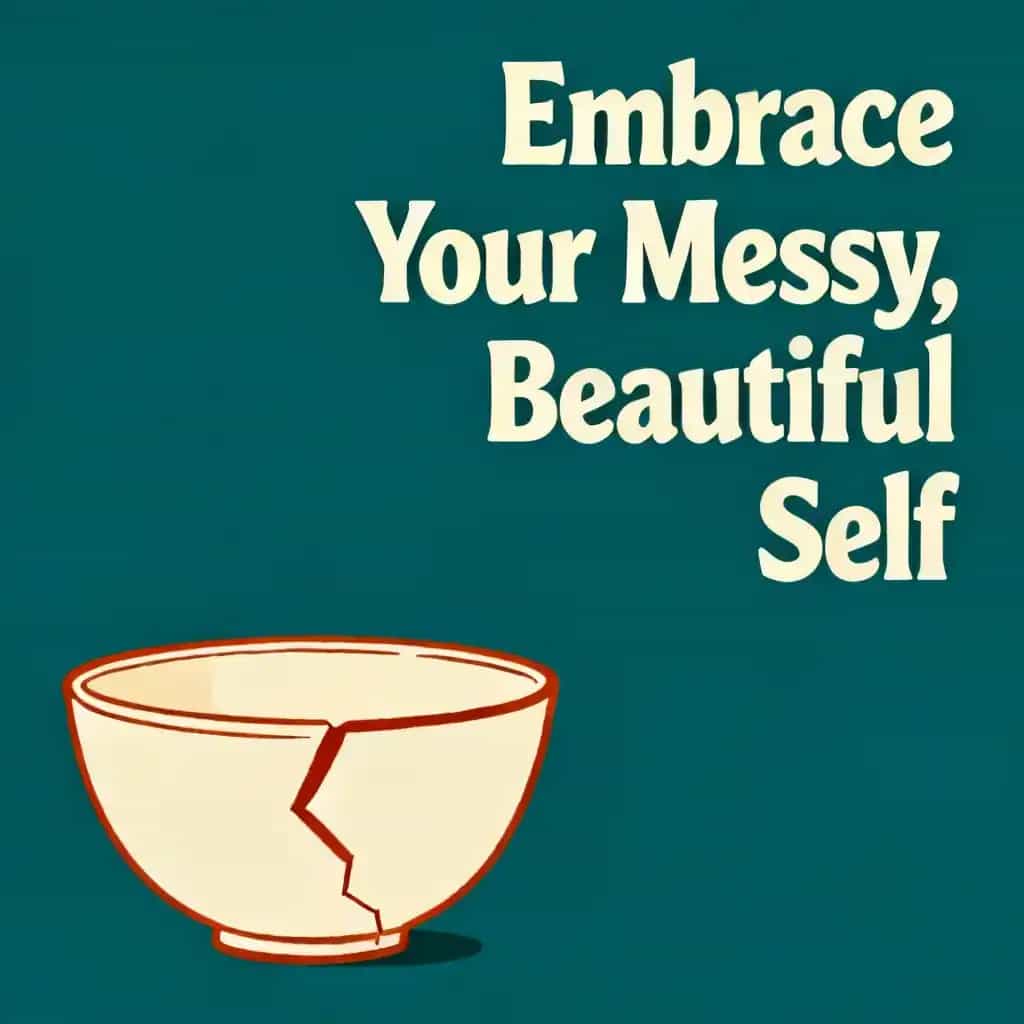
The Paradox of Being Human: Embracing Our Essential Imperfection
Have you ever noticed how the most profound spiritual teachings often come from the most unlikely sources? In 1934, a desperate alcoholic named Bill Wilson had a life-changing conversation with his friend Ebby that would eventually spark a worldwide spiritual movement. What emerged wasn't a new religion but a rediscovery of ancient wisdom about human imperfection. "The Spirituality of Imperfection" by Ernest Kurtz and Katherine Ketcham has become a modern classic, selling over 200,000 copies since its publication and influencing countless recovery programs worldwide. Oprah Winfrey once cited it as one of her "books that made a difference," noting how it transformed her understanding of human frailty. The book's genius lies in showing that our flaws aren't obstacles to spiritual growth but the very pathway to it-a message that resonates deeply in our perfectionism-obsessed culture.
Глава 2
Finding Wisdom in Brokenness
Wisdom begins where knowledge ends. As Viktor Frankl observed, wisdom is "knowledge plus: knowledge-and the knowledge of its own limits." This recognition of limitation forms the foundation of the spirituality of imperfection. Unlike our modern culture's obsession with perfection, this ancient spiritual tradition embraces human flaws as essential to our condition.
What exactly is spirituality? To have the answer is to misunderstand the question. Like the fragrance of a rose, spirituality can be experienced but never fully captured or defined. It exists without physical properties, defining us rather than being defined by us. We cannot prove spirituality; rather, it "proves" us as we measure our human "be-ing" against it.
Spirituality begins in suffering because to suffer means "to undergo," to endure what we cannot control. This leads to kenosis-emptying out, surrendering, hitting bottom-and the realization that by ourselves, we are lost. The spirituality of imperfection begins by rejecting human claims to be "God," recognizing our essential powerlessness.
Through the via negativa-understanding what spirituality is not-we paradoxically come closer to grasping it. Spirituality differs from religion in that it has no boundaries-it's fluid rather than solid. Where religion often creates an "us versus them" mentality, spirituality remains open. And unlike therapy, which offers explanations, spirituality offers forgiveness. Therapy releases from addiction; spirituality releases for life.
This spirituality points beyond the ordinary, beyond material possessions, beyond self-confinement. Material realities can stunt spirituality because as we possess things, they begin to possess us. The story of Saint Francis illustrates this understanding-he embraced poverty not because material possessions were "evil," but because living without property releases us from self-centered demands for control.
Paradoxically, spirituality transcends the ordinary yet can be found only in the ordinary. It's not spectacular but spectacularly simple-like the Zen novice who learned simply "to open and close doors" during his first year. This simplicity makes spirituality difficult to define or describe-it is literally ineffable, beyond words.
Глава 3
The Reality of Human Limitation
To be human is to be imperfect. Spirituality is rooted in and revealed by our uncertainties, inadequacies, and helplessness-providing a context where imperfections can be endured. Throughout centuries, spiritual thinkers have expressed this "awry-ness" as being off balance, broken, or torn apart.
The Desert Fathers explored this paradox most clearly, depicting our human alienation as inner tension. They discovered that we are like others not in our virtues but precisely in our faults and failings. As Evagrius Ponticus put it: The nearer we draw to God, the more we should see ourselves as being one with every sinner.
Stories from desert spirituality emphasize the importance of not judging others. When a monk committed a fault, Abba Moses refused to judge him, carrying a leaking jug to demonstrate how his own sins "run out behind me." Similarly, Abba Ammonas sat on a barrel hiding another monk's mistress, later simply advising him to "pay attention to yourself."
This self-knowledge-honestly accepting one's own imperfections-forms the foundation of compassion. The desert monks didn't retreat to escape temptation but to confront it in a setting where they could recognize it. They used temptation as a valuable tool for self-knowledge.
Spirituality begins in accepting our limitations and developing compassion from this self-knowledge. As Bill Wilson noted, "Alcoholics Anonymous is a terribly imperfect society because it is made up of very imperfect people." The Rabbi of Lelov taught that redemption comes only when we recognize the flaws in our soul and try to mend them. The line separating good and evil runs not between groups but through the core of each human being.
Глава 4
Embracing Our Paradoxical Nature
The spirituality of imperfection recognizes that within each of us exists a mixture of light and darkness, love and hate, trust and fear. This paradoxical nature of human existence requires a sense of balance to navigate life's complexities. To be human is to be caught between the infinite and nothing, essentially limited yet capable of transcendence. We are, as various philosophers have noted, both "beast" and "angel"-neither purely divine nor merely animal, but uniquely positioned in the middle.
William James distinguished between the "once-born" (healthy-minded) who know no doubts and the "twice-born" (sick souls) who are haunted by a sense of risk, danger, and moral evil. The once-born possess a natural serenity and self-confidence, while the twice-born experience inner instability and conflict. Yet this openness to suffering isn't a failure of spirituality-it's essential to it. Only those who acknowledge darkness can truly appreciate light. Our brokenness allows us to become whole, as Rabbi Moshe Leib said: "No one is as whole as he who has a broken heart."
All spirituality involves perceiving and living out paradox-apparent contradictions that need not exclude each other. Openness to paradox allows us to understand our human condition as "both/and" (both saint and sinner) rather than "either/or." Both Augustine and Martin Luther understood this core truth: everything human is limited because it comes conjoined with its opposite. Luther described believers as "simul Justus et peccator"-righteous and sinner simultaneously.
When we deny our mixed-up-ed-ness, we engage in self-deception, the greatest dishonesty that blocks spiritual growth. Stories serve as mirrors reflecting our mixed human nature, allowing us to discover both our tragedy and comedy-the ambiguity at the core of human existence.
Глава 5
Experiencing the Spiritual Through All Our Senses
Spirituality is fundamentally a way of life that permeates our entire being, affecting how we perceive the world, feel about it, and make choices. Three essential elements are always at play in spiritual experience: what we see, how we feel, and why we choose. While these elements intertwine, "seeing" holds a necessary priority-not physical sight but an inner vision that perceives self in context.
Spirituality engages all our senses in profound ways. Hearing holds special precedence as Gadamer noted-unlike seeing, we cannot "hear away" but must listen, implying a belonging together with what is being said. The Master's story about listening to what one's wife "isn't saying" illustrates this deeper hearing. Taste and smell convey spiritual experience through their ineffability-the fragrance of a rose that disciples couldn't put into words, or the "sweetness" in Jewish prayers for "a good and sweet year."
The spirituality of imperfection requires healing the artificial division between head and heart. For millennia, philosophers and physicians have debated which is more essential to being human-brain or heart. Spiritual thinkers resist making humans "one-sided conversations" with either head or heart dominating. Jonathan Edwards spoke of "the sense of the heart," insisting on a center of human personality where thought and emotion are integrated.
Evagrius Ponticus identified destructive thought patterns that distort our vision of reality. Anger is clinging to resentment rather than practicing forgiveness-becoming obsessed with those who wronged us. Acedia, the "noonday devil," manifests as listlessness and self-pity where nothing engages our interest. The cure? "Be real!" Accept there's no escape from the human condition.
William James and Evagrius Ponticus, though separated by sixteen centuries, both recognized that willing-choosing what to attend to-forms the core of spirituality's union of vision and feeling. "My experience is what I agree to attend to," James wrote. We learn life's essential lessons not by reading or thinking about them but by doing them-we act ourselves into new ways of thinking.
Глава 6
The Power of Shared Experience
Spirituality flourishes in community through mutuality-the awareness that life's most precious realities are attained only in giving them and given only in receiving them. As Bill Wilson discovered in his first meeting with Dr. Bob Smith, "I needed this alcoholic as much as he needed me." This mutual give-and-take became the heart of AA's Twelfth Step work.
In mutuality, we give by getting and get by giving, recognizing we gain only what we seek to give and can give only what we seek to gain. Community emerges when people seek the same spiritual reality, finding what they're looking for only by being looked for. We need "significant others" who reflect back to us the meanings of our actions, for being human never happens in isolation-"it's more like a wink than a blink."
The practice of seeking guides or soul-friends for spiritual direction is ancient across traditions. These mentors rarely "teach" by telling truths but serve primarily as listeners who elicit honesty and wholehearted truth-telling. As Cassian noted, "Hidden things hinder wholeheartedness." Spiritual directors help uncover one's spiritual condition through attentive listening and asking the right questions.
True wisdom comes not from reading books but from identification with others. As Rabbi Bunam explained to merchants who questioned why he visited zaddikim despite his own knowledge: "I know all about those wonderful things. I have read the program." When they protested that reading a program isn't the same as seeing a play, he replied, "That's just how it is with the books and the zaddikim."
Identification involves willingness to become like another while respecting that one can never be another. It's the bridge between self-love and other-love, helping us answer "Who am I?" by discovering where we belong. This happens through listening to others' stories of how they found their place.
Глава 7
The Rediscovery of Ancient Wisdom
Ancient wisdom about human paradox was resurrected by the most unlikely group-"hopeless" drunks. In the 1930s when alcoholism was deemed medically incurable, AA's founders drew on their Oxford Group origins and philosophies of William James and Carl Jung to create a way to live with their "hopeless disease."
They rediscovered four essential insights: First, spirituality is essential but different from what people initially imagine. Second, spirituality involves mystery and miracle rather than magic's manipulation. Third, spirituality is open-ended, more comfortable with questions than answers. Fourth, true spirituality must pervade every aspect of life.
The earliest AA members learned through painful experience that spirituality was essential to recovery, but different from conventional understanding. Bill Wilson's 1940 letters reveal this truth: groups emphasizing only fellowship without spiritual foundation had "few survivors," while those embracing spirituality showed remarkable success rates-Akron and Cleveland maintained 80% sobriety compared to New York's 40%.
The spiritual approach wasn't religious perfectionism but acceptance of imperfection. Newcomers arrive with two false stereotypes: alcoholics as hopeless degenerates, and spirituality as rigid religion. Both dissolve as they witness sober alcoholics sharing authentic stories that combine spiritual language with raw honesty.
This unconventional spirituality traces back to Carl Jung, who told Rowland H. his alcoholism was hopeless without "a spiritual or religious experience." Jung later explained to Wilson: "spiritus contra spiritum"-spiritual thirst counteracting alcohol's poison. Through storytelling, alcoholics discover a new "map" for living, replacing the wrong map that led nowhere.
Глава 8
Beyond Magic to Miracle
The spirituality of imperfection rejects control in favor of openness to mystery. As Bill Wilson noted, A.A.'s success is "fundamentally a mystery" and "adds up to a miracle." Unlike magic-which attempts to control everything-miracle involves accepting realities beyond our control. Spirituality aligns with miracle, "the wonder of the unique that points us back to the wonder of the everyday."
This distinction proves crucial for alcoholics, whose addiction represents the ultimate effort to control through chemical "magic." Recovery requires abandoning the demand to be God-like and giving up the search for magical solutions. The difference between magic and miracle reflects the difference between willfulness (demanding change) and willingness (accepting one's lack of control and opening to being changed).
Modern idolatry often manifests as worship of "technique"-the demand for procedures and methods for everything, refusing to acknowledge what cannot be measured or manipulated. This denial of limitation rejects our very humanity. Spirituality can never be reduced to technique, as Soviet addiction experts discovered when trying to extract A.A.'s "formula"-the only "technique" being TIME.
Leslie Farber identifies our "Age of Disordered Will" where we confuse what can be directly willed (objects) with what cannot (directions). We can will knowledge but not wisdom, pleasure but not happiness, dryness but not sobriety. This confusion leads first to anxiety, then addiction, as we attempt to control the uncontrollable, ironically destroying what we crave.
Глава 9
The Journey of Spiritual Transformation
The Alcoholics Anonymous approach embraces an open-ended spirituality, one that doesn't claim to be the final word on treatment but perhaps only the first. This philosophy allows people to experiment with the therapy in whatever way works for them, rejecting rigid dogmatism in favor of personal discovery. The program acknowledges that spiritual awakening takes different forms for different people - some experience sudden, dramatic changes while others undergo gradual transformations over time.
While modern approaches favor metaphors of growth or building for spiritual life, the spirituality of imperfection offers an alternative image: that of journey, specifically pilgrimage. Unlike the fixed, efficient travel of modern times, pilgrimage involves a winding, turning, occasionally backtracking peregrination. Spiritual pilgrimage is neither a straight-line trip nor aimless wandering, but a journey where the distance traveled matters less than the experience gained. This metaphor resonates particularly well with recovery, as individuals often face setbacks, unexpected challenges, and moments of profound revelation along their path.
Spiritual masters throughout history warn against rigid regulation, which stifles the flexibility where spirituality flourishes. "Set practices" leave us unable to respond to real situations, enslaving us "under colour of holiness." Jean-Pierre Caussade cautioned against "pious pigheadedness" - being so attached to our spiritual practices that we miss the point. This wisdom finds practical application in A.A.'s flexible approach to recovery, where members are encouraged to take what works and leave the rest.
A.A.'s departure from the Oxford Group's "Four Absolutes" exemplifies its embrace of open-endedness. The fellowship even dropped the word "honest" from its membership criterion, recognizing that for someone at rock bottom, even this simple word could seem too absolute. A.A. operates on the paradoxical philosophy that "there are no absolutes but one: I am not absolute." This approach acknowledges human imperfection while still providing a framework for growth and healing.
The program's spiritual foundation emphasizes progress rather than perfection, understanding that recovery is rarely linear. Members are encouraged to develop their own understanding of a higher power, whether that means God in a traditional religious sense, the collective wisdom of the group, or any other conception that helps them maintain sobriety. This flexibility has proven crucial to A.A.'s effectiveness across diverse populations and belief systems.
The journey metaphor extends beyond individual recovery to encompass the entire A.A. fellowship. Each member's story becomes part of a larger narrative of healing and transformation, creating a tapestry of shared experience that helps others find their way. This collective wisdom, accumulated over decades, demonstrates how personal spiritual journeys, though unique, often share common elements and challenges.
Глава 10
A Spirituality That Permeates All of Life
Spirituality must touch all aspects of life or none at all. Three of the Twelve Steps emphasize totality through the word "all." The chapter establishes that spirituality is indivisible-it has no parts and must penetrate to all our depths, residing at our very core rather than being something we can temporarily adopt.
A powerful metaphor emerges when a presenter, struggling to explain spirituality's pervasive nature, realizes it resembles the mortar in a stone fireplace-not the individual beautiful stones, but the plain substance binding them together. Like mortar transforms scattered rocks into a meaningful structure, spirituality integrates our experiences into a coherent whole.
Early A.A. members discovered that spirituality must pervade one's entire life-those who held something back inevitably relapsed. The spirituality of imperfection teaches that there are no shortcuts or quick fixes. Storytelling itself conveys this truth through its format of "what we used to be like, what happened, and what we are like now," emphasizing healing through time.
By telling our past in the present, we recreate ourselves and recover possession of our existence. Living "one day at a time" connects our past with our future through the present moment we can actually experience. All spiritual traditions emphasize this focus on "now," recognizing that those who cannot connect their past with their future become trapped in Kierkegaard's "aesthete" condition-racing through life without truly experiencing it.
Глава 11
The Essential Spiritual Experiences
Spirituality involves not just talking, reading or doing something, but actually experiencing life in a new way. Through telling and listening to stories, people begin to experience specific spiritual realities: Release, Gratitude, Humility, Tolerance, Forgiveness, and Being-at-home. These experiences cannot be commanded-they become available when needed, if we are available to them.
Release is the first experience of spirituality-not freedom that must be won, but a free-ing that is received rather than attained. What blocks release most is our demand for security and certainty-spirituality requires risk. Release involves breaking down resistance to reality and surrendering our demand for certitude. All spiritual traditions emphasize detachment, not because material things are bad, but because our relationship with possessions becomes problematic when we interpret them as essential parts of our very self.
Gratitude flows naturally from the experience of release as the only possible response to something recognized as freely given. Our culture risks losing the meaning of gratitude because we've lost the sense of true gifts-those freely and spontaneously given rather than ritual obligations. Gratitude isn't merely a fleeting feeling but an ongoing vision of thankfulness rooted in remembering what it was like to be without the gift.
Humility, often misunderstood in our "Me First" culture, isn't about self-abasement or timidity, but simply accepting our human nature-embracing our both-and-ness as both saint and sinner, both beast and angel. Beginning with the acceptance that being human is good enough, humility involves learning to live joyfully with that reality. Paradoxically, those who possess humility rarely realize it, while those who believe they have it usually don't understand what it is.
Глава 12
The Path to Wholeness Through Acceptance
Tolerance flows naturally from humility-when we accept our own imperfections, we become able to accept the flaws in others. As Bill Wilson observed, "Honesty gets us sober, but tolerance keeps us sober." This isn't grudging acceptance but loving identification with others.
Unlike most social groups that form around shared strengths and common interests, Alcoholics Anonymous and other Twelve-Step fellowships connect people through their shared weaknesses. There's a healing oneness in mutual flawedness-what might be irritating qualities in others instead evoke compassion when we recognize our common vulnerability.
At our most fundamental human level, it's our weaknesses that make us alike; our strengths that make us different. Acknowledging shared weakness creates a rooted connectedness, with our roots in the same soil-the earthy humus of our imperfection.
Forgiveness represents the divine answer to the question implied in our existence-but this answer only makes sense to those who have asked the question, who are aware of their need for forgiveness. Resentment, the "number one offender" that destroys more alcoholics than anything else, is the poison of spiritual life-literally "feeling backward," clinging to past hurts and reinforcing our self-as-victim vision.
The path to forgiveness often begins with experiencing being forgiven ourselves. This process can't be commanded but emerges through willingness, often cultivated through prayer-the classic A.A. advice to "pray for the son of a bitch" underlines that we're forgiven only if we're first willing to forgive.
Forgiveness is not explanation, nor is it forgetting. "The stupid neither forgive nor forget; the naive forgive and forget; the wise forgive, but do not forget." There can be no "unconditional forgiveness" because we are not God-such claims devalue responsibility.
Глава 13
Finding Home in Our Imperfection
Being-at-home represents the ultimate spiritual destination-finding where we truly fit in the world. In accepting our vision of self as imperfect, we let go of the feeling that we must betray our true self to become part of humanity. Home becomes that place where we find peace and harmony from learning to live with our own imperfections and accepting the imperfections of others.
In such a place, we experience a falling away of tensions and a balance between the pushing and pulling forces of our lives. We can cease fighting-especially with ourselves. We find the space to be the imperfect beings we are, which allows us to let others be who they are.
Our boundaries define us by establishing our identity-telling us who we are and are not. This makes it possible to fit, to belong, and to feel good. The words "hide" and "home" share the same root-the Indo-European word KEI, signifying a bounded space. Home is like our hide-it covers us not to conceal but to protect.
The surest way to touch the human spirit-to find home, to find where we fit-is through telling and listening to stories. This is why great spiritual teachers have always been storytellers. Stories convey how humans like us sought and found (or failed to find) "home"-the experience of fitting into reality. Stories bring us home to ourselves and into fellowship with others.
When we show each other what we usually hide, we enter into trust. In storytelling and storylistening, hearers know "the truth" about tellers in a special way. This hearing fashions a narrative home where our anomalies, ambivalences, and ambiguities all fit in.
The message of all spirituality is that we are all one-the joy and sorrow of any one is the joy and sorrow of all. This isn't codependence; it's love. When we accept our common imperfection, defenses fall away and we begin to see ourselves and others as we really are. Through spirituality, we become free not so much from fear or dependence, but free for love and life itself.