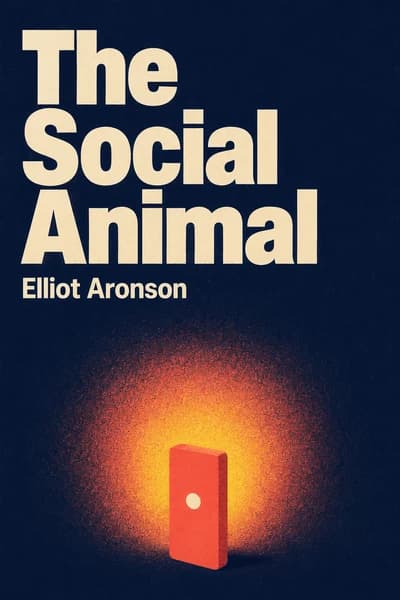
Dive into the landmark psychology text that's shaped our understanding of human behavior for 50+ years. Translated into 14 languages, Aronson's masterpiece reveals why we conform, love, and hate - insights that transformed classrooms and decoded tragedies from Columbine to 9/11.
Elliot Aronson, renowned social psychologist and author of The Social Animal, is celebrated for his groundbreaking contributions to understanding human behavior, cognitive dissonance, and prejudice reduction. A protégé of Leon Festinger, Aronson’s work bridges rigorous academic research with accessible insights into social dynamics. His expertise stems from decades as a professor at Harvard, Stanford, and the University of California, Santa Cruz, where he developed the Jigsaw Classroom—a cooperative learning method adopted globally to combat racial tensions in schools.
The Social Animal is a cornerstone of social psychology literature that explores themes of conformity, attraction, and irrationality through relatable narratives. Aronson’s other influential works include Nobody Left to Hate: Teaching Compassion After Columbine and the widely used textbook Social Psychology. He is the only psychologist to win the American Psychological Association’s highest awards for research, teaching, and writing, and has shaped both academic and public understanding of human interaction.
Now in its 12th edition, The Social Animal has been translated into 20 languages and remains a staple in university curricula worldwide, cementing Aronson’s legacy as a pioneer who transformed abstract theories into tools for real-world change.
The Social Animal explores the psychological forces shaping human behavior through research on cognitive dissonance, social influence, and self-justification. Aronson uses real-world examples and experiments to explain how situational factors—not just personality—drive actions, emphasizing topics like prejudice reduction and educational techniques like the Jigsaw Classroom.
This book is ideal for psychology students, educators, and anyone interested in social dynamics. Its accessible style appeals to readers seeking insights into human motivation, decision-making, and practical strategies for fostering cooperation in diverse groups.
Yes—it’s a foundational text in social psychology, praised for blending rigorous research with relatable narratives. Critics note occasional pacing issues in its fictional examples, but its enduring relevance (12 editions since 1972) and actionable insights on communication and bias make it a standout.
Key ideas include:
Aronson integrates hypothetical scenarios to illustrate research findings, though some readers find these narratives uneven. For example, a character’s unlikely rise to a presidential advisory role stretches plausibility but serves to contextualize concepts like social mobility.
Critics argue that its fictional elements sometimes overshadow scientific depth, with underdeveloped explanations of studies. However, its strengths in synthesizing psychology with everyday life outweigh these flaws for most readers.
The book offers strategies for improving education (via the Jigsaw method), resolving conflicts, and understanding political polarization. Its lessons on empathy and situational awareness are widely used in organizational and community settings.
Unlike pop psychology titles, Aronson’s work prioritizes empirical rigor while remaining engaging. It contrasts with Malcolm Gladwell’s storytelling-focused books by grounding narratives in decades of experimental research.
Yes—its themes of misinformation, bias, and social cohesion remain critical in addressing modern challenges like AI-driven communication and global conflicts. Updated editions incorporate contemporary examples.
Elliot Aronson is a pioneering social psychologist, renowned for cognitive dissonance research and the Jigsaw Classroom. The only person to win all three top American Psychological Association awards, his work spans six decades, influencing education, media, and conflict resolution.
Aronson co-authored Mistakes Were Made (But Not by Me), which examines self-justification in relationships, politics, and law. Like The Social Animal, it combines research with accessible storytelling to explain systemic biases.
The Jigsaw Classroom technique—grouping students into interdependent teams—reduces hostility by fostering empathy. Studies show it improves academic performance and cross-cultural collaboration, making it a landmark contribution to applied psychology.
Почувствуйте книгу через голос автора
Превратите знания в увлекательные, богатые примерами идеи
Захватите ключевые идеи мгновенно для быстрого обучения
Наслаждайтесь книгой в весёлой и увлекательной форме
Society precedes the individual.
We're wired to cooperate and view outsiders with suspicion.
Organizations function better as communities.
We focus more on threats than blessings.
Разбейте ключевые идеи The social animal на понятные тезисы, чтобы понять, как инновационные команды создают, сотрудничают и растут.
Выделите из The social animal быстрые подсказки для запоминания, подчёркивающие ключевые принципы открытости, командной работы и творческой устойчивости.

Погрузитесь в The social animal через яркие истории, превращающие уроки инноваций в запоминающиеся и применимые моменты.
Задавайте любые вопросы, выбирайте голос и совместно создавайте идеи, которые действительно находят у вас отклик.

Создано выпускниками Колумбийского университета в Сан-Франциско
"Instead of endless scrolling, I just hit play on BeFreed. It saves me so much time."
"I never knew where to start with nonfiction—BeFreed’s book lists turned into podcasts gave me a clear path."
"Perfect balance between learning and entertainment. Finished ‘Thinking, Fast and Slow’ on my commute this week."
"Crazy how much I learned while walking the dog. BeFreed = small habits → big gains."
"Reading used to feel like a chore. Now it’s just part of my lifestyle."
"Feels effortless compared to reading. I’ve finished 6 books this month already."
"BeFreed turned my guilty doomscrolling into something that feels productive and inspiring."
"BeFreed turned my commute into learning time. 20-min podcasts are perfect for finishing books I never had time for."
"BeFreed replaced my podcast queue. Imagine Spotify for books — that’s it. 🙌"
"It is great for me to learn something from the book without reading it."
"The themed book list podcasts help me connect ideas across authors—like a guided audio journey."
"Makes me feel smarter every time before going to work"
Создано выпускниками Колумбийского университета в Сан-Франциско

Получите резюме книги «The social animal» в формате PDF или EPUB бесплатно. Распечатайте или читайте офлайн в любое время.
Think about the last time you judged someone harshly for their behavior. Maybe it was a stranger who cut you off in traffic, a politician who made a controversial decision, or someone who fell for an obvious scam. Our instinct is almost always the same: we assume something must be fundamentally wrong with *them*. They're selfish, stupid, or morally deficient. But here's an unsettling truth that cuts to the heart of social psychology-people who do crazy things are not necessarily crazy. When 613 parents in Jonestown killed their children and themselves in 1978, neighbors back home were stunned. These weren't monsters. They were teachers, nurses, social workers-ordinary people who, under extraordinary circumstances, did the unthinkable. This gap between who we think we are and what we're capable of becoming reveals the most important insight about human nature: we are profoundly shaped by forces we rarely recognize.