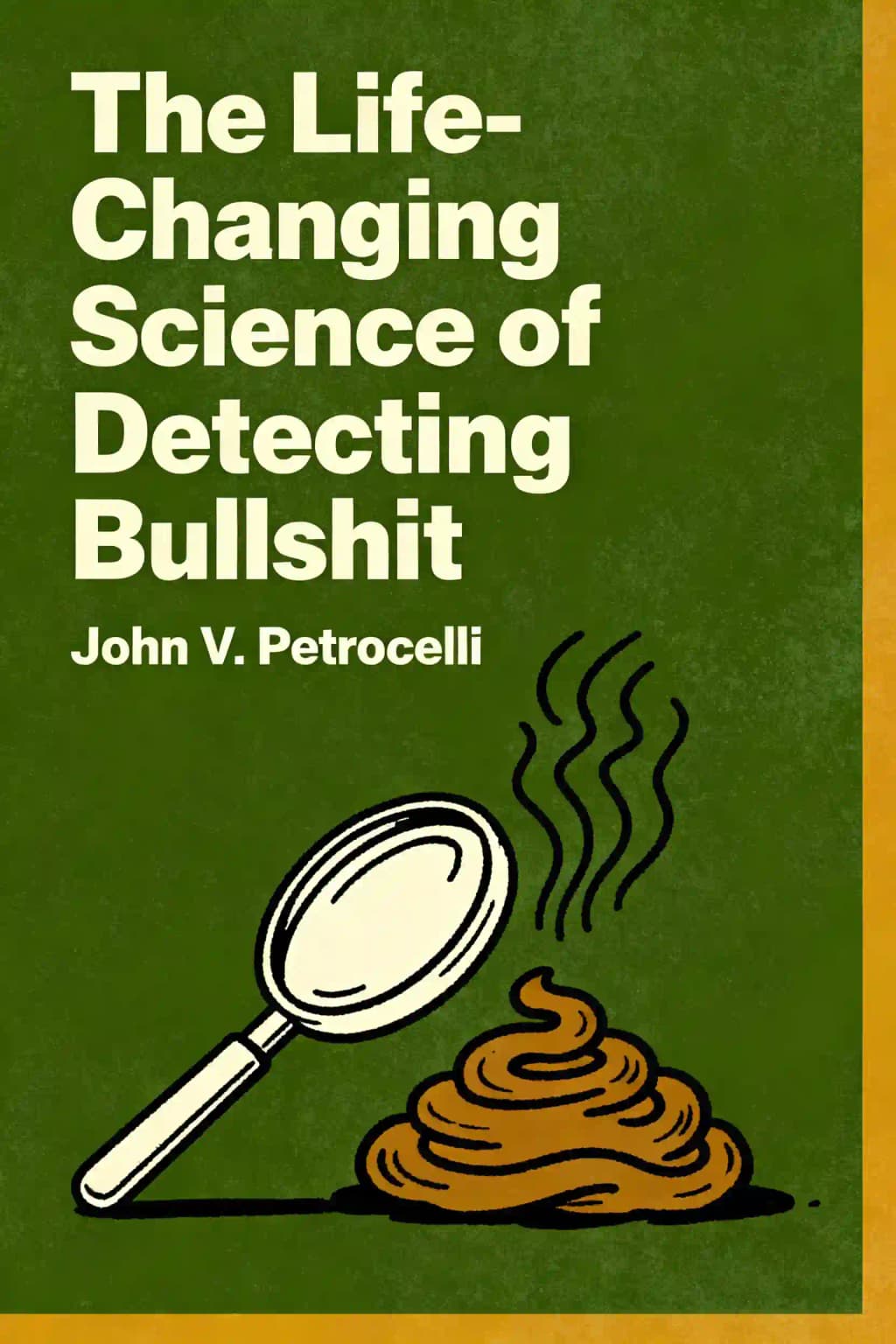
The Life-Changing Science of Detecting Bullshit
Обзор книги The Life-Changing Science of Detecting Bullshit
In an era of rampant misinformation, Petrocelli's guide reveals why 36 million died during Mao's "Great Leap Forward" - bullshit has consequences. Endorsed by Adam Grant and Philip Zimbardo, this toolkit helps you detect deception across industries, social media, and even within yourself.

Ключевые темы в The Life-Changing Science of Detecting Bullshit
- critical thinking skills
- misinformation detection
- evidence based reasoning
- logical fallacies
- cognitive bias mitigation
Цитаты из The Life-Changing Science of Detecting Bullshit
Bullshit isn't simply lying-it's something potentially more dangerous.
Effective bullshitting might lead to promotion or even presidency.
Humans naturally accept information as true initially.
We rely heavily on intuition over evidence-based reasoning.
People sometimes prefer bullshit over truth.
Персонажи в The Life-Changing Science of Detecting Bullshit
- John V. PetrocelliAuthor and Wake Forest social psychologist
- Harry FrankfurtPhilosopher whose essay inspired the research
- Robert HodgsonStatistics professor who studied wine competitions
- Frederic BrochetResearcher who conducted wine expertise experiments
- Daniel GilbertPsychologist who studied how humans accept info
Об авторе
Об авторе книги The Life-Changing Science of Detecting Bullshit
John V. Petrocelli, author of The Life-Changing Science of Detecting Bullshit, is an experimental social psychologist and professor at Wake Forest University, where he directs the Bullshit Studies Lab. A leading expert in critical thinking and decision-making, Petrocelli’s research on bullshit detection has been published in top journals like the Journal of Personality and Social Psychology and featured in the Wall Street Journal. His TEDx Talk, Why BS Is More Dangerous Than a Lie, distills his decades of work into actionable insights for combating misinformation.
As an associate editor of Personality and Social Psychology Bulletin and advisory board member of Seekr Technologies, Petrocelli bridges academic rigor with real-world applications. His book merges behavioral science with practical strategies to identify and reject misleading claims, drawing from his studies on persuasion, memory, and counterfactual thinking.
Petrocelli’s research framework is utilized by educators, corporate trainers, and policymakers, and his viral TEDx Talk has been streamed in over 90 countries. The Life-Changing Science of Detecting Bullshit has become a foundational resource in psychology courses and critical thinking workshops worldwide.
Скачать резюме книги «The Life-Changing Science of Detecting Bullshit»
Получите резюме книги «The Life-Changing Science of Detecting Bullshit» в формате PDF или EPUB бесплатно. Распечатайте или читайте офлайн в любое время.
Часто задаваемые вопросы об этой книге
The Life-Changing Science of Detecting Bullshit by John V. Petrocelli provides strategies to identify and combat misinformation by sharpening critical thinking skills. The book explores how bullshit differs from lies, examines its societal consequences, and offers evidence-based methods to recognize manipulative tactics like emotional language and anecdotal claims.
This book is ideal for critical thinkers, professionals in leadership or decision-making roles, and anyone navigating today’s information-saturated world. Petrocelli’s insights are particularly valuable for readers seeking to avoid manipulation in areas like finance, marketing, or social media.
Yes, the book is praised for blending academic rigor with practical advice, using real-world examples like Bernie Madoff’s Ponzi scheme and Mao’s Great Leap Forward to illustrate bullshit’s dangers. Readers gain actionable tools to question authority, evaluate evidence, and reduce personal bias.
John V. Petrocelli is a social psychology professor at Wake Forest University, known for researching decision-making and misinformation. A TEDx speaker and author of over 50 academic papers, he combines scientific expertise with accessible writing to demystify bullshit detection.
Petrocelli defines bullshit as statements made without regard for truth, often relying on personal biases or vague claims. Unlike lies, bullshit aims to persuade rather than deceive, using emotional language, buzzwords, and anecdotal stories to exploit cognitive gaps.
The book cites Bernie Madoff’s financial fraud, Mao Zedong’s catastrophic policies, and tactics from industries like real estate and diamonds. These cases highlight how bullshit erodes trust and leads to harmful decisions.
Key strategies include questioning anecdotal evidence, recognizing emotional manipulation, and verifying claims through evidence. Petrocelli emphasizes skepticism, scientific reasoning, and avoiding societal pressure to conform to unverified ideas.
Red flags include overuse of jargon, appeals to authority without evidence, vague language, and stories prioritizing emotion over facts. The book teaches readers to spot these patterns in marketing, politics, and everyday interactions.
Petrocelli advocates applying critical thinking to evaluate sources, check data accuracy, and resist echo chambers. The book stresses the importance of calling out falsehoods and avoiding the spread of unverified claims.
Notable quotes include:
- “Bullshit is the foundation of contaminated thinking and bad decisions”
- “To bullshit is to disregard the truth in all its obviousness”
These highlight the book’s focus on truth-seeking and cognitive vigilance.
Unlike abstract philosophy texts, Petrocelli’s work combines psychology research with concrete examples, making it accessible for everyday use. It complements books like Thinking, Fast and Slow by focusing specifically on misinformation tactics.
Some may find the academic tone dense, and the focus on individual critical thinking overlooks systemic solutions to misinformation. However, its actionable frameworks remain widely applicable.