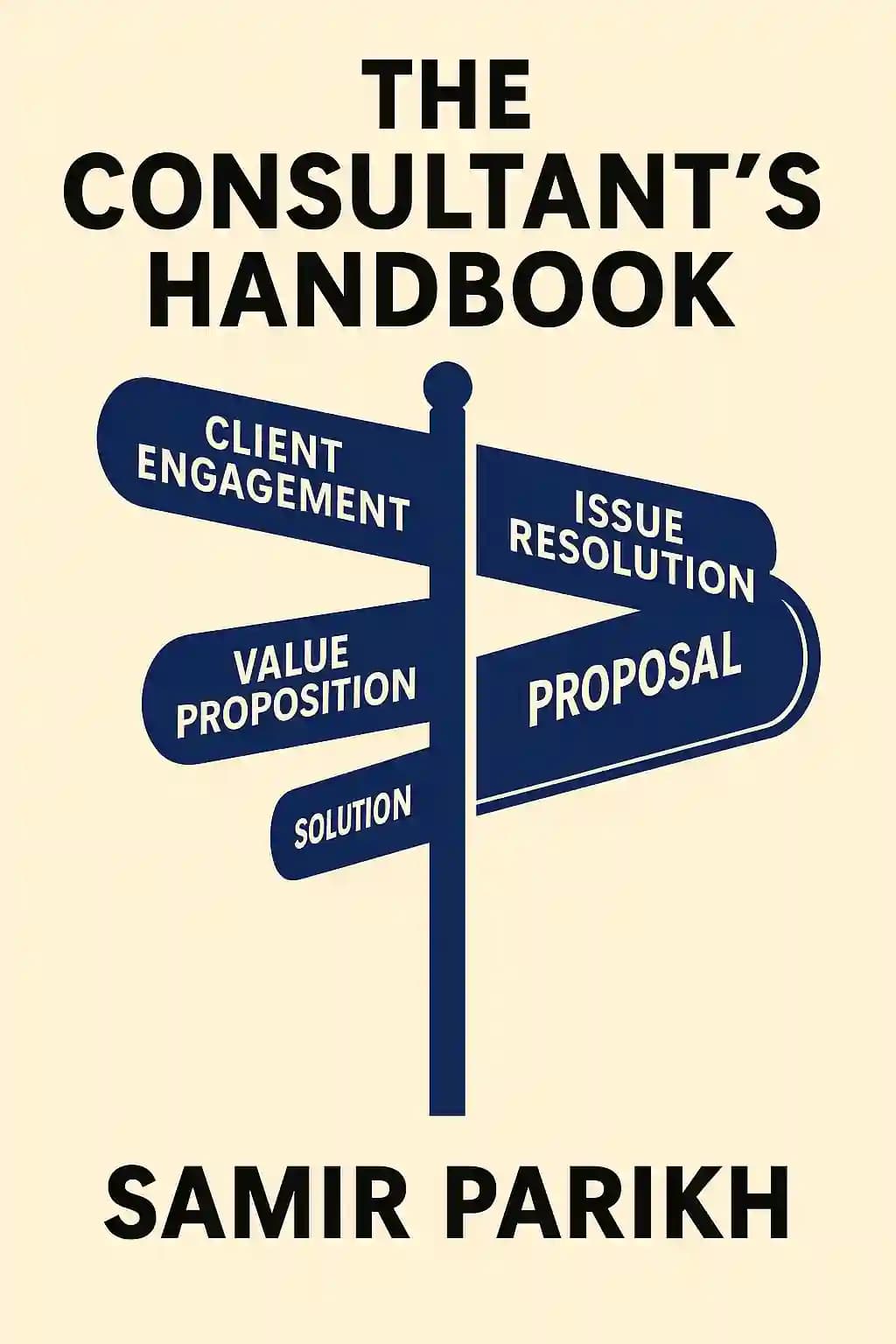
The Consultant's Handbook: where elite consulting meets actionable strategy. Parikh's 25-year industry wisdom has made this the secret weapon for consultants worldwide. Beyond theory - it's the practical playbook that transforms client interactions into career-defining successes. Ready to join the consulting elite?
Samir Parikh, author of The Consultant’s Handbook, is a renowned management consultant and organizational strategy expert with over 25 years of global experience. As CEO of SPConsulting AB, a leading consulting firm, he has directed transformative projects across 50+ countries in industries like finance, technology, and telecommunications. His book distills practical insights from real-world engagements, offering a proven framework for delivering high-value consultancy services.
Parikh’s expertise extends to his second influential work, The Ultimate Guide to Storytelling in Business, which provides a 7-step process for crafting compelling business narratives. A sought-after speaker, Parikh regularly addresses senior corporate leaders and university audiences, blending academic rigor with actionable strategies.
His firm, SPConsulting, partners with Fortune 500 companies to optimize operations and pre-sales processes, cementing his reputation as a trusted advisor in competitive markets. The Consultant’s Handbook has become a staple resource for professionals, praised for its clarity and adaptability to diverse market conditions. Parikh’s methodologies are applied by consulting teams worldwide, supported by his firm’s track record of 1,000+ client engagements.
The Consultant's Handbook provides actionable strategies for navigating complex business challenges, emphasizing problem-solving frameworks and client management techniques. Drawing from Samir Parikh’s expertise in business law and restructuring, it blends theoretical insights with real-world applications, addressing topics like stakeholder alignment and adaptive decision-making in dynamic markets.
Aspiring consultants, mid-career professionals, and business leaders seeking to refine their strategic toolkit will benefit most. The book caters to those managing organizational change, negotiations, or financial restructuring, with practical examples relevant to legal, corporate, and entrepreneurial contexts.
Yes—it distills decades of industry expertise into accessible frameworks, making it valuable for both newcomers and seasoned practitioners. Parikh’s focus on translating academic rigor into actionable steps ensures relevance across sectors like bankruptcy law, corporate consulting, and crisis management.
Key themes include adaptive leadership, ethical decision-making, and optimizing client relationships under pressure. Parikh emphasizes balancing financial pragmatism with long-term trust-building, particularly in high-stakes scenarios like mass tort negotiations or municipal distress.
It tackles AI-driven market shifts, remote team dynamics, and post-pandemic financial recovery strategies. Parikh advocates for “opaque capital” awareness and data-driven storytelling to align stakeholders in fragmented industries.
Yes—examples include restructuring tactics from Purdue Pharma’s bankruptcy and municipal debt crises. These illustrate crisis communication, forensic accounting, and mitigating “forum shopping” risks in litigation.
While The McKinsey Way focuses on general strategy, Parikh’s guide delves into niche areas like mass torts and bankruptcy tourism, offering specialized tools for legal-financial consulting unavailable in broader primers.
Some may find its legal focus overly narrow for generalists. However, its granularity appeals to practitioners in restructuring, litigation finance, or regulatory advisory roles.
With global debt markets destabilized by AI and climate policy shifts, Parikh’s risk-assessment frameworks help consultants navigate sectors like green energy financing and cryptocurrency insolvencies.
These underscore Parikh’s emphasis on reframing crises as opportunities for systemic realignment.
It offers resilience-building exercises for pivoting into consultancy roles, including networking in specialized niches and translating domain expertise into advisory services.
Почувствуйте книгу через голос автора
Превратите знания в увлекательные, богатые примерами идеи
Захватите ключевые идеи мгновенно для быстрого обучения
Наслаждайтесь книгой в весёлой и увлекательной форме
Consulting is fundamentally a helping relationship provided based on expertise and experience.
Anyone can claim the title, resulting in varying service quality.
Consultants must prioritize the client's best interests.
Clients can immediately detect who is well-prepared versus working from a blank sheet.
Establishing credibility is fundamental to consulting success.
Разбейте ключевые идеи Consultant's Handbook на понятные тезисы, чтобы понять, как инновационные команды создают, сотрудничают и растут.
Погрузитесь в Consultant's Handbook через яркие истории, превращающие уроки инноваций в запоминающиеся и применимые моменты.
Задавайте любые вопросы, выбирайте свой стиль обучения и создавайте идеи, которые действительно вам подходят.

Создано выпускниками Колумбийского университета в Сан-Франциско
"Instead of endless scrolling, I just hit play on BeFreed. It saves me so much time."
"I never knew where to start with nonfiction—BeFreed’s book lists turned into podcasts gave me a clear path."
"Perfect balance between learning and entertainment. Finished ‘Thinking, Fast and Slow’ on my commute this week."
"Crazy how much I learned while walking the dog. BeFreed = small habits → big gains."
"Reading used to feel like a chore. Now it’s just part of my lifestyle."
"Feels effortless compared to reading. I’ve finished 6 books this month already."
"BeFreed turned my guilty doomscrolling into something that feels productive and inspiring."
"BeFreed turned my commute into learning time. 20-min podcasts are perfect for finishing books I never had time for."
"BeFreed replaced my podcast queue. Imagine Spotify for books — that’s it. 🙌"
"It is great for me to learn something from the book without reading it."
"The themed book list podcasts help me connect ideas across authors—like a guided audio journey."
"Makes me feel smarter every time before going to work"
Создано выпускниками Колумбийского университета в Сан-Франциско

Получите резюме книги «Consultant's Handbook» в формате PDF или EPUB бесплатно. Распечатайте или читайте офлайн в любое время.
In today's business landscape, the term "consultant" has been stretched to encompass everyone from strategic advisors to gardeners. Yet true consulting represents something far more precise-a helping relationship built on expertise and experience. What distinguishes genuine consultants isn't just their knowledge, but their ethical foundation. While new graduates rely heavily on formal education, seasoned consultants leverage years of accumulated wisdom. Unlike regulated professions such as medicine or law, consulting lacks formal oversight-anyone can claim the title. This creates both opportunity and risk, making reputation and demonstrated results essential currencies in the consulting world. The most respected consultants position themselves as trusted advisers, sometimes walking away from potential business when it's not in the client's best interest. Consider the consultant who declined a lucrative project because the client already possessed the necessary internal capabilities. While this meant immediate revenue loss, the client was so impressed by this integrity that they later awarded a much larger contract, noting: "We knew you would tell us the truth, even when it wasn't in your financial interest." This client-first approach ultimately strengthens relationships and creates future opportunities that transactional approaches never could.
Just as doctors must understand patients before prescribing treatment, consultants need thorough client knowledge to provide effective solutions. This preparation creates an immediate competitive edge - clients can instantly detect who has done their homework. Effective preparation follows a scalable framework with three levels of increasing depth based on available time. Basic preparation (1-2 hours) covers the client's industry, geography, financials, key executives, market position, and competitors. Detailed preparation extends to strategic objectives, company history, industry trends, and deeper financial analysis. Engagement-specific preparation focuses on the particular topic, including clarifying the agenda, researching stakeholders, and identifying relevant consulting experience. This approach's power was demonstrated when two competing consulting teams met with the same client. The team that had researched the client's specific financial challenges, leadership changes, and competitive pressures won before the presentation began - their preparation demonstrated genuine interest in the client's unique situation rather than just another sales opportunity.
Clients evaluate advice based on both recommendations and the consultant's perceived credibility. Research shows 85% of client decisions are influenced by credibility before substantive work even begins. Establishing credibility requires mastering four elements: objectivity, tangibility, relevance, and conciseness. Share specific project outcomes with measurable results rather than making broad capability claims. Replace vague statements like "extensive implementation experience" with precise metrics: "delivered 15 successful ERP implementations across five industries with an average ROI of 127%." When introducing your organization, balance credentials with a consultative approach through techniques like the "reference hook" - briefly mentioning relevant experience then asking permission to share specific examples. Documentation builds credibility through organized credentials presentations, case studies with verifiable metrics, and reference lists with named contacts. This approach proved decisive in a $2M healthcare transformation project competition. The winning firm distinguished itself by presenting detailed case studies with quantified outcomes, providing direct client references, and demonstrating deep understanding of specific challenges. As the client's CFO noted: "Both teams were clearly capable, but one team showed us exactly how they'd solved similar problems before. The other team told us they could solve our problems. That difference was decisive."
Effective client meetings follow a three-phase structure: the set-up phase (introductions and context), the body phase (information exchange, discussions, agreements, and action items), and the closure phase (summary and next steps). Exceptional consultants navigate this structure while remaining responsive to client needs, using navigation checkpoints to eliminate irrelevant topics and focus on priorities. Rather than ending with a generic "Thanks for the meeting," an effective consultant might conclude: "You're experiencing a 20% excess inventory problem costing approximately $2.3 million annually. Your current system requires manual stock logging, which is both time-consuming and error-prone. You need a solution that automates tracking, improves ordering accuracy, and manages component build lists for over 100 product configurations. Have I captured that correctly?" This specificity demonstrates attentiveness and builds trust that generic approaches cannot achieve.
When facing complex business challenges, the ability to structure problems systematically becomes invaluable. Logic trees serve as powerful frameworks for breaking down complex issues into manageable components, revealing hierarchical relationships. For example, consultants improved an airline's profitability by identifying "high costs" and "low revenues" as main branches, then exploring subcategories like fuel efficiency, maintenance, routes, and pricing-revealing previously hidden opportunities. Effective analytical frameworks require branches that are mutually exclusive and collectively exhaustive (MECE) to ensure comprehensive coverage without overlap. During client discussions, successful consultants explain the methodology clearly, use visual aids, guide systematic discussions, incorporate feedback, establish priorities, and provide summaries. As one executive noted: "For the first time, I could see our entire problem landscape on one page. It transformed how we approached the solution." This illustrates how analytical frameworks create clarity-turning overwhelming challenges into manageable components that can be systematically addressed.
A consulting proposal serves as both technical document and persuasive marketing tool. The executive summary must address pain points with a compelling value proposition. Rather than "we will implement a new CRM system," frame it as "we will increase sales productivity by 25% through intelligent automation and streamlined customer engagement processes." Your solution approach should outline methodology phases and success factors without revealing proprietary frameworks. Align pricing models with project characteristics - fixed price for defined scope, time and materials for dynamic environments, or shared risk/reward for transformational projects. Breaking complex projects into phases manages risk while building confidence. A major transformation might begin with a 12-week diagnostic before full implementation, with each phase delivering value while advancing the larger vision. This approach enables adjustments based on learning and changing circumstances. The best proposals "feel less like a sales pitch and more like the first deliverable of the project itself" - showing clients exactly what working together will achieve.
Client satisfaction in consulting follows the "50:50 rule" - it's driven equally by delivering results and creating a positive client experience. In competitive industries where vendors offer similar solutions at comparable prices, client experience becomes the key differentiator. Like airlines, where safe transportation is expected but passengers choose based on service quality, consulting clients assume technical competence but select providers based on the working relationship. Optimizing this experience requires active relationship management at all project levels, creating genuine partnerships beyond transactions. Consultants build these relationships through thorough preparation, friendly attitudes, clear role definition, and genuine interest in clients' perspectives. When projects face inevitable challenges, strong relationships become the safety net ensuring successful outcomes. The most successful consultants recognize their work isn't just delivering solutions - it's creating experiences that clients value enough to return for. By balancing technical excellence with relationship quality, they transform one-time projects into enduring partnerships. Ultimately, consulting excellence is about applying knowledge in service of others, creating results and relationships that endure.