Глава 1
The Weight of History: Confronting Our Darkest Chapters
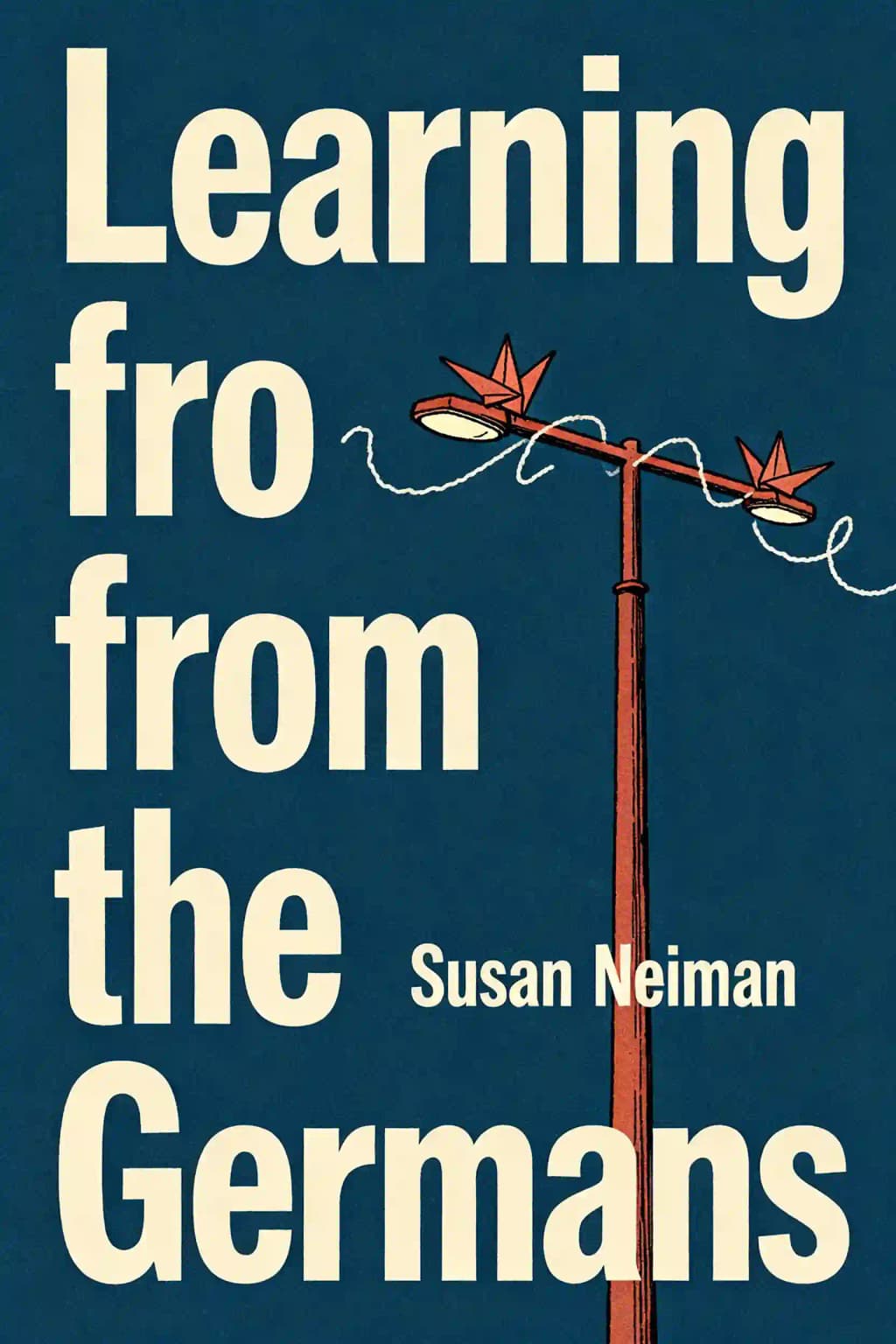
What happens when a nation must face its worst atrocities? In "Learning from the Germans," philosopher Susan Neiman tackles this question with extraordinary depth, drawing from her unique perspective as a white Jewish woman raised in the segregated American South who now calls Berlin home. The book has become essential reading for those grappling with historical injustice, with figures from Bryan Stevenson to Ta-Nehisi Coates citing its insights. Neiman's work arrives at a critical moment when America's racial reckoning intersects with Germany's widely-praised approach to confronting its Nazi past. As she writes in the opening pages, "I began life as a white girl in the segregated South and will likely end it as a Jewish woman in Berlin" - a journey that positions her uniquely to guide readers through the thorny moral landscape of national guilt, responsibility, and reconciliation.
Глава 2
Two Nations, Two Histories: Parallel Paths of Confrontation
Germany's approach to its Nazi past offers valuable lessons for America's struggle with its legacy of slavery and racism. Both nations committed horrific crimes against humanity, though in different historical contexts. The Nazi genocide occurred within twelve years and was thoroughly documented, while American slavery and its aftermath spanned centuries with less systematic record-keeping. Yet both nations initially responded to their crimes with denial and resistance.
In postwar Germany, most citizens focused primarily on their own suffering rather than acknowledging the Holocaust. They remembered bombed cities, lost territories, and bitter winters surviving on dandelion greens and potato peels. They resented moral condemnation after all they'd endured. Young Germans born after the war couldn't ignore the discrepancy between their parents' perspective and world opinion, often passing themselves off as Danish or Dutch when traveling to avoid cold shoulders.
Similarly, white Southerners constructed elaborate myths about the "Lost Cause" that portrayed the Confederacy as fighting for states' rights rather than slavery. They erected monuments to Confederate generals decades after the Civil War, not as innocent historical markers but as assertions of white supremacy during periods when it felt threatened.
The German term Vergangenheitsaufarbeitung-"working-off-the-past"-describes the painstaking process of confronting historical crimes. This process isn't merely academic; it requires transforming a nation's self-image and values. For Germans, this meant acknowledging that the Holocaust wasn't perpetrated by a small group of Nazi fanatics but required widespread participation or acquiescence. For Americans, it means recognizing that slavery and segregation weren't mere "Southern problems" but foundational to the nation's development.
What makes Germany's example so powerful is that it demonstrates how a nation can transform itself through honest confrontation with its past. Despite initial resistance, Germany has created a culture where Holocaust denial is unthinkable and Nazi symbols are banned. This didn't happen overnight-it took decades of difficult work across multiple generations. The process wasn't perfect, but it shows that national redemption is possible through persistent effort.
Глава 3
The Burden of Memory: How Germany Confronted Its Nazi Past
Germany's path to confronting its Nazi past was neither straightforward nor immediate. After World War II, the country split into two nations with different approaches to historical memory. Contrary to popular belief, East Germany (the GDR) was often more aggressive in its denazification efforts than West Germany.
East Germany built its national identity on antifascism, declaring itself "the other Germany" that had resisted Hitler from the start. For GDR leadership, this was actually true-many were communists who had fled Nazi Germany or been imprisoned in concentration camps. Just a month after Berlin's surrender in June 1945, the Central Committee of the German Communist Party issued a statement acknowledging German guilt and responsibility for the war. No such claim was made by authorities in the Western zones, where most Germans wallowed in victimhood for decades.
East Germany put far more Nazis on trial than the West, where denazification efforts were quickly abandoned when the Cold War began. Per capita, East Germany convicted six times as many Nazis as West Germany, despite most heavily implicated Nazis fleeing to the Western zones. The low conviction rate in West Germany is unsurprising given that 66% of Justice Ministry officials were former Nazis as late as 1966.
Before 1990, East Berlin erected 246 monuments to victims of National Socialism, while West Berlin had 177-despite West Berlin having a larger population and area. The GDR restored concentration camps Buchenwald, Ravensbruck, and Sachsenhausen as museums, requiring all schoolchildren to visit at least one. In contrast, West Germany provided no federal funding for concentration camp memorials until after reunification.
However, West Germany did make significant progress in other areas. While East Germany focused on political categories and structural change, West Germans, particularly the '68 generation, emphasized psychological confrontation, demanding personal reckonings with Nazi-era parents. The '68ers witnessed the Eichmann and Auschwitz trials on television, confronting their parents' grim silence. Unable to identify with their parents, many in this generation awkwardly identified with victims instead.
After reunification, Germany's memorial culture flourished with projects like the Holocaust Memorial near Brandenburg Gate and the "stumbling stones" (Stolpersteine)-small brass plaques embedded in sidewalks marking where Holocaust victims once lived. These have become the world's largest decentralized monument, with nearly 70,000 stones laid across Europe. Artist Gunter Demnig personally installs most stones, with each commemorating a single victim, their name and fate.
What makes Germany's approach remarkable is its willingness to place monuments of shame at the center of national identity. When AfD politician Bjorn Hocke criticized the Holocaust Memorial as a "monument of shame in the heart of our capital," he faced swift condemnation for breaking foundational taboos. Unlike Britain's limited acknowledgment of colonial wrongs or America's absence of slavery monuments on the National Mall, Germany unflinchingly memorializes its failures.
Глава 4
The Southern Discomfort: America's Unresolved Racial Legacy
The American South, particularly Mississippi, serves as a cultural laboratory where people must learn to live with their troubled past. Once America's fifth-richest state from cotton wealth, the Civil War devastated Mississippi, with only 28,000 of 78,000 Confederate soldiers returning. Without a Marshall Plan-like recovery program, Mississippi festered after Reconstruction failed, becoming the first state to implement Black Codes that revoked freedmen's rights.
The South's constant confrontation with its racial history stands in stark contrast to Northern avoidance. In Southern spaces, street interactions between Black and white people carry historical weight-should a Black man step aside? Is it deference born of historical fear or simply Southern courtesy? These everyday encounters force continuous awareness of racial history, reinforced by thousands of Civil War battle sites dotting the landscape.
Unlike typical Southern plantations repurposed as romantic bed-and-breakfasts, the Whitney Plantation stands as "America's Auschwitz." Visitors receive tags with names and stories of former slaves, focusing on the enslaved rather than the enslavers. Owner John Cummings, a white retired lawyer who spent $8 million creating this museum, explains: "This is not black history, it's our history." He notes there are more Holocaust museums in America than in Israel, Germany, and Poland combined, but until Whitney opened in 2014, not one devoted to slavery.
In stark contrast to Confederate nostalgia, a small group of locals in Holly Springs created the "Behind the Big House" project to restore and showcase slave dwellings alongside the grand mansions. They partnered with Joseph McGill, an African American whose Slave Dwelling Project involves sleeping in every extant slave dwelling in America. Together with anthropologist Jodi Skipper, they meticulously restore these forgotten spaces, documenting the lives of those who built the wealth displayed in the Big Houses.
Charles Reagan Wilson, the foremost authority on Lost Cause mythology, explains how Confederate defeat created a theological problem resolved by replacing political nationhood with cultural identity rooted in evangelical Protestantism. The South reimagined itself as an innocent victim crucified by superior forces but destined to rise again-a powerful narrative for a region devastated by war casualties comparable to Europe in WWI.
Wilson's scholarship explores how a deeply religious people maintained racist beliefs. Southern religious fundamentalism's insistence on literal Bible readings may stem from defending slavery against abolitionist arguments. While abolitionists reasoned from biblical principles of justice and brotherhood, slaveholders focused on the Bible's literal mentions of slavery.
Despite this history, Wilson sees undeniable progress in Mississippi, including a thriving Black middle class and influential legislative caucus. Yet Southern defensiveness persists from antebellum times, with an "almost subconscious" resistance to federal authority that Wilson traces to Reconstruction trauma-"their original sin" that continues to shape national politics today.
Глава 5
The Face That Launched a Movement: Emmett Till's Legacy
Emmett Till's face became the catalyst for the civil rights movement when his mother, Mamie Till Mobley, insisted on an open casket to show his brutalized body. This strategic decision transformed personal tragedy into a spark for social change, with many African Americans of a certain generation remembering exactly where they were when they first saw that horrific image.
The facts of Till's murder are well-established: In 1955, fourteen-year-old Till from Chicago visited Mississippi relatives. Despite his mother's warnings about Southern racial codes, his interaction with Carolyn Bryant at a grocery store led to his abduction and brutal murder by her husband Roy Bryant and his half-brother J.W. Milam.
Till's mother insisted on an open casket funeral, allowing tens of thousands to view his mutilated body in person while millions more saw the photographs, turning private grief into national outrage. Despite brave testimony from African Americans including Till's great-uncle Mose Wright, who risked his life by identifying the killers in court, an all-white jury acquitted Bryant and Milam after deliberating just 67 minutes. Protected from double jeopardy, the killers later confessed to Look magazine, claiming they needed to keep "those people in their place."
While the case became a catalyst for the civil rights movement nationally (Rosa Parks cited Till when explaining her refusal to give up her bus seat), many Delta residents, both Black and white, maintained decades of silence about the crime. This collective amnesia contrasts with the meticulous documentation of the crime's facts, revealing how communities negotiate painful histories through strategic forgetting.
Today, the Emmett Till Interpretive Center represents the ongoing struggle between remembrance and resistance, operating in the same town where Till's murderers were acquitted. The center works to "incubate new stories" of reconciliation while facing continued hostility from some locals who repeatedly vandalize Till memorials.
Patrick, a white man working at the center, distinguishes between guilt and responsibility in confronting racial injustice. Coming from a Republican family that avoided overt racism but maintained problematic views, Patrick now believes responsibility is more sustainable than guilt: "It's not guilt that drives me. It's a sense of responsibility."
Wheeler Parker, Till's cousin who witnessed the night of his abduction, brings moral clarity through his lived experience. Having served in Germany in the 1960s, Parker draws parallels between historical fascism and contemporary politics. Despite witnessing America's worst racial violence, Parker maintains remarkable grace, lamenting that greed has replaced community values, while still celebrating Obama's presidency as something he "never thought I'd see in my lifetime." His philosophy of "when they go low, we go high" exemplifies his spiritual resilience in the face of incomprehensible hatred.
Глава 6
Monuments and Memory: Making Values Visible
American philosophers once brought passion and clarity to major social events. William James, whose brother was wounded in battle, gave the dedication speech for the monument to Colonel Robert Shaw and the 54th Massachusetts Regiment, the first African American company to fight in the Civil War. James's speech reveals why monuments matter: they are values made visible, not merely historical markers. He emphasized that Shaw showed civil courage by accepting command of the first black company despite inevitable loneliness and ridicule. For James, memorials embody ideals we choose to honor, reminding ourselves and future generations that these ideals were actually embodied by brave individuals.
The 2017 Charlottesville demonstrations against removing Robert E. Lee's statue revealed that Nazis aren't just a German problem. Most Confederate statues were erected fifty years after the Civil War to create the Lost Cause myth, with a second wave appearing during 1960s desegregation-not innocent historical markers but assertions of white supremacy when it felt threatened.
Germany has no statues of Nazis or even Wehrmacht soldiers, with one little-known exception. Since 1945, Germany has spent over a billion dollars building Holocaust memorials and millions annually maintaining them. As Bryan Stevenson notes, "We would not respect Germany had they erected Hitler statues throughout the country or romanticized Nazism"-which is precisely what America has done with Confederate monuments.
At Grunewald station, one track has been permanently closed as a memorial to the 50,000 Berlin Jews deported to their deaths, with concrete impressions of human bodies symbolizing their absence. Similarly, Micha Ullmann's book burning memorial consists of empty white bookshelves visible through a glass panel in the square where Nazi students burned books in 1933. A plaque quotes Heinrich Heine's prophetic words: "That was just a prologue. Whoever burns books will eventually burn people."
Berliners insist on confronting national shame, even at practical cost. When the city proposed an underground parking garage near Ullmann's book burning memorial, thousands protested that it would profane the space. Though the garage was eventually built, the delay revealed citizens' deep commitment to preserving these markers of shame.
Bryan Stevenson, inspired by German memorial culture, created the National Lynching Memorial in Montgomery to counter Confederate monuments with markers of shame. His Equal Justice Initiative documented over 4,000 lynchings across 816 counties, collecting soil from lynching sites in glass jars labeled with victims' names and locations. The memorial features over 800 rusting metal columns representing counties where lynchings occurred, with duplicate columns available for communities willing to claim their history.
Глава 7
The Case for Reparations: Acknowledging Historical Debts
No material payment can truly compensate for suffering from slavery or concentration camps. Jean Amery, an Auschwitz survivor who refused reparations, argued in his 1966 essays that only the impossible-turning back time to undo atrocities-could provide true healing. Amery rehabilitated the concept of resentment as moral, opposing Nietzsche's view of it as slavish. He believed victims had the right to "nail the criminal to his deed" and that healing required keeping resentment alive among victims while fostering self-mistrust among perpetrators.
Amery pessimistically predicted Germans would never truly confront their Nazi past, seeing it merely as a historical accident. Yet half a century later, Germany has largely achieved what Amery considered an "extravagant moral daydream"-integrating Auschwitz into national consciousness so thoroughly that even far-right parties feel compelled to acknowledge Germany's responsibility to Israel.
True reparations require a "revolution of national consciousness" and "spiritual renewal." America needs to develop shame about Confederate glorification and integrate the brutal truth of slavery into its historical narratives. The U.S. Congress only apologized for slavery in 2008, acknowledging "commitment to rectify the lingering consequences" of slavery and Jim Crow-but meaningful rectification remains unfulfilled.
German reparations for the Holocaust differ from potential American slavery reparations. West Germany ultimately paid some 80 billion marks to Holocaust victims, including payments to individual survivors and to Israel. The process for survivors to receive compensation was arduous, requiring extensive documentation of their suffering, only to receive $450 for each year spent in concentration camps-less than pensions paid to former SS guards.
Many Israelis found accepting German reparations morally repugnant. Israel initially considered legally forbidding all contact with Germany, stamping passports with "NOT VALID IN GERMANY" and newspapers instructed readers to avoid even casual contact with Germans. Yet David Ben-Gurion took a pragmatic approach, recognizing that Israel and West Germany needed each other geopolitically as the Cold War intensified.
Those opposing American reparations for slavery point to the differences from Holocaust reparations, arguing it's impossible to assess claims for crimes generations removed. They question whether slavery is responsible for today's racial wealth gap and how to determine who's entitled to relief when slaveholders' records weren't as systematic as Nazi documentation.
But any serious discussion of American reparations must acknowledge two facts: America's wealth is intrinsically bound with profits from slavery, and though chattel slavery ended in 1865, it was replaced by other forms of legal subjugation. Enslaved people themselves constituted 20% of America's wealth, serving as the most liquid form of capital. Cotton production relied on systematic torture-overseers' ledgers recorded cotton picked and whippings administered, with the whip being "as important to making cotton grow as sunshine and rain."
Beyond incarceration, economic policies like redlining systematically excluded Black Americans from building wealth. Government mortgage support that helped millions of white Americans enter the middle class after the Great Depression explicitly excluded Black neighborhoods. This systematic exclusion helps explain why white households are worth roughly twenty times as much as Black ones.
Глава 8
The Path Forward: Balancing Memory with Hope
The author reflects on how dramatically America's political climate has changed since she began writing the book in 2015. She contrasts the hopeful moment following the Charleston church massacre, when America seemed to unite against racism under President Obama's leadership, with the darker turn represented by Trump's presidency. She frames this as an "American antinomy"-two opposing claims about America's soul: Obama embodying the American ideal of progress through intelligence and fortitude, and Trump representing determinism where ideals are reduced to naked struggles for wealth and power.
The author examines how racial attitudes shaped opposition to Obama's presidency, citing pollster Cornell Belcher's research showing a dramatic spike in negative sentiments toward Black people among Republicans after Obama entered the White House. She notes that racial aversion studies that correlated with antagonism toward Obama were equally useful in predicting support for Trump. The author argues that despite Obama's exemplary personal behavior and forward-looking approach, his presidency revealed the depth of America's unresolved racial issues.
She compares American and German responses to right-wing extremism, using the 2018 Nazi demonstrations in Chemnitz, Germany as a counterpoint to Charlottesville. Unlike Trump's equivocation, Angela Merkel immediately condemned the violence, declaring "Hate has no place in this country." While the initial riot drew 4,000 white nationalists, the subsequent counter-concert attracted 65,000 people, and a later Berlin demonstration against racism brought 250,000 to the streets.
Despite Germany's progress in confronting its past, racism persists beyond anti-Semitism. People of color regularly experience discrimination, from the seemingly innocent question "Where are you really from?" to serious educational tracking and employment barriers. Until 2000, German citizenship was based on ethnicity rather than birthplace, reflecting Germany's self-perception as ethnically homogeneous rather than a land of immigration.
Memory isn't magic-Santayana's warning that those who forget history are condemned to repeat it has proven false, as genocides continued after Auschwitz. Memory can be partial, subjective, and political; it can stoke grievance as easily as healing. Yet while memory lacks absolute truth, we can still recognize dangerous lies-like Germans remembering only their own suffering after the war, or Southerners clinging to the noble Lost Cause myth.
America's failure to face its past manifests not only in white supremacist outbursts but in subtler resistance to federal programs like Obamacare, driven by false memories of Reconstruction. By contrast, Germany's confrontation with its crimes has made it more open, free, and trusted globally-a remarkable transformation from 1990 when the world feared German reunification.
At a Berlin citizenship ceremony, Mayor Franziska Giffey skillfully balanced particular and universal values, acknowledging the emotional power of national anthems while emphasizing Germany's constitutional principles: human dignity, personal freedom, and equality before the law. New citizens were assured they could retain their cultural identities while adding German citizenship.
As scholar Aleida Assmann notes, perpetrators taking the perspective of victims represents something historically unprecedented. Shame and guilt are painful emotions we naturally avoid, making memory work essential but difficult. Yet as Richard Rorty observed, "National pride is to countries what self-respect is to individuals: a necessary condition for self-improvement." Without sources of light in our history, we cannot penetrate its darkness.
Глава 9
Embracing Our Shared Humanity: Beyond Tribalism and Trauma
After five years living in Israel, the author discovered that tribalism inevitably narrows one's world while universalism expands it. Though she moved there seeking community after her first marriage ended, she realized her worldview isn't tribal-she feels more connected to people who share her values than those who merely share her ethnicity.
Though universalism seems suspect today, the Enlightenment philosophers who first articulated universal principles were also the first to critique Eurocentrism. Despite their limitations, thinkers like Montesquieu, Wolff, Diderot, Kant and Rousseau built foundations to challenge prejudice by attempting to view Europe through other perspectives.
Today, universalism faces twin challenges: its association with failed state socialism and its co-option by neoliberal globalism, which reduces human fulfillment to passive consumption. These distortions, alongside biological determinism and post-structuralist skepticism about truth claims, have fueled tribal identity politics. Yet figures like Cornel West and Kwame Anthony Appiah demonstrate how to balance particular identities with universal humanity-an increasingly necessary balance on our "small, warming planet."
The longing for home's stability remains powerful, but home will become increasingly elusive as younger generations develop more fluid global perspectives. Scientific discoveries in genetics have shown ethnic purity to be largely mythical; most of us are more biologically cosmopolitan than we realize.
This book itself serves as an exercise in universalism, hoping that understanding difference will help us find shared souls. We must reject our fear of sentiment and embrace our common vulnerability to what Hannah Arendt called "the banalities of evil"-our tendency to prioritize fame or fortune over our deepest beliefs. Only by acknowledging our shared humanity can we critically examine our histories without tribalism or trauma. As Toni Morrison urged, our human project must be "to remain human and to block the dehumanization and estrangement of others."
The German experience offers hope precisely because it demonstrates how a nation can, through difficult and imperfect work, eventually face its darkest history. The process isn't complete-it never will be-but it shows that meaningful progress is possible. America stands at a crossroads, with the choice between continuing to evade its past or following Germany's example of confronting it honestly. The path forward requires both acknowledging historical injustices and maintaining hope in our capacity for moral growth. As Bryan Stevenson puts it: "We are not doomed by this history. We are not controlled by this history. But we cannot deny this history."