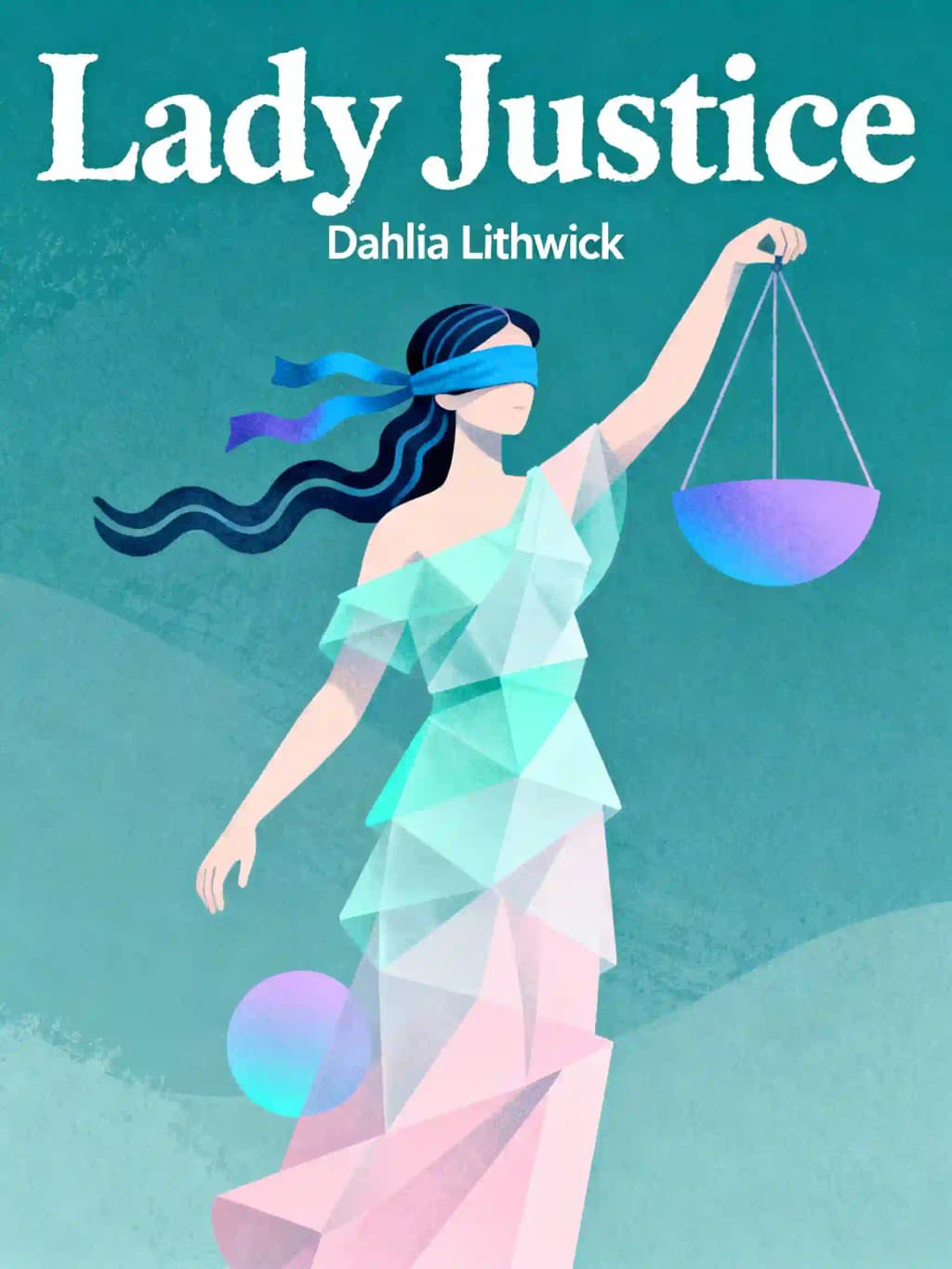
In "Lady Justice," Dahlia Lithwick profiles the fearless women lawyers who battled Trump's policies, proving that "women plus law equals magic." This New York Times bestseller moved readers to tears, revealing how unsung legal heroines preserved our freedoms when democracy trembled.
Dahlia Lithwick, New York Times bestselling author of Lady Justice: Women, the Law, and the Battle to Save America, is a leading legal journalist and Supreme Court analyst. A senior editor at Slate, she has written the outlet’s "Supreme Court Dispatches" and "Jurisprudence" columns since 1999 and hosts its award-winning podcast Amicus.
A Yale-educated lawyer and Stanford Law School graduate, Lithwick’s expertise in constitutional law and social justice stems from her decades covering landmark cases and her visiting faculty positions at universities like the University of Virginia School of Law.
Her work intersects law, gender equity, and democracy, themes central to Lady Justice, which chronicles women’s transformative impact on American jurisprudence. Lithwick co-authored Me Versus Everybody and I Will Sing Life, and her writing has appeared in The New York Times, The New Yorker, and The Washington Post. A frequent commentator on MSNBC and The Rachel Maddow Show, she has testified before Congress on judicial transparency and received honors including the Hillman Prize and a National Magazine Award. Lady Justice became an instant New York Times bestseller, solidifying her reputation as a vital voice in legal discourse.
Lady Justice by Dahlia Lithwick chronicles the pivotal role of women lawyers who fought to uphold civil liberties during Donald Trump’s presidency. It highlights landmark battles like the Muslim travel ban injunction, the Charlottesville neo-Nazi lawsuit, and voting rights advocacy, emphasizing how these women leveraged legal frameworks to counter systemic injustices. The book blends legal analysis with personal narratives to showcase their resilience and strategic ingenuity.
This book is essential for readers interested in legal history, social justice, or women’s leadership. It appeals to law students, activists, and anyone seeking inspiration from grassroots legal victories. Lithwick’s accessible storytelling makes it engaging for both legal professionals and general audiences passionate about democracy and equality.
Yes—Lithwick’s sharp legal insights and vivid profiles of unsung heroes offer a timely exploration of law’s dual power to constrain and enable progress. Its blend of drama and analysis makes it a compelling read for understanding contemporary legal battles and the women who shaped them.
Key cases include:
Lithwick argues that law simultaneously restricts and enables progress. She praises her subjects for navigating this tension—using existing legal tools creatively while acknowledging systemic flaws. For example, Becca Heller’s rapid-response legal aid for immigrants exemplifies pragmatic idealism.
Some reviewers note uneven pacing and a reliance on “Great Man” (or woman) narratives despite Lithwick’s critique of such frameworks. However, the book’s firsthand accounts of harassment and institutional failures add depth to its celebration of legal advocacy.
The book dissects how women lawyers countered Trump-era policies through litigation, public advocacy, and grassroots organizing. Lithwick details their responses to family separations, voter suppression, and extremist violence, framing these efforts as a blueprint for legal resistance.
Unlike her shorter legal commentaries, Lady Justice offers sustained narratives blending biography and jurisprudence. It expands on themes from her Slate and Amicus podcast coverage, providing deeper context on post-2016 legal crises.
Its examination of legal resilience against authoritarianism remains urgent amid ongoing debates about judicial reform, voting rights, and anti-discrimination laws. The book serves as both a historical record and a call to action for future advocates.
The book highlights how race, gender, and class shaped its protagonists’ experiences. For example, Stacey Abrams’ voting rights work explicitly addressed systemic racism, while Latina lawyers faced dual biases while fighting family separations.
Почувствуйте книгу через голос автора
Превратите знания в увлекательные, богатые примерами идеи
Захватите ключевые идеи мгновенно для быстрого обучения
Наслаждайтесь книгой в весёлой и увлекательной форме
The law could be weaponized against women.
Lady Justice has found her voice in a new generation of women lawyers.
The Attorney General has a responsibility to uphold the Constitution.
You just get to work.
Jews will not replace us.
Разбейте ключевые идеи Lady Justice на понятные тезисы, чтобы понять, как инновационные команды создают, сотрудничают и растут.
Погрузитесь в Lady Justice через яркие истории, превращающие уроки инноваций в запоминающиеся и применимые моменты.
Задавайте любые вопросы, выбирайте свой стиль обучения и создавайте идеи, которые действительно вам подходят.

Создано выпускниками Колумбийского университета в Сан-Франциско
"Instead of endless scrolling, I just hit play on BeFreed. It saves me so much time."
"I never knew where to start with nonfiction—BeFreed’s book lists turned into podcasts gave me a clear path."
"Perfect balance between learning and entertainment. Finished ‘Thinking, Fast and Slow’ on my commute this week."
"Crazy how much I learned while walking the dog. BeFreed = small habits → big gains."
"Reading used to feel like a chore. Now it’s just part of my lifestyle."
"Feels effortless compared to reading. I’ve finished 6 books this month already."
"BeFreed turned my guilty doomscrolling into something that feels productive and inspiring."
"BeFreed turned my commute into learning time. 20-min podcasts are perfect for finishing books I never had time for."
"BeFreed replaced my podcast queue. Imagine Spotify for books — that’s it. 🙌"
"It is great for me to learn something from the book without reading it."
"The themed book list podcasts help me connect ideas across authors—like a guided audio journey."
"Makes me feel smarter every time before going to work"
Создано выпускниками Колумбийского университета в Сан-Франциско

Получите резюме книги «Lady Justice» в формате PDF или EPUB бесплатно. Распечатайте или читайте офлайн в любое время.
When the 2016 election results rolled in, a new chapter in American legal resistance began. As chants of "Lock her up" echoed through campaign rallies, women across the legal profession recognized the dangerous weaponization of law against women and minorities. Rather than surrender to despair, they rose in unprecedented numbers to defend constitutional principles. These weren't just any women-they were seasoned attorneys, judges, and activists who understood the dual nature of American law: its power to protect and its capacity to oppress. Their resistance draws from a rich lineage including pioneers like Pauli Murray, whose groundbreaking legal theories laid foundations for landmark civil rights decisions despite facing triple barriers of racism, sexism, and homophobia. Today, as the Supreme Court shifts dramatically rightward, these modern legal warriors continue fighting with renewed urgency, reminding us that Lady Justice may be blindfolded, but her voice grows stronger through their advocacy.
When Sally Yates refused to defend Trump's Muslim ban in January 2017, she became the first official to say "no" to an administration testing constitutional boundaries. "I looked at this EO. I thought about it. I read the law. I re-read the law. And I believed that it was unconstitutional," she explained after her immediate dismissal as Acting Attorney General. What drove this career Justice Department lawyer to sacrifice her position? Perhaps it was her grandmother's legacy-a woman who secretly studied law despite being relegated to secretarial work-or her formative experiences winning significant pro bono cases. Throughout her career, Yates had built a reputation for nonpartisan professionalism, reforming sentencing guidelines and reducing over-incarceration. When Senator Cruz later tried cornering her about constitutional authority, she responded with characteristic precision: "I was not convinced that the defense of the executive order was consistent with my responsibilities." What makes her stand remarkable wasn't partisan motivation but principled conviction. In an era when loyalty to power often trumps loyalty to principle, Yates reminded young lawyers everywhere that their ultimate duty is to the law itself.
"Sir, where is your son?" The question, posed to an Iraqi interpreter who had served alongside American troops, captured the chaos unfolding at airports nationwide following the Muslim ban. Travelers with valid documents found themselves detained, their papers confiscated, facing immediate deportation. Into this maelstrom stepped Becca Heller and her International Refugee Assistance Project team. "We had no idea it would apply to people already in transit," she recalled. "People with valid documents were being stopped at the border. It was unprecedented." Within hours, they filed emergency habeas corpus petitions-the ancient legal principle requiring authorities to present detained individuals before a judge. What happened next was extraordinary: lawyers across America flocked to airports, creating impromptu legal clinics in terminal buildings. Thousands volunteered, many sitting cross-legged on floors with laptops balanced on knees, drafting emergency motions. "A spontaneous constitutional flash mob," one volunteer called it. Outside, massive crowds chanted "Let them in!" as ordinary citizens joined what became both legal battle and public demonstration of values. "I never thought I'd be drafting habeas petitions in an airport food court," remarked one attorney. "But when the government violates constitutional rights this flagrantly, you don't ask where your office is. You just get to work."
The 2017 Charlottesville white nationalist rally, marked by violent demonstrations and Heather Heyer's death, prompted attorney Robbie Kaplan to take legal action. Using the Ku Klux Klan Act of 1871, she targeted rally organizers for conspiring to commit racially motivated violence. Despite facing antisemitic harassment and defendants' attempts to destroy evidence, Kaplan persisted, arguing that the First Amendment doesn't protect violent conspiracies. In another pivotal case, ACLU attorney Brigitte Amiri defended an undocumented minor's right to abortion while in federal custody. When Office of Refugee Resettlement director Scott Lloyd blocked the procedure and personally intervened, Amiri argued that undocumented minors retain constitutional rights, including those established in Roe v. Wade. The case revealed disturbing oversight practices, including Lloyd's tracking of pregnant minors' menstrual cycles in custody.
How do you change a system while working both within and outside its structures? This question defines Vanita Gupta's career, from exposing the Tulia, Texas drug enforcement scandal to leading the Leadership Conference on Civil and Human Rights. "Legal victories alone don't create lasting change," Gupta emphasizes. "You need organizing, coalition-building, and public education alongside litigation." As the daughter of Indian immigrants, Gupta's outsider perspective combined with insider legal knowledge gives her unique insight into addressing systemic inequities. Her "inside-outside strategy" works with institutions when possible while maintaining pressure through organized communities when necessary. "The most effective advocacy happens when those most affected by injustice lead the fight," she explains. "Lawyers can provide tools and expertise, but the vision must come from communities themselves." This approach represents an evolution in civil rights work, moving from lawyer-centered strategies to community-empowered movements that build lasting power among those traditionally excluded.
After losing Georgia's 2018 gubernatorial race amid voter suppression concerns, Stacey Abrams launched Fair Fight and the New Georgia Project to expand voter access. Her systematic approach to voter registration, particularly in communities of color, helped register over 800,000 new Georgia voters between 2018 and 2020, contributing to Democratic victories in both presidential and Senate races. At the same time, Nina Perales of the Mexican American Legal Defense and Educational Fund tackled discriminatory redistricting affecting Latino communities. Through strategic litigation using the Voting Rights Act and Constitution, she successfully fought for districts where Latino voters could effectively elect their chosen candidates. Together, these leaders exemplify how mass mobilization and legal action can protect voting rights in the post-Shelby County era.
The women profiled in this journey represent different facets of a remarkable legal resistance. From government service to grassroots organizing, from litigation to voter mobilization, they have deployed diverse strategies to protect constitutional values during a period of profound challenge. Their stories reveal several important truths: the legal system remains both battleground and bulwark, capable of enabling injustice but also providing tools to combat it; women's leadership has been central to defending democratic norms; and the most effective advocacy combines professional expertise with deep connection to affected communities. What unites these legal warriors isn't ideology but methodology-a commitment to using legal tools strategically and creatively to advance justice. The challenges continue evolving as Supreme Court decisions erode protections for voting rights and reproductive freedom, state legislatures enact new restrictions on civic participation, and the legal profession itself struggles with diversity and harassment issues. Yet these women's work offers a template for moving forward-combining rigorous legal advocacy with broader movement building. As Ruth Bader Ginsburg observed, "Real change, enduring change, happens one step at a time." The women leading today's legal resistance understand this principle deeply, reshaping American law and democracy for generations to come.