Глава 1
The Rise and Fall of America's Most Notorious Criminal Enterprise
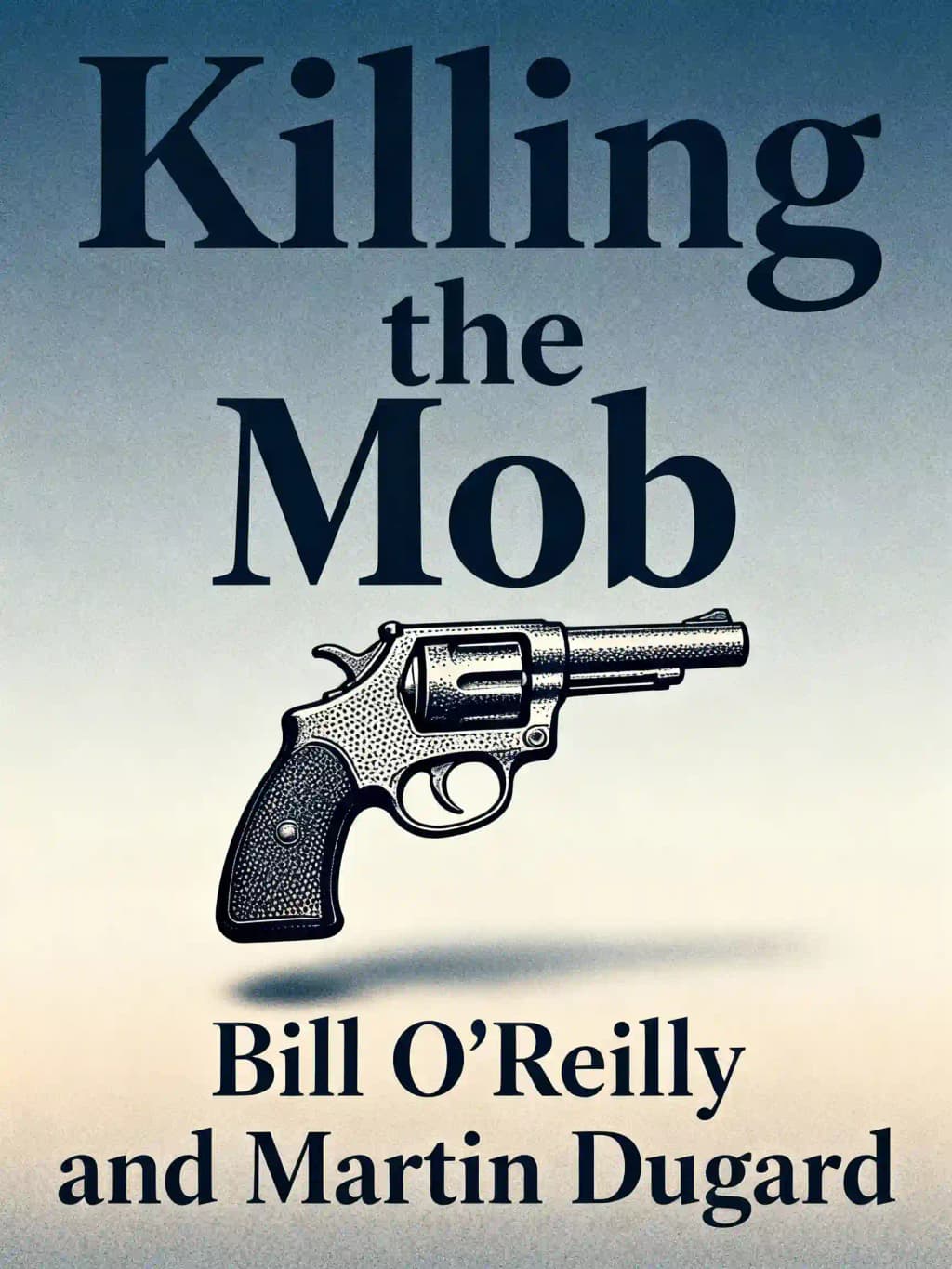
Frank Sinatra once famously quipped, "The big lesson in life is never be scared of anyone or anything." Yet even Ol' Blue Eyes himself had reason to fear the shadowy organization that helped launch his career. Bill O'Reilly and Martin Dugard's "Killing the Mob" offers a riveting chronicle of America's decades-long battle against organized crime, revealing how the Mafia infiltrated every aspect of American life-from Hollywood to the White House. This New York Times bestseller captivated readers upon its 2021 release, with celebrities like Robert De Niro praising its unflinching portrayal of the criminal underworld he so memorably depicted in films like "Goodfellas" and "The Irishman." The book's cultural impact extends beyond entertainment, offering crucial insights into how America's legal and political institutions evolved in response to the Mob's corrupting influence-a struggle that fundamentally reshaped American society in ways we still experience today.
Глава 2
Public Enemies and the Birth of the FBI
The Great Depression created a perfect storm for criminal activity in America. With unemployment at a staggering 21.7% and thousands of homes being foreclosed daily, desperate citizens sometimes viewed bank robbers like John Dillinger as folk heroes-modern-day Robin Hoods striking back against a financial system that had failed them. This romanticized view conveniently overlooked the trail of bodies these criminals left behind.
In 1934, J. Edgar Hoover's newly empowered Division of Investigation (soon to be renamed the FBI) gained expanded authority to pursue these "public enemies" across state lines. Hoover had spent a decade transforming what was once a corrupt, ineffective agency into a professional law enforcement organization. He fired agents with questionable backgrounds, established rigorous training protocols, and created the nation's first centralized fingerprint database.
The Crime Control Acts of 1934 marked a turning point, giving federal agents jurisdiction over bank robberies, kidnappings, and attacks on federal officers. Perhaps more crucially, these laws finally authorized agents to carry firearms and make arrests. Hoover wasted no time putting these new powers to use against America's most notorious criminals.
The violent ends of Bonnie Parker and Clyde Barrow illustrated the new era of federal law enforcement. After a two-year crime spree involving thirteen murders and over a hundred felonies, the couple was ambushed in rural Louisiana by a posse led by Texas Ranger Frank Hamer, who had tracked them for months with intelligence from Hoover's agents. When their Ford V-8 slowed to help what appeared to be a disabled vehicle, the posse unleashed 167 bullets in sixteen seconds, riddling the car and its infamous occupants.
John Dillinger, America's first official "Public Enemy Number One," met a similar fate outside Chicago's Biograph Theater in July 1934. After watching "Manhattan Melodrama"-ironically starring Clark Gable as a gangster character reportedly based on Dillinger himself-the bank robber emerged to find Agent Melvin Purvis waiting with twenty federal agents. Despite extensive plastic surgery to alter his appearance, Dillinger was recognized and killed in the ensuing confrontation.
The deaths of Pretty Boy Floyd, Baby Face Nelson, and Alvin "Creepy" Karpis soon followed, effectively ending the era of the celebrity bank robber. By 1936, Hoover believed he had crime under control. What he failed to recognize was that a far more dangerous and sophisticated criminal organization-the Mafia-was already embedding itself deeply into American society.
Глава 3
The Rise of Organized Crime
While Hoover's agents were hunting down bank robbers, a different breed of criminal was quietly building empires in America's cities. Al Capone exemplified this new model of organized crime, transforming street gangs into sophisticated criminal enterprises. At just twenty-six, the 250-pound "Scarface" controlled Chicago's prostitution, speakeasies, illegal breweries, and racetracks, earning hundreds of thousands weekly. Though he cultivated a celebrity image with bulletproof Cadillacs, $500 custom suits, and occasional charity work at soup kitchens, brutal violence defined his reign. His organization employed over 1,000 gunmen and had half of Chicago's police force on its payroll.
The St. Valentine's Day Massacre of 1929 marked both the height of Capone's notoriety and the beginning of his downfall. From his Palm Island estate in Florida, Capone orchestrated the murder of seven of rival Bugs Moran's men, who were lined up against a garage wall and shot at least fifteen times each with Thompson submachine guns. The brutality shocked the nation and prompted President Herbert Hoover to declare war on gangsters. Though Capone couldn't be convicted of murder, federal agent Eliot Ness and his "Untouchables" team, along with Treasury investigator Frank Wilson, finally imprisoned him for tax evasion in 1931.
As Capone's mental health deteriorated from untreated syphilis at Alcatraz, a new generation of mob leaders was emerging. Charles "Lucky" Luciano revolutionized organized crime by creating the National Crime Syndicate that united Italian, Irish, and Jewish crime families. He established "The Commission," a governing board of crime families that settled disputes and allocated territories. To enforce discipline, he established Murder, Incorporated, led by Albert Anastasia who allegedly killed over a thousand men. Operating from a candy store in Brooklyn, Murder Inc. carried out hundreds of contract killings across the country.
Luciano's criminal genius extended to international affairs, demonstrating organized crime's reach beyond traditional criminal activities. During World War II, as Allied forces prepared to invade Sicily, they needed local intelligence. The Mafia, which Benito Mussolini had brutally suppressed in Sicily (causing many members to flee to America), became unlikely allies. Through Operation Underworld, Luciano provided crucial intelligence for General Patton's Sicilian invasion through his crime network, even supplying names of Sicilian Mafiosi who would assist Allied forces. The Navy's Office of Naval Intelligence worked directly with mob-connected union leaders to gather information.
After the war, Luciano was deported to Italy as part of a deal with authorities, but his criminal organization continued to thrive under leaders like Frank Costello, nicknamed "The Prime Minister" for his political connections. When the SS Normandie caught fire under mysterious circumstances while being converted for troop transport, Naval Intelligence reluctantly formed an alliance with the mob in "Operation Underworld" to prevent further sabotage on the vital New York waterfront. The mob's control of labor unions proved crucial in securing the ports against German infiltration.
This pattern of cooperation with authorities, followed by expansion of criminal enterprises, became a hallmark of organized crime's growth in America. The mob's ability to adapt, infiltrate legitimate businesses, and corrupt officials allowed it to flourish despite occasional setbacks. They diversified into construction, waste management, and the entertainment industry, creating complex networks of legitimate businesses that masked their criminal activities. By the 1950s, organized crime had become so deeply embedded in American society that Senator Estes Kefauver's investigative committee estimated it generated annual profits of $20 billion, equivalent to nearly $200 billion today.
Глава 4
The Mafia's Golden Age in Las Vegas
"We're bigger than U.S. Steel," boasted Meyer Lansky, and by the 1950s, this wasn't mere criminal bravado. The Mafia had transformed from street gangs into sophisticated business enterprises with tentacles reaching into unions, entertainment, and politics. Nowhere was this evolution more evident than in Las Vegas.
Benjamin "Bugsy" Siegel, a violent enforcer with Hollywood dreams, convinced his mob associates to invest in a luxury resort in the Nevada desert. The Flamingo initially struggled, opening to a disappointing turnout despite celebrity entertainers. Siegel desperately tried to make the venture profitable, knowing his life depended on its success.
By June 1947, the Flamingo finally became profitable, bringing in millions monthly. Siegel began repaying Mafia loans, instantly cashing out anyone requesting immediate reimbursement. With the casino packed and the showroom becoming a Las Vegas entertainment centerpiece, Siegel felt his gamble had paid off. He was wrong. On June 20, 1947, while relaxing in his girlfriend Virginia Hill's Beverly Hills mansion, Siegel was shot through the face by an unknown assassin. The killer's identity remains a mystery, though many suspect the New York Mafia finally completed the hit Meyer Lansky had postponed.
After Siegel's death, Lansky expanded operations to become Vegas's most powerful gambling force. By 1960, Las Vegas had become the gambling mecca Siegel envisioned, drawing eight million visitors annually who spent over $160 million on entertainment and gambling. The Mob controlled major casinos including the Sands, Flamingo, Tropicana, Desert Inn, and Riviera, dividing them among Chicago, Detroit, and New York crime families.
The Rat Pack-Frank Sinatra, Dean Martin, Joey Bishop, Peter Lawford, and Sammy Davis Jr.-became the entertainment face of mob-controlled Vegas, performing sold-out shows while filming "Ocean's Eleven" by day. Their popularity was so immense that over 18,000 reservation requests flooded the 212-room Sands Hotel during their three-week run. Behind the scenes, Sinatra maintained close relationships with mob figures, occasionally serving as their liaison to political figures-including presidential candidate John F. Kennedy.
Las Vegas represented the Mafia's most successful legitimate-appearing business venture, generating enormous profits while providing a mechanism for laundering money from less reputable enterprises. The desert oasis became a symbol of the mob's golden age-a glittering monument to their power and influence in American society.
Глава 5
The Mob's Infiltration of American Culture
By the 1950s, organized crime had embedded itself deeply into American culture, extending far beyond traditional rackets like gambling and protection. The Mafia's influence reached into Hollywood studios, the music industry, labor unions, and even professional sports.
In Hollywood, the connection between organized crime and the film industry dated back to the 1920s. Traditional banks often refused to finance studios, creating an opening for the Mafia to launder money through film investments while skimming profits. The Mob gained control by infiltrating film industry unions, ensuring movies couldn't be made without their approval.
Sidney Korshak, known as "the Fixer," exemplified this influence. Living lavishly in Bel Air surrounded by original Renoirs and Chagalls, Korshak could change union management, influence Vegas operations, or elevate studio executives with a single phone call. The Justice Department called him "the most significant link in the relationship between the crime syndicate, politics, labor, and management."
When Desi Arnaz's show "The Untouchables" portrayed Italian-Americans negatively, Sam Giancana ordered a hit on Arnaz. The situation was only resolved when Arnaz met with Johnny Roselli and Frank Sinatra, agreeing to change character names and cast Roselli's friend-saving his life without ever knowing how close he came to death.
The Mafia's reach extended into the music industry as rock 'n' roll emerged as America's newest cultural phenomenon. "Payola"-bribing DJs to play specific records-became a common Mob investment to boost royalties and attendance at Mob-run venues. In Detroit, Berry Gordy allegedly started Motown with loans from the Detroit Mafia, while Philadelphia singers like Bobby Rydell benefited from connections to crime boss Angelo Bruno.
Morris Levy, with deep ties to Vito Genovese, owned Birdland nightclub and Roulette Records, securing copyright control of songs and forcing artists to grant him songwriting credits. When congressional hearings investigated payola in 1960, DJ Alan Freed's career was destroyed while Dick Clark survived by divesting his music holdings before testifying.
Even professional boxing fell under the Mob's control. Sonny Liston, the former heavyweight champion, had deep connections to mobsters John Vitale and Blinky Palermo. Despite being heavily favored to win against Cassius Clay (later Muhammad Ali), Liston trained poorly and quit after six rounds in their first fight. The rematch ended even more controversially when Liston fell to a "phantom punch" just 1:44 into the first round. Despite FBI investigations, the inquiry was eventually abandoned, with prosecutors declaring further investigation "fruitless."
The Mob's cultural infiltration created a shadow economy that operated alongside legitimate business, blurring the lines between entertainment and organized crime in ways that would take decades to untangle.
Глава 6
The Kennedy Crusade Against Organized Crime
While J. Edgar Hoover publicly denied the existence of organized crime, a young Senate lawyer named Robert Kennedy was building a case against what he called America's "alternate government." As chief counsel for the Senate's McClellan Committee investigating labor racketeering, Kennedy directly challenged the FBI's denial during televised hearings in 1957: "Is there any organization such as the Mafia?"
Kennedy's question came at a pivotal moment. Just as Federal Bureau of Narcotics agent Joseph Amato confirmed the Mafia's existence on national television, Vito Genovese was convening a major Mob summit in Apalachin, New York. The gathering included crime family leaders from across North America, Cuba, Puerto Rico, and Sicily, who had assembled to discuss gambling, narcotics, prostitution, and ambitious expansion plans.
New York State Police Sergeant Edgar Dewitt Croswell, who had long suspected local businessman Joseph Barbara of criminal connections, established roadblocks around the property after noticing unusual activity. When the mobsters attempted to flee, sixty were captured and taken to the Vestal barracks for questioning. The raid exposed the Mob's national reach, with representatives from Texas, Colorado, Kansas, and Alabama alongside delegates from New York, Chicago, and Miami.
The Apalachin raid forced Hoover to acknowledge organized crime's existence by instituting the Top Hoodlum Program, though he still refused to use the words "Mafia" or "Apalachin." Kennedy seized the opportunity, subpoenaing each Apalachin attendee for the McClellan hearings while boosting his brother John's public profile as JFK eyed the White House.
Kennedy's questioning of Chicago Outfit leader Sam Giancana exemplified his determination. Giancana, who privately boasted "I own Chicago, I own Miami, I own Las Vegas," simply giggled and repeatedly pleaded the Fifth Amendment. When Kennedy remarked, "I thought only little girls giggled, Mr. Giancana," the mobster continued his silence, invoking the Fifth thirty-four times.
Despite Kennedy's monumental effort-253 investigations, 8,000 subpoenas, 1,526 witnesses, and 150,000 pages of testimony-the hearings yielded little immediate legal action against the Mob. By 1959, public interest waned, and ironically, Kennedy himself was portrayed as the villain by some legal scholars.
When John F. Kennedy won the presidency in 1960 (with alleged help from Sam Giancana in the crucial Illinois vote), he appointed his brother as Attorney General. Bobby Kennedy wasted no time attacking organized crime, authorizing the IRS to investigate mob figures and establishing the Justice Department's Organized Crime and Racketeering Section to bypass Hoover's FBI.
In a bold move, he ordered the deportation of Carlos Marcello, the New Orleans crime boss. Kennedy's momentum continued with fifty lawyers sent to Chicago to prosecute the Outfit, resulting in thirteen gambling indictments. He secured four anti-crime bills and the Interstate Wire Act, allowing federal monitoring of gambling. In 1961 alone, his efforts yielded eleven major convictions and dismantled the French Connection heroin ring.
Глава 7
The Mob's Political Connections and Counterattack
The Kennedy brothers' crusade against organized crime was complicated by their own family's connections to the very criminals they were pursuing. Their father, Joseph Kennedy, had allegedly met with Sam Giancana and Johnny Roselli to discuss how the Mafia could assist JFK's presidential campaign. Despite Bobby Kennedy's public attacks on Giancana during the McClellan hearings, Joe Kennedy assured the mobster that "it's Jack who's running for president, not Bobby."
These connections gave J. Edgar Hoover powerful leverage. In December 1961, Hoover sent Bobby Kennedy a memo revealing a Giancana wiretap where the mobster complained his efforts to elect Kennedy hadn't reduced pressure on the Outfit. Giancana boasted he'd use his relationship with Joseph Kennedy to keep the Justice Department away, admitting he had funneled illegal campaign donations through the patriarch to help JFK win the West Virginia primary.
In February 1962, Hoover delivered another blow-a memo detailing Judith Campbell's seventy calls to the White House, noting she was also a companion to Giancana and Roselli. Kennedy immediately instructed his secretary to stop taking Campbell's calls, and Frank Sinatra was similarly cut off from the Kennedy inner circle.
The situation grew more complicated when Bobby learned the CIA had enlisted Giancana and Roselli to assassinate Fidel Castro-a plan initially approved by Eisenhower, then continued under Kennedy's administration. The Mob was eager to eliminate Castro and regain their lucrative Cuban casino operations lost after his revolution.
As the Kennedy brothers distanced themselves from their mob connections, organized crime figures felt betrayed. Carlos Marcello, who had been unceremoniously deported to Guatemala on Kennedy's orders, swore revenge. Jimmy Hoffa, the powerful Teamsters president who had been a primary target of Bobby Kennedy's investigations, celebrated openly when President Kennedy was assassinated in Dallas, calling his lawyer to exclaim "They killed the son of a bitch."
Given the Kennedy brothers' relentless pursuit of organized crime, the assassination bore hallmarks of a mob hit. Bobby Kennedy immediately suspected Hoffa and the Mafia, believing they intended to kill him rather than his brother. He dispatched Walter Sheridan to investigate, especially after learning Hoffa had discussed assassinating RFK with a high-powered rifle. Despite these suspicions, no definitive connection between the Mafia and JFK's assassination was established.
Bobby Kennedy remained at the Justice Department under President Johnson, finally securing Jimmy Hoffa's conviction in March 1964 for attempting to bribe a grand juror. After exhausting appeals, Hoffa began serving his sentence in March 1967. However, Kennedy's broader war on organized crime was winding down. In September 1964, he resigned as attorney general, leaving behind an impressive record of 687 organized crime indictments with a 90 percent conviction rate.
Глава 8
Breaking the Code of Silence
For decades, the Mafia's power rested on omerta-their code of silence that guaranteed death to anyone who spoke against them. This wall of silence began to crack in 1963 when Joseph Valachi, a member of the Genovese crime family, became the first major mob informant.
After mistakenly killing the wrong man in prison and fearing Mob retaliation, Valachi agreed to testify against his former associates in exchange for avoiding the death penalty. During hundreds of hours of interviews, he revealed the Mafia's hierarchical structure (associates, soldiers, caporegime, underboss, boss, and consigliere), named the current heads of New York's five families, and provided details of decades of crimes.
Valachi's testimony before the Senate in October 1963 exposed Mafia initiation rituals and named Vito Genovese as Boss of Bosses, while a $100,000 bounty hung over his head. His revelations forever changed law enforcement's understanding of organized crime, though the momentum of this breakthrough was temporarily lost after President Kennedy's assassination and Bobby Kennedy's departure from the Justice Department.
The most significant blow to the Mafia's code of silence came in the 1970s through FBI agent Joseph D. Pistone's unprecedented undercover operation. Using the alias "Donnie Brasco," Pistone infiltrated the Bonanno crime family for six years, gaining unprecedented access to their operations.
Pistone was the perfect candidate-a street-smart agent of Sicilian heritage who grew up in Paterson, New Jersey around Mob social halls. For his assignment, Pistone spent months learning gemology to pose as jewel thief "Donnie Brasco," while his identity was erased from FBI files and his family relocated with new names.
He developed a deep friendship with Benjamin "Lefty Guns" Ruggiero, a vicious killer with twenty-six confirmed murders. Their relationship grew so close that Brasco dined at Ruggiero's home, helped with his stepson's heroin addiction, and was even asked to be Lefty's best man. By 1980, Lefty pushed for Brasco to become a "made man"-requiring him to commit murder, which the FBI would never sanction.
After witnessing brutal Mob violence-including the assassination of Philadelphia boss Angelo Bruno and the machine-gun execution of three Bonanno capos-Pistone's operation reached its breaking point in July 1981 when he was ordered to kill Bruno Indelicato. After five years undercover, Pistone disappeared from the Mob and returned to the FBI.
The FBI arrested Lefty Ruggiero "for his protection" and deliberately created paranoia by revealing Brasco's true identity to Bonanno members. Dominick Napolitano, who vouched for Brasco, was murdered and found with his hands cut off-the Mob's signal for betrayal. Pistone's testimony led to 200 indictments and over 100 convictions, dealing a devastating blow to organized crime's operations and mystique.
Глава 9
The Mob's Decline and Legacy in American Society
By the mid-1980s, organized crime in America was severely weakened. The Mafia's sacred code of silence had been broken, the powerful Bonanno family infiltrated, and local drug gangs challenged Italian dominance in narcotics. The Mob's days of running entire cities and industries were over.
The RICO statute (Racketeer Influenced and Corrupt Organizations Act) of 1970 forever altered the power balance between law enforcement and the Mob by making it illegal to run a criminal enterprise. This allowed prosecutors to target entire criminal organizations rather than just individual crimes.
Rudolph Giuliani's 1985 case against the Commission and John Gotti's eventual conviction demonstrated the effectiveness of this new approach. The "Teflon Don," who had flamboyantly flaunted his mob connections, finally fell when his underboss Salvatore "Sammy the Bull" Gravano turned government witness.
Despite these successes, the Mafia continues operating with an estimated 3,000 members in America today, adapting to modern times with internet crimes and offshore operations. The organization that once controlled unions, casinos, and entertainment has been forced to evolve, becoming less visible but still present in American society.
The cultural fascination with organized crime persists, exemplified by the success of "The Godfather" novels and films. Ironically, after the movies' success, many mobsters readopted rituals they saw in the films, including cheek-to-cheek kisses and using the term "Godfather."
The Mob's influence on American history extends beyond crime. Their involvement in politics-from alleged election tampering to connections with the Kennedy administration-shaped crucial moments in the 20th century. Their control of entertainment venues and record companies influenced the development of popular music, while their infiltration of unions affected labor relations across multiple industries.
The battle against organized crime transformed American law enforcement, leading to the creation of new investigative techniques, legal tools, and inter-agency cooperation. J. Edgar Hoover's FBI evolved from hunting bank robbers to sophisticated intelligence gathering, while prosecutors developed new strategies to dismantle criminal networks rather than just punishing individual crimes.
Though diminished, the shadow of organized crime continues to influence American society. The methods developed to combat the Mob now help fight international terrorism and drug cartels. The legal precedents established in Mafia prosecutions shape how we address modern criminal enterprises. And the cultural narratives about organized crime-from "The Godfather" to "The Sopranos"-continue to fascinate us, reminding us of a time when an invisible empire operated alongside legitimate society, blurring the boundaries between crime, business, and politics in ways that forever changed America.