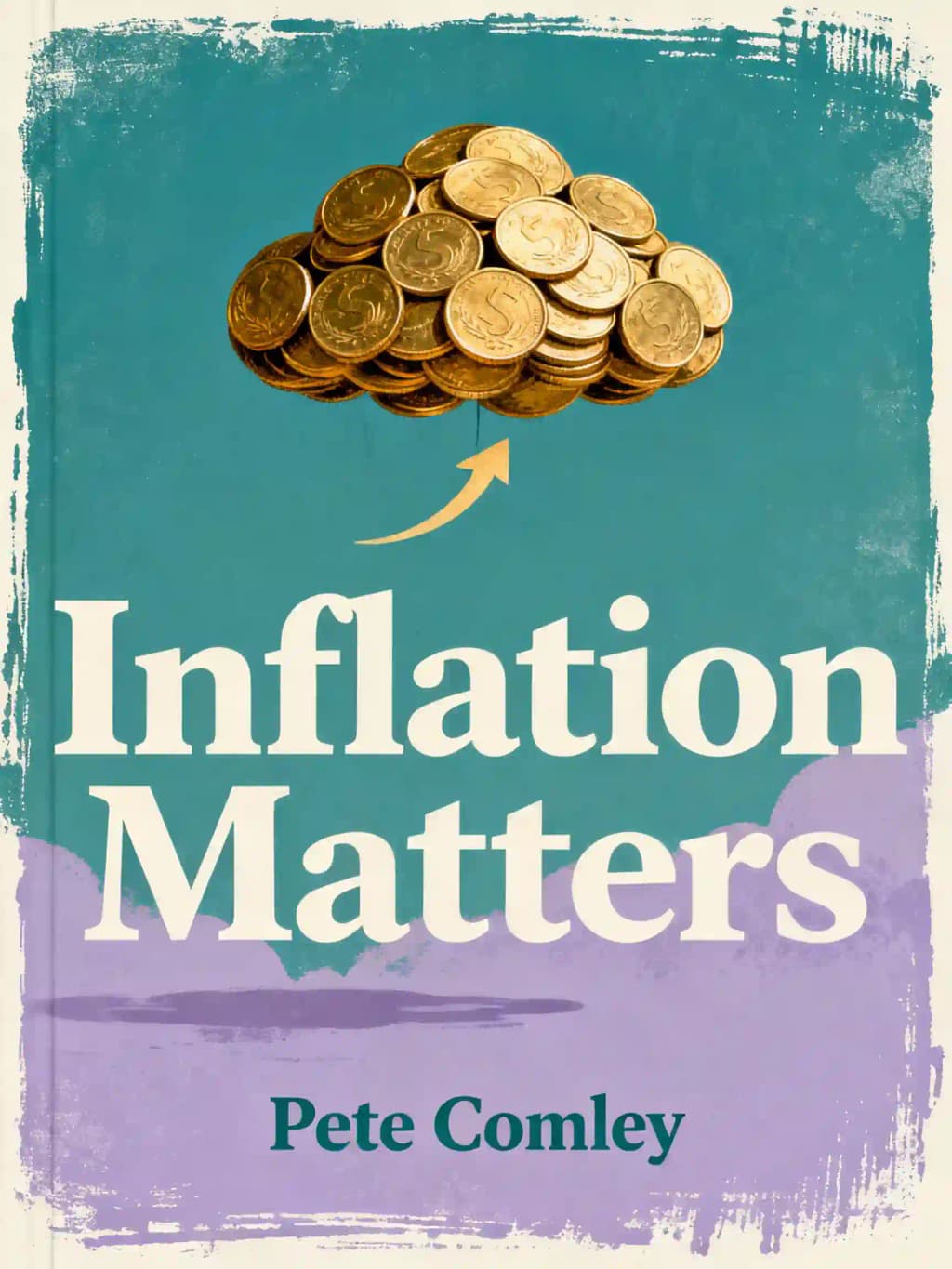
"Inflation Matters" demystifies economic cycles through Comley's revolutionary Inflationary Wave Theory. Praised by economist John Mills for making complex concepts accessible, this thoroughly researched guide reveals how population growth drives centuries-long inflation patterns - and why deflation might be our surprising future.
Pete Comley is the acclaimed author of Inflation Matters: Inflationary Wave Theory, its impact on inflation past and present... and the deflation yet to come, establishing himself as a leading voice in macroeconomic analysis. A seasoned economist and former market research pioneer, Comley draws on decades of professional expertise, including co-founding the consumer insight agency Join the Dots (formerly Virtual Surveys), which specialized in large-scale data analytics for global corporations.
His works blend historical economic patterns with forward-looking theories, particularly his innovative "inflationary wave theory" that examines cyclical price movements across centuries.
Comley’s financial acumen extends to his earlier book Monkey With A Pin Investing, which critiques traditional investment strategies. Recognized by the World Economic Forum as essential reading for understanding inflation, Inflation Matters synthesizes research from hyperinflation episodes to modern monetary policies. His analysis has been leveraged by academic institutions and financial professionals seeking to navigate volatile markets, cementing his reputation for translating complex economic concepts into actionable insights.
Inflation Matters explores inflation through Comley’s Inflationary Wave Theory, arguing that inflation and deflation follow cyclical patterns driven by population growth and resource competition. The book analyzes historical events like hyperinflations, the 1970s crisis, and modern monetary policies, while predicting a transition to near-zero inflation. It offers insights into measuring inflation, its economic impact, and strategies for managing wealth in a deflationary future.
This book is ideal for investors, economists, and policymakers seeking a non-technical understanding of inflation’s long-term trends. It’s also valuable for history enthusiasts interested in economic cycles and general readers preparing for future financial shifts. Comley’s clear explanations make complex concepts accessible without oversimplifying.
Inflationary Wave Theory posits that inflation occurs in cyclical “waves” over centuries, driven by population growth and resource scarcity. Prices rise, stabilize, then surge again, with Comley predicting a coming era of near-zero inflation as economies consolidate. This theory challenges conventional views of continuous inflation, emphasizing demographic and competitive pressures.
The book analyzes critical periods:
Yes. Comley advises diversifying into inflation-resistant assets (e.g., real estate, commodities) and preparing for deflationary shocks. He emphasizes understanding central bank policies and long-term demographic trends to navigate upcoming price stability.
Comley highlights flaws in indices like the UK’s CPI, which often underestimate true inflation by excluding housing costs and using substitution biases. He argues these metrics mislead policymakers and savers, distorting economic decisions.
Unlike technical academic texts, Comley combines historical storytelling, accessible analysis, and original theories like the Inflationary Wave. It avoids jargon while addressing complex topics like monetary policy, making it suitable for non-experts.
Governments benefit from inflation by reducing real debt burdens, often exacerbating it through loose monetary policies. Comley critiques short-term political incentives that prioritize growth over price stability, leading to cyclical crises.
Comley argues that demographic shifts (e.g., aging populations) and technological advances will reduce resource competition, stabilizing prices. This “consolidation period” follows centuries of inflationary waves but requires navigating deflationary risks first.
Deflation is framed as an inevitable phase post-inflationary waves, often triggered by debt crises or technological disruptions. Comley warns against fear-driven policies that might artificially prolong inflation, advocating adaptive strategies instead.
Yes. It offers a fresh perspective on economic history and actionable insights for future financial planning. The blend of theory, data, and clear prose makes it a standout resource for understanding inflation’s past, present, and future.
Почувствуйте книгу через голос автора
Превратите знания в увлекательные, богатые примерами идеи
Захватите ключевые идеи мгновенно для быстрого обучения
Наслаждайтесь книгой в весёлой и увлекательной форме
Modern corporations heavily reliant on debt financing do suffer during deflation.
Arguments against deflation often confuse symptom with cause.
This oversimplification has led to policies that may actually harm economic growth.
We accept it as inevitable, like gravity or taxes.
Разбейте ключевые идеи Inflation Matters на понятные тезисы, чтобы понять, как инновационные команды создают, сотрудничают и растут.
Погрузитесь в Inflation Matters через яркие истории, превращающие уроки инноваций в запоминающиеся и применимые моменты.
Задавайте любые вопросы, выбирайте свой стиль обучения и создавайте идеи, которые действительно вам подходят.

Создано выпускниками Колумбийского университета в Сан-Франциско
"Instead of endless scrolling, I just hit play on BeFreed. It saves me so much time."
"I never knew where to start with nonfiction—BeFreed’s book lists turned into podcasts gave me a clear path."
"Perfect balance between learning and entertainment. Finished ‘Thinking, Fast and Slow’ on my commute this week."
"Crazy how much I learned while walking the dog. BeFreed = small habits → big gains."
"Reading used to feel like a chore. Now it’s just part of my lifestyle."
"Feels effortless compared to reading. I’ve finished 6 books this month already."
"BeFreed turned my guilty doomscrolling into something that feels productive and inspiring."
"BeFreed turned my commute into learning time. 20-min podcasts are perfect for finishing books I never had time for."
"BeFreed replaced my podcast queue. Imagine Spotify for books — that’s it. 🙌"
"It is great for me to learn something from the book without reading it."
"The themed book list podcasts help me connect ideas across authors—like a guided audio journey."
"Makes me feel smarter every time before going to work"
Создано выпускниками Колумбийского университета в Сан-Франциско

Получите резюме книги «Inflation Matters» в формате PDF или EPUB бесплатно. Распечатайте или читайте офлайн в любое время.
Inflation is that economic force we've all felt but rarely understood. It's not just rising prices - it's a complex phenomenon that redistributes wealth in ways most people never notice. Since 1900, prices in the UK have increased roughly 100-fold. That means a pound from 1900 would be worth about 120 today. But what if everything you thought about inflation was incomplete? Pete Comley's groundbreaking work reveals that inflation isn't the inevitable economic gravity we assume. Throughout history, there have been extended periods - some lasting centuries - where people lived entire lives without experiencing inflation. The medieval period from 1200-1500 in England saw remarkably stable prices for basic commodities, with only seasonal fluctuations. We're not experiencing an economic law of nature - we're riding a century-long wave that may be approaching its end.
Inflation manifests through several interconnected forces. Consumer price inflation affects daily purchases, while asset price inflation impacts investments-often moving independently. Wage inflation reflects labor market pressures, and producer price inflation reveals cost pressures at earlier production stages. The monetary theory links inflation to money supply expansion. When Spanish galleons brought New World gold to 16th century Europe, prices rose dramatically. Copernicus observed this connection in 1517, while John Stuart Mill later formalized it in the quantity theory of money (MV=PQ). Modern financial systems complicate this relationship. Most new money (97% in the UK) comes from commercial bank lending, not government currency printing, and often flows into asset markets rather than consumer goods, creating distinct inflation patterns. Keynesian theory distinguishes between demand-pull inflation (demand exceeding supply capacity) and cost-push inflation (from increased production costs). The 1970s stagflation demonstrated how cost-push factors could drive inflation even during economic stagnation.
We've been conditioned to fear deflation, but this oversimplification ignores important distinctions. Bad deflation stems from decreased demand during financial crises when credit tightens and money contracts. The Great Depression exemplifies this destructive spiral, where falling prices increased debt burdens, triggering defaults and further contraction. Good deflation occurs when prices fall because things become cheaper to produce through technological improvements or globalization, benefiting consumers without economic harm. The Great Deflation of 1870s-1890s proves this point - despite a 1.7% annual price decline, real wages rose by 3% annually, and GDP growth averaged 4%. This period saw remarkable technological advances including electricity, internal combustion engines, and mass production. Japan's experience since the 1990s further challenges deflation fears. Despite moderate price declines around 1% annually, Japan maintained stable employment and continued technological advancement. The argument that deflation causes consumers to delay purchases awaiting lower prices contradicts real-world evidence. The smartphone market demonstrates how consumers eagerly purchase products despite knowing prices will decline. Why fear something that can benefit average citizens?
Inflation statistics aren't neutral mathematical facts - they're political constructs with enormous financial implications. The UK employs two primary measures: the Retail Prices Index (RPI), which includes housing costs like mortgages and house prices, and Consumer Prices Index (CPI), which excludes them. CPI also uses geometric means that mathematically produce lower figures than RPI's methods. From 2000-2013, RPI showed prices increasing by 50% while CPI showed only 37%, making CPI-indexed incomes 10% worse off than RPI-indexed ones. This matters tremendously for pensions, benefits, and wage negotiations. Governments have strong incentives to show low inflation rates to make economic growth appear stronger and reduce indexed payment obligations. Argentina's official inflation rate is widely believed to be less than half the actual rate, while alternative calculations suggest U.S. inflation might be 8% higher than reported using 1980s methodology. These distinctions determine how much your pension increases, whether savings grow or shrink in real terms, and how wage negotiations are framed. Inflation measurements fundamentally shape who wins and loses in the economy.
Inflation functions as a massive wealth transfer mechanism operating largely unnoticed. Since 2008, central banks have maintained interest rates below inflation, creating an "inflation conveyor belt" that systematically transfers wealth from savers to debtors. In the UK alone, this transfer amounts to approximately 23 billion annually from savers. Between 2009-2013, UK savers suffered a 13% erosion in purchasing power, with cumulative losses exceeding 100 billion. This wealth transfer occurred without public outcry, unlike the protests in Cyprus when the government attempted a one-time 6.7% levy on savings accounts. The stealth nature of inflation makes it particularly insidious - most savers remain unaware of this ongoing wealth confiscation. Meanwhile, wages have failed to keep pace with inflation. From February 2008 to August 2014, UK average weekly wages increased just 5% while RPI rose 22%. This means the average person effectively earns 17% less in real terms, translating to a loss of over 2,500 annually in purchasing power. Have you checked how much your savings have actually grown in real terms lately? The answer might shock you.
History reveals inflation moves in long waves spanning decades or centuries. These waves begin with population growth pressuring resources, not from money supply increases (which follow later). Once prices exceed normal ranges, an inflationary mindset takes hold - people demand wage increases and borrow for assets, reinforcing the cycle. These waves eventually crest, typically halted by war or population decline. Periods of price stability follow, where prices remain within range, asset returns decline, and purchasing power rises - often coinciding with cultural flourishing like the Italian Renaissance. Previous UK inflationary waves lasted 85-140 years, and we're about 115 years into the current one. Demographic decline in developed nations and technological deflation may signal transition. Japan might already be entering this new phase, with near-zero inflation and interest rates since 1990. Perhaps the inflation we've known isn't permanent but part of a longer cycle nearing its conclusion.
Powerful deflationary forces are suppressing global prices: bank deleveraging, stagnant economies, unemployment, currency devaluations, Chinese slowdown, technological advancement, government debt, and aging populations. Central banks combat these through unprecedented money printing, primarily affecting asset prices rather than consumer goods. Massive latent inflation has accumulated, requiring either prices to double or money supply to halve for equilibrium. World debt has reached unsustainable levels - approximately $223 trillion in 2012 and growing. Developed countries now average debt nearly four times their annual GDP. The transition to price stability will likely involve financial turbulence, with historical precedents suggesting temporary price declines around 50%. After this disruption, the world could enter a period of stable prices extending into the 22nd Century. This stability would incentivize productivity improvements, raise real wages, reduce inequality, and benefit business. Money would return to its fundamental purpose as an exchange method and value store. What would it mean to live where savings don't silently erode year after year? Where wages rise through genuine productivity rather than inflation adjustments? The end of our century-long inflation wave might bring economic turbulence, but could also restore money's original purpose and create a more transparent financial system for future generations.