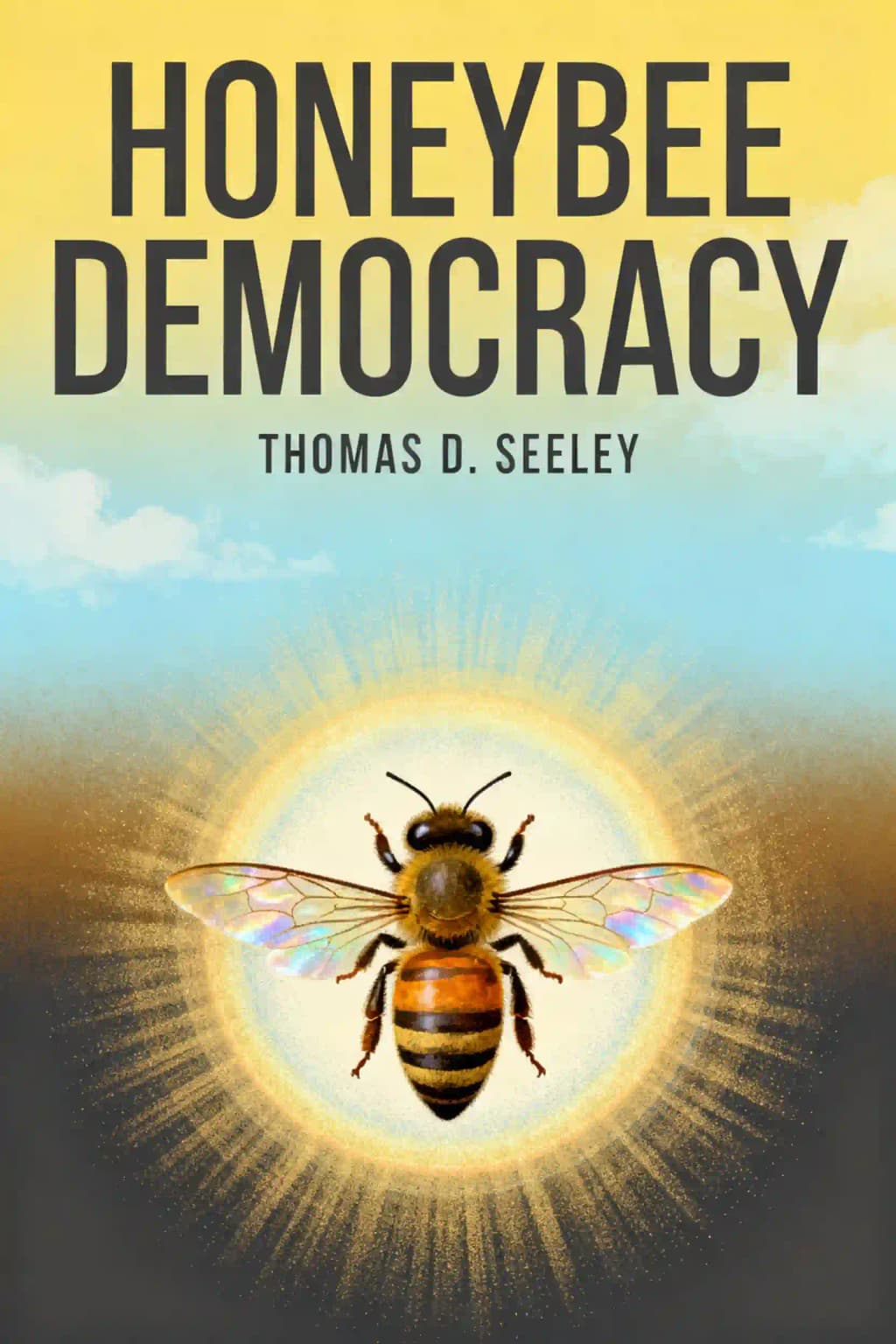
Honeybee Democracy
Обзор книги Honeybee Democracy
Discover how honeybees make life-altering group decisions with near-perfect accuracy. Cornell biologist Seeley's influential work reveals collective wisdom that's revolutionized business management strategies. What surprising democratic principles could humans learn from these tiny masters of consensus? Required reading in Master Beekeeper programs worldwide.

Ключевые темы в Honeybee Democracy
- collective intelligence
- group decision-making
- swarm behavior
- organizational governance
- biological superorganisms
Цитаты из Honeybee Democracy
Honeybees have perfected the art of collective decision-making.
The colony functions as a hermaphrodite.
Swarming-the honeybee colony's method of reproduction.
The true governance happens collectively among the worker bees.
The colony circulates resources through food exchange between workers.
Персонажи в Honeybee Democracy
- Thomas D. SeeleyAuthor and biologist who studied bee democracy
Об авторе
Об авторе книги Honeybee Democracy
Thomas Dyer Seeley, author of Honeybee Democracy, is a pioneering behavioral biologist and Horace White Professor of Biology at Cornell University, renowned for his groundbreaking research on swarm intelligence in honey bees.
This nonfiction work explores collective decision-making in animal behavior, drawing on Seeley’s decades of field studies demonstrating how bee colonies democratically select nesting sites through decentralized debates.
His expertise stems from over 50 years studying honey bee ecology, sociobiology, and evolution, detailed in acclaimed works like The Wisdom of the Hive and The Lives of Bees: The Untold Story of the Honey Bee in the Wild. A frequent speaker on nature’s organizational wisdom, Seeley’s research has been featured in Scientific American, NPR, and TED-style talks.
His books, published by Princeton University Press, blend rigorous science with accessible storytelling, making complex biological concepts relatable to beekeepers and general readers alike. Honeybee Democracy has been translated into 12 languages and remains essential reading in courses on animal behavior and systems biology.
Скачать резюме книги «Honeybee Democracy»
Получите резюме книги «Honeybee Democracy» в формате PDF или EPUB бесплатно. Распечатайте или читайте офлайн в любое время.
Часто задаваемые вопросы об этой книге
Honeybee Democracy explores how honeybee swarms collectively choose new hive locations through decentralized decision-making. Thomas D. Seeley details their process of scouting, debating via "waggle dances," and reaching consensus via quorum sensing. The book draws parallels to human group dynamics, arguing that democratic principles—shared goals, diverse input, and minimized leadership—enhance collective intelligence.
This book is ideal for biology enthusiasts, beekeepers, and professionals in leadership or organizational behavior. It appeals to readers interested in animal behavior, swarm intelligence, and applications of nature-inspired strategies for human decision-making. Seeley’s accessible writing bridges academic research and practical insights.
Yes. Seeley combines decades of research with engaging storytelling, offering a unique lens into democratic systems in nature. Its lessons on collaborative decision-making are relevant to fields like business, education, and community planning, making it valuable beyond entomology circles.
Scout bees search for sites, assess quality, and return to the swarm to perform waggle dances signaling their findings. Bees engage in debate by comparing dance intensity, then build a quorum at the best site. This decentralized process ensures efficient, error-resistant decisions.
Key lessons include fostering shared goals, encouraging open debate, diversifying solutions, and relying on majority rule. Seeley suggests minimizing leader influence to harness collective wisdom—principles applicable to corporate teams, nonprofits, and government bodies.
Swarm intelligence refers to a group’s ability to solve complex problems through decentralized collaboration. Bee colonies exemplify this by pooling individual knowledge without centralized control, achieving outcomes superior to any single member’s input.
His insights help beekeepers manage swarms by understanding natural nest-site preferences, such as cavity size and insulation. This promotes sustainable practices that mimic bees’ evolutionary adaptations, reducing colony stress.
After scouts advertise potential sites, bees independently evaluate options and aggregate support through dance debates. A quorum forms once a critical mass of scouts agrees, triggering the swarm’s move.
Scouts act as “search engines,” evaluating sites for factors like size, safety, and sun exposure. They communicate findings through waggle dances, with longer dances indicating stronger preferences, guiding the swarm’s choice.
Some argue Seeley oversimplifies parallels between bee and human decision-making, neglecting cultural and emotional complexities. Others note the book underplays individual bee roles in favor of group dynamics.
While The Wisdom of the Hive focuses on colony-level physiology and Honeybee Ecology on environmental adaptations, this book emphasizes democratic decision-making. It integrates behavioral research with broader lessons for human collaboration.
Notable lines include:
- “A democratic group can be smarter than even its smartest member”
- “Bees show us how to design organizations that balance information sharing and collective action”
- “Evolution has built swarm smarts into their genes”