Глава 1
The Meeting Revolution: Transforming Tedium into Triumph
Imagine if surgeons complained about having to operate or conductors dreaded concerts. Sounds absurd, right? Yet countless executives bemoan what constitutes the very essence of their role: meetings. Patrick Lencioni's "Death by Meeting" tackles this paradox head-on with refreshing candor and practical solutions. Since its 2004 publication, this business fable has become required reading at companies like Microsoft, Southwest Airlines, and countless Silicon Valley startups. When Apple's Tim Cook was asked about his management philosophy in a rare 2015 interview, he specifically mentioned Lencioni's meeting framework as instrumental to Apple's decision-making culture. The book's enduring popularity stems from its counterintuitive premise: the problem isn't that we have too many meetings-it's that we're having the wrong kinds of meetings in the wrong ways. Through the story of Casey McDaniel, a video game company CEO whose job hangs in the balance, Lencioni delivers a message that continues to resonate with frustrated executives worldwide: meetings don't have to be painful. They can actually be the competitive advantage that sets your organization apart.
Глава 2
The Ordinary CEO with an Extraordinary Problem
Casey McDaniel was, by all accounts, an extraordinary man but just an ordinary CEO. As founder of Yip Software, a successful sports video game company in Monterey, California, Casey had built a comfortable life for himself, his wife Patricia, and their four children. His employees genuinely liked him-he was the kind of boss who remembered birthdays, asked about families, and never raised his voice in frustration.
Casey's journey to becoming a CEO had been unconventional. A talented golfer who had nearly made the PGA Tour before developing "the yips"-a condition affecting putting steadiness-he'd pivoted to creating the most realistic golf video game on the market. His deep knowledge of the sport allowed him to program subtleties of actual venues that competitors couldn't match. When one of Casey's professional golfer friends credited the game for improving his putting during a televised interview, Yip Software's popularity exploded.
Over ten years, Casey had grown the company to nearly 200 employees, expanding beyond golf into cycling and tennis games. Unlike competitors, he refused to produce violent or fantasy games, focusing instead on realistic sports simulations that attracted adults and serious teen athletes. His company occupied a beautifully renovated historic building in Old Monterey, providing professional jobs to a community otherwise dominated by tourism.
But despite this success, there was another side to Yip and its CEO that puzzled everyone who knew the company well. Even Casey's biggest supporters privately acknowledged that the company was an underachiever, operating at perhaps half its potential. The organization seemed perpetually content with modest wins rather than decisive victories. If quarterly numbers barely added up and Casey got his golf rounds in, he seemed satisfied. His executive team mirrored this complacency, and the entire workforce lacked the passion you'd expect from a company making popular video games in beautiful Monterey.
At the heart of this mediocrity lay a ritual that epitomized everything wrong with the organization: the weekly executive staff meeting. Lethargic. Unfocused. Passionless. These words commonly described these gatherings, which the leadership team dismissed as a necessary evil of doing business. What they failed to recognize was how the company's entire culture had come to mirror these lifeless meetings.
Глава 3
The Catalyst for Change
Everything changed when Casey hired Michelle Hannah as VP of Human Resources. She quickly conducted an employee survey revealing morale was lower than at her previous companies and employees "seemed largely unconcerned about the business." This hard data finally awakened the executive team to a problem they'd always known existed but never addressed.
Each leader had a different theory: Matt from product development thought employees wanted more focus on quality; Sophia from sales pushed for expanding into fantasy games; Casey believed people needed a challenge to rally around; and Tim, the CFO, suggested employees wanted financial upside after years of winning awards but seeing modest personal gains. It was Connor from marketing's resigned comment about accepting "his fate" that kept Casey awake that night, wondering if he'd been letting his people down.
Increasingly distracted by this concern, Casey made a decision he would soon regret. At Yip's tenth anniversary celebration, he announced he was taking the company public, believing his people deserved a financial payoff for their loyalty. Despite his longstanding vow never to subject himself to a board of directors, Casey and Tim began planning an IPO.
Then an unexpected opportunity arose-a call from J.T. Harrison at Playsoft, the nation's second-largest video game maker. Playsoft wanted to acquire Yip to quickly enter the sports market where they were underrepresented. Casey agreed, but with three conditions: he would run the company autonomously, retain his management team, and keep the Yip brand separate. Playsoft's CEO Wade Justin agreed immediately, and Casey distributed hundreds of thousands of Playsoft shares among employees based on their tenure.
For a few weeks after the acquisition, Yip employees were giddy with their paper wealth. Then disaster struck. The market collapsed, and Playsoft's stock plummeted. Office morale dropped lower than ever before. When J.T. Harrison called, Casey expected sympathy but instead got a callous "Live by the sword, die by the sword" and an unwelcome request to attend Yip's next staff meeting. As they hung up, Casey "heard the first faint sounds of his world falling apart."
Глава 4
The Meeting That Changed Everything
When J.T. Harrison attended his first Yip staff meeting, he couldn't pinpoint exactly what was wrong, but he found it remarkable how these competent executives could sit through two hours of mind-numbing conversation without showing frustration. What he didn't realize was that the Yip team had long resigned themselves to these horrible meetings.
The meeting began twelve minutes late, with executives trickling in at various times. Tim, the CFO, arrived thirty minutes late with Casey's permission. The agenda jumped randomly between strategic issues like management training and trivial matters like whether to save $72 monthly by handling their own document shredding. When interesting topics did arise-like concerning decreases in golf course pro shop orders and competition from Gamestar-Casey abruptly suggested a separate meeting rather than exploring the issue. The meeting ended precisely at noon, regardless of unfinished agenda items.
These meetings were the birthplace of Yip's morale problems, draining energy and momentum from every issue discussed. The team had severely underestimated the danger posed by their meetings-especially with J.T. Harrison now watching.
Shortly after, Casey received an unexpected call from one of J.T.'s young MBAs informing him that Harrison would be attending his staff meetings for the next three months, sometimes without notice. Casey also learned his trusted assistant Gia was pregnant with twins and would need to stop working within two weeks due to medical concerns.
In this moment of crisis, serendipity intervened. During dinner with Ken and Kathryn Petersen, old family friends visiting Monterey, Casey mentioned his need for a temporary administrative assistant. Ken suggested their son Will-a brilliant 27-year-old graduate student taking time off between film school and his career-might be perfect for the job.
Глава 5
The Unlikely Hero
Will Petersen was physically unremarkable but possessed a magnetic personality that made him instantly likable. With a varied background including psychology studies, three years at an advertising agency, and a master's in film from USC, he was dramatically overqualified for an administrative role. But the temporary position would allow him time for writing and golf while living with a friend in Carmel.
What Casey didn't know was that Will had recently stopped taking medication for a condition similar to OCD or Tourette's that had affected him since childhood. The medication had helped him control inappropriate remarks in sensitive situations, but he believed the break between school and work was the perfect time to manage his condition independently.
On his first day observing a Yip staff meeting, Will was appalled by what he witnessed. The meeting began late, wandered through an unfocused agenda, and wasted time on trivial matters while rushing through critical issues. When his pen ran out of ink during the meeting, Will's frustration boiled over and he bluntly criticized the meeting's inefficiency, creating an awkward silence.
Later, alone with Casey, Will confessed about stopping his medication. Surprisingly, Casey already knew about Will's condition from his parents and responded with remarkable understanding. When the team returned, Matt surprisingly agreed with Will's criticism of their meetings. Tim added that regardless of how they compared to other departments' meetings, they weren't productive and felt draining. Sophia likened the experience to watching the clock as a bank teller, waiting for time to pass.
This moment of honesty sparked something in Will. He became determined to find a solution to Casey's meeting problem, especially after discovering an email from J.T. Harrison that revealed the threat to Casey's position. J.T. had bluntly expressed doubts about Casey's leadership abilities, specifically citing the "unproductive, uninspired meeting" he had observed.
Глава 6
The Film School Approach to Meetings
After weeks of research and observation, Will developed a theory about meetings based on his film school background. During a staff meeting, he boldly interrupted the proceedings to share his insights.
"I've been thinking about why meetings are inherently boring," Will began. "They should be more engaging than movies since they're interactive and directly relevant to our lives, yet people universally prefer movies. The missing element? Conflict."
Will demonstrated how all their favorite films-from The Sound of Music to The Godfather to Tommy Boy-revolve around compelling conflicts that keep viewers engaged. When Matt questioned whether workplace meetings could match movie-level drama, Will countered that the stakes are actually higher: "The issues you talk about here are what puts bread on your tables and keeps you all employed."
Will explained that the most crucial part of any movie is the first ten minutes-the hook that captures the audience's attention. He challenged the team to reimagine how they begin meetings, particularly on dry topics like budget reviews. Instead of Tim's typical "turn to page forty-two" approach, Will demonstrated a compelling alternative: framing the budget discussion around competition, employee welfare, and personal accountability.
After setting up a meeting with drama, Will explained, leaders need to keep "mining for conflict"-searching for places where people have different opinions but aren't expressing them. The leader's job is to force these buried conflicts into the open until everything has been said. When Matt worried this would take too long, Sophia countered that the alternative is worse-unresolved issues that resurface later.
Will clarified that consensus isn't the goal (it's rarely achievable among intelligent people on complex topics). Instead, they need passionate, unfiltered discussions where everyone speaks their mind, after which the leader makes the final call if needed. But once a decision is made, everyone must support it regardless of their original position.
Глава 7
The Four-Meeting Solution
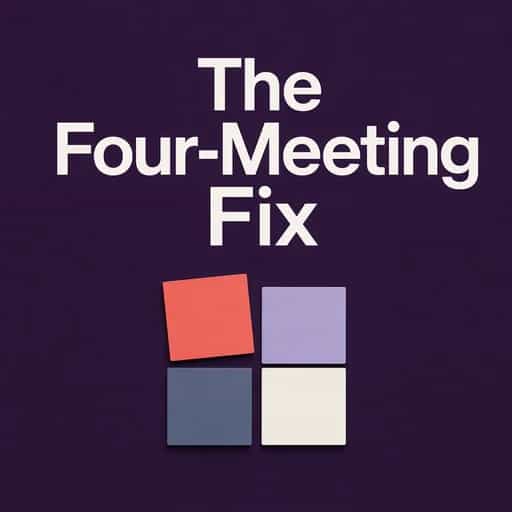
Despite his initial breakthrough, Will realized his theory was incomplete. After more research, he presented a revolutionary idea: their problem wasn't too many meetings, but too few-of the right kinds.
Will drew parallels between different types of television programming and different types of meetings. Just as viewers wouldn't want one hybrid show trying to be all things (headline news, sitcom, movie, and mini-series combined), organizations shouldn't try to accomplish everything in one meeting format.
He introduced four distinct meeting types:
The Daily Check-in: A five-minute, stand-up meeting where team members simply announce what they're doing that day. Like CNN Headline News, it should be brief, consistent, and focused solely on alignment. Despite concerns about people being out of the office, Will argued that even with just three people present, it would create alignment and save countless emails, voicemails, and office drop-ins.
The Weekly Tactical: Comparable to sitcoms or crime dramas-predictable, consistent, and focused exclusively on tactical issues. Controversially, Will suggested eliminating pre-set agendas. Instead, meetings should start with a "lightning round" where everyone gives a 60-second report on their three primary activities for the week, followed by a brief review of key metrics to provide context before setting the real-time agenda.
The Monthly Strategic: Like feature films, these meetings should focus on just 1-3 strategic issues and require proper preparation. Unlike the tightly-timed daily and weekly meetings, these can run 2-4 hours because strategic discussions need adequate time. Topics for Monthly Strategics typically emerge from the Weekly Tactical meetings when important strategic issues arise that require deeper discussion.
The Quarterly Off-Site Review: Unlike their current "boondoggle" off-sites mixing brief business discussions with recreational activities, a proper Quarterly Off-Site Review requires two full days to step back from daily operations and address critical long-term issues. These include reviewing strategy, competitive landscape, team dynamics, top and bottom performers, and customer satisfaction.
Casey and his team were intrigued by Will's framework but wondered if they could implement it before J.T.'s next visit, which had taken on ominous significance for Casey's future with the company.
Глава 8
The High-Stakes Test
With J.T.'s crucial visit approaching, Casey and Will spent hours reviewing Will's meeting document and strategizing. They determined the upcoming meeting should be a Monthly Strategic rather than a Weekly Tactical, as they needed to demonstrate depth and passion on meaningful issues rather than just running through updates.
Casey called an urgent meeting with his executive team, announcing they wouldn't rehearse for J.T.'s visit but would prepare for an authentic, powerful Monthly Strategic meeting limited to two topics: expansion into mainstream video games and PGA golf tournament sponsorship. For the next week, the executives divided into teams researching sales figures, budgets, and gathering input from vendors and customers on their chosen topics.
As the team collaborated on research, morale visibly improved-executives worked late, hallway interactions increased, and employees engaged in friendly competition to uncover information. Though subtle, the office atmosphere transformed through this collective purpose.
When the critical meeting day arrived, J.T. was already seated when they entered, initially upbeat on his phone but turning cool when addressing the group. Casey launched the meeting with Sophia presenting on whether to expand into traditional games for the growing mass market segment. The discussion became heated with team members taking opposing positions-some arguing for expansion based on divisional metrics, while others worried about diluting their brand and stretching resources.
After forty-five minutes of vigorous debate using sales data and market projections, Casey polled the team before deciding against expansion. Instead, he announced they'd focus on stealing market share from competitors by getting "leaner and meaner." When J.T. attempted to derail the meeting by asking about recent sales numbers, Casey firmly but respectfully redirected him, explaining they handle metrics in their Weekly Tactical meetings.
The team then moved to discussing a potential PGA tournament sponsorship, finding it surprisingly affordable compared to their current advertising budget. The debate grew passionate as they weighed the effectiveness of traditional advertising versus sponsorship. J.T. surprisingly engaged constructively in the discussion until his phone rang, and he abruptly left without acknowledging Casey.
Глава 9
The Unexpected Resolution
The next morning, Casey arrived at work to find an email from Wade Justin addressed to all executives. The message delivered two surprising announcements: Wade's decision to step down as CEO while maintaining his position as Chairman, and the appointment of J.T. Harrison as the new CEO. More significantly, Wade's email revealed J.T.'s carefully concealed role spanning the past nine years: he had been secretly tasked with challenging newly acquired companies to improve their performance in areas where they showed weakness. This revelation finally explained J.T.'s controversial reputation for "ruffling feathers" throughout the organization - his methods, while uncomfortable, had resulted in an impressive 25% average sales increase in acquired businesses during their first two years of integration.
Later that day, J.T. appeared unannounced in Casey's doorway, his typically stern demeanor softened. "This is always the hardest part," he admitted, referring to explaining his methods to those who had been unknowing participants in his improvement process. He acknowledged the strain the past months had placed on Casey and her team, but emphasized there was deliberate purpose behind every challenge. J.T. explained his systematic approach: he puts all new division heads through similar customized tests designed to expose and address their specific weaknesses. The meeting issue, he insisted, wasn't just an exercise - it represented a genuine organizational need he had identified.
The team's reaction to the news evolved in distinct phases. Initial shock at J.T.'s appointment as CEO quickly gave way to collective relief when they learned Casey's position was secure. Will took an active role in helping Casey's team implement the new meeting structure, though the transition wasn't without its challenges. While daily operational meetings and weekly tactical reviews became routine within a month, the strategic meetings proved more problematic. The team initially overcorrected, scheduling too many "strategic" discussions before learning to properly differentiate between truly strategic topics and routine operational matters requiring different forums.
The meeting system gradually became more refined. Teams developed clear criteria for different meeting types, established consistent agendas, and created accountability for follow-through on decisions. After three months, the new structure had reduced total meeting time by 35% while increasing documented decision-making and action item completion rates by over 40%.
Will, seeing his mission accomplished, announced his resignation just before Thanksgiving. His departure was bittersweet - while the team had come to appreciate his guidance, they understood his desire to pursue his true passion in film and television production in Southern California. His final assessment noted that the division had successfully transformed its meeting culture from a source of frustration to a model of efficiency that other divisions were beginning to emulate.
Глава 10
The Meeting Revolution: Principles for Transformation
The core insight of Lencioni's approach is that meetings suffer from two fundamental problems: they're boring and they're ineffective.
Meetings are boring because they lack drama and conflict, which are essential for keeping humans engaged. Most leaders avoid tension rather than mining for constructive ideological conflict that keeps people passionate and leads to better decisions. Like screenwriters who understand that conflict drives engagement in films, meeting leaders must recognize that healthy tension keeps participants invested.
The key to injecting drama into meetings is setting up the stakes from the outset. Leaders must jolt participants in the first ten minutes by illustrating the dangers of bad decisions, highlighting competitive threats, or connecting to the organization's larger mission. For example, rather than blandly announcing "we're 12 percent over budget," a leader might frame expense control as a competitive necessity that affects customers, shareholders, and employees' own families.
When intelligent people gather to discuss important matters, disagreement is both natural and productive. Resolving these conflicts makes meetings engaging and effective. Avoiding debate guarantees issues won't be resolved, creating frustration that often emerges later as unproductive politics. Leaders must actively seek out and uncover disagreements, forcing team members to engage even when uncomfortable.
Meetings are ineffective because they lack contextual structure. Organizations consistently suffer from "meeting stew"-throwing every type of issue into the same meeting. This ensures meetings will be ineffective and unsatisfying for everyone. Some want quick information exchange, others strategic discussion, others meaningful conversation about culture, and others just want to make decisions and move on. Everyone's right-different meetings should serve different purposes.
Глава 11
Beyond the Meeting Myth
While many assume Lencioni advocates fewer meetings, the solution isn't eliminating meetings but making them better. Good meetings accelerate decision-making, eliminate revisiting issues, and reduce what he calls "sneaker time"-the countless hours executives spend clarifying through emails, voicemails, and hallway conversations what should have been made clear during meetings.
The most dangerous and underestimated time-waster in corporate America is the hours executives spend clarifying issues after poorly run meetings. In a seven-person executive team, there are twenty-one one-to-one relationships to maintain, plus dozens more connections with direct reports. Without clarity from meetings, a massive wave of follow-up communication ensues. Ironically, executives often rush to end meetings to "do real work," not realizing this work largely consists of explaining what wasn't properly communicated during the meeting itself.
Bad meetings exact a toll beyond mere dissatisfaction, generating real human suffering through anger, lethargy, and cynicism. This impacts not just organizational performance but people's self-esteem, families, and outlook on life. Improving meetings therefore represents an opportunity not only to enhance company performance but to positively impact the lives of everyone involved, including leaders themselves.
Years after implementing Lencioni's framework, Casey's company remained a profitable division of Playsoft. When Will asked about the meetings during a chance reunion, Casey joked that they'd stopped having them before revealing the truth-they still followed the meeting structure Will helped establish, with newer team members initially skeptical of the conflict and drama but eventually embracing it. The transformation wasn't just about better business outcomes; it had fundamentally changed how people experienced their work and each other.
In a world where we increasingly question the value of face-to-face interaction, Lencioni's message remains powerfully relevant: meetings aren't the problem-they're the solution. When structured properly and infused with meaningful conflict, they become the competitive advantage that separates thriving organizations from those merely surviving. The choice isn't between having meetings or not having them-it's between having meetings that drain life from your organization or meetings that breathe life into it.