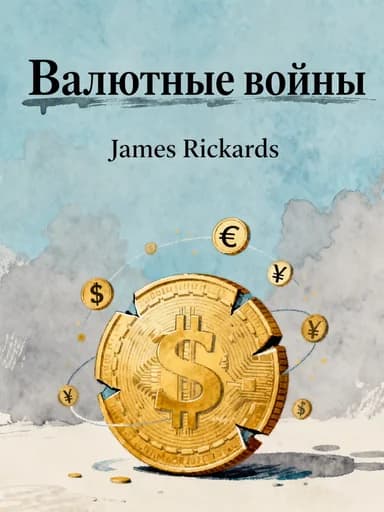
In "Currency Wars," financial expert James Rickards exposes how nations weaponize currencies for economic dominance. Featured on Wall Street Journal bestseller lists and praised by financial advisors worldwide, this alarming analysis reveals why central banks' monetary policies might be silently destroying your wealth.
James G. Rickards, bestselling author of Currency Wars: The Making of the Next Global Crisis, is a renowned economic strategist and geopolitical risk analyst with four decades of experience in global finance. A partner at JAC Capital Advisors, Rickards draws on his roles at Citibank, Long-Term Capital Management, and the Federal Reserve’s 1998 LTCM bailout negotiations to dissect currency conflicts and systemic financial risks.
His expertise spans hedge fund management, intelligence advisory work for the U.S. Department of Defense, and lecturing at institutions like Johns Hopkins and the U.S. Army War College.
Rickards’ works, including The Death of Money and The New Case for Gold, explore monetary policy collapse, gold’s enduring value, and elite contingency planning for economic crises. A frequent commentator on CNBC, Bloomberg, and NPR, he contributes op-eds to the Financial Times and The Wall Street Journal while editing the Strategic Intelligence newsletter. Currency Wars has sold over 1 million copies worldwide and remains a foundational text on modern financial warfare.
Currency Wars analyzes how nations manipulate currencies to gain economic advantages, detailing three historical currency wars and warning that current policies (like quantitative easing) risk hyperinflation, financial collapse, and global instability. Rickards advocates for a gold-backed monetary system or IMF Special Drawing Rights (SDRs) to stabilize the global economy.
Investors, policymakers, and anyone interested in global finance will benefit from Rickards’ insights into currency manipulation and systemic financial risks. The book is particularly relevant for those concerned with monetary policy, geopolitical strategy, or safeguarding assets against economic instability.
Yes—Rickards’ stark warnings about dollar collapse and pragmatic solutions (like a modernized gold standard) remain critically relevant. The book combines historical analysis with forward-looking scenarios, offering a compelling case for monetary reform. Kirkus Reviews praises its “intriguing thinking” about global financial vulnerabilities.
Rickards defines currency wars as systemic efforts by nations to devalue their currencies through monetary policies (e.g., quantitative easing) to boost exports and destabilize rivals. These wars create short-term gains but lead to hyperinflation, trade imbalances, and long-term economic chaos, as seen in 20th-century precedents.
Currency War III refers to the post-2010 era where the U.S., China, and Europe engage in competitive devaluations. Rickards argues this conflict, driven by the Federal Reserve’s unconventional policies, risks collapsing the dollar-dominated system and triggering a global financial crisis.
Rickards advocates two paths: (1) a gold standard with gold revalued to $7,000–$9,000 per ounce to stabilize currencies, or (2) expanding the IMF’s SDRs as a global reserve currency. Both aim to curb reckless monetary policies and restore trust in the financial system.
The book criticizes economists for overreliance on flawed models and abstract theories (e.g., rational markets), which failed to predict crises like 2008. Rickards argues their “high priest” status enables destructive policies like negative interest rates and excessive money printing.
Globalization allows state-subsidized firms (e.g., Chinese corporations) to exploit currency advantages, undermining free markets. Rickards highlights how companies with “no home currency” chase cheap capital, distorting trade and incentivizing competitive devaluations.
Key examples include:
Some economists dispute Rickards’ gold standard advocacy as impractical in modern economies. Others argue his catastrophic predictions overlook central banks’ crisis-management tools. However, his analysis of interconnected financial risks remains widely cited.
The book’s warnings align with 2020s trends like rising inflation, cryptocurrency adoption, and geopolitical tensions over resource control. Rickards’ emphasis on dollar vulnerability resonates amid debates about BRICS nations challenging USD dominance.
SDRs—a IMF-managed basket of currencies—could replace the dollar as a neutral global reserve, reducing reliance on any single nation’s currency. Rickards suggests SDRs might stabilize trade but warns they could centralize power undemocratically.
Почувствуйте книгу через голос автора
Превратите знания в увлекательные, богатые примерами идеи
Захватите ключевые идеи мгновенно для быстрого обучения
Наслаждайтесь книгой в весёлой и увлекательной форме
This wasn't just another political speech - it was the declaration of a financial emergency.
Conventional thinking could be dangerously inadequate against innovative attacks on the dollar's dominance.
Currency wars, fought through competitive devaluations, are among the most destructive outcomes in international economics.
Despite these adverse outcomes, currency wars have occurred twice in the twentieth century.
The system's simplicity was its strength.
Разбейте ключевые идеи Currency Wars на понятные тезисы, чтобы понять, как инновационные команды создают, сотрудничают и растут.
Погрузитесь в Currency Wars через яркие истории, превращающие уроки инноваций в запоминающиеся и применимые моменты.
Задавайте любые вопросы, выбирайте свой стиль обучения и создавайте идеи, которые действительно вам подходят.

Создано выпускниками Колумбийского университета в Сан-Франциско
"Instead of endless scrolling, I just hit play on BeFreed. It saves me so much time."
"I never knew where to start with nonfiction—BeFreed’s book lists turned into podcasts gave me a clear path."
"Perfect balance between learning and entertainment. Finished ‘Thinking, Fast and Slow’ on my commute this week."
"Crazy how much I learned while walking the dog. BeFreed = small habits → big gains."
"Reading used to feel like a chore. Now it’s just part of my lifestyle."
"Feels effortless compared to reading. I’ve finished 6 books this month already."
"BeFreed turned my guilty doomscrolling into something that feels productive and inspiring."
"BeFreed turned my commute into learning time. 20-min podcasts are perfect for finishing books I never had time for."
"BeFreed replaced my podcast queue. Imagine Spotify for books — that’s it. 🙌"
"It is great for me to learn something from the book without reading it."
"The themed book list podcasts help me connect ideas across authors—like a guided audio journey."
"Makes me feel smarter every time before going to work"
Создано выпускниками Колумбийского университета в Сан-Франциско

Получите резюме книги «Currency Wars» в формате PDF или EPUB бесплатно. Распечатайте или читайте офлайн в любое время.
Imagine watching your Sunday evening television when the President interrupts to announce that money as you know it has fundamentally changed. This wasn't just a hypothetical scenario-it happened in 1971 when Nixon shocked Americans by ending dollar-to-gold convertibility, effectively admitting America's currency was in crisis. Today, we're engaged in what former Brazilian Finance Minister Guido Mantega bluntly called a "global currency war"-one potentially far more destructive than previous monetary conflicts. Currency wars aren't fought with guns or missiles but through competitive devaluations, where nations deliberately weaken their currencies to gain trade advantages. These financial battles may seem abstract, but they directly impact everything from your grocery bills to your retirement savings.
On a rainy morning in 2009, sixty experts gathered in a top-secret facility between Baltimore and Washington for the Pentagon's first-ever financial war game. Unlike traditional military simulations, participants would wage war using only currencies, stocks, bonds, and derivatives. The Pentagon had recognized that America's overwhelming conventional military superiority had pushed rivals toward unconventional tactics-including financial warfare. During the simulation, Russia announced a new gold-backed currency for international trade, effectively abandoning the dollar. Academic experts initially dismissed this as "ridiculous," but when Russia doubled down by purchasing China's entire gold reserves-the largest gold transaction in history-what had been ridiculed became a serious threat to dollar dominance. The war game revealed how unprepared the U.S. was for financial attacks on the dollar. Meanwhile, in the real world, a currency war had already begun with the Federal Reserve's quantitative easing program in 2008. The simulation demonstrated that in financial warfare, conventional thinking could be dangerously inadequate against innovative attacks on the dollar's global position.
Before modern currency wars, the world experienced what economists consider a golden age of monetary stability: the classical gold standard era of 1870-1914. This 44-year period featured remarkable economic growth without inflation. The system's simplicity was its strength-countries merely declared their currency's gold value and stood ready to buy or sell gold at that price. When two currencies anchored to gold, they anchored to each other without requiring international institutions. This efficient anchor eliminated currency hedging and provided merchants greater certainty. The world hasn't seen a pure gold standard since 1914, when World War I disrupted the system. By 1921, the stage was set for the first modern currency war: Germany's hyperinflation became so extreme that American visitors couldn't spend dollars because merchants couldn't make change, and diners paid for meals in advance before prices rose further during their meal. The Great Depression triggered the most dangerous phase when England abandoned the gold standard in 1931, causing sterling to fall 30% against the dollar. When Roosevelt took office in 1933, he confronted deflation by confiscating citizens' gold and devaluing the dollar by about 70% against gold-a shocking move that nonetheless helped end the Depression for Americans.
The Bretton Woods Conference of 1944 established a new monetary order where the international system anchored to gold through the U.S. dollar at $35 per ounce. This system created remarkable stability until the mid-1960s, when Lyndon Johnson's "guns and butter" policies (funding both Vietnam War and Great Society programs) began undermining dollar confidence. By August 1971, Nixon ended dollar-gold convertibility completely. The promised prosperity never materialized-instead, the U.S. suffered three recessions between 1973-1981, with 50% dollar purchasing power decline and quadrupling oil prices. "Stagflation"-the unprecedented combination of high inflation and stagnant growth-proved devaluation's proponents completely wrong. Salvation came through Paul Volcker's Federal Reserve chairmanship beginning August 1979 and Ronald Reagan's presidency starting November 1980. Volcker applied monetary "shock therapy" by raising interest rates to 20%, crushing inflation from 12.5% in 1980 to 1.1% by 1986. This Reagan-Volcker partnership launched one of America's strongest growth periods-contradicting conventional wisdom that a strong dollar hurts growth.
Currency War III erupted in 2010 following the 2007 depression, with three supercurrencies-the dollar, euro and yuan-forming the battleground. Unlike previous currency wars, this conflict involves not just national central banks but also multilateral institutions and powerful private entities like hedge funds and global corporations. The scale dwarfs previous conflicts and carries the risk not just of competitive devaluations but potentially of monetary system collapse itself. The Pacific theater features the most direct confrontation, with U.S. politicians attacking China's currency policies as unfair trade advantages. The Atlantic theater-the dollar-euro relationship-is characterized by codependence rather than confrontation. Germany found the perfect balance: a euro weak enough to boost exports to the U.S. and China but not so weak as to collapse. In the Eurasian theater, China emerged as a potential savior for peripheral European economies like Greece through sovereign bond purchases. China's European strategy serves multiple objectives: diversifying reserves beyond dollars, cultivating goodwill, and securing valuable concessions like direct investment in sensitive infrastructure.
Currency wars can escalate beyond competitive devaluations to become actual weapons causing economic harm to rivals. A nation's currency is its Achilles' heel-destroy it and everything else collapses. Russia has weaponized gas supplies, cutting off Ukraine in 2006 and 2009, demonstrating Russia's willingness to combine energy and currency as geopolitical weapons. China's military doctrine explicitly recognizes financial warfare as a "hyperstrategic weapon" that's "easily manipulated and allows for concealed actions." While China holds over a trillion dollars in U.S. Treasury securities, their strategy isn't simple dumping but rather shortening maturities and diversifying new reserves into commodities-including gold, which they secretly doubled between 2004-2009. The greatest financial warfare risk may be correlation-multiple threats striking simultaneously, either through coordination or catalytic reaction. Russia and China could time commodity and currency assaults to be self-reinforcing. These trends pose difficult choices for U.S. national security, as dependence on rivals to finance debt constrains both fiscal and military options.
Using both conventional and cutting-edge analysis, we can foresee four potential outcomes for the dollar-"The Four Horsemen of the Dollar Apocalypse." In order of increasing disruptive potential, these are: multiple reserve currencies, special drawing rights (SDRs), gold, and chaos. A world of multiple paper reserve currencies would create greater volatility and instability, potentially leading to regional trading blocs and diminished world trade. The SDR-world money controlled by the IMF, backed by nothing and printed at will-could replace the dollar as global reserve currency, effectively creating a central bank without democratic oversight. A modern gold standard could take several forms, requiring gold prices between $3,500-$7,500 per ounce to provide adequate backing. However, the most likely outcome may be a chaotic collapse of investor confidence, triggering emergency government measures including a "New United States Dollar" backed by America's massive gold reserves-an 85% devaluation against gold. The dollar's current path is unsustainable. To avoid catastrophe, we must recognize that financial complexity becomes dangerous at scale. Without reforms like breaking up big banks and implementing a flexible gold standard, we risk economic collapse that even military power cannot contain. There's still time to save the dollar-but that time grows short. The question is whether we'll make these choices voluntarily or have them forced upon us through crisis.