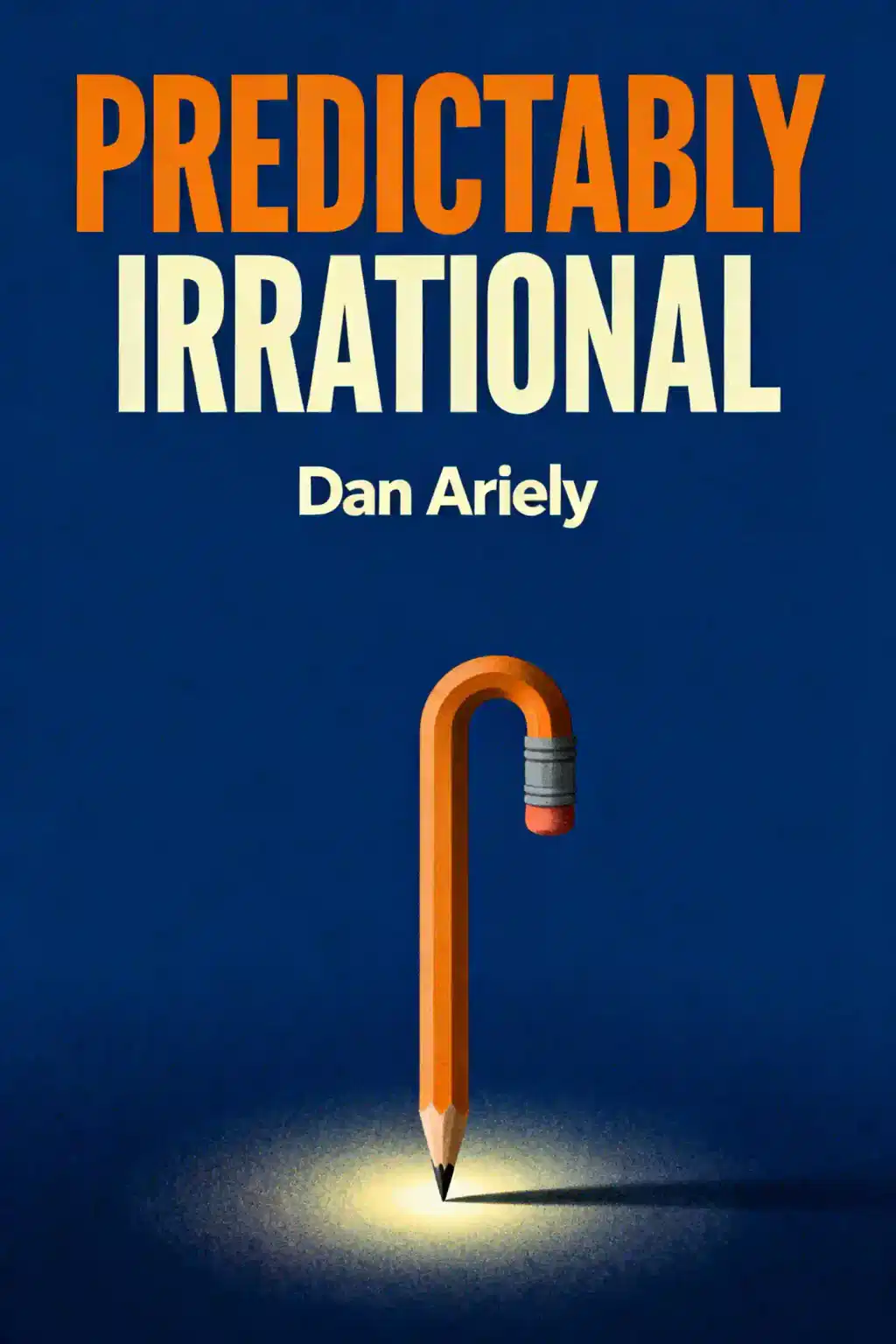
Predictably Irrational: The Hidden Forces That Shape Our Decisions by Dan Ariely Summary

Overview of Predictably Irrational
Why are we so predictably irrational? Dan Ariely's groundbreaking bestseller reveals how hidden psychological forces sabotage our decision-making. Endorsed by Charles Schwab, this mind-bending exploration has transformed business strategies worldwide. Discover why your brain's systematic biases might be costing you money every day.
- Relativity traps us in flawed comparisons between easily measurable options.
- Free offers override rational cost-benefit analysis due to zero-cost bias.
- Anchoring effects lock decisions to irrelevant initial price points.
- Social norms outperform monetary incentives in motivating sustained effort.
- Pre-commitment strategies counteract procrastination and impulsive decision-making.
- Ownership distortion (endowment effect) inflates personal valuation of possessions.
- Non-cash transactions increase dishonesty by easing moral justifications.
- Price expectations alter experiences through placebo-like "marketing placebo effects."
- Decoy options manipulate choices by framing primary alternatives as superior.
- Loss aversion outweighs gain-seeking in financial and emotional decisions.
- Separating pain-of-paying from consumption increases overspending (credit card effect).
- Self-herding creates irrational loyalty through repeated mindless behavior patterns.
About the Author of Predictably Irrational
Dan Ariely, author of the bestselling book Predictably Irrational: The Hidden Forces That Shape Our Decisions, is a renowned Israeli-American behavioral economist and psychologist. A James B. Duke Professor at Duke University, Ariely combines academic rigor with accessible storytelling to explore human decision-making, cognitive biases, and the paradoxes of irrational behavior.
His work in Predictably Irrational—a foundational text in behavioral economics—draws from decades of experimental research, including studies on pain perception and dishonesty, to explain systemic flaws in human logic.
Ariely’s expertise extends to other influential works like The Upside of Irrationality and The Honest Truth About Dishonesty, both of which expand on behavioral themes central to modern psychology and business strategy. A TED Talk luminary and former Wall Street Journal columnist, he co-founded Duke’s Center for Advanced Hindsight to bridge academic insights with real-world applications.
His ideas have influenced corporate practices, public policy, and even entertainment—Predictably Irrational inspired NBC’s 2023 series The Irrational, starring Jesse L. Martin. Translated into over 30 languages, Ariely’s work continues to redefine how we understand motivation, trust, and human error.
FAQs About Predictably Irrational
What is Predictably Irrational by Dan Ariely about?
Predictably Irrational explores how human decision-making is systematically irrational, shaped by emotions, social norms, and cognitive biases. Dan Ariely uses behavioral experiments to reveal patterns like the decoy effect, placebo pricing, and procrastination, showing how these "predictable" flaws influence consumer behavior and personal choices.
Who should read Predictably Irrational?
Marketers, business leaders, and psychology enthusiasts benefit most. Ariely’s insights help professionals design better pricing strategies, while general readers gain tools to recognize irrational habits in spending, relationships, and health decisions.
Is Predictably Irrational worth reading?
Yes—it combines academic rigor with actionable insights. Readers praise its engaging experiments and real-world applications, like avoiding impulse purchases or negotiating effectively.
What are the key concepts in Predictably Irrational?
Key ideas include:
- Relative pricing: Choices depend on context (e.g., a decoy product making others seem cheaper).
- Ownership bias: Overvaluing what we own.
- Market vs. social norms: Mixing monetary and social incentives backfires.
- Procrastination: Immediate gratification often overrides long-term goals.
How does Dan Ariely explain irrational decision-making?
Ariely argues irrationality stems from mental shortcuts (heuristics) and emotional triggers. For example, free products create irrational excitement, while arbitrary price anchors skew perceptions of value.
What experiments in Predictably Irrational reveal human biases?
Notable experiments include:
- The Economist subscription: Adding a decoy option increased print+digital sales.
- Placebo pricing: Cheap painkillers were perceived as less effective than identical expensive ones.
- Free vs. paid: Participants chose inferior free items over better-paid alternatives.
How does Predictably Irrational apply to marketing?
Marketers can use relative pricing (highlighting mid-tier products), leverage free offers to drive demand, and avoid mixing social gestures (e.g., gifts) with transactional relationships.
What are criticisms of Predictably Irrational?
Some argue Ariely focuses too narrowly on micro-behaviors, neglecting systemic economic factors. Others note his experiments, while insightful, sometimes oversimplify real-world complexity.
How does Predictably Irrational compare to Thinking, Fast and Slow?
Both explore decision-making biases, but Ariely emphasizes actionable business/personal applications, while Kahneman delves deeper into cognitive psychology theory.
Why is Predictably Irrational relevant in 2025?
As AI and personalized marketing grow, understanding irrational triggers (e.g., dynamic pricing, decoy algorithms) remains critical for consumers and businesses.
What famous quotes come from Predictably Irrational?
- “We don’t have an internal value meter… we focus on relative comparisons.”
- “Procrastination is the thief of time... and the ally of every advertiser.”
Can Predictably Irrational improve personal finance habits?
Yes—by recognizing anchoring bias (e.g., overspending due to “discounts”) and ownership obsession (clinging to underperforming investments), readers can make more rational financial choices.
Feel the book through the author's voice
Turn knowledge into engaging, example-rich insights
Capture key ideas in a flash for fast learning
Enjoy the book in a fun and engaging way
Key Themes in Predictably Irrational
Quotes from Predictably Irrational
Most people don't know what they want unless they see it in context.
We are pawns in a game, and our only consolation is that we are chess pieces capable of rational thought. Though we may not win, we can at least understand why we lose.
Giving up on our long-term goals for immediate gratification, my friends, is procrastination.
We constantly compare our salaries, possessions, and achievements to others.
These aren't random mistakes but systematic, repeatable patterns of irrationality.
Characters in Predictably Irrational
Quick Summary Mode - Read or listen to Predictably Irrational Summary in 9 Minutes

Break down key ideas from Predictably Irrational into bite-sized takeaways to understand how innovative teams create, collaborate, and grow.

Flash Card Mode - Top 7 Insights from Predictably Irrational in a Nutshell

Distill Predictably Irrational into rapid-fire memory cues that highlight key principles of candor, teamwork, and creative resilience.

Fun Mode - Predictably Irrational Lessons Told Through 24-Min Stories

Experience Predictably Irrational through vivid storytelling that turns innovation lessons into moments you'll remember and apply.
Personalize Mode - Read or listen to Predictably Irrational Summary in 0 Minutes

Ask anything, pick the voice, and co-create insights that truly resonate with you.

From Columbia University alumni built in San Francisco
"Instead of endless scrolling, I just hit play on BeFreed. It saves me so much time."


"I never knew where to start with nonfiction—BeFreed’s book lists turned into podcasts gave me a clear path."


"Perfect balance between learning and entertainment. Finished ‘Thinking, Fast and Slow’ on my commute this week."
"Crazy how much I learned while walking the dog. BeFreed = small habits → big gains."
"Reading used to feel like a chore. Now it’s just part of my lifestyle."

"Feels effortless compared to reading. I’ve finished 6 books this month already."
"BeFreed turned my guilty doomscrolling into something that feels productive and inspiring."

"BeFreed turned my commute into learning time. 20-min podcasts are perfect for finishing books I never had time for."
"BeFreed replaced my podcast queue. Imagine Spotify for books — that’s it. 🙌"

"It is great for me to learn something from the book without reading it."
"The themed book list podcasts help me connect ideas across authors—like a guided audio journey."
"Makes me feel smarter every time before going to work"
From Columbia University alumni built in San Francisco
"Instead of endless scrolling, I just hit play on BeFreed. It saves me so much time."
"I never knew where to start with nonfiction—BeFreed’s book lists turned into podcasts gave me a clear path."
"Perfect balance between learning and entertainment. Finished ‘Thinking, Fast and Slow’ on my commute this week."
"Crazy how much I learned while walking the dog. BeFreed = small habits → big gains."
"Reading used to feel like a chore. Now it’s just part of my lifestyle."
"Feels effortless compared to reading. I’ve finished 6 books this month already."
"BeFreed turned my guilty doomscrolling into something that feels productive and inspiring."
"BeFreed turned my commute into learning time. 20-min podcasts are perfect for finishing books I never had time for."
"BeFreed replaced my podcast queue. Imagine Spotify for books — that’s it. 🙌"
"It is great for me to learn something from the book without reading it."
"The themed book list podcasts help me connect ideas across authors—like a guided audio journey."
"Makes me feel smarter every time before going to work"
"Instead of endless scrolling, I just hit play on BeFreed. It saves me so much time."
"I never knew where to start with nonfiction—BeFreed’s book lists turned into podcasts gave me a clear path."
"Perfect balance between learning and entertainment. Finished ‘Thinking, Fast and Slow’ on my commute this week."
"Crazy how much I learned while walking the dog. BeFreed = small habits → big gains."
"Reading used to feel like a chore. Now it’s just part of my lifestyle."
"Feels effortless compared to reading. I’ve finished 6 books this month already."
"BeFreed turned my guilty doomscrolling into something that feels productive and inspiring."
"BeFreed turned my commute into learning time. 20-min podcasts are perfect for finishing books I never had time for."
"BeFreed replaced my podcast queue. Imagine Spotify for books — that’s it. 🙌"
"It is great for me to learn something from the book without reading it."
"The themed book list podcasts help me connect ideas across authors—like a guided audio journey."
"Makes me feel smarter every time before going to work"
"Instead of endless scrolling, I just hit play on BeFreed. It saves me so much time."
"I never knew where to start with nonfiction—BeFreed’s book lists turned into podcasts gave me a clear path."
"Perfect balance between learning and entertainment. Finished ‘Thinking, Fast and Slow’ on my commute this week."
"Crazy how much I learned while walking the dog. BeFreed = small habits → big gains."
"Reading used to feel like a chore. Now it’s just part of my lifestyle."
"Feels effortless compared to reading. I’ve finished 6 books this month already."
"BeFreed turned my guilty doomscrolling into something that feels productive and inspiring."
"BeFreed turned my commute into learning time. 20-min podcasts are perfect for finishing books I never had time for."
"BeFreed replaced my podcast queue. Imagine Spotify for books — that’s it. 🙌"
"It is great for me to learn something from the book without reading it."
"The themed book list podcasts help me connect ideas across authors—like a guided audio journey."
"Makes me feel smarter every time before going to work"

Get the Predictably Irrational summary as a free PDF or EPUB. Print it or read offline anytime.


![[PDF] Toward a Theory of Behavioral Operations - Harvard Business School](/_next/image?url=https%3A%2F%2Fd1y2du6z1jfm9e.cloudfront.net%2Fassets%2Fpodcast%2Fblue.png&w=1024&q=50)