BeFreed
    Categories>Finance & Economics>Day trading stocks without losing your shirt

    Day trading stocks without losing your shirt

    25 min
    |
    |
    5 de abr. de 2026
    FinancePsychologyEducation

    Most retail traders lose money because they wing it. Learn the technical tools and risk management systems you need to survive the market open.

    Day trading stocks without losing your shirt

    Melhor citação de Day trading stocks without losing your shirt

    “

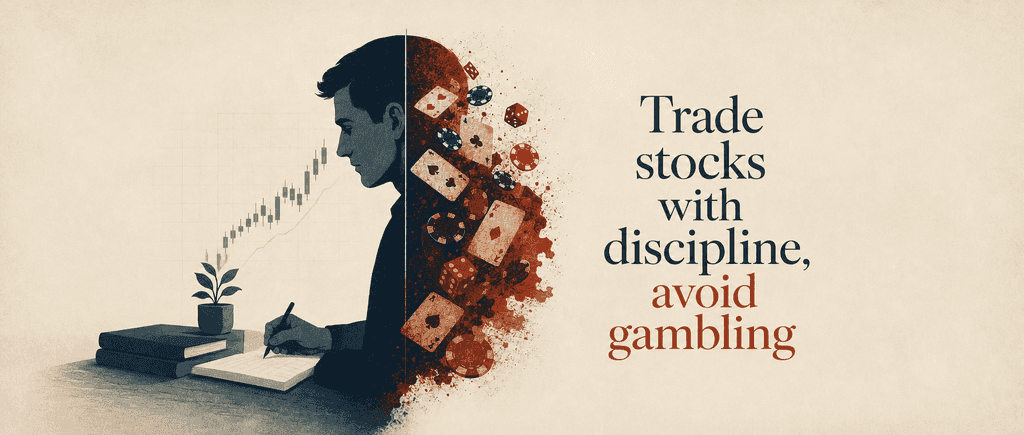
    Day trading is not a 'get rich quick' scheme; it’s a high-skill profession that requires moving from emotional 'feeling' to a repeatable, data-driven process. You want to be a scientist in a lab—not a gambler at a craps table.

    ”

    Esta aula em áudio foi criada por um membro da comunidade BeFreed

    Pergunta de entrada

    Stock market day trading

    Vozes dos apresentadores
    Jacksonplay
    Milesplay
    Estilo de aprendizagem
    Divertido
    Fontes de conhecimento
    The disciplined trader
    What I learned losing a million dollars
    Day Trading for Dummies
    Mastering the Trade
    VOLUME PROFILE
    Building Winning Algorithmic Trading Systems

    Perguntas frequentes

    Descubra mais

    Stock Trading

    Stock Trading

    PLANO DE APRENDIZADO

    Stock Trading

    Stock trading offers potential for financial growth but requires specific knowledge and skills to navigate successfully. This learning plan guides beginners and intermediate traders through essential concepts, technical analysis, and risk management strategies needed to make informed trading decisions in today's dynamic markets.

    2 h 2 m•4 Seções
    Day trader

    Day trader

    PLANO DE APRENDIZADO

    Day trader

    This comprehensive path bridges the gap between retail trading and professional market execution. It is designed for aspiring traders who want to transition from gambling to a systematic, data-driven approach to the markets.

    3 h 10 m•4 Seções
    Learn to trade the stock market

    Learn to trade the stock market

    PLANO DE APRENDIZADO

    Learn to trade the stock market

    This plan bridges the gap between basic investing and professional trading by focusing on both technical mastery and psychological discipline. It is ideal for aspiring traders who want a structured path from market foundations to advanced systematic strategies.

    2 h 14 m•4 Seções
    Learn money, trading, and discipline

    Learn money, trading, and discipline

    PLANO DE APRENDIZADO

    Learn money, trading, and discipline

    This plan bridges the gap between financial theory and the psychological grit required for successful trading. It is ideal for aspiring investors who want to combine technical market skills with the self-discipline necessary to manage risk and build lasting wealth.

    3 h 4 m•4 Seções
    Trading & Investment Pro

    Trading & Investment Pro

    PLANO DE APRENDIZADO

    Trading & Investment Pro

    This comprehensive trading and investment program bridges the gap between theoretical knowledge and practical market success, addressing both the technical and psychological aspects that determine profitability. It's designed for aspiring traders, active investors seeking to refine their approach, and anyone committed to building wealth through intelligent market participation rather than speculation.

    1 h 52 m•4 Seções
    Become a millionaire this year though trading

    Become a millionaire this year though trading

    PLANO DE APRENDIZADO

    Become a millionaire this year though trading

    This learning plan targets aspiring traders who want to pursue aggressive wealth building through markets but lack the comprehensive foundation needed for sustainable success. It's designed for individuals willing to invest serious time mastering both technical skills and psychological discipline, progressing from fundamentals through advanced execution strategies while prioritizing capital preservation and systematic growth.

    2 h 14 m•4 Seções
    My goal is to be a professional forex trader

    My goal is to be a professional forex trader

    PLANO DE APRENDIZADO

    My goal is to be a professional forex trader

    Forex trading offers significant income potential but requires specialized knowledge and disciplined execution to succeed where most fail. This learning plan provides a structured pathway from basic concepts to advanced techniques, ideal for aspiring traders serious about developing professional-level skills in the world's largest financial market.

    2 h 2 m•4 Seções
    McMillan on options

    McMillan on options

    PLANO DE APRENDIZADO

    McMillan on options

    Options trading offers powerful tools for generating income, hedging risk, and enhancing portfolio returns, but requires structured knowledge to avoid costly mistakes. This comprehensive learning plan takes you from foundational concepts through professional-level strategies, making it ideal for investors seeking to add sophisticated trading capabilities to their skillset. Whether you're looking to generate consistent income, protect existing positions, or capitalize on market volatility, this progression provides the technical knowledge and psychological framework needed for confident options trading.

    3 h 11 m•4 Seções

    Criado por ex-alunos da Universidade de Columbia em San Francisco

    BeFreed Reúne Uma Comunidade Global De 1,000,000 Mentes Curiosas
    Veja mais sobre como o BeFreed é discutido na web

    "Instead of endless scrolling, I just hit play on BeFreed. It saves me so much time."

    @Moemenn
    platform
    star
    star
    star
    star
    star

    "I never knew where to start with nonfiction—BeFreed’s book lists turned into podcasts gave me a clear path."

    @Chloe, Solo founder, LA
    platform
    comments
    12
    likes
    117

    "Perfect balance between learning and entertainment. Finished ‘Thinking, Fast and Slow’ on my commute this week."

    @Raaaaaachelw
    platform
    star
    star
    star
    star
    star

    "Crazy how much I learned while walking the dog. BeFreed = small habits → big gains."

    @Matt, YC alum
    platform
    comments
    12
    likes
    108

    "Reading used to feel like a chore. Now it’s just part of my lifestyle."

    @Erin, Investment Banking Associate , NYC
    platform
    comments
    254
    likes
    17

    "Feels effortless compared to reading. I’ve finished 6 books this month already."

    @djmikemoore
    platform
    star
    star
    star
    star
    star

    "BeFreed turned my guilty doomscrolling into something that feels productive and inspiring."

    @Pitiful
    platform
    comments
    96
    likes
    4.5K

    "BeFreed turned my commute into learning time. 20-min podcasts are perfect for finishing books I never had time for."

    @SofiaP
    platform
    star
    star
    star
    star
    star

    "BeFreed replaced my podcast queue. Imagine Spotify for books — that’s it. 🙌"

    @Jaded_Falcon
    platform
    comments
    201
    thumbsUp
    16

    "It is great for me to learn something from the book without reading it."

    @OojasSalunke
    platform
    star
    star
    star
    star
    star

    "The themed book list podcasts help me connect ideas across authors—like a guided audio journey."

    @Leo, Law Student, UPenn
    platform
    comments
    37
    likes
    483

    "Makes me feel smarter every time before going to work"

    @Cashflowbubu
    platform
    star
    star
    star
    star
    star

    Criado por ex-alunos da Universidade de Columbia em San Francisco

    BeFreed Reúne Uma Comunidade Global De 1,000,000 Mentes Curiosas
    Veja mais sobre como o BeFreed é discutido na web

    "Instead of endless scrolling, I just hit play on BeFreed. It saves me so much time."

    @Moemenn
    platform
    star
    star
    star
    star
    star

    "I never knew where to start with nonfiction—BeFreed’s book lists turned into podcasts gave me a clear path."

    @Chloe, Solo founder, LA
    platform
    comments
    12
    likes
    117

    "Perfect balance between learning and entertainment. Finished ‘Thinking, Fast and Slow’ on my commute this week."

    @Raaaaaachelw
    platform
    star
    star
    star
    star
    star

    "Crazy how much I learned while walking the dog. BeFreed = small habits → big gains."

    @Matt, YC alum
    platform
    comments
    12
    likes
    108

    "Reading used to feel like a chore. Now it’s just part of my lifestyle."

    @Erin, Investment Banking Associate , NYC
    platform
    comments
    254
    likes
    17

    "Feels effortless compared to reading. I’ve finished 6 books this month already."

    @djmikemoore
    platform
    star
    star
    star
    star
    star

    "BeFreed turned my guilty doomscrolling into something that feels productive and inspiring."

    @Pitiful
    platform
    comments
    96
    likes
    4.5K

    "BeFreed turned my commute into learning time. 20-min podcasts are perfect for finishing books I never had time for."

    @SofiaP
    platform
    star
    star
    star
    star
    star

    "BeFreed replaced my podcast queue. Imagine Spotify for books — that’s it. 🙌"

    @Jaded_Falcon
    platform
    comments
    201
    thumbsUp
    16

    "It is great for me to learn something from the book without reading it."

    @OojasSalunke
    platform
    star
    star
    star
    star
    star

    "The themed book list podcasts help me connect ideas across authors—like a guided audio journey."

    @Leo, Law Student, UPenn
    platform
    comments
    37
    likes
    483

    "Makes me feel smarter every time before going to work"

    @Cashflowbubu
    platform
    star
    star
    star
    star
    star

    "Instead of endless scrolling, I just hit play on BeFreed. It saves me so much time."

    @Moemenn
    platform
    star
    star
    star
    star
    star

    "I never knew where to start with nonfiction—BeFreed’s book lists turned into podcasts gave me a clear path."

    @Chloe, Solo founder, LA
    platform
    comments
    12
    likes
    117

    "Perfect balance between learning and entertainment. Finished ‘Thinking, Fast and Slow’ on my commute this week."

    @Raaaaaachelw
    platform
    star
    star
    star
    star
    star

    "Crazy how much I learned while walking the dog. BeFreed = small habits → big gains."

    @Matt, YC alum
    platform
    comments
    12
    likes
    108

    "Reading used to feel like a chore. Now it’s just part of my lifestyle."

    @Erin, Investment Banking Associate , NYC
    platform
    comments
    254
    likes
    17

    "Feels effortless compared to reading. I’ve finished 6 books this month already."

    @djmikemoore
    platform
    star
    star
    star
    star
    star

    "BeFreed turned my guilty doomscrolling into something that feels productive and inspiring."

    @Pitiful
    platform
    comments
    96
    likes
    4.5K

    "BeFreed turned my commute into learning time. 20-min podcasts are perfect for finishing books I never had time for."

    @SofiaP
    platform
    star
    star
    star
    star
    star

    "BeFreed replaced my podcast queue. Imagine Spotify for books — that’s it. 🙌"

    @Jaded_Falcon
    platform
    comments
    201
    thumbsUp
    16

    "It is great for me to learn something from the book without reading it."

    @OojasSalunke
    platform
    star
    star
    star
    star
    star

    "The themed book list podcasts help me connect ideas across authors—like a guided audio journey."

    @Leo, Law Student, UPenn
    platform
    comments
    37
    likes
    483

    "Makes me feel smarter every time before going to work"

    @Cashflowbubu
    platform
    star
    star
    star
    star
    star

    "Instead of endless scrolling, I just hit play on BeFreed. It saves me so much time."

    @Moemenn
    platform
    star
    star
    star
    star
    star

    "I never knew where to start with nonfiction—BeFreed’s book lists turned into podcasts gave me a clear path."

    @Chloe, Solo founder, LA
    platform
    comments
    12
    likes
    117

    "Perfect balance between learning and entertainment. Finished ‘Thinking, Fast and Slow’ on my commute this week."

    @Raaaaaachelw
    platform
    star
    star
    star
    star
    star

    "Crazy how much I learned while walking the dog. BeFreed = small habits → big gains."

    @Matt, YC alum
    platform
    comments
    12
    likes
    108

    "Reading used to feel like a chore. Now it’s just part of my lifestyle."

    @Erin, Investment Banking Associate , NYC
    platform
    comments
    254
    likes
    17

    "Feels effortless compared to reading. I’ve finished 6 books this month already."

    @djmikemoore
    platform
    star
    star
    star
    star
    star

    "BeFreed turned my guilty doomscrolling into something that feels productive and inspiring."

    @Pitiful
    platform
    comments
    96
    likes
    4.5K

    "BeFreed turned my commute into learning time. 20-min podcasts are perfect for finishing books I never had time for."

    @SofiaP
    platform
    star
    star
    star
    star
    star

    "BeFreed replaced my podcast queue. Imagine Spotify for books — that’s it. 🙌"

    @Jaded_Falcon
    platform
    comments
    201
    thumbsUp
    16

    "It is great for me to learn something from the book without reading it."

    @OojasSalunke
    platform
    star
    star
    star
    star
    star

    "The themed book list podcasts help me connect ideas across authors—like a guided audio journey."

    @Leo, Law Student, UPenn
    platform
    comments
    37
    likes
    483

    "Makes me feel smarter every time before going to work"
    @Cashflowbubu
    platform
    star
    star
    star
    star
    star
    1.5K Ratings4.7
    Comece sua jornada de aprendizado, agora
    BeFreed App
    BeFreed

    Aprenda Qualquer Coisa, Personalizado

    DiscordLinkedIn
    Resumos de livros em destaque
    Crucial ConversationsThe Perfect MarriageInto the WildNever Split the DifferenceAttachedGood to GreatSay Nothing
    Categorias em alta
    Self HelpCommunication SkillRelationshipMindfulnessPhilosophyInspirationProductivity
    Lista de leitura de celebridades
    Elon MuskCharlie KirkBill GatesSteve JobsAndrew HubermanJoe RoganJordan Peterson
    Coleção premiada
    Pulitzer PrizeNational Book AwardGoodreads Choice AwardsNobel Prize in LiteratureNew York TimesCaldecott MedalNebula Award
    Tópicos em destaque
    ManagementAmerican HistoryWarTradingStoicismAnxietySex
    Melhores livros por ano
    2025 Best Non Fiction Books2024 Best Non Fiction Books2023 Best Non Fiction Books
    Autores em destaque
    Chimamanda Ngozi AdichieGeorge OrwellO. J. SimpsonBarbara O'NeillWinston ChurchillCharlie Kirk
    BeFreed vs outros apps
    BeFreed vs. Other Book Summary AppsBeFreed vs. ElevenReaderBeFreed vs. ReadwiseBeFreed vs. Anki
    Ferramentas de aprendizado
    Knowledge VisualizerAI Podcast Generator
    Informações
    Sobre Nósarrow
    Preçosarrow
    Perguntas Frequentesarrow
    Blogarrow
    Carreirasarrow
    Parceriasarrow
    Programa de Embaixadoresarrow
    Diretórioarrow
    BeFreed
    Try now
    © 2026 BeFreed
    Termos de UsoPolítica de Privacidade
    BeFreed

    Aprenda Qualquer Coisa, Personalizado

    DiscordLinkedIn
    Resumos de livros em destaque
    Crucial ConversationsThe Perfect MarriageInto the WildNever Split the DifferenceAttachedGood to GreatSay Nothing
    Categorias em alta
    Self HelpCommunication SkillRelationshipMindfulnessPhilosophyInspirationProductivity
    Lista de leitura de celebridades
    Elon MuskCharlie KirkBill GatesSteve JobsAndrew HubermanJoe RoganJordan Peterson
    Coleção premiada
    Pulitzer PrizeNational Book AwardGoodreads Choice AwardsNobel Prize in LiteratureNew York TimesCaldecott MedalNebula Award
    Tópicos em destaque
    ManagementAmerican HistoryWarTradingStoicismAnxietySex
    Melhores livros por ano
    2025 Best Non Fiction Books2024 Best Non Fiction Books2023 Best Non Fiction Books
    Ferramentas de aprendizado
    Knowledge VisualizerAI Podcast Generator
    Autores em destaque
    Chimamanda Ngozi AdichieGeorge OrwellO. J. SimpsonBarbara O'NeillWinston ChurchillCharlie Kirk
    BeFreed vs outros apps
    BeFreed vs. Other Book Summary AppsBeFreed vs. ElevenReaderBeFreed vs. ReadwiseBeFreed vs. Anki
    Informações
    Sobre Nósarrow
    Preçosarrow
    Perguntas Frequentesarrow
    Blogarrow
    Carreirasarrow
    Parceriasarrow
    Programa de Embaixadoresarrow
    Diretórioarrow
    BeFreed
    Try now
    © 2026 BeFreed
    Termos de UsoPolítica de Privacidade

    Pontos-chave

    1

    The High-Stakes Reality of Day Trading

    0:00

    Jackson: You know, Miles, I was looking at some data recently that really stopped me in my tracks. It turns out that in 2025, retail traders actually accounted for over 25% of the total U.S. equity volume. People are jumping into the markets faster than ever!

    0:16

    Miles: It’s incredible, right? Technology has made everything so accessible. But here’s the counterintuitive part: despite all that access, studies consistently show that 70 to 90% of day traders actually lose money. It’s a high-risk, high-reward world where the difference between the profitable minority and everyone else usually comes down to preparation and discipline, not just luck.

    0:39

    Jackson: Exactly, it’s not a "get rich quick" scheme; it’s a high-skill profession that requires a real playbook. You can’t just wing it when the market opens at 9:30 AM.

    0:49

    Miles: Definitely not. So, let’s dive into the essential mechanics and the specific strategies you need to actually stay in the game.

    2

    The Three Pillars of a Professional Setup

    0:57

    Jackson: You know, Miles, we just touched on the idea that you can't just wing it when the opening bell rings. But what does that preparation actually look like for someone sitting at their desk at 9:15 AM? Is it just about having a fast internet connection and a couple of monitors—or is there a deeper framework we should be looking at?

    1:16

    Miles: It is definitely deeper than just hardware, Jackson. I like to think of it as the "Three Pillars" of a professional setup: capital, compliance, and strategy. If any one of those is shaky—the whole thing falls apart. For starters—you have to understand the regulatory environment, especially if you are trading in the U.S. market. Have you ever heard of the Pattern Day Trader—or PDT—rule?

    1:38

    Jackson: I have—and it sounds like a major roadblock for anyone starting with a smaller account. It is that FINRA regulation—Rule 4210—right?

    1:46

    Miles: Precisely. If you are using a margin account with less than $25,000 in equity—you are limited to only three day trades in any rolling five-business-day window. If you hit that fourth trade—your broker flags you as a Pattern Day Trader and—boom—your account is restricted to "closing transactions only" for 90 days. Imagine seeing the perfect setup and not being able to click "buy" for three months because you lost track of your count!

    2:12

    Jackson: That sounds incredibly frustrating. So—if someone has, say, $5,000—are they just stuck? Or are there legitimate ways to work around that?

    2:21

    Miles: There are actually several professional workarounds. The most common is switching to a cash account. The PDT rule only applies to margin accounts. In a cash account—you can trade as much as you want—as long as you use settled funds. Now—the catch there is that stock trades take two days to settle—T plus two—so you have to manage your liquidity carefully. But—it removes that three-trade-per-week ceiling.

    2:44

    Jackson: Okay—so cash accounts are one option. What else? I have heard people mention futures or forex as a way to sidestep those specific equity rules.

    2:53

    Miles: Spot on. Futures—like the E-mini S&P 500 or the Micro versions—and Forex are regulated differently. They are not subject to the same FINRA PDT rules. You could theoretically day trade /MES—the Micro S&P futures—with a $2,000 account and trade fifty times a day if you really wanted to. Another growing trend is using prop firm accounts—where you pay a small fee to pass an evaluation and then trade the firm's capital. Since it is their money—not yours—the $25,000 rule does not apply to your personal bank balance.

    3:24

    Jackson: That is a game changer for accessibility. But even with the right account type—we still have to talk about the "how." You mentioned that preparative framework—and I was reading about how professionals use indicators not as "magic buttons"—but as a "decision-support framework."

    3:41

    Miles: That is a great way to put it. Indicators like the Exponential Moving Average—or EMA—and the Volume Weighted Average Price—VWAP—are essentially filters. They help you stay objective when the market is moving a hundred miles an hour. For instance—a professional might have a hard rule: "I only take long trades if the price is above the 20 EMA and above the VWAP." It stops you from fighting the trend—which is where most beginners lose their shirts.

    4:08

    Jackson: It is like having a set of guardrails. If the data does not align—you do not take the trade. No matter how much your "gut" says otherwise.

    4:17

    Miles: Exactly. The goal of the setup is to move trading from an emotional "feeling" to a repeatable—data-driven process. You want to be a scientist in a lab—not a gambler at a craps table. If you can master the compliance side with things like the PDT rule—and the technical side with a solid indicator stack—you are already ahead of the 90% who are just guessing.

    3

    Mastering the "Big Seven" Technical Toolkit

    4:40

    Jackson: So—let's get into the actual tools. If I am looking at a chart—it can be overwhelming. There are hundreds of indicators out there. But I kept seeing these "Big Seven" mentioned in the source materials as the essentials for 2026. Where do we even start?

    4:57

    Miles: You have to start with the "King of Intraday"—VWAP. That stands for Volume Weighted Average Price. Unlike a normal moving average—which just looks at price—VWAP factors in how much volume was traded at each price level. Institutional traders—the big banks and mutual funds—use VWAP as their primary benchmark. If they are buying below VWAP—they feel they got a "good" price.

    5:20

    Jackson: So—it is essentially the "fair value" of the day?

    4:17

    Miles: Exactly. And because the big players use it—it becomes a self-fulfilling prophecy. Price often reacts—bounces or stalls—right at the VWAP line. For a day trader—it is the ultimate trend filter. If the price is above VWAP—the bulls are in control. If it is below—the bears are running the show.

    5:41

    Jackson: Okay—VWAP for the big picture. But what about timing? I saw that the Exponential Moving Average—the EMA—is preferred over the Simple Moving Average for day trading because it is faster.

    5:54

    Miles: Right—it gives more weight to recent price data. In a five-minute chart—every second counts. Many pros use a 9 EMA and a 21 EMA crossover. When the 9 crosses above the 21—it signals a burst of short-term momentum. It is like a "go" signal—provided it aligns with your other filters. But you can't just look at trend—you need to measure the "stretch" of the move—and that is where the Relative Strength Index—or RSI—comes in.

    6:20

    Jackson: I have seen RSI before—the 0 to 100 scale. People usually say "buy at 30 because it is oversold" and "sell at 70 because it is overbought." But I have a feeling it is not that simple—is it?

    6:33

    Miles: That is actually the biggest mistake beginners make! In a strong trend—RSI can stay above 70 for an hour while the price keeps ripping higher. If you sell just because it hit 70—you are stepping in front of a freight train. Professionals use it for "divergence." If the price makes a new high—but the RSI makes a lower high—that tells you the momentum is fading. The engine is revving—but the car isn't going faster. That is your warning sign to tighten your stop-loss.

    7:01

    Jackson: That is a huge distinction. So—we have VWAP for trend—EMA for momentum—and RSI for exhaustion. What about volatility? I was reading about Bollinger Bands—they look like these expanding and contracting envelopes around the price.

    7:17

    Miles: Bollinger Bands are incredible for identifying "the squeeze." When the bands get really tight—it means volatility has dropped to almost nothing. It is the calm before the storm. Usually—that precedes a massive breakout. Traders watch for the bands to "open their mouth"—and then they ride the momentum.

    7:34

    Jackson: And we can't forget the ones that are especially popular in fast-moving markets like India—the SuperTrend and the MACD.

    7:41

    Miles: Oh—the SuperTrend is a fan favorite because it is so visual. It literally turns green for a "buy" and red for a "sell" on your chart. It uses the Average True Range—or ATR—to calculate volatility-adjusted stops. And the MACD—the Moving Average Convergence Divergence—is great because it gives you a histogram. When those bars are growing—momentum is accelerating. When they shrink—the move is likely over.

    8:06

    Jackson: It sounds like a full dashboard. But—Miles—if I put all seven of these on my screen at once—I won't even be able to see the price candles! It will just be a rainbow of lines.

    8:18

    Miles: And that is exactly why the pros don't do that. They use the "Three-Indicator Rule." One for trend—like VWAP or EMA. One for momentum—like RSI or MACD. And one for volume or volatility—like Bollinger Bands or just the raw Volume bars. You want a "confirmation stack"—not a cluttered screen. If your trend indicator says "up"—and your momentum indicator confirms it—that is a high-probability trade.

    4

    The Invisible Battlefield of Order Book Dynamics

    8:47

    Jackson: Okay—so we have our indicators on the chart—but there is another layer to this that I find fascinating—and a little intimidating. It is the "Level 2" or the "Order Book." One of the sources called it the "invisible force" that actually moves the market. What are we looking at there that the charts aren't showing us?

    9:07

    Miles: Think of the chart as a map of where the car has *already been*—but the order book is a view of the road *ahead*. It shows you the resting limit orders—the "Bids" from people wanting to buy and the "Asks" from people wanting to sell. In the world of High-Frequency Trading—or HFT—this is where the real game is played. HFT firms account for about 50% of the volume in the U.S.—and they move in microseconds.

    9:31

    Jackson: Microseconds! That is literally faster than a human can blink. How are we supposed to compete with that?

    9:37

    Miles: We don't compete on speed—we compete on *reading their footprints*. One of the biggest concepts in 2026 is "Liquidity Disappearance." See—HFT algorithms provide a lot of liquidity—but it is "brittle." If they detect a large—toxic order coming in—they might instantly withdraw their quotes.

    9:55

    Jackson: "Toxic flow"—that sounds like something out of a thriller. What does that mean in a trading context?

    10:01

    Miles: It is just a fancy term for an order that is likely to move the price significantly. If an HFT market maker sees a huge institutional sell order—they don't want to be the ones buying it—because they know the price is about to drop. So—they pull their bids. Suddenly—there is a "liquidity vacuum." The price falls through the floor because there is nobody left to buy. If you are watching the order book and see the bid depth vanish—you know a move is coming *before* it shows up on the candlestick chart.

    10:28

    Jackson: So—the "disappearance" is the signal. But I also read about something called "Spoofing" and "Layering." Is that still a thing in 2026?

    10:37

    Miles: It is—though regulators are much stricter now. Spoofing is when an algorithm places a massive buy order at a certain price level—not because they want to buy—but because they want to trick *you* into thinking there is strong support there. They want to lure retail traders into buying so the HFT can sell to them at a higher price. Then—as soon as the price gets close—that massive buy order disappears. It was fake.

    11:00

    Jackson: That feels incredibly predatory. How does a regular trader distinguish a "fake" wall of orders from a "real" one?

    11:08

    Miles: You look at "Persistence." Real institutional orders tend to be "sticky"—they stay on the book even as the price approaches. Fake orders—spoofs—are "flickering." They vanish the moment they are about to be touched. Also—you look at the "Point of Control" in the Volume Profile. If a lot of actual trading—not just resting orders—is happening at a level—that is real support.

    11:31

    Jackson: It is really about seeing the "Smart Money" footprints. I saw another term: "Iceberg Orders." It sounds like only the tip is visible.

    11:40

    Miles: Exactly! A big institution might want to buy 100,000 shares—but they don't want to show that all at once—because it would spike the price. So—they use an algorithm to only show 500 shares at a time. Every time those 500 are bought—another 500 automatically pop up at the same price. It looks like a small order—but it is actually an "iceberg" that keeps absorbing all the selling.

    Jackson: Wow. So—if I see a price level that just *refuses* to break—even though people are selling into it like crazy—I might be looking at an iceberg.

    12:12

    Miles: You nailed it. That is where "Absorption" happens. When you combine that order book knowledge with your technical indicators—you are no longer just looking at lines. You are seeing the actual struggle between buyers and sellers in real time. You are seeing the *why* behind the price move—not just the *what*.

    5

    Risk Management as a Survival System

    12:31

    Jackson: Miles—we have talked about some pretty advanced stuff—indicators—order books—HFT footprints. But I have to go back to that statistic we started with—the 90% who lose money. Usually—it is not because they didn't have the right indicators—it is because they blew up their account on one or two bad trades—right?

    12:53

    Miles: Every single time. You can have a 90% win rate—but if your one losing trade wipes out your last nine winners—you are still at zero. Or worse—negative. In day trading—risk management isn't a "part" of the strategy—it *is* the strategy. The most fundamental rule used by professionals is the "1% Risk Rule."

    13:12

    Jackson: Right—never risking more than 1% of your total account equity on a single trade. So—on a $10,000 account—that is $100. But wait—does that mean I can only buy $100 worth of stock? That seems tiny.

    13:27

    Miles: Common misconception! It doesn't mean your *position size* is $100—it means your *potential loss* is $100. If you buy a stock at $10 and set your stop-loss at $9.50—you are risking $0.50 per share. To keep your total risk at $100—you can buy 200 shares. That is a $2,000 position. See the difference? The distance to your stop-loss determines how many shares you can buy.

    13:50

    Jackson: Okay—that makes much more sense. But what about when things go wrong? I was reading about "Slippage" and "Market Impact." If I am trying to exit a losing trade—I might not get out at exactly my stop-loss price—especially if the market is moving fast.

    14:07

    Miles: That is a huge hidden cost. "Market Impact" is the price movement caused by *your own* trading. If you are trading a small—illiquid stock and you try to dump a huge position—you are going to push the price down yourself as you try to exit. This is why pros focus on "Liquid" stocks—things like the Nifty 50 in India or the S&P 500 in the U.S. You want to be a small fish in a giant ocean—so your movements don't cause waves.

    14:34

    Jackson: And then there is the psychological side. One of the books in our sources—"The Disciplined Trader"—talks about how our brains aren't naturally wired for this. We want to "hope" that a losing trade will turn around.

    14:46

    Miles: "Hope" is a four-letter word in trading! Professionals replace hope with a "Hard Stop." A hard stop is an automated order sitting with your broker that says: "If the price hits X—get me out immediately." It takes the decision away from your emotional brain. Because when you are watching your hard-earned money disappear—your brain will lie to you. It will say—"Just give it one more minute—it will bounce." And that is how a small loss becomes a catastrophic one.

    15:12

    Jackson: It is about "Capital Preservation." If you lose 50% of your account—you don't just need 50% to get back to even—you need a 100% gain! The math of losing is much harder than the math of winning.

    4:17

    Miles: Exactly. That is why many pros also use a "Daily Loss Limit." If they lose—say—$500 in a single morning—they shut down the computer. They are done for the day. It prevents "Revenge Trading"—where you try to "win back" your losses by taking bigger and riskier trades.

    15:45

    Jackson: I love that. It is like a circuit breaker for your own ego. "The market is telling me I'm out of sync today—so I'm going to walk away and protect what I have left."

    15:56

    Miles: It is the ultimate sign of maturity. The goal is not to "win" every day—the goal is to "stay in the game" long enough for your statistical edge to play out over hundreds of trades. If you can survive the learning curve—the profits eventually take care of themselves. But you have to survive first.

    6

    The Professional Strategy Playbook

    16:14

    Jackson: Let's get practical. If a listener is sitting there—they have their account ready—they understand the risk—how do they actually combine all this into a "Playbook"? One of the sources mentioned three specific professional setups that have been field-tested for the 2026 markets. Can we walk through those?

    16:31

    Miles: Let's do it. The first one is the "Trend Rider." This is the bread and butter for most intraday pros. You use VWAP as your session bias. If the price is above VWAP—you are only looking for longs. Then—you wait for a pullback to the 20 EMA. You aren't chasing the breakout—you are waiting for the price to "rest." Once the RSI confirms that the momentum is still intact—say—it dips to 50 and starts turning back up—you enter. Your stop-loss goes right below the VWAP line.

    17:00

    Jackson: I like that. It is patient. You are waiting for the market to come to you—rather than chasing it. What about the second one? The "Momentum Scalper"?

    17:08

    Miles: This one is for faster-moving stocks or indices like the Bank Nifty. You are looking for a "SuperTrend Flip." When the SuperTrend line changes from red to green—it is a signal that the trend has shifted. But—you don't just jump in. You check the MACD histogram. If those bars are growing—it confirms the momentum is accelerating. You look for a volume spike—that "Smart Money" footprint—and you enter for a quick move. You use the SuperTrend line itself as your trailing stop-loss—so as the price goes up—your stop moves up with it.

    17:36

    Jackson: And the third one—the "Range Reverter"? That sounds like it is for those sideways days when the market isn't really going anywhere.

    4:17

    Miles: Exactly. Most people lose money on sideways days because they keep trying to catch a breakout that never happens. The Range Reverter uses Bollinger Bands and Volume Profile. If the VWAP is flat—and the price is oscillating—you look for the price to hit the "Value Area High" or "Value Area Low" on the Volume Profile. If the price touches the upper Bollinger Band *and* the Volume Profile shows that sellers are stepping in—you take a short trade back toward the VWAP.

    18:12

    Jackson: It is like playing tennis. You are just hitting the ball back and forth within the court—rather than trying to hit a home run.

    1:46

    Miles: Precisely. And the key to all three of these is "Confluence." You never enter a trade based on one indicator. You want at least two—ideally three—different tools telling you the same thing. If the EMA says "buy"—but the VWAP says "stay away"—you do nothing. The best traders are often the ones who trade the *least*—because they only take the "A plus" setups where everything aligns.

    18:42

    Jackson: That is a great takeaway. It is not about how many trades you make—it is about the quality of the ones you do take. And—I noticed all three of these have a clear exit plan. You know exactly where you are wrong *before* you even enter.

    18:58

    Miles: That is the hallmark of a professional. Amateurs focus on how much they can *make*. Professionals focus on how much they could *lose*. If you can define your risk—the reward will take care of itself. And—of course—you have to practice this. You don't start with your life savings. You use a paper trading simulator—like Stoxra or TradingView—and you track your results for at least 50 to 100 trades. You need to prove to yourself that your playbook actually works before you risk a single real rupee or dollar.

    7

    Common Pitfalls and the "Losing a Million" Lesson

    19:28

    Jackson: Miles—we have painted a very structured—professional picture here. But we have to talk about the dark side. One of the books in our source list is "What I Learned Losing a Million Dollars" by Jim Paul. It is a legendary cautionary tale. Why do even "smart" people fail so spectacularly at this?

    19:48

    Miles: It is usually "Internalization." Jim Paul’s big lesson was that he started to equate his *net worth* with his *self-worth*. When he was winning—he felt like a genius—so he took bigger risks. When he started losing—he couldn't admit he was wrong—because admitting he was wrong on a trade felt like admitting he was a failure as a person. So—he "averaged down"—he bought more as the price fell—hoping to prove the market wrong.

    20:13

    Jackson: And the market doesn't care about your ego. It will stay irrational longer than you can stay solvent.

    20:19

    Miles: Every time! That is the biggest pitfall: "Trading against the trend." You see a stock like Nvidia or a Nifty index ripping higher—and you think—"It has gone up too much—it *has* to come down." So you short it. But RSI is at 80—momentum is accelerating—and you are just getting run over. That is "predicting" instead of "reacting."

    20:41

    Jackson: Another one I saw is "Over-optimizing." People spend months trying to find the "perfect" settings for their MACD or RSI—thinking there is a secret code that will give them 100% accuracy.

    20:56

    Miles: It is a wild goose chase. Market conditions change. A setting that worked in a high-volatility month will fail in a low-volatility one. Professionals use standard settings—like the 14-period RSI or the 9/21 EMA—because that is what everyone else is looking at. You want to see what the *majority* of the market is seeing—so you can anticipate their moves.

    21:17

    Jackson: And we can't forget the "Rainbow Chart" problem we mentioned earlier. Too many indicators leading to "Analysis Paralysis."

    21:26

    Miles: Right. If you have six indicators—at any given moment—three will say "buy" and three will say "sell." You will just sit there frozen—missing the actual move. Simplicity is the ultimate sophistication in trading. Pick a few tools—master them deeply—and ignore the noise.

    21:42

    Jackson: One last pitfall that stood out to me: "Ignoring the Broader Context." A stock might look like a great buy—but if the overall market—the Nifty or the S&P 500—is crashing—that stock is probably going to get dragged down with it.

    21:57

    Miles: You have to check the "Sector Heat Maps" and the "Market Breadth." If only five stocks are pushing the index up—and the other 45 are falling—that is a "hollow" move. It is not sustainable. A professional always looks at the big picture before zooming in on the individual trade. They want the wind at their back—not in their face.

    22:16

    Jackson: It really comes down to discipline. Trading is probably the only profession where you can do everything "right"—follow your rules perfectly—and still lose money on a trade. You have to be okay with that. You have to be okay with the "Statistical Nature" of the game.

    22:31

    Miles: That is the final hurdle. Most people can't handle the uncertainty. They want a "sure thing." But there are no sure things in the market—only "probabilities." If you can accept that—and manage your risk so that no single loss can hurt you—you have found the key to the kingdom.

    8

    The Playbook for Tomorrow’s Open

    22:49

    Jackson: So—Miles—we have covered a lot of ground today. From the regulatory hurdles like the PDT rule to the "Big Seven" indicators—and even the hidden world of HFT and order books. If someone is listening to this and they want to take their first real step tomorrow—what is the "Actionable Playbook" we can leave them with?

    23:10

    Miles: First—define your environment. If you are under $25,000—decide now if you are using a cash account or a different vehicle like futures to avoid the PDT trap. Don't let that 90-day restriction catch you by surprise. Second—pick your "confirmation stack." Choose one trend indicator—one momentum indicator—and one volatility tool. Master those three before you add anything else.

    23:35

    Jackson: And for the actual trading?

    23:36

    Miles: Start with "Paper Trading." I can't stress this enough. Treat your virtual account exactly like real money. If you wouldn't risk $5,000 of your savings on a trade—don't do it in the simulator. Prove you can follow your rules for 50 trades. If your "win-loss" ratio and your "risk-reward" math don't work on paper—they certainly won't work with real skin in the game.

    23:57

    Jackson: And finally—set those "Emotional Circuit Breakers."

    4:17

    Miles: Exactly. Write down your "Daily Loss Limit" and your "Max Risk Per Trade" on a sticky note and put it on your monitor. When you hit those numbers—you are done. No arguments. No "just one more." Discipline is the only thing that separates the professional from the gambler.

    24:18

    Jackson: You know—it is interesting. We started talking about "Stock Market Day Trading"—but what we are really talking about is "Self-Mastery." The market is just a giant mirror—it reflects your own impatience—your own greed—and your own fears back at you.

    24:36

    Miles: That is exactly right. The best traders aren't the ones who are the "smartest" at math—they are the ones who are the most "honest" with themselves. They admit when they are wrong—they take their losses quickly—and they let their winners run without getting greedy. It is a simple game—but it is not an easy one.

    24:54

    Jackson: Well—to everyone listening—we hope this has given you a clearer map for navigating those fast-moving intraday waters. It is a journey of continuous improvement. As we wrap things up today—take a moment to reflect: which of these "Big Seven" tools actually fits your personality? Are you a "Trend Rider" or a "Range Reverter"? Finding that "fit" is your first step toward consistency.

    25:19

    Miles: Absolutely. And remember—the market will be there tomorrow. You don't have to catch every move. You just have to catch the ones that fit *your* playbook. Thank you so much for joining us and diving into the mechanics of the market. It has been a blast exploring this with you.

    25:34

    Jackson: It really has. Thanks for listening—and here is to disciplined—data-driven trading!

    Mais como este

    podcast cover
    Start day trading nowDay Trading StocksDay Trading for DummiesHow to day trade for a living
    24 sources
    Day trading basics: Why most traders fail
    Most day traders lose money because they lack a clear playbook. Learn how to manage risk and master the mental game to protect your account from the start.
    22 min
    podcast cover
    Start Day Trading NowDay Trading For DummiesHow to Day Trade for a LivingDay Trading Stocks - The Market Whisperer
    27 sources
    Day Trading Reality: Smart Strategies Beyond Hype
    Lena and Miles cut through day trading myths to reveal why 85-90% lose money and share systematic approaches that actually work for consistent profits.
    30 min
    podcast cover
    Start Day Trading NowDay Trading Stocks - The Market WhispererDay Trading For DummiesHow to Day Trade for a Living
    25 sources
    Day Trading Reality: Why 97% Fail
    Uncover the brutal truth behind day trading's 97% failure rate and discover the systematic approaches that separate successful traders from the masses who lose money.
    37 min
    podcast cover
    The Trading BookThe Disciplined TraderMastering the TradeTrading in the Zone
    20 sources
    Risk Management: Your Trading Defense System
    Discover why 100 million traders fail and how the 1% rule separates profitable traders from those who blow up accounts. Learn the psychology and math behind protecting capital.
    22 min
    podcast cover
    Start Day Trading NowDay Trading Stocks - The Market WhispererDay Trading For DummiesHow to Day Trade for a Living
    29 sources
    The $100 to $1000 Day Trading Dream
    Exploring the brutal math behind viral trading promises and what realistic success actually looks like for everyday investors.
    12 min
    book cover
    Day Trading Stocks
    Meir Barak
    A comprehensive guide to day trading, offering strategies and insights to help novices and experienced traders achieve financial independence.
    10 min
    book cover
    Start day trading now
    Michael Sincere
    Learn the truth about day trading, from setup to strategy, with expert guidance on managing risks and maximizing profits.
    9 min
    book cover
    Day Trading for Dummies
    Ann C. Logue
    Profit from market chaos: master day trading's volatile opportunities now.
    8 min