Capítulo 4
The First Trade: Planning, Execution, and Management
Before making your first trade, develop a detailed plan. Professional traders identify potential trades and document three critical prices for each: expected purchase price, realistic selling price based on technical analysis, and a stop-loss exit price to limit potential losses. This written plan provides crucial focus during emotional trading moments.
When evaluating trades, calculate the risk-reward ratio-ideally 1:2 or better-meaning for every $1 risked, you expect at least $2 in profit. Always consider position size when analyzing risk, and remember that calculating potential losses is even more important than projecting gains.
Understanding order types is crucial for executing trades effectively. Market orders execute immediately at the best available price but offer no price control. Limit orders give traders price control by specifying the maximum buying price or minimum selling price. Stop orders trigger when a stock reaches a specified price, helping capture breakout moves or limit losses.
Day traders must understand both sides of the market. When you're "long" a stock, you buy low hoping to sell high. When you're "short," you sell first hoping to buy back lower. Shorting works by borrowing shares from your broker, selling them, then buying them back at a lower price to return to the lender, pocketing the difference. Many pros prefer shorting because stocks often fall faster than they rise, creating profit opportunities.
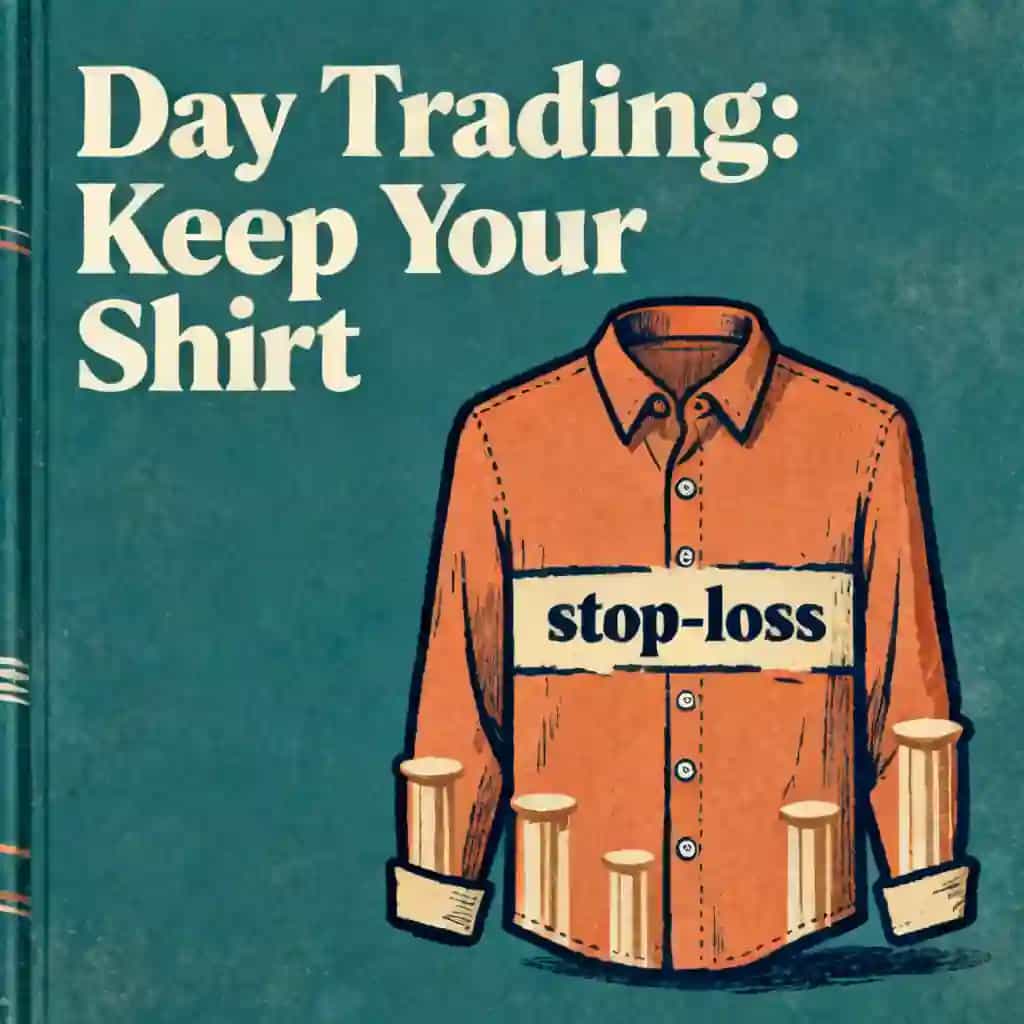
Position management is crucial to trading success. Stop-loss orders automatically sell a position when it reaches a specified price, limiting potential losses. For example, if you buy Microsoft at $23.05 and set a stop-loss at $22.25, your shares will be sold if the price drops to that level, containing your loss to less than a point. As the stock rises in your favor, trailing stops can protect profits by automatically adjusting higher as the stock price increases.
Capítulo 5
Learning from Failure: The One Bad Trade Syndrome
Rather than simply listing rules, Sincere presents a narrative based on a mostly true story to show what being an undisciplined trader is really like. Hal, a waiter at an upscale restaurant, heard from colleagues that day trading could earn $200-300 daily. Enticed by the prospect of making $50,000 annually from home, he began immersing himself in financial media, watching CNBC religiously and devouring trading books from popular authors, though without developing a systematic approach to learning.
At work, Hal met Mr. Morgan, a charismatic regular customer who presented himself as a successful professional day trader. Morgan spoke confidently about market trends and recommended buying Citigroup at $38, calling it a bargain due to its strong fundamentals and dividend yield. Impressed by the well-known bank's reputation, positive analyst consensus, and Morgan's apparent expertise, Hal purchased 1,000 shares at $40.50, using both his savings and margin borrowing. The stock immediately climbed to $42.08, giving him an unrealized $1,500 profit, which only reinforced his belief in his decision.
Despite his girlfriend suggesting he sell and lock in profits, pointing out the volatile market conditions, Hal held overnight. He was further encouraged by positive TV coverage discussing Citigroup's expansion plans and strong earnings forecast. However, over the following weeks, as the financial crisis deepened, Citigroup plummeted to $35, turning his paper gain into a $5,000 loss. When he frantically called Morgan for advice, Morgan confidently insisted they were buying more, describing it as a "lifetime opportunity." Intimidated and desperate to average down, Hal purchased another 1,000 shares at $36, depleting his remaining savings and increasing his margin exposure.
As Citigroup continued its precipitous decline to $25 and then $20, Hal discovered through another restaurant regular that Morgan had actually sold his entire position a month earlier at a small loss. With multiple margin calls from his broker and mounting losses, Hal and his father were forced to liquidate the position, resulting in a devastating loss of over $45,000 - more than his annual salary.
Reflecting on this catastrophic trade, Hal identified numerous critical mistakes that exemplified classic novice trader errors: blindly trusting a tip from a supposed expert without independent research, borrowing money he couldn't afford to lose through margin trading, betting too big without proper position sizing or money management, having unrealistic expectations about trading profits, and failing to create a detailed trading plan with clear entry/exit rules. He neglected fundamental risk management practices like using stop-losses, traded purely on emotions and fear, placed market orders at open without considering price action, and was woefully unprepared for the psychological warfare of trading. This experience taught him that successful trading requires discipline, proper education, and a systematic approach rather than hot tips and emotions.
Capítulo 6
Learning from the Pros: Strategies that Work
Toni Turner, bestselling author and president of TrendStar Trading Group, explains that novice traders lose money because they can't properly read market conditions. While beginners might see rising indexes as buying opportunities, experienced traders recognize when these moves occur within larger downtrends. She compares market reading to wilderness navigation-experienced guides notice warning signs that novices miss.
Turner strongly recommends paper trading for several months to gain experience without risking capital. This practice builds confidence and teaches crucial market signs before putting real money at stake. When day trading, she watches S&P 500 E-mini futures as leading indicators for S&P stocks, noting they tick higher or lower seconds before most stocks follow suit.
Her strategy involves finding stocks in uptrends above their 20-day and 50-day moving averages, then using 10-period and 20-period moving average crossovers on 15-minute charts for buy and sell signals. When the 10-period crosses above the 20-period, she buys; when it crosses below, she sells.
John Kurisko, known as Day Trader Rock Star, emphasizes simplicity and patience in trading. Rather than trying to pick tops or bottoms, he follows price trends and waits for high-probability setups. His ideal setup involves quality stocks pulling back to a trendline before bouncing upward-a textbook trade that aligns with market trends.
Kurisko relies on five key indicators: Stochastics (preferably oversold), exponential moving averages (20-, 50-, and 200-day), trendlines, support and resistance levels, and recognizable patterns like candlestick reversals or inverted head and shoulders. He requires at least three indicators to align before taking a trade.
Peter Reznicek, chief strategist at ShadowTrader.net, warns against getting distracted by too many ideas when day trading. He approaches trading as a monthly or quarterly game rather than feeling pressured to profit daily. The key is identifying genuine opportunities when they appear naturally, not forcing trades.
Reznicek primarily uses technical indicators to measure market breadth. He favors the Advance-Decline Line to track how many NYSE stocks are advancing versus declining, and the NYSE/Nasdaq TICK to monitor upticking versus downticking stocks. He watches for divergences between indicators and price movement that might signal reversals.
Capítulo 7
The Patient Day Trader: Doing Your Homework
Successful day trading doesn't require constant activity. Sometimes staying on the sidelines is the wisest move. As investor Jim Rogers says: "One of the best rules anybody can learn about investing is to do nothing, absolutely nothing, until there is something to do.... I just wait until there is money lying in the corner, and all I have to do is go over there and pick it up." Rogers waits patiently for high-probability investments rather than forcing trades.
Despite criticism for their short-term mindset, day traders offer valuable lessons. They learn early to exit losing positions quickly rather than hoping for recovery. Professional day traders don't rely on hope but on tools, charts, discipline, and the ability to make fast decisions under stress.
Even as a day trader, it's crucial to monitor the broader market context. Many traders get so focused on small details they miss what's really happening. As legendary trader Jesse Livermore noted, it's easier to be bullish in a bull market and bearish in a bear market.
Rather than asking how long it will take to become profitable, new traders should ask how much effort is required to truly understand what they're doing. Understanding the market is a lifelong pursuit, and traders should leverage resources like their brokerage firm's help desk for questions.
A typical day trader's routine includes evening preparation (reviewing trades, planning strategies), pre-market preparation (scanning news, arranging charts), and market hours activities. Many traders use a "trading checklist" similar to a pilot's pre-flight checklist. The schedule includes specific times: reviewing previous day's trades at 7:00 PM, scanning charts at 9:30 PM, monitoring news and setting up screens at 8:00 AM, managing positions at market open (9:30 AM), and closing all positions by 3:30 PM before market close.
Capítulo 8
The High-Frequency Revolution and Market Evolution
High-frequency traders (HFTs) represent the ultimate day traders, using sophisticated high-speed computers and complex algorithms to automatically execute millions of orders, often accounting for over 70% of daily trading volume on major exchanges. These systems operate at speeds measured in microseconds, utilizing dedicated fiber optic lines and specialized co-location services near exchange servers to gain microscopic timing advantages. Retail traders, even with the fastest internet connections, cannot compete with their nanosecond transaction speeds and advanced pattern recognition capabilities.
While HFT firms claim to provide essential market benefits by adding liquidity and narrowing bid-ask spreads, several controversial practices have emerged. Flash trading, which allows certain traders a 30-millisecond preview of outstanding orders, has particularly damaged market confidence. Other contested practices include quote stuffing (flooding markets with rapid orders and cancellations), momentum ignition (using large orders to trigger other traders' algorithms), and layering (creating false impressions of supply or demand).
The dangers of automated trading systems became starkly apparent during the 2010 flash crash, when the Dow Jones Industrial Average plummeted nearly 1,000 points (about 9%) in minutes before recovering most losses. This unprecedented event was partially triggered by a large sell order that overwhelmed the market's liquidity, causing automated systems to temporarily withdraw from trading. The incident exposed the fragility of modern market structure and led to several SEC proposals, including circuit breakers, prohibitions on flash orders, and new rules for market makers.
For individual traders, these structural changes have fundamentally altered the trading landscape. Traditional technical analysis patterns and breakout strategies that worked reliably in previous decades now frequently result in false signals and "bull traps" - situations where stocks appear to break resistance levels but quickly reverse, trapping buyers at higher prices. Many professional traders attribute these changes to sophisticated HFT algorithms that can detect and counter common retail trading patterns, essentially using the predictability of human behavior against traditional traders.
To adapt, successful traders have modified their approaches, incorporating longer holding periods, focusing on less HFT-dominated securities, and developing counter-algorithmic strategies. Some have shifted toward trading in pre-market and post-market sessions when HFT activity is typically lower, while others concentrate on fundamental analysis and longer-term positions that are less affected by short-term algorithmic trading patterns.
Capítulo 9
The Day Trader's Mindset: Discipline Over Emotion
Trading resembles an emotional roller coaster with pockets full of cash, especially for day traders. Your initial goal should be learning to trade well, not necessarily making money. Capital preservation is paramount-there will always be more opportunities, but only if you remain in the game.
Many traders focus on buying but neglect planning their exits. As a day trader, you need three specific numbers before entering a trade: entry price, stop price, and target selling price. Unlike investors, day traders can't "let winners run" indefinitely and typically exit positions within hours or by day's end.
The "cockroach theory" suggests that one negative sign likely indicates more problems hiding beneath the surface. When bad news emerges about a stock or sector, react quickly rather than hoping the issue will pass. Follow the wisdom that "when in doubt, get out"-the moment you first think about selling is often the right time to exit.
When you start counting profits prematurely, giving high-fives, or declaring yourself a market genius, it's time to sell or enter trailing stops. These emotional signals often precede market reversals. One trader made $130,000 in options profits in one day but didn't sell due to greed, eventually losing everything.
Never hold a losing stock overnight hoping it will recover-it almost never does. As a day trader, sell losers before market close to limit losses. The emotional challenge of day trading is ten times harder than mastering the technical tools, which is why only about 5% of aspiring day traders consistently profit.
Day trading requires the same level of commitment as any other profession. Professional trading firms typically require a full year of training before allowing real money trades, so take your time studying the market and strategies while practicing with paper trading. With proper preparation, discipline, and a realistic understanding of the challenges involved, day trading can be a viable path for those willing to put in the necessary work.
Capítulo 10
The Continuous Learning Journey
Markets evolve with new technology, strategies, and regulations, making continuous learning essential for day traders. Successful traders maintain a student mindset, constantly reading books, studying charts, and exploring new ideas before committing real money. This includes staying updated on market news, following industry experts on social media, attending webinars, and participating in trading communities where experiences and insights are shared.
Technical analysis skills require regular refinement through practice. Traders often spend hours each week reviewing their past trades, analyzing what worked and what didn't, and documenting these lessons in a trading journal. Many successful traders dedicate at least an hour each day to education, whether that's studying new chart patterns, testing trading strategies in paper trading accounts, or analyzing market trends.
For finding trading candidates, experienced traders rely on real-time stock scanners from third-party software or their brokerage platform. Popular platforms like ThinkOrSwim, TradeStation, and FinViz offer sophisticated scanning tools that can filter stocks based on multiple criteria such as price, volume, volatility, and technical indicators. The goal is to find stocks with appropriate volatility-enough to be profitable but not excessively volatile. Many traders maintain watch lists of potential day trading stocks, often drawn from most-active stock lists, sector leaders, and trending market themes.
Risk management education is equally crucial. Successful traders constantly refine their position sizing, stop-loss strategies, and risk-reward ratios. They understand that market conditions change, requiring adaptable strategies. For instance, volatile markets might demand tighter stops and smaller position sizes, while range-bound markets might require different entry and exit strategies.
Trading is not a get-rich-quick scheme but a profession that rewards those who approach it with dedication and discipline. Forget unrealistic goals of making $200-500 daily; if you can make 20% annually, you're outperforming most professionals. Simply having enough capital to continue trading after your first year would be an achievement. Many successful traders spend their first year focusing on capital preservation rather than aggressive growth.
The path to day trading success isn't about finding a magical indicator or secret formula-it's about developing the right mindset, building a solid foundation of knowledge, and creating systems that protect you from your own emotional responses. This includes developing pre-market routines, maintaining trading checklists, and establishing clear criteria for entering and exiting trades. As you continue your trading journey, remember that patience and discipline often matter more than technical expertise, and that sometimes the best trade is no trade at all. Successful traders often cite their ability to stay out of suboptimal trades as a key factor in their long-term survival and success.