Capítulo 1
The Wealth Extraction Machine: Why the Rich Get Richer While Everyone Else Struggles
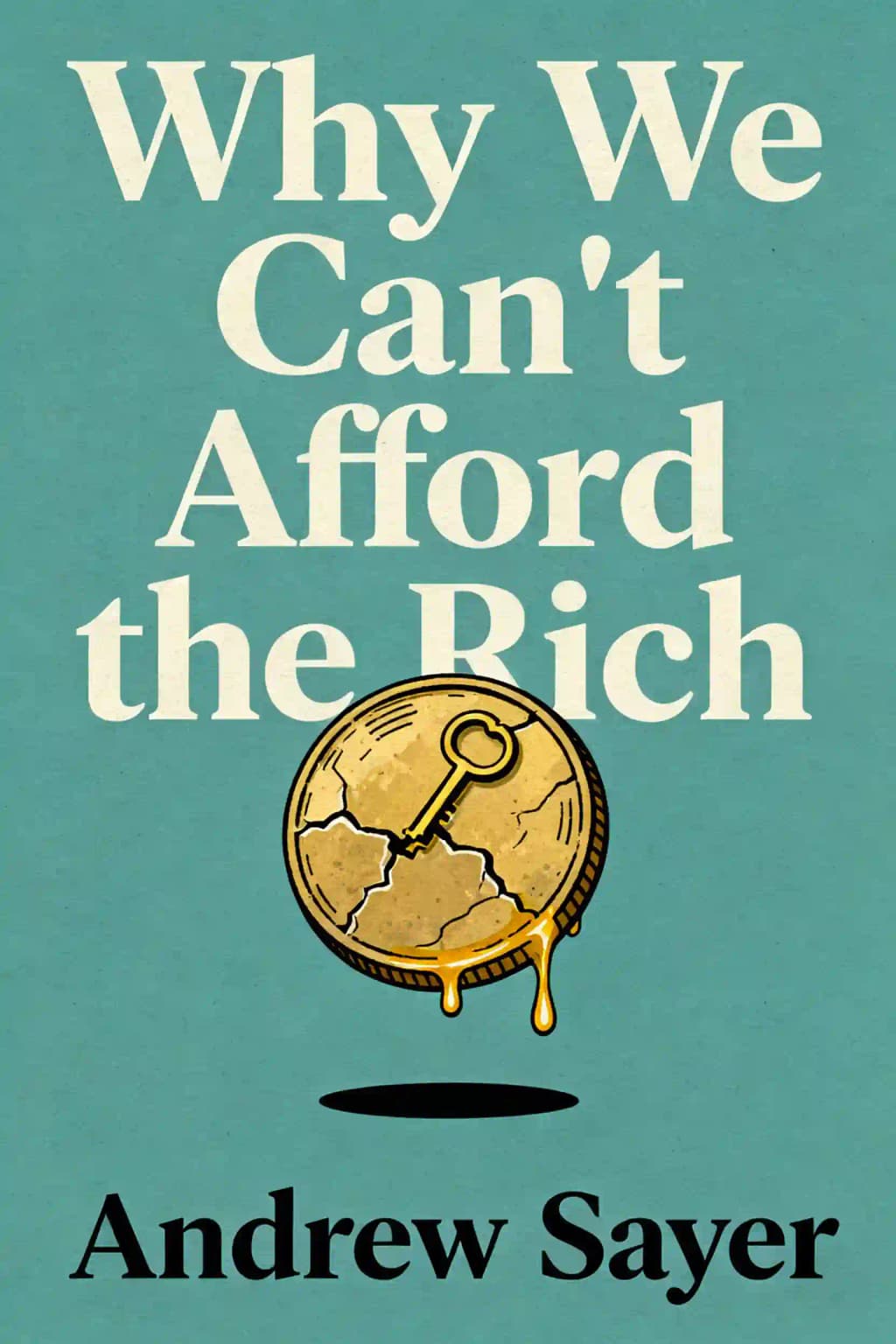
Did you know that Warren Buffett's son once called philanthropy "conscience laundering" - feeling better about excessive wealth by "sprinkling a little around"? Andrew Sayer's groundbreaking book "Why We Can't Afford the Rich" has become required reading in progressive economic circles, praised by Nobel laureate Joseph Stiglitz as "the most comprehensive demolition of the economic justifications for extreme inequality." The book has gained particular relevance since the 2008 financial crisis, as inequality has continued to widen despite economic turmoil. Even as ordinary people faced austerity measures, the wealthy not only recovered but thrived - a phenomenon Sayer meticulously dissects. The book has influenced policy discussions in countries like Iceland and Denmark, where more equitable economic models are being pursued, and has been cited by politicians including Bernie Sanders and Jeremy Corbyn in their campaigns against economic inequality.
Capítulo 2
The Fundamental Divide: Earned vs. Unearned Income
At the heart of our economic system lies a politically explosive distinction that has been deliberately obscured: the difference between earned and unearned income. This distinction explains how the rich have managed to capture an increasing share of wealth despite economic crises. Earned income comes from actual work that produces goods and services others can use. Whether you're a teacher educating future generations, a nurse providing essential healthcare, a factory worker manufacturing necessary products, or an engineer designing infrastructure, you're contributing something tangible to society. These contributions create real value and advance human wellbeing.
Unearned income, by contrast, flows to those who control assets others need but lack. This includes rent from property ownership, interest from lending, dividends from shareholding, and capital gains from asset inflation. A landlord collecting rent from multiple properties, an investor earning passive income from stock dividends, or a speculator profiting from currency trading - these forms of income require no productive work. They simply extract wealth from those who do work. As Christian socialist R.H. Tawney noted, "The man who lives by owning without working is necessarily supported by the industry of someone else, and is, therefore, too expensive a luxury to be encouraged." This observation remains particularly relevant in today's economy where wealth concentration accelerates through passive income streams.
The rich aren't primarily "wealth creators" but wealth extractors who have positioned themselves as gatekeepers between people and essential resources. When landlords charge rent for access to land they didn't create, when banks create money through fractional reserve lending and charge interest on it, or when shareholders extract dividends from companies they had no hand in building - they're not contributing to the economy but siphoning value from it. Consider how private equity firms often acquire companies, load them with debt, extract maximum value, and leave them struggling - a perfect example of wealth extraction rather than creation.
This system creates a fundamental imbalance: for some to consume without producing, others must produce more than they consume. Part of workers' labor must effectively be unpaid, transferred to asset owners through various extraction mechanisms like rent, interest, and financial fees. A worker paying half their income in rent to a landlord, or a small business paying high interest rates to banks, exemplifies this transfer of value. The rich get what they get not because they deserve it or because it benefits the economy, but simply because they can - through established power structures and property rights that favor asset ownership over labor.
The neoliberal era has seen this distinction deliberately erased from public discourse, with misleading terms like "earnings" applied to all income regardless of source, and "investment" conflating productive spending with mere financial speculation. This linguistic sleight-of-hand has helped normalize extreme inequality by suggesting the wealthy somehow earned their fortunes through superior contribution. Modern financial instruments and complex derivatives further obscure the extractive nature of many wealth-building mechanisms, making it harder for the public to distinguish between productive economic activity and sophisticated rent-seeking behavior.
Capítulo 3
The Mechanisms of Wealth Extraction: Rent, Interest, and Financial Engineering
Rent represents perhaps the most fundamental form of wealth extraction. When you pay rent for housing, you're not primarily compensating someone for creating or maintaining that property - you're paying for access to space that already exists. As Adam Smith recognized, landlords "love to reap where they have not sowed." Land value increases not through landlord effort but through collective social development - new transportation links, schools, businesses, and other amenities that make an area desirable.
This "unearned increment," as Winston Churchill called it, allows property owners to extract wealth created by the wider community. In London's wealthiest neighborhoods, mansions stand empty as investment vehicles while their values soar by millions - not through owner improvements but through development gains from London's wider growth. Meanwhile, the government imposes a punitive "bedroom tax" on low-income people with spare bedrooms rather than taxing these underutilized mansions.
Interest functions as "money's rent" - a claim on future production that grows exponentially through compounding. What makes modern interest particularly problematic is that banks don't merely lend existing savings; they create new electronic money when issuing loans. This means both principal and interest represent unearned income - a private tax on borrowers. As former Bank of England governor Mervyn King acknowledged, "When banks extend loans to their customers, they create money by crediting their customers' accounts."
Compound interest is mathematically unsustainable, doubling principal every 14 years at 5%. This exponential growth eventually leads to crisis as debts become unpayable unless interest rates remain below economic growth rates. Nigeria's former President Obasanjo called it "the worst thing in the world," explaining how $5 billion borrowed grew to a $28 billion debt despite $16 billion in payments.
The system disadvantages the poor, who pay higher interest rates and are more likely to default. Research shows only the top 10% of households receive more interest than they pay out, while the bottom 80% pay far more than they receive - creating a massive upward redistribution of wealth from ordinary people to rich bondholders.
Financial engineering has created even more sophisticated extraction mechanisms. Banks package loans into securities, creating complex instruments that generate fees at every step. High-frequency traders skim value from transactions happening in microseconds. Private equity firms use leveraged buyouts to saddle productive companies with debt while extracting massive fees. The financial sector has transformed from serving the real economy to dominating it, extracting ever-larger portions of national income.
Capítulo 4
The Commons: Our Shared Inheritance and Unacknowledged Wealth
The wealth we enjoy today doesn't come primarily from individual brilliance but from our common inheritance - the accumulated knowledge, technology, institutions, and natural resources passed down through generations. Today's workers produce far more than their ancestors not because they work harder or deserve more, but because they benefit from centuries of technological and organizational advances. From the wheel to the internet, from mathematics to modern medicine, our productive capacity builds on countless innovations developed collectively over human history.
The 15-fold increase in US output per hour since 1870 reflects society's collective productivity gains, not individual merit. A modern factory worker can produce more in an hour than their great-grandfather could in a day, not through superior ability, but by leveraging advances in machinery, power generation, and production methods. Even seemingly individual achievements rely heavily on shared knowledge - today's software developers build on programming languages and protocols developed by others, while medical researchers utilize vast databases of previous studies and established methodologies.
Even billionaires like Warren Buffett acknowledge their success depended on being born into technologically advanced societies with vast knowledge inheritances: "If I'd been born in Bangladesh, I'd probably be living on a dollar a day right now." Similar talents and work ethic yield radically different results depending on access to society's accumulated capabilities. A brilliant inventor in ancient Rome could not have created smartphones without centuries of intervening discoveries in electronics, materials science, and information theory.
Given our enormous debt to this inheritance, none of us can truly claim to be "self-made." The language we speak, the scientific knowledge we utilize, the infrastructure we rely on - all are gifts from previous generations. Yet access to the commons is governed by power and property rights. Under capitalism, ownership of production means is centralized in the hands of a minority who extract unearned income from the majority as a condition for accessing our technological inheritance.
This privatization of common wealth allows property owners to charge others for access to what should be treated as social wealth. Patents and intellectual property rights often fence off discoveries that built on public research. Corporate giants profit from freely available internet protocols while restricting access to their platforms. The rich effectively monopolize the benefits of our shared inheritance while claiming they deserve their fortunes through individual merit. This represents a massive free-riding on collective achievement - taking credit and extracting payment for what was collectively produced over generations of human cooperation and discovery.
The implications are profound: if most wealth stems from our common inheritance, shouldn't its benefits be more equitably shared? The current system privatizes collective achievements while socializing costs, allowing a privileged few to extract rent from humanity's accumulated knowledge and capabilities. Recognizing wealth's collective origins challenges conventional notions of desert and merit-based rewards.
Capítulo 5
The Myth of Meritocracy and the Reality of Power
The idea that markets reward people according to their contribution is perhaps the most persistent myth in modern economics. In reality, pay is determined primarily by power, not desert. When organizations create jobs, they typically pay only what's necessary to attract qualified candidates, not what workers might deserve based on their contribution. This is evident in how similar roles can have vastly different compensation across industries and regions, reflecting market power rather than actual value created. For instance, a software developer in Silicon Valley might earn triple what their equally skilled counterpart makes in the Midwest, not because they're three times more productive, but due to market dynamics and corporate power structures.
The division of labor itself reflects and reinforces inequality in profound ways. The quality of work - whether tedious, interesting, stressful, varied, or fulfilling - is distributed highly unequally. Some get interesting, varied, responsible roles while others get monotonous, closely supervised tasks. This stratification appears across industries: compare the autonomy of a creative director to that of a production line worker, or a university professor to a teaching assistant. This isn't a natural reflection of different abilities but largely shapes those abilities. As Adam Smith recognized, the apparent differences in intelligence between occupations were largely effects, not causes, of the division of labor. Workers in more challenging roles develop additional capabilities simply through exposure to complex problems and decision-making opportunities.
Children's cognitive development is strongly influenced by parents' position in the social hierarchy, creating a self-perpetuating cycle. Working-class parenting typically emphasizes obedience, punctuality, and following rules, while middle-class parenting stresses reasoning, negotiation, and self-development. These different approaches prepare children for their likely positions in the labor market - whether taking orders or giving them. Research shows that by age three, children from professional families have heard 30 million more words than those from working-class backgrounds. These acquired dispositions shape aspirations, motivation and comfort levels in different roles, perpetuating inequality across generations.
The "level playing field" is a myth that obscures deep structural inequalities. Young people enter job markets already unequal due to their parents' position in the unequal division of labor. Social mobility is far more limited than politicians claim - a UK study found middle-class children are 15 times more likely to get middle-class jobs than working-class children. Educational advantages compound over time: private schools, extra tutoring, unpaid internships, and social networks all tilt the field further. Our position at birth profoundly shapes who we become, making the playing field steeply sloped, not level.
Even well-intentioned politicians face an environment dominated by financial interests and corporate power. Those controlling the "commanding heights" of the economy - increasingly the financial sector - can pressure governments through multiple channels: capital flight threats, demanding minimal regulation, hiding money in tax havens, and funding political campaigns. The revolving door between politics and finance ensures their interests are protected - former Goldman Sachs executives regularly take senior government positions, while ex-regulators join private equity firms. This creates a self-reinforcing system where economic power translates directly into political influence, further entrenching existing inequalities.
Capítulo 6
How the Rich Got Richer: The Rise of Financialized Capitalism
The economic crisis and the resurgence of the rich since the 1970s are deeply connected through financialization. Unlike the Great Depression, many rich people have gotten even richer after this crisis. Capitalism's most successful decades (1950s-60s) coincided with the rich having their lowest share of national income - no coincidence.
The crisis originated with the end of the post-war boom's "productionist capitalism," where companies prioritized long-term profitability over short-term gains. During that era, bank credit was regulated, wages rose with productivity, and trade unions ensured workers enjoyed economic development's fruits. When Prime Minister Macmillan declared "most of our people have never had it so good," rentiers had "never had it so bad," though they weren't extinct.
When Nixon ended the Bretton Woods agreement in 1971, he liberalized credit creation and capital movement, complementing globalization of production with globalization of capital. This strengthened the financial sector while weakening governments' ability to control interest rates and encourage real investment. Thatcher and Reagan seized this opportunity to attack unions, raising interest rates that devastated manufacturing while benefiting the financial sector.
Banking debts soared from 50% to over 500% of GDP since the 1970s. With wages stagnating, consumer demand grew slowly, making productive investment less profitable. Companies increasingly sought financial rather than productive investments, with GM making 80% of its profits from its financial division by 2004. The shareholder value movement pressured companies to distribute more profits as dividends (rising from 30% to 60% of profits) and cut costs aggressively.
Financialization transformed everything with predictable income streams into sellable assets - from hospital parking to student loans. The key mechanism was "securitization" - bundling loans and selling them as income-yielding assets through special purpose vehicles often hidden in tax havens. When mortgage companies exhausted middle-class markets, they targeted low-income households with predatory lending, then securitized these high-risk loans too.
The bailouts of banks "too big to fail" represent a massive transfer of debts from private to public sector - a subsidy for rentiers. Governments raided public funds to lend money at rock-bottom rates to banks, which then lent it back at higher interest. Estimates of the UK bank bailout range from 289-550 billion - nearly 10,000 per resident. The total value of bailouts across US, UK and euro area by 2009 equaled $14 trillion - almost a quarter of world GDP.
Capítulo 7
The Plutocratic Capture of Democracy
While we still live in nominal democracies, they're increasingly overshadowed by plutocracy - rule by the rich. Modern plutocracy isn't a conspiracy with central organization but rather shifting alliances among rich organizations and individuals whose interests overlap enough for periodic cooperation.
The most visible manifestations include political donations, lobbying, overlapping social and corporate networks between politicians and the wealthy, and the elite origins of politicians themselves. In the US, the 2012 presidential election saw each candidate spend over $1 billion. Romney received major funding from Wall Street banks while Obama got $700,000 each from Microsoft and Google and over $1 million from Goldman Sachs - explaining the lack of serious regulation of banks or tech monopolies.
Less visible is the offshore world of tax havens - secrecy jurisdictions where financial wealth can be hidden. These havens conceal ownership, amounts, and sources of wealth through shell companies and offshore trusts. In 2011, 98 of the top 100 companies on London's stock exchange used tax havens, with 4,492 subsidiaries located offshore. The Tax Justice Network estimates that between $21-32 trillion was hidden in tax havens by the world's wealthiest people in 2012, with governments losing approximately $250 billion in taxes annually.
Multinational companies use "transfer pricing" to shift profits across borders and minimize taxes. They manipulate their internal accounting to declare profits in low-tax jurisdictions while showing minimal profits where taxes are higher. Starbucks paid no UK corporation tax on $398 million in sales by channeling revenue through the Netherlands. Amazon reported $11.6 billion in European revenue but paid only 8 million in tax - an effective rate of just 0.1%.
The plutocracy engages in activities ranging from ethically questionable to criminal: insider dealing, money laundering, sanctions evasion, loading companies with debt while raiding pension funds, designing products meant to fail, mis-selling financial products, manipulating interest rates, and forcing small businesses into bankruptcy to seize assets. Despite causing economic devastation, the sector has escaped serious restructuring by controlling the economy, colonizing politics, and constructing a narrative of success that portrays finance as the indispensable economic powerhouse.
Capítulo 8
The Environmental Endgame: Climate Crisis and the Limits to Growth
The rich cause problems not just in how they acquire wealth but in how they spend it. Their luxury consumption diverts resources from more essential needs and drives up prices of necessities like housing. No one has a larger carbon footprint than the rich with their private jets and multiple mansions. The WallyPower 118 yacht consumes a staggering 3,400 liters of fuel per hour at top speed - nearly a liter per second. When combined with luxury fittings of rare woods, multiple vehicles, exotic foods and high-speed operation, the owner of such a vessel "will do more damage to the biosphere in 10 minutes than most Africans inflict in a lifetime."
But the greatest threat to our future is climate change, driven by capitalism's dependence on compound growth. The vast majority of climate scientists agree that rapid global warming is occurring due to human greenhouse gas emissions. Without rapid action, temperatures could rise 4-6C by century's end, far beyond the politically acceptable 2C target.
The responsibility for climate change is highly unequal. The richest 7% of people globally (about 500 million) are responsible for 50% of all greenhouse gas emissions, while the poorest 50% emit very little. Americans have approximately 150 "energy slaves" working for them through their energy consumption.
We face a diabolical double crisis: the solution to our economic problems (growth and redistribution) would accelerate climate change, while addressing climate change requires economic contraction in wealthy nations. The notion of "green growth" - a continuously growing economy without increasing carbon emissions - is more attractive than plausible. Despite a 33% improvement in energy efficiency per unit of output since 1970, total CO2 emissions have increased by 80% because economic growth has more than offset efficiency gains.
Capitalism is fundamentally incompatible with environmental sustainability because it requires perpetual growth. Workers must produce not only enough for their own wages and production costs, but also for owners, shareholders, landlords, and speculators. Competition forces companies to constantly increase productivity. A capitalist economy where "enough is enough" is impossible.
Capítulo 9
Toward a Sustainable Future: Reimagining Our Economic System
We can't afford the rich or an economic system predicated on inequality and endless growth. We need an economy based on sufficiency rather than insatiable acquisitiveness. Equal societies allow all to develop capacities and foster mutual respect and solidarity. Environmental equality is essential - no one has the right to more earth resources than their fair share.
To create fairer, sustainable societies, we need drastic changes targeting the sources of unearned income:
First, tackle rent by nationalizing land and minerals or implementing land-value taxes. This would bring rents under democratic control while still allowing building ownership and improvements. Even conservative economists like Adam Smith and Milton Friedman supported land-value taxes.
Second, reform interest and credit money. Credit should primarily fund productive investments with risk shared between lenders and borrowers. Money creation should be controlled democratically rather than by private banks that fuel asset bubbles.
Third, transform business ownership. Workers should have representation and part-ownership in organizations with more than 20 employees. Cooperatives networked with mutual banks can thrive without making shares transferable to outside speculators.
We need progressive wealth taxation targeting unearned income from asset ownership. Piketty's proposed global capital tax would require international agreements and financial transparency. An "exceptional tax" on private capital could eliminate national debt within a year, freeing governments from bondholder control.
We must leave fossil fuels in the ground and rapidly develop sustainable energy systems while reducing consumption through improved insulation and waste reduction. A "green army" is needed to make buildings energy efficient and partially self-sufficient, creating thousands of jobs oriented toward sufficiency rather than endless growth.
To achieve meaningful change, we must remove both the political and economic dominance of the rich and rebuild democracy. Political donations must be severely limited, with state funding for election campaigns. Politicians must face stronger restrictions on corporate relationships. Corporate lobbying must be strictly controlled and corporate infiltration of government reversed.
Combined action on blocking asset-based unearned income, improving needs-based welfare, reducing pay inequalities, making workers and users key stakeholders, democratizing politics, and redirecting investment into sustainable living could dramatically improve our lives and those of future generations. Freed from excessive competition, overwork, and economic insecurity, able to live as equals without deference or condescension, enjoying a stable climate and caring for our environment rather than conquering it, we could actually start living more fully and enjoying each other and our extraordinary world.
The rich are living beyond our means and those of the planet. Their interests fundamentally conflict with those of the 99% and the environment. We must stop supporting them.