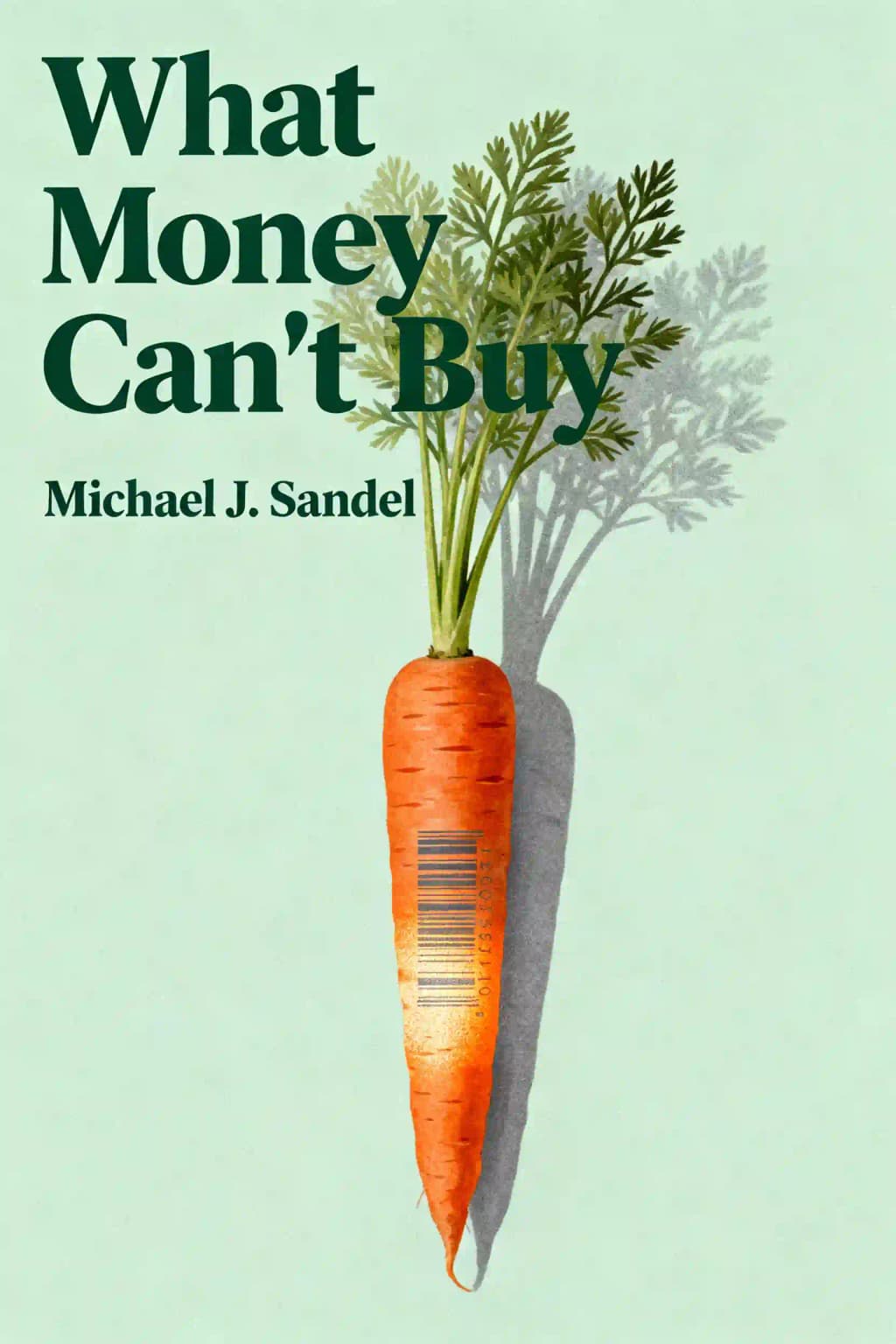
In "What Money Can't Buy," Harvard's Michael Sandel explores where markets shouldn't reach. Since 2012, this bestseller has sparked global debates about moral economics, challenging us to question: Should everything be for sale? The book that made philosophers and economists rethink capitalism's boundaries.
Michael J. Sandel, author of What Money Can’t Buy: The Moral Limits of Markets, is a renowned political philosopher and the Anne T. and Robert M. Bass Professor of Government at Harvard University. His work explores ethics, democracy, and the role of markets in society, blending philosophical rigor with contemporary moral debates.
A pioneer in public intellectual engagement, Sandel’s Harvard course “Justice” became the university’s first freely available online class, reaching tens of millions globally through broadcasts and digital platforms.
Sandel’s influential books, including Justice: What’s the Right Thing to Do? and The Tyranny of Merit: What’s Become of the Common Good?, examine citizenship, inequality, and the civic consequences of economic systems. His writings have been translated into over 30 languages, reflecting their global resonance.
A frequent speaker on international media, Sandel has delivered the BBC Reith Lectures and advised leaders worldwide on ethical governance. What Money Can’t Buy, a New York Times bestseller, challenges conventional wisdom about market-driven societies and remains essential reading in political philosophy courses.
Michael J. Sandel critiques the unchecked expansion of market values into non-economic spheres, arguing that commodifying education, healthcare, and civic life erodes moral and social norms. He examines examples like paid queue-jumping, carbon trading, and incentivized education to question whether everything should be for sale. The book challenges readers to redefine the moral limits of markets in a democratic society.
This book is essential for policymakers, ethics scholars, and anyone concerned about market overreach in public life. It appeals to readers interested in political philosophy, economic justice, and the societal impacts of privatization. Sandel’s accessible style also makes it suitable for general audiences seeking to understand modern capitalism’s moral dilemmas.
Yes, particularly for its timely analysis of how market logic infiltrates domains like education, healthcare, and environmental policy. Sandel’s compelling case studies—from ticket scalping to surrogate motherhood—spark critical reflection on equity and ethics. While some critics argue he oversimplifies market benefits, the book remains a seminal critique of commodification.
Sandel defines market triumphalism as the post-Cold War belief that free markets solve all social and moral problems. He argues this ideology wrongly equates economic efficiency with societal good, dismissing non-market values like fairness, civic duty, and intrinsic worth. Examples include privatization of public goods and pay-to-pollute schemes.
Sandel warns that fines (penalties for wrongdoing) risk becoming fees (priced services) for the wealthy. For example, a parking fine perceived as a “convenience fee” by affluent drivers undermines accountability. Similarly, late pickup fees at schools may incentivize wealthy parents to ignore time policies, eroding communal responsibility.
Sandel condemns carbon credit systems for allowing wealthy nations or corporations to “buy” pollution rights rather than reduce emissions. He argues this commodifies ecological responsibility, prioritizing profit over ethical obligations to future generations. Such markets, he claims, corrupt environmental stewardship into a transactional exchange.
Sandel criticizes cash incentives for student performance, arguing they replace intrinsic motivation (love of learning) with transactional thinking. Similarly, he opposes corporate-sponsored school programs that prioritize branding over educational integrity. These practices, he argues, degrade the moral purpose of education.
Sandel highlights “concierge medicine,” where affluent patients pay premiums for instant access to doctors, as exacerbating healthcare inequality. By allowing wealth to dictate care priority, this market-driven model undermines the normative principle that medical attention should reflect need, not financial capacity.
Both books dissect moral philosophy in everyday contexts, but What Money Can’t Buy focuses specifically on market ethics. While Justice explores broad ethical theories, this later work examines how market logic corrupts civic virtues, offering a sharper critique of neoliberal capitalism.
Libertarian critics argue Sandel underestimates markets’ ability to solve social problems efficiently. Others contend his “moral crowding out” theory lacks empirical rigor, and that many cited issues (e.g., ticket scalping) reflect regulated markets, not free ones. Despite this, the book’s ethical framework remains influential.
As debates over AI ethics, climate reparations, and healthcare privatization intensify, Sandel’s warnings about market overreach remain urgent. The book provides a lens to evaluate newer issues like data commodification, gig economy exploitation, and algorithm-driven inequality, reinforcing its enduring relevance.
Sandel advocates democratic deliberation to establish boundaries protecting civic goods from market incursion. This involves prioritizing equity, dignity, and collective well-being over efficiency. Examples include:
Sinta o livro através da voz do autor
Transforme conhecimento em insights envolventes e ricos em exemplos
Capture ideias-chave em um instante para aprendizado rápido
Aproveite o livro de uma forma divertida e envolvente
Markets are useful instruments for organizing productive activity. But unless we want to let the market rewrite the norms that govern social institutions, we need a public debate about the moral limits of markets.
Putting a price on the good things in life can corrupt them.
To decide what belongs in the domain of markets, and what should be governed by nonmarket values, we have to decide how to value these goods.
We've banished substantive debate about the good life from public discourse.
Divida as ideias-chave de What Money Can't Buy em pontos fáceis de entender para compreender como equipes inovadoras criam, colaboram e crescem.
Destile What Money Can't Buy em dicas de memória rápidas que destacam os princípios-chave de franqueza, trabalho em equipe e resiliência criativa.

Experimente What Money Can't Buy através de narrativas vívidas que transformam lições de inovação em momentos que você lembrará e aplicará.
Pergunte qualquer coisa, escolha a voz e co-crie insights que realmente ressoem com você.

Criado por ex-alunos da Universidade de Columbia em San Francisco
"Instead of endless scrolling, I just hit play on BeFreed. It saves me so much time."
"I never knew where to start with nonfiction—BeFreed’s book lists turned into podcasts gave me a clear path."
"Perfect balance between learning and entertainment. Finished ‘Thinking, Fast and Slow’ on my commute this week."
"Crazy how much I learned while walking the dog. BeFreed = small habits → big gains."
"Reading used to feel like a chore. Now it’s just part of my lifestyle."
"Feels effortless compared to reading. I’ve finished 6 books this month already."
"BeFreed turned my guilty doomscrolling into something that feels productive and inspiring."
"BeFreed turned my commute into learning time. 20-min podcasts are perfect for finishing books I never had time for."
"BeFreed replaced my podcast queue. Imagine Spotify for books — that’s it. 🙌"
"It is great for me to learn something from the book without reading it."
"The themed book list podcasts help me connect ideas across authors—like a guided audio journey."
"Makes me feel smarter every time before going to work"
Criado por ex-alunos da Universidade de Columbia em San Francisco

Obtenha o resumo de What Money Can't Buy como PDF ou EPUB gratuito. Imprima ou leia offline a qualquer momento.
Picture a world where you can buy your way out of almost any inconvenience. Need to skip airport security? That'll be $39. Want to hunt an endangered black rhino? $150,000, please. Prefer not to wait in line at a congressional hearing? Hire someone to stand there for you. This isn't science fiction-it's our reality. Over the past three decades, market thinking has seeped into nearly every corner of life, transforming civic duties into purchasable commodities and moral questions into price calculations. What began as faith in free markets for economic efficiency has evolved into something far more pervasive: a worldview that treats everything as tradable, every choice as a cost-benefit analysis, and every human interaction as a potential transaction. The 2008 financial crisis briefly shook our confidence in markets' wisdom, yet somehow strengthened their grip on our imagination. We've created a society where the answer to almost any problem is "let the market handle it"-but we've stopped asking whether some things shouldn't be for sale at all.




