Capítulo 1
When Freedom of the Press Becomes Unfreedom
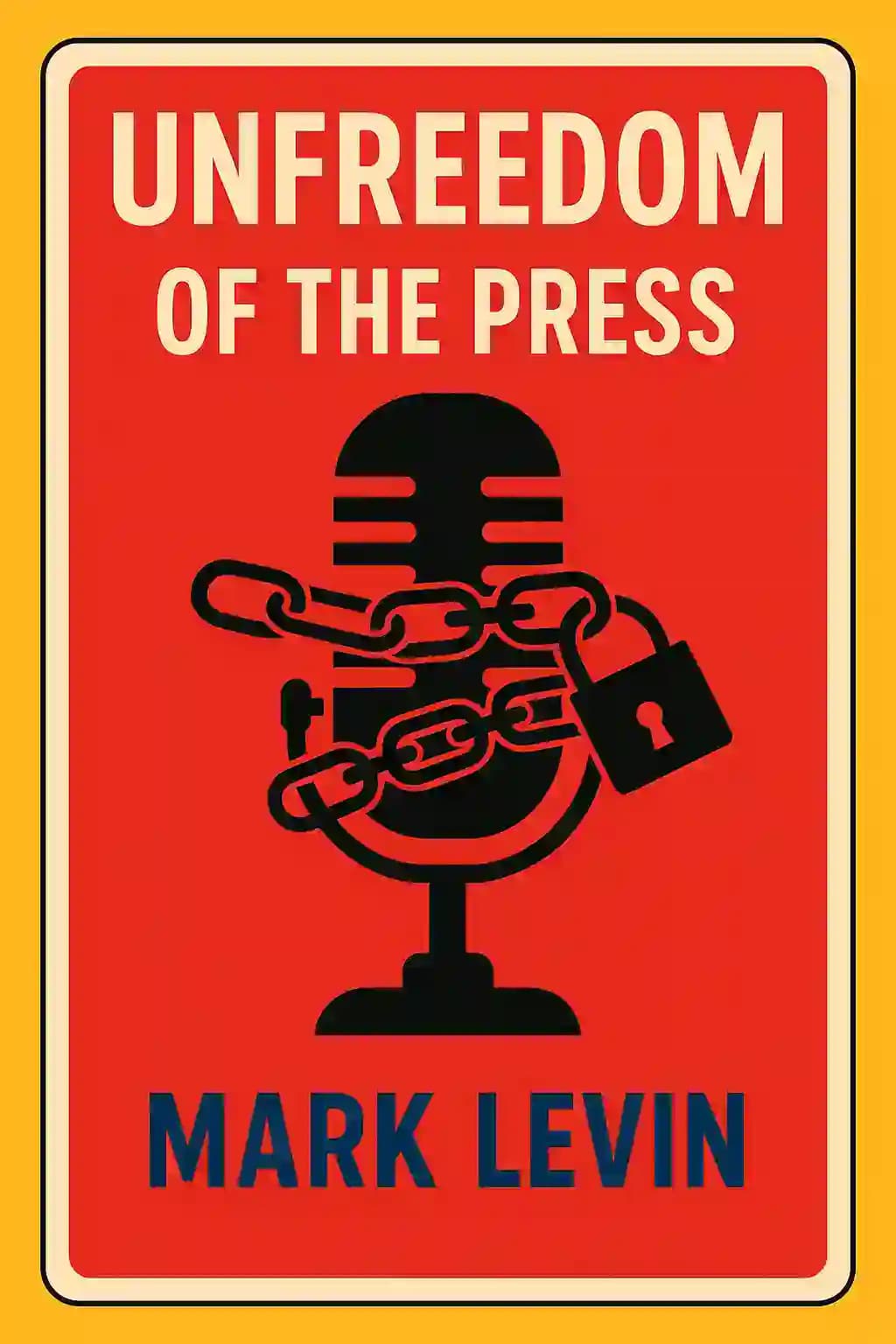
In an era where media credibility has plummeted to historic lows, Mark Levin's "Unfreedom of the Press" arrives as a scathing indictment of modern journalism's descent from its noble origins. This New York Times #1 bestseller has resonated deeply with readers across the political spectrum, selling over 500,000 copies in its first months of publication. Levin, a constitutional scholar and National Radio Hall of Fame inductee, doesn't merely criticize-he meticulously documents how today's media landscape has been transformed from watchdog to activist. What makes this work particularly compelling is that Levin isn't arguing for government control of media, but rather exposing how journalists themselves have abandoned their professional responsibilities. As media trust continues to fracture along partisan lines-with nearly 80% of Republicans distrusting mainstream outlets while 80% of Democrats maintain faith in them-this book offers a provocative explanation for why this divide exists and what it means for American democracy.
Capítulo 2
The Modern Media's Ideological Transformation
The fundamental problem with modern journalism isn't government censorship but internal corruption through activism, groupthink, and partisan advocacy. Today's media landscape reveals a stark ideological homogeneity that has intensified over decades. A comprehensive 2014 Indiana University study found just 7.1% of journalists identify as Republican compared to 28.1% as Democrats, down from 25.7% Republican identification in 1971. Among financial journalists, nearly 60% identify as liberal while fewer than 5% identify as conservative. This imbalance extends to political engagement - during the 2016 election, 96% of political donations from journalists went to Hillary Clinton, representing an unprecedented level of partisan uniformity.
This ideological uniformity manifests in coverage decisions across multiple dimensions. A Harvard Kennedy School study found that coverage of Trump's first 100 days was 80-90% negative across most outlets, while Obama's first 100 days received twice as many positive stories as negative ones. The geographic concentration of media further reinforces this bubble - 73% of internet publishing jobs are concentrated in coastal areas that voted heavily for Clinton. This geographic clustering creates an echo chamber effect where journalists primarily interact with others sharing similar worldviews and cultural assumptions.
Former CBS correspondent Lara Logan has documented how traditional journalistic standards requiring multiple independent sources have been systematically abandoned. Stories now routinely rely on single anonymous sources, particularly for politically charged topics. She characterizes the New York Times as "the anti-Trump paper of record," publishing dozens of negative stories daily - reflecting a political position rather than journalistic inquiry. The consequences for dissent are severe: when journalists break from the media consensus, they face coordinated personal attacks aimed at destroying their reputation and career prospects rather than addressing their substantive critiques. Notable examples include Glenn Greenwald's departure from The Intercept and Bari Weiss's resignation from the New York Times.
Media scholars Bill Kovach and Tom Rosenstiel have articulated essential "elements of journalism" including obligations to truth, loyalty to citizens, verification discipline, and independence from faction. Yet these foundational principles appear increasingly abandoned in modern newsrooms where ideological conformity trumps factual accuracy. The concept of journalistic objectivity that evolved from early 20th century progressivism - what Walter Lippmann and Charles Merz called a "scientific spirit" in reporting - has given way to advocacy journalism that prioritizes preferred narratives over empirical evidence. This shift represents a fundamental transformation in how news organizations understand their role, moving from neutral arbiters of fact to active participants in political and social movements.
The erosion of traditional standards has coincided with the rise of social media, where the pressure for engagement metrics often supersedes accuracy. Newsrooms increasingly shape coverage around what generates clicks and shares rather than what best informs the public. This dynamic creates perverse incentives that reward inflammatory and partisan content while penalizing nuanced reporting that might challenge readers' preexisting beliefs.
Capítulo 3
The Revolutionary Origins of American Press Freedom
The American press tradition began with a fundamentally different orientation than today's media. Early American journalism was intertwined with the battle for individual liberty and free speech-essential elements of the American Revolution. The first printing house was established in 1638 in Cambridge, Massachusetts, with printing beginning in 1639. Initially, Massachusetts authorities kept tight control over the press, appointing licensers in 1662 and restricting printing to Cambridge, fearing "contentions and heresies" might arise without oversight.
By 1768, publishers like Benjamin Edes had articulated the press's essential role in protecting liberty, keeping government in check, and ensuring officials followed the consent of the governed-establishing the press as "the bulwark of the People's Liberties." Early historians universally credited the press with playing a crucial role in America's revolution and independence. Professor Carol Sue Humphrey explains that historians writing immediately after the war praised printers for their patriotism and contributions to victory.
The revolutionary period saw unprecedented intellectual development through pamphlets-over 400 published between 1750-1776 and more than 1,500 by 1783. These writings weren't merely informative but provided philosophical arguments for liberty, independence, and representative government. As historian David Ramsay famously wrote in 1789, "in establishing American independence, the pen and press had merit equal to that of the sword."
Thomas Paine's "Common Sense," published January 10, 1776, became the revolution's most influential pamphlet. Despite being only 48 pages and written in plain English, it sold an astonishing 120,000 copies in its first three months and approximately 500,000 by war's end. An estimated 20% of colonists owned a copy, with numerous newspapers reprinting it wholly or partially. Paine's pamphlet distinguished between society and government, arguing that while society emerges from human wants and promotes happiness positively, government arises from human wickedness and operates negatively by restraining vices. He maintained that "Government, even in its best state, is but a necessary evil" that should remain simple, small in size, and confined in power.
This patriot press stands in stark contrast to modern progressive media, which often rejects America's founding principles. The early American press was courageous, vigorous, and openly partisan in promoting American principles-reflecting the remarkable unity during the revolutionary period. These early printers, pamphleteers, and publishers were truly brave patriots who risked everything to advance liberty based on Enlightenment principles, natural law, and individual rights-the essence of the Declaration of Independence.
Capítulo 4
Today's Democratic Party-Press: A New Partisan Era
Today's media environment resembles the partisan "party-press era" of early American history (1780s-1860s), but with crucial differences that make the current situation more problematic. During that earlier period, most newspapers openly aligned themselves with politicians or parties. By the mid-1790s, competing factions established partisan newspapers championing their viewpoints, subsidized through patronage. Publications like Philip Freneau's National Gazette (backed by Jefferson) and John Fenno's Federalist Gazette created partisan lenses through which readers viewed the world.
The 1800 presidential election between Jefferson and Adams reached extraordinary personal animosity, with Federalist papers warning that under Jefferson "murder, robbery, rape, adultery, and incest will be openly taught." The 1828 campaign between John Quincy Adams and Andrew Jackson was similarly brutal, with Jackson's supporters creating "a vast, nationwide newspaper system." Jackson appointed numerous editors to political positions, with an estimated 50-60 editors receiving government jobs. By the 1850s, partisan journalism kept voters in a "perpetual state of political arousal" approaching religious fervor.
Today's media environment has reverted to a party-press system, but with key differences. While modern journalists aren't directly on political payrolls, a revolving door exists between journalism and Democratic administrations, congressional offices, and campaigns. The progressive ideological mindset that dominates today's media results in news being "interpreted," "analyzed," or "given context" through a framework of social activism that largely conforms to Democratic Party objectives.
Unlike the early party-press era where newspapers were evenly divided between parties and openly proclaimed their partisanship, today's media is overwhelmingly supportive of Democrats while hostile to Republicans-particularly conservatives-and virulently antagonistic to President Trump, his supporters, and his policies. This partisan approach has created a media environment where journalists regularly use inflammatory rhetoric against Trump, comparing him to fascists, dictators, Nazis, and sociopaths.
The kinship between journalists and Democratic Party ideology debases professional standards, as demonstrated by Ben Bradlee's unethical relationship with President Kennedy. As Washington Post's executive editor, Bradlee had been close friends with Kennedy, even providing him private political intelligence about opponent Lyndon Johnson and allowing Kennedy editing control over a Newsweek story involving FBI files. Unlike the party-press of old that openly declared their partisanship, today's media hide their bias while claiming to protect press freedom against critics.
Capítulo 5
The Real Threats to Press Freedom
When discussing threats to press freedom, the typical scenario involves government actions to silence media organizations or journalists through legal restrictions, intimidation, or direct censorship. Today's American media claim they face unprecedented rhetorical attacks from President Trump, whose characterizations of certain outlets as "the enemy of the people" or "fake news" are portrayed as dictatorial language that undermines public respect for journalism. These claims have sparked intense debate about the nature of press freedom and what constitutes genuine threats to journalistic independence.
Led by the Boston Globe, hundreds of media organizations coordinated editorial responses in an unprecedented show of unity, with deputy managing editor Marjorie Pritchard declaring "We are not the enemy of the people" and framing Trump's criticism as "an attack on the First Amendment." The Boston Globe's editorial claimed Trump was attempting to replace free media with state-run media and labeled him a "charlatan." However, these claims mischaracterize Trump's actual complaints, which focus on negative coverage of his administration rather than demands for supportive coverage. His criticisms primarily target specific coverage decisions and perceived bias - not calls for government control of media content.
Analysis by RealClearPolitics found Trump receives three times more media coverage than Obama did, with overwhelmingly negative framing across major networks and publications. The Shorenstein Center's comprehensive study confirmed that Trump's first 100 days received unfavorable coverage across all major topics, including the economy, immigration, and foreign policy - reaching levels of negativity unprecedented in modern presidential coverage. Public polling reveals a more nuanced reality than the media portrays. While 95 percent of voters support press freedom as a fundamental right, many question media objectivity, with 55 percent of Republicans and Independents citing political filtering as their biggest concern. Additional surveys show declining trust in mainstream media across all political affiliations.
The Obama administration's unprecedented attacks on press freedom included prosecuting eight people under the 1917 Espionage Act for leaking information to journalists - more than all previous modern administrations combined. These prosecutions created a chilling effect on whistleblowers and investigative journalism. After the Justice Department secretly seized phone records from 20 Associated Press lines used by over 100 reporters, AP CEO Gary Pruitt condemned this overreach, stating it revealed "communications with confidential sources" and provided "a road map to AP's newsgathering operations" that the government had no right to access. The seizure lasted two months and included both work and personal phone records.
Obama's administration briefly considered placing government monitors in newsrooms to assess story selection, bias, and whether "critical information needs" were being met - a program that would have extended beyond broadcast media to print outlets the FCC had no authority over. This initiative, while ultimately abandoned after public outcry, represented a direct threat to editorial independence. His administration also set records for withholding Freedom of Information Act requests, denying or redacting more documents than any previous administration and severely limiting transparency into executive branch operations. The administration cited national security concerns but often applied exemptions broadly to routine documents. Despite these genuine threats to press freedom - including surveillance of journalists, prosecution of sources, and restricted access to government information - most journalists remained supportive of Obama's progressive agenda, raising questions about media objectivity and institutional bias in coverage of different administrations.
Capítulo 6
The Manufacturing of Propaganda and Pseudo-Events
Given the progressive ideology and Democratic Party attachment of most modern media, their commitment to "community" journalism and social activism, and the blending of opinion with news, the public increasingly receives propaganda rather than objective reporting. Edward Bernays, considered the founder of modern public relations, pioneered "engineering consent" through scientific manipulation of public opinion. After working in Woodrow Wilson's propaganda operation, Bernays developed theories about how elites could mold public thinking through media control.
Bernays viewed propaganda not as troubling but as inevitable and necessary, arguing that "the minority has discovered a powerful help in influencing majorities" and that propaganda had become "the executive arm of the invisible government." He believed the public was incapable of enlightened thinking and needed guidance from intellectual elites. Bernays demonstrated how propaganda operated by analyzing New York Times front page stories, showing how half represented attempts to influence public opinion rather than report spontaneous events.
A modern example of Bernays's propaganda principles was the Obama administration's selling of the Iran nuclear deal. Ben Rhodes, Obama's deputy national security adviser, bragged in a New York Times profile about creating "an echo chamber" of experts and compliant journalists who repeated administration talking points. The administration's narrative about negotiating with "moderate" Iranian leaders was "actively misleading," as meaningful negotiations had begun months before the supposed moderates were elected.
Chuck Todd of NBC's Meet the Press demonstrated Bernays's propaganda principles when he devoted an entire program to climate change while refusing to allow any dissenting voices. Todd declared, "We're not going to debate climate change, the existence of it. The Earth is getting hotter. And human activity is a major cause, period. We're not going to give time to climate deniers." This approach deliberately silenced numerous credentialed scientists who question aspects of climate change orthodoxy.
Daniel Boorstin warned that in democratic societies, people become "flooded by pseudo-events" as competing politicians and media vie to create attractive but contrived accounts of reality. We live in a world where "fantasy is more real than reality," becoming "eager accessories to the great hoaxes of the age." The media's self-promotion exemplifies this, as with Jim Acosta's book claiming "unprecedented" attempts to silence the press while engaging in precisely the self-aggrandizing behavior Boorstin criticized.
Capítulo 7
The New York Times' Catastrophic Failures
As Claude Cockburn observed, "All stories are written backwards"-beginning with a journalist's conception rather than facts. This principle manifested tragically in American media's monumental betrayal during the Holocaust, where journalistic groupthink and self-censorship kept Americans largely unaware of Hitler's extermination program until well into 1944 or later.
By December 1942, the Allied powers had unambiguous evidence of the Nazis' systematic murder of Jews, with British Foreign Secretary Anthony Eden publicly acknowledging Hitler's intention to "exterminate the Jewish people." Yet Roosevelt remained silent, never mentioning the mass killing in his press conferences, while journalists never pressed him on the matter. Most newspapers printed minimal Holocaust information, burying what they did publish on inner pages.
The New York Times' failure was particularly egregious given its influence, resources, and Jewish ownership. Publisher Arthur Hays Sulzberger intentionally buried Holocaust news deep within the paper or ignored it completely. While fewer than half of the Times' 12-15 daily front-page stories concerned the war, the "greatest mass slaughter in history" appeared on page five, while stories about fewer than 100 civilian deaths regularly made the front page.
Sulzberger's personal philosophy about Judaism significantly influenced his callous disengagement. He believed being Jewish was solely religious, not racial or ethnic, carrying no special obligation to help fellow Jews. He maintained Jews should neither be persecuted nor rescued specifically as Jews, and that American Jews who helped other Jews threatened their position as Americans.
In 2001, former Times executive editor Max Frankel finally addressed the paper's "staggering, staining failure" to properly cover the Holocaust. He acknowledged that only six times in nearly six years did the Times' front page mention Jews as Hitler's unique target for annihilation, with only one lead editorial and two passionate Sunday magazine pieces about their rescue. Frankel concluded no single explanation sufficed for "the century's biggest journalistic failure."
The Times' Holocaust cover-up wasn't its first concealment of genocide. During 1932-33, Stalin's regime deliberately starved millions of Ukrainians in what became known as the Holodomor. While reporters like Malcolm Muggeridge of the Manchester Guardian and Gareth Jones accurately reported the catastrophe, the Times' Moscow correspondent Walter Duranty actively denied the famine's existence. In March 1932, Duranty published "Russians Hungry, but Not Starving," dismissing eyewitness accounts and claiming his "exhaustive inquiries" revealed no starvation deaths. Even as millions perished, Duranty wrote in September 1933 that "the harvest is splendid and all talk of famine now is ridiculous." Yet privately, he admitted to British officials that up to 10 million had died.
Times executives celebrated Duranty's "journalistic" record despite his obvious Soviet propaganda. He became a celebrity journalist-consulting with FDR on Soviet recognition, traveling with Soviet officials to diplomatic functions, and receiving standing ovations at events. In Moscow, he enjoyed lavish quarters, a chauffeur, assistants, and traveled in a Buick with the Soviet secret police's horn.
Capítulo 8
The Media's Partisan Double Standards
The media's allegations against President Trump have been overwhelmingly dishonest, portraying him as corruptly abusing executive power, serving as a Russian agent, and damaging the presidency with personal behavior. This Democratic party-press narrative began before Trump even took office and requires unraveling to expose modern journalism's propagandistic nature.
For years, media fixated on a baseless narrative that Trump colluded with Russians to defeat Hillary Clinton in 2016. Despite extensive investigations, no evidence emerged. Both Special Counsel Robert Mueller and Senate Intelligence Committee Chairman Richard Burr concluded there was "no factual evidence of collusion between the Trump campaign and Russia." Ironically, the collusion plot originated with the Hillary Clinton campaign and DNC, who hired Perkins Coie to retain Fusion GPS, which then hired Christopher Steele to compile unverified allegations.
The Democratic party-press has manufactured endless accusations of "abuse of power" against Trump while ignoring actual historical abuses by Democrats. Trump's firing of FBI Director Comey was within his constitutional authority, as Comey himself acknowledged: "a President can fire an FBI Director for any reason, or no reason at all." Despite media narratives, the Russia investigation continued unimpeded after Comey's removal.
A brief look at history reveals far more egregious abuses by celebrated presidents. Franklin Roosevelt systematically weaponized the IRS against political opponents. He ordered Treasury Secretary Henry Morgenthau to target conservative newspaper publisher Andrew Mellon with false tax charges, harassing him for years despite his innocence. Roosevelt personally directed tax investigations against political threats like Huey Long and conservative publishers William Randolph Hearst, Frank Gannett, and Moses Annenberg.
The Kennedy administration continued these abuses. President Kennedy illegally accessed and shared confidential tax information about wealthy individuals with journalist Ben Bradlee. IRS Commissioner Mortimer Caplin established a formal process for the White House to receive confidential tax records and created the "Ideological Organizations Audit Project" targeting right-wing groups critical of Kennedy. The administration also authorized the FBI to spy extensively on Martin Luther King Jr., with Attorney General Robert Kennedy personally approving wiretaps and bugs in King's home and office.
While the Democratic party-press obsesses over Trump's pre-presidential personal life, they've historically ignored far more concerning behavior from Democratic presidents. John Kennedy conducted numerous affairs before and during his presidency with actresses, secretaries, and even a nineteen-year-old White House intern. Most troubling was his relationship with Ellen Rometsch, an alleged East German spy who was hastily deported in 1963. His treatment of intern Mimi Alford was particularly appalling-he took her virginity just four days into her internship and once directed her to perform oral sex on aide Dave Powers while he watched.
The press deliberately concealed these behaviors from the public. As Robert Dallek explains, journalists in the 1960s were "reluctant to undermine someone as progressive as LBJ" despite his "Neanderthal" private behavior, because he championed social reforms they supported.
Capítulo 9
A Profession Without Standards
The modern media has abandoned the transparency and honest partisanship of America's early press. While Revolutionary-era patriots and later party-press outlets were open about their allegiances, today's media claims objectivity while practicing ideological activism. Since the Progressive Movement, journalists have redefined objectivity to focus on methods rather than personal politics.
The media's ideological and political motivations have led to numerous fabrications and deceptions, including Rolling Stone's false campus rape story, the Duke lacrosse team rape allegations, Dan Rather's discredited report on George W. Bush's military record, the smearing of Brett Kavanaugh and Covington Catholic students, and countless false reports about President Trump.
The New York Times, despite its slogan "All the News That's Fit to Print" and claims of impartiality, has a "wretched history of deceit" including its catastrophic failure to properly cover Hitler's genocide against Jews and Stalin's genocide against Ukrainians. Yet it portrays itself as journalism's gold standard and defender of press freedom. When President Trump called the Times "the enemy of the people" after yet another story filled with anonymous allegations, publisher Arthur Gregg Sulzberger responded with a self-righteous lecture about press freedom, claiming the Times "pursues the truth wherever it leads."
Veteran journalist Ted Koppel contradicts this assertion, noting that analysis and commentary now appear on the front page, and many journalists openly consider themselves part of "the Resistance" against Trump. Unlike certain predecessors who used government power against the press (Adams, Lincoln, Wilson, FDR, Obama), Trump has taken no official steps to silence news organizations.
The Times' own public editor Daniel Okrent admitted in 2004 that the paper reflects "the conceptions, attitudes and interests of the people who put it out," acknowledging they don't deliver objective reporting. Times correspondent Jim Rutenberg was even more direct, suggesting that journalists who view Trump as dangerous "have to throw out the textbook" of American journalism and become "oppositional" in their coverage.
The crisis in American journalism isn't one of external censorship but internal corruption. The media has transformed from watchdog to activist, abandoning professional standards in favor of ideological conformity. This transformation threatens not just media credibility but the very foundation of informed citizenship upon which democratic self-governance depends. Until journalists rediscover their proper role-providing factual information rather than ideological narratives-the unfreedom of the press will continue to undermine America's constitutional republic.